Ganden Monastery
Ganden Monastery, People's Republic of China
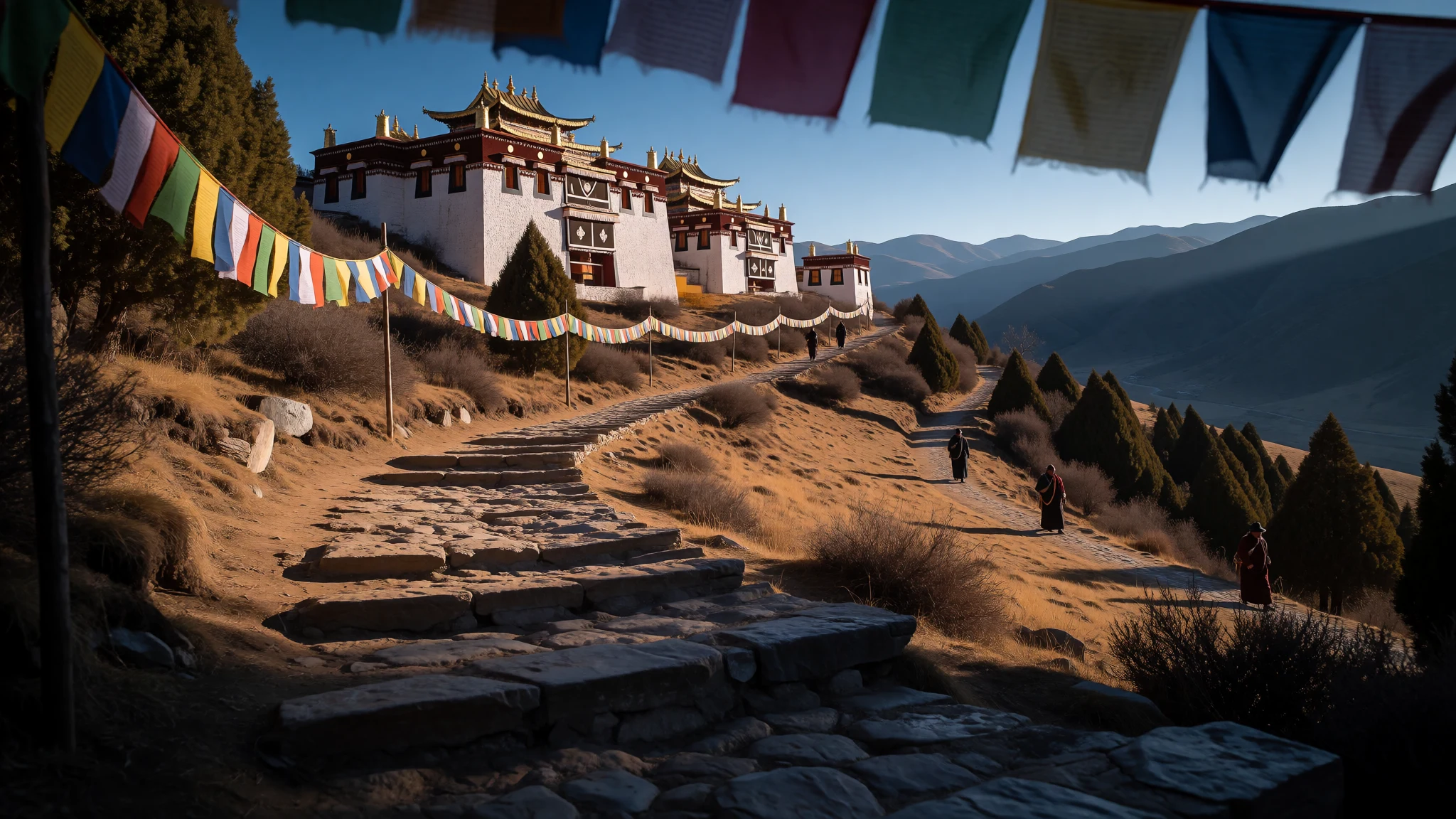
Ganden Monastery is a rebuilt Gelug university high above Lhasa, where ruins, new halls and a pilgrim path share one windy hillside.
The place
Ganden Monastery stands on Wangbur Mountain in Dagzê County, about 40 kilometres northeast of Lhasa, at an altitude of 4,300 metres. The buildings fill a hilly natural amphitheatre, and a path around the ridge looks out over the valleys below. It is one of the three great Gelug university monasteries near Lhasa, the others being Sera and Drepung. The Gelug school takes its name from this hillside: Gelug is a contraction of Ganden Lug, the Ganden tradition.
The full name, Ganden Namgyal Ling, pairs two ideas. Ganden is the Tibetan word for Tushita, the celestial realm where the bodhisattva Maitreya is believed to dwell; Namgyal Ling translates to 'victorious temple'. English spellings vary, so Gaden and Gandain also turn up on maps and signs.
What stands today is largely a rebuilding. The monastery was destroyed after 1959 and has been restored only in part, so ruined walls and freshly painted halls sit close together. Anyone expecting an unbroken ancient skyline will be surprised; those who come to see a community bringing a place back to life are likely to find it more affecting.
Ganden feels far from the city as well as being far from it. The air is thin and cold, the road climbs, and wind sweeps across the slopes. A second Ganden of the same tradition was founded in southern India in 1966 by Tibetan exiles, which is worth remembering when searching for the name online.
Reaching the monastery takes planning. Visitors who are not Chinese nationals need a special permit for Tibet and must travel with a guide.
Its story
Ganden Monastery began in 1409, when Je Tsongkhapa Lozang-dragpa (1357–1419) founded it as the home of the school that became the Gelug order. He built the main temple himself, furnished with large statues and three-dimensional mandalas, and stayed there often. He died at Ganden in 1419, and his disciples entombed his preserved body in a tomb encrusted with silver and gold.
Leadership of the school passed to the Ganden Tripa, the throne-holder of Ganden. Tsongkhapa's robe and staff went to Gyeltsabjey, the first Ganden Tripa, ahead of his death. The post rotates every seven years, and 99 people had held it by 2003.
Teaching was organised around colleges. Four existed in the time of the second Ganden Tripa; they were later folded into two, Jangtsey to the north of the main temple and Shartsey to its east. Both combine sutra with tantra. Students learn by committing texts to memory, working through logic and arguing in debate, and degrees are awarded after examinations and formal public debates.
In the 1860s a lay aristocrat named Shatra organised a gathering that brought together Ganden, Drepung and government officials, a sign that the great monasteries had weight in the affairs of their day.
After 1959 the monastery was destroyed. Rebuilding has been partial, so much of what visitors see is recent work rather than anything Tsongkhapa knew. The tradition he started survived all the same, and the Ganden set up in southern India in 1966 carries the name abroad.
What to see
- The kora around the ridge — Wangbur Mountain, Dagzê County
The circuit around the monastery follows the rim of the hillside bowl, with the buildings on one side and open valleys on the other. Pilgrims walk it clockwise, often slowly, and visitors fall in behind. At 4,300 metres even this gentle loop is tiring, so frequent pauses for the views are no bad thing.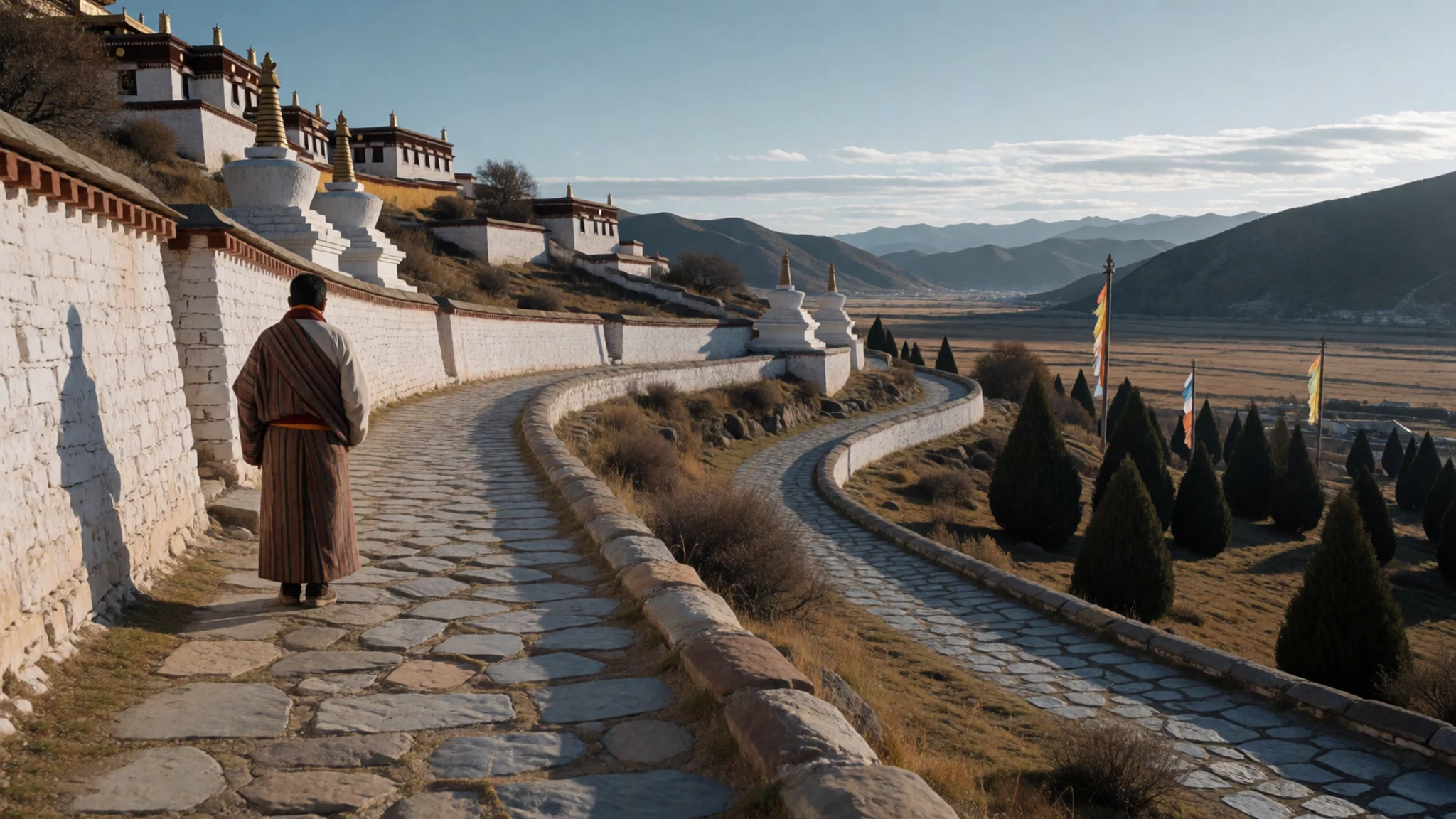
- Rebuilt halls and ruins — Main monastery complex
Ganden's rebuilt halls stand close to stretches of ruin left by the destruction after 1959, and walking between them makes the scale of both the loss and the rebuilding plain. A photograph from 1985 shows broken walls with only a few new buildings among them, a useful point of comparison.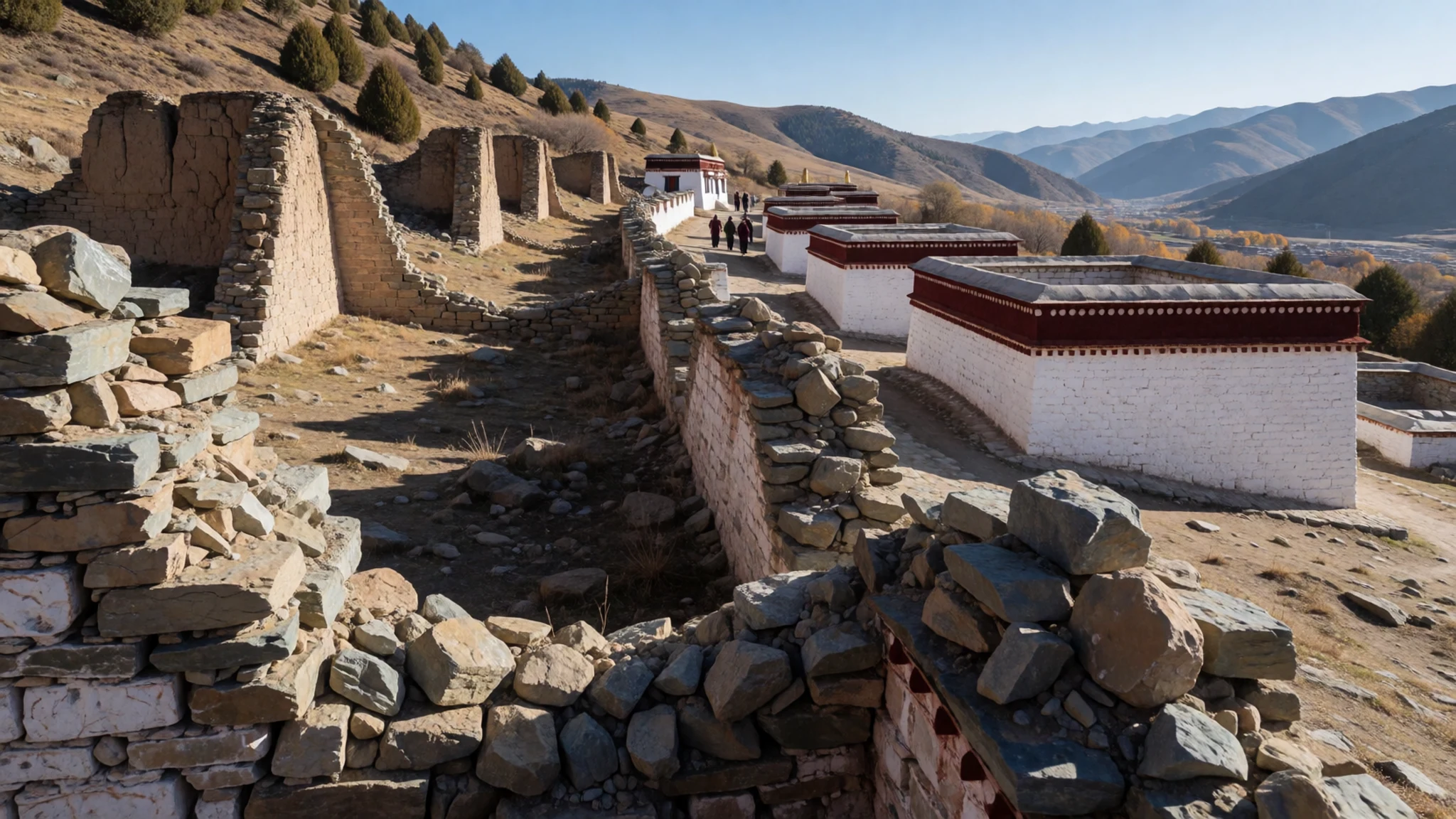
- Jangtsey and Shartsey colleges — North and east of the main temple
Jangtsey lies north of the main temple and Shartsey to its east. These are the two colleges where monks study sutra and tantra together, learning through memorisation, logic and debate. Students in maroon robes can often be glimpsed between buildings; teaching spaces belong to the community, so keep a respectful distance and ask a guide what may be entered.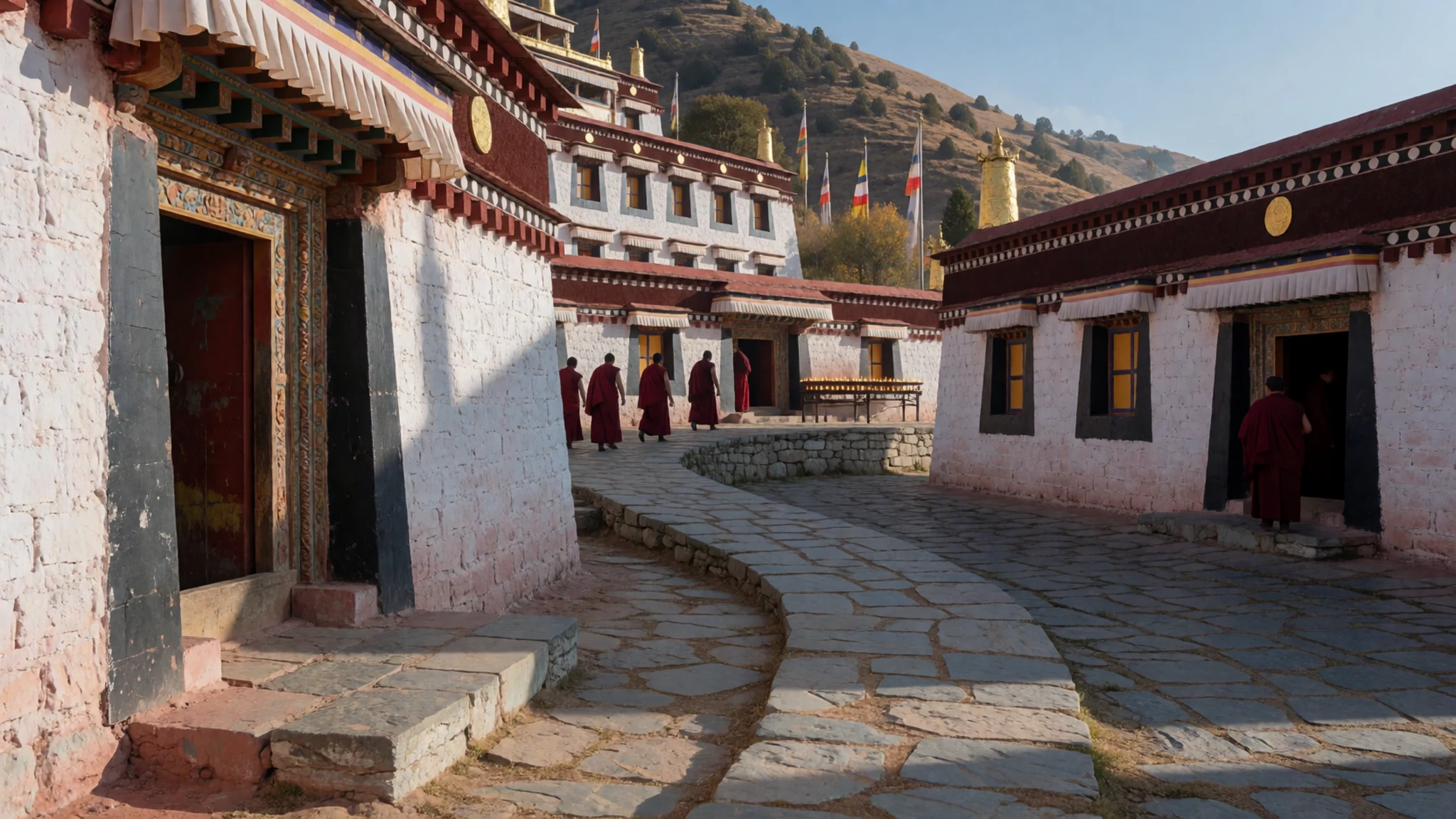
- The hillside after repainting — Whole monastery hillside
Ganden is repainted every year after the rainy season, and a photograph taken in November shows fresh whitewash and coloured trim standing out against the slope. Visiting in the weeks after the rains means seeing the buildings at their neatest, though nights are cold by then and the wind can be sharp.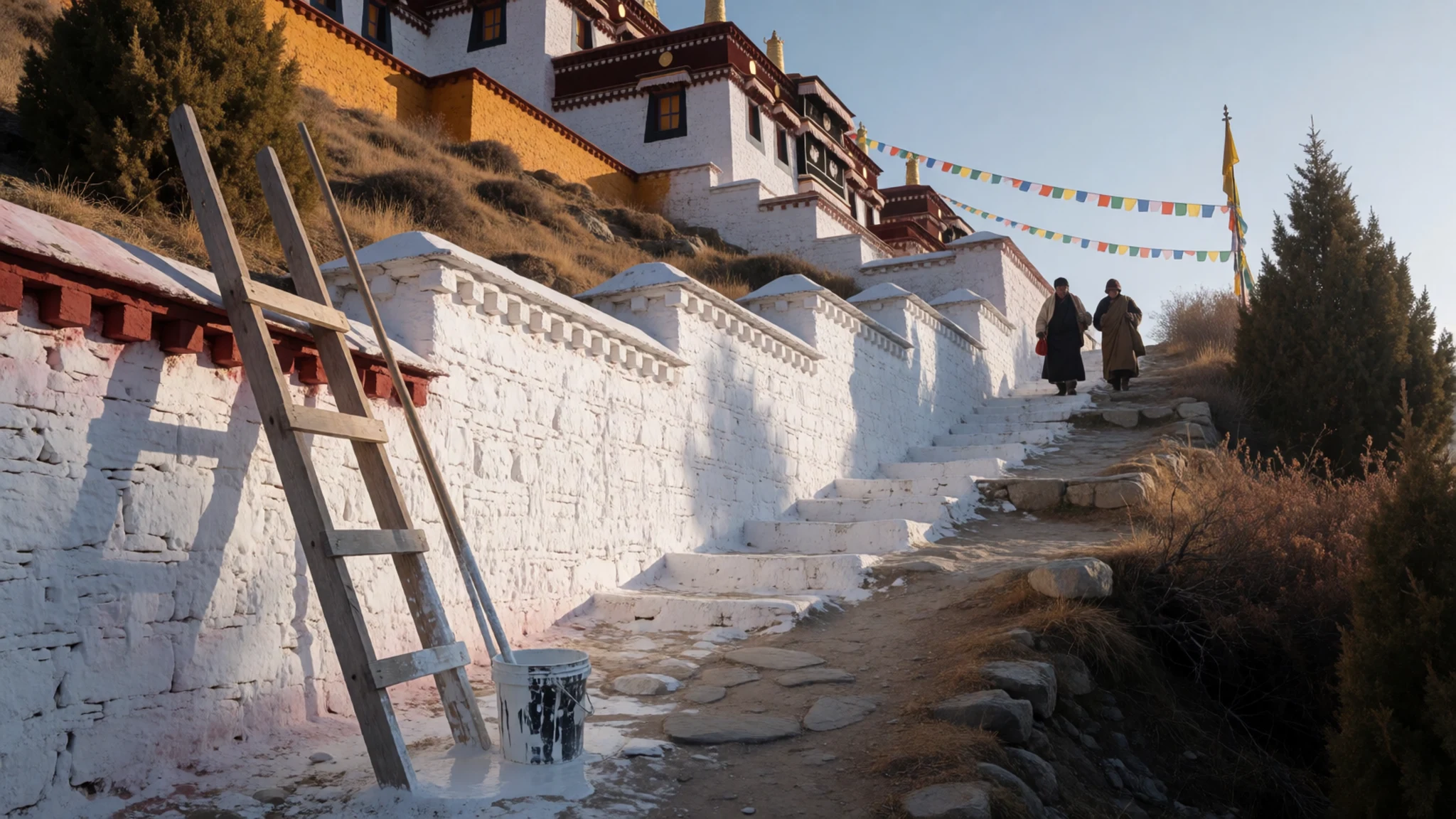
- Barkhor Street, Lhasa — Old town, Lhasa
Barkhor Street circles the Jokhang Temple in the old part of Lhasa and pairs well with a day at Ganden. Pilgrims in traditional dress walk their own clockwise kora here, spinning prayer wheels, while stalls sell handicrafts and bargaining is expected. It shows the same customs at city scale.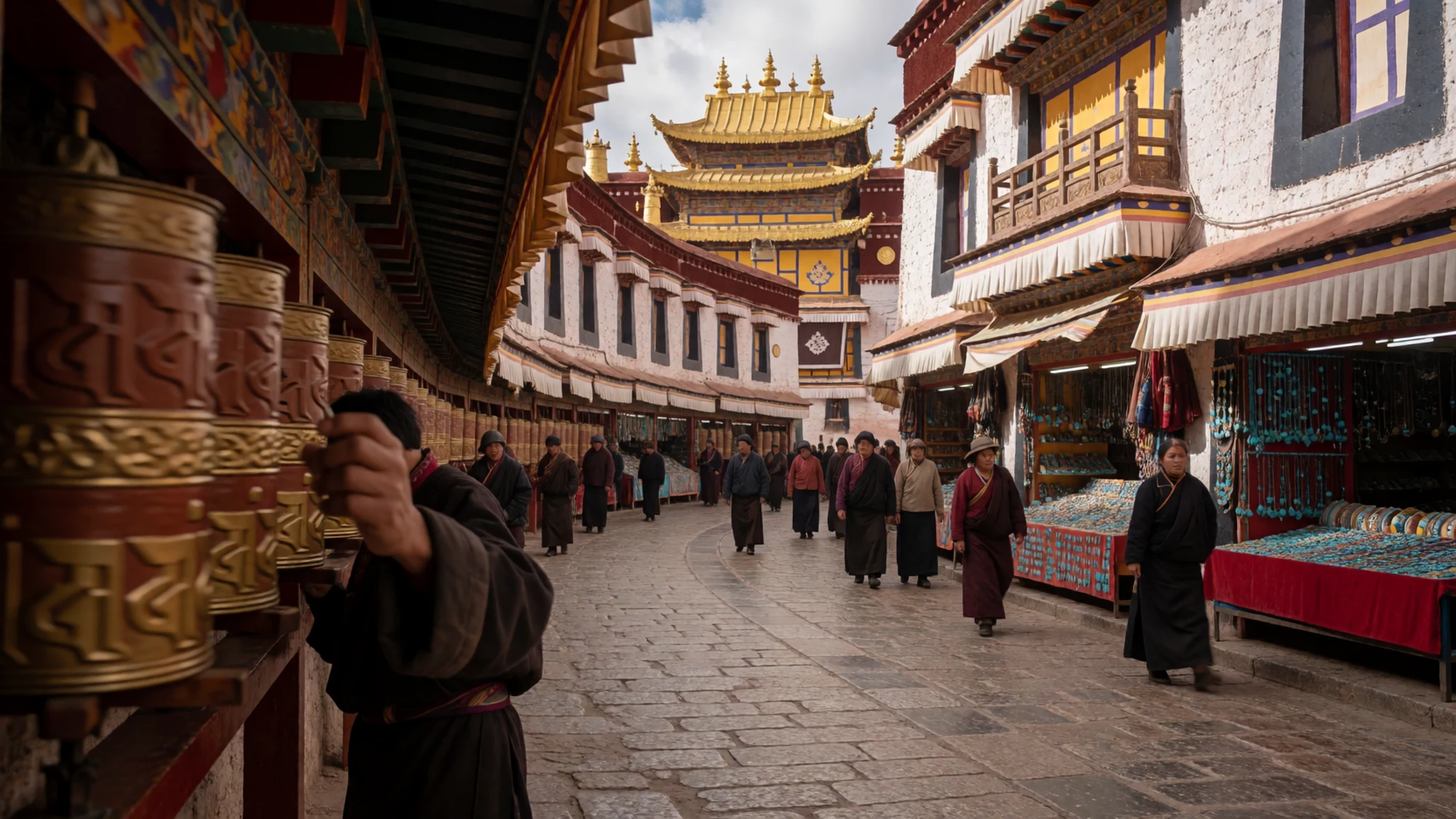
Culture
Ganden Monastery is a working religious community as well as a place to visit, and its customs follow Tibetan Buddhist practice around Lhasa. Pilgrims move clockwise around stupas, sacred objects and the hillside circuit itself, and many spin prayer wheels or murmur mantras as they go. Visitors who join them keep to the same direction, however narrow the path.
The Gelug tradition puts great weight on study, so many of the monks here are students, with debate and examination part of their training. A quiet manner near prayer halls respects that. Lay visitors commonly leave a small money offering at shrines, especially where no ticket is sold, and it helps with the cost of upkeep and rebuilding.
Dress is modest: no shorts, no tank tops and no hats inside sacred buildings. Statues, mani stones and other holy objects are never climbed on. Photography rules differ between monasteries; some allow it for a small donation and others forbid it in certain halls, so asking first is the safest habit. Monks who beg will often agree to a photograph after a contribution, but a refusal should be accepted at once.
Walk clockwise, ask before photographing anyone or anything inside a hall, and take your hat off before you step through a temple door.
What to wear
Around Ganden Monastery the traditional garment is the chuba, a long wrapped robe made of wool or sheepskin and tied at the waist with a sash. Married women have long worn it with a striped woven apron, and turquoise, coral and amber jewellery often goes with it. Fur-trimmed hats appear in cold weather. Chubas are most common at festivals, on pilgrimages and among older people.
Monks wear maroon and yellow robes, which are the colours most visitors will remember from the hillside.
Day to day in Lhasa, most people wear what people wear in any Chinese city: jackets, jeans, trainers and fleeces. Pilgrims walking a kora are more likely to be in chubas or in layers over them, often with a woollen hat or scarf against the wind.
Visitors should dress for altitude and for sacred ground. At 4,300 metres the sun is fierce and the wind cold even on a clear day, so layers, a windproof jacket, sunglasses and a sun hat for the outdoor paths all earn their place. Long trousers and covered shoulders suit the halls, and the hat comes off indoors. Sturdy shoes with good grip matter more than style on steep, uneven paths.
What to eat
- Butter tea (po cha) — Tibetan teahouses near the Jokhang Temple
A salty, buttery tea whisked until smooth, drunk throughout the day to warm and fortify people at altitude. It is an acquired taste, and a first cup is often best sipped slowly. Most Tibetan teahouses in Lhasa serve it.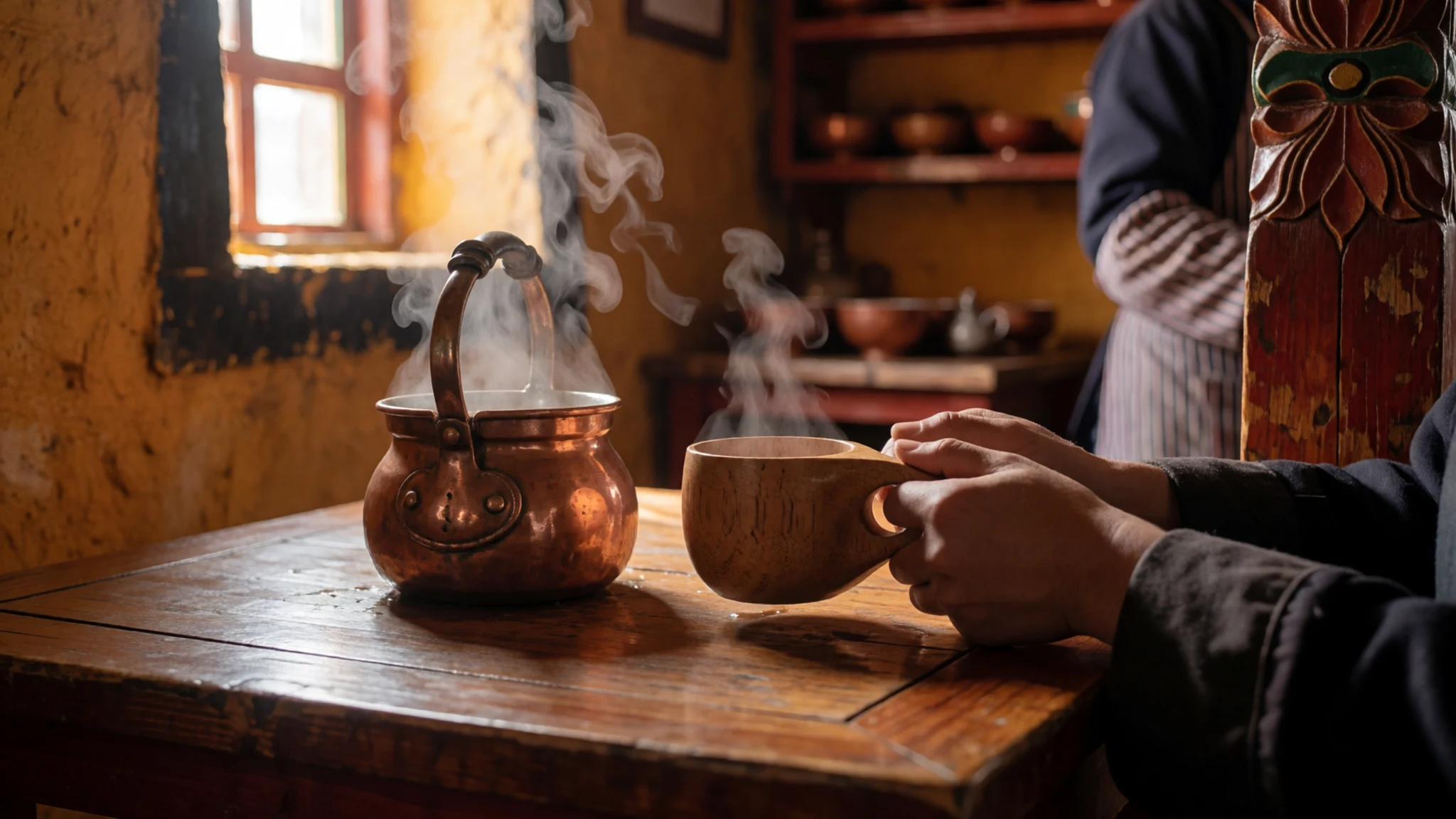
- Sweet milky tea — Local teahouses in the old town of Lhasa
A sweet tea made with milk and sugar, much gentler than butter tea and popular with locals who sit for hours over a flask. It suits travellers who want something warm and familiar after a cold morning on the road.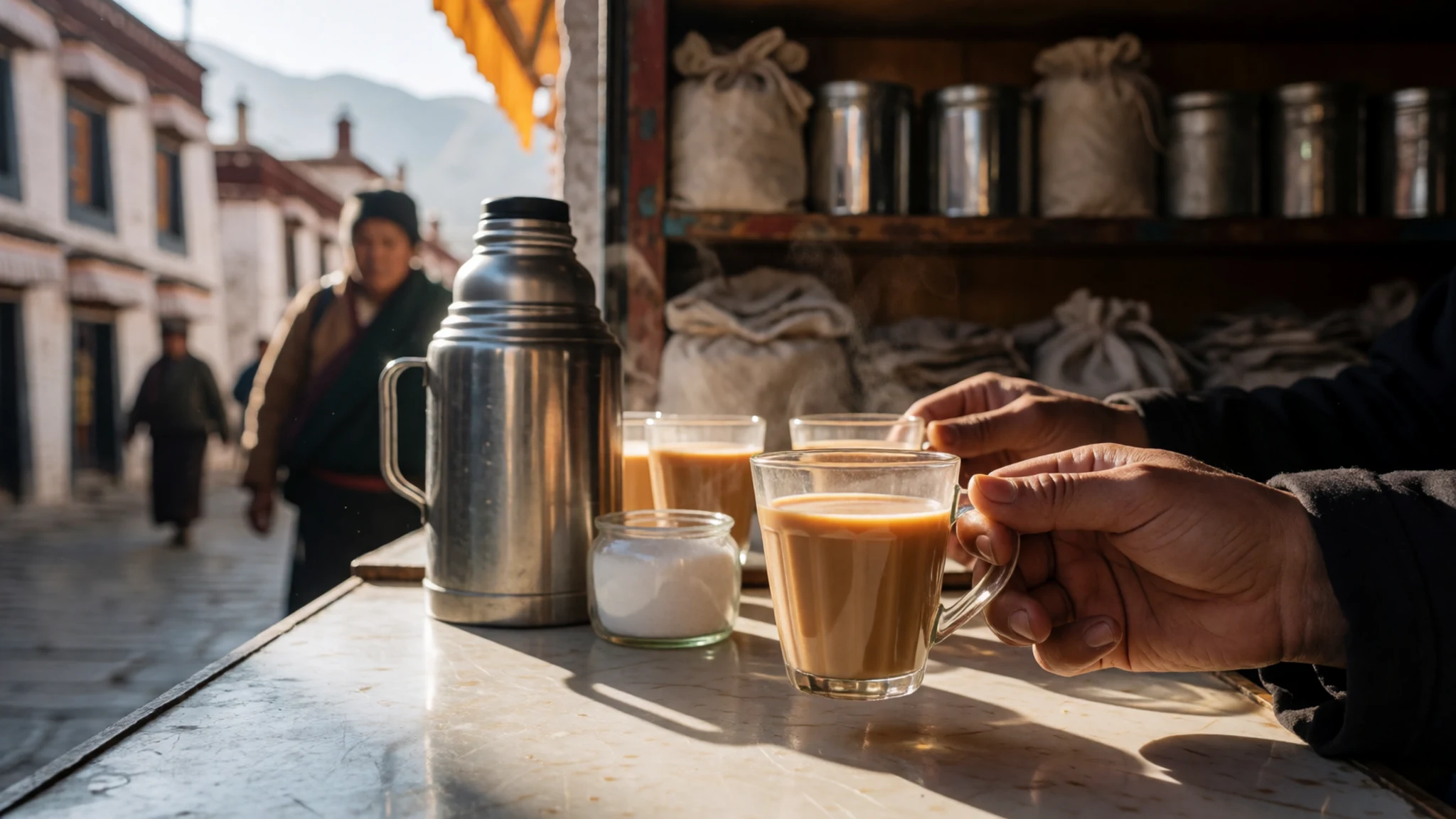
- Tsampa — Tibetan restaurants around Barkhor Street
Roasted barley flour, traditionally mixed with butter tea into a dough that is eaten by hand. It is simple, filling and long associated with pilgrims and herders. Many restaurants offer it as a snack or side. - Momo — Small Tibetan eateries along Beijing Zhong Lu
Steamed or fried dumplings, usually filled with yak meat or vegetables and served with a hot chilli sauce. They make an easy, cheap meal and a good introduction to Tibetan cooking before heading up to altitude. - Thukpa — Tibetan restaurants and teahouses near the Jokhang Temple
A hearty noodle soup with meat and vegetables, welcome after a cold day at Ganden. Portions are generous and the broth warming, and it is one of the lighter dishes for stomachs still adjusting to altitude.
Plan it
Best time. April–May and September–October, when the weather is generally more comfortable at 4,300 metres. Summer brings the rainy season, and Ganden is repainted once the rains end; midwinter is bitterly cold at this height.
How long. 1
Getting there. Reach Lhasa by air (the airport is 40–60 minutes from the city by road) or on the Qinghai–Tibet railway, which links Lhasa with Golmud, Xining, Beijing, Chengdu, Shanghai, Guangzhou and Chongqing. Ganden is about 40 kilometres northeast of Lhasa. Non-Chinese nationals need a special Tibet permit, must be met by their guide and cannot use intercity buses, so the last leg is by vehicle arranged with the guide.
Budget. mid
Tips
- Spend a few days in Lhasa to acclimatise before going up to 4,300 metres
- Start early so the kora is walked in daylight and before the wind picks up
- Carry water, snacks, sun protection and warm layers, as there is little shelter on the hillside
- Bring small cash for offerings and donations
- Arrange the permit and guide well ahead, and ask your operator to confirm current access rules before travel
Etiquette
- Walk clockwise around the monastery and all sacred objects
- Ask before photographing people or anything inside a hall, and be ready to accept no
- Remove your hat and keep legs and shoulders covered inside sacred buildings
Nearby
Sources
- Wikidata Q932446 (CC0)
- Wikipedia: Ganden Monastery (rev 1374916137) (CC BY-SA 4.0)
- Wikivoyage: Lhasa (rev 5409049) (CC BY-SA 4.0)
- Photo: Ganden monastery.jpg, Unknown author, via Wikimedia Commons (CC BY 3.0)
- Photo: Ruins and with a few new buildings of part of Ganden Monastery, Tibet 1985, Tashi0, via Wikimedia Commons (CC BY 3.0)
- Photo: Ganden monastery in 2013, Maris Burbergs, via Wikimedia Commons (CC BY 3.0)
- Photo: Ganden Monastery 19, ignat, via Wikimedia Commons (CC BY 3.0)
- Photo: Ganden monastery, 2013, Maris Burbergs, via Wikimedia Commons (CC BY 3.0)
- Photo: Monks at Ganden monastery, Maris Burbergs, via Wikimedia Commons (CC BY 3.0)
- Photo: Ganden monastery after repainting, Maris Burbergs, via Wikimedia Commons (CC BY 3.0)
- Photo: Ganden monastery, Tibet, 2013, Maris Burbergs, via Wikimedia Commons (CC BY 3.0)


