Frankfurt
Frankfurt, Germany
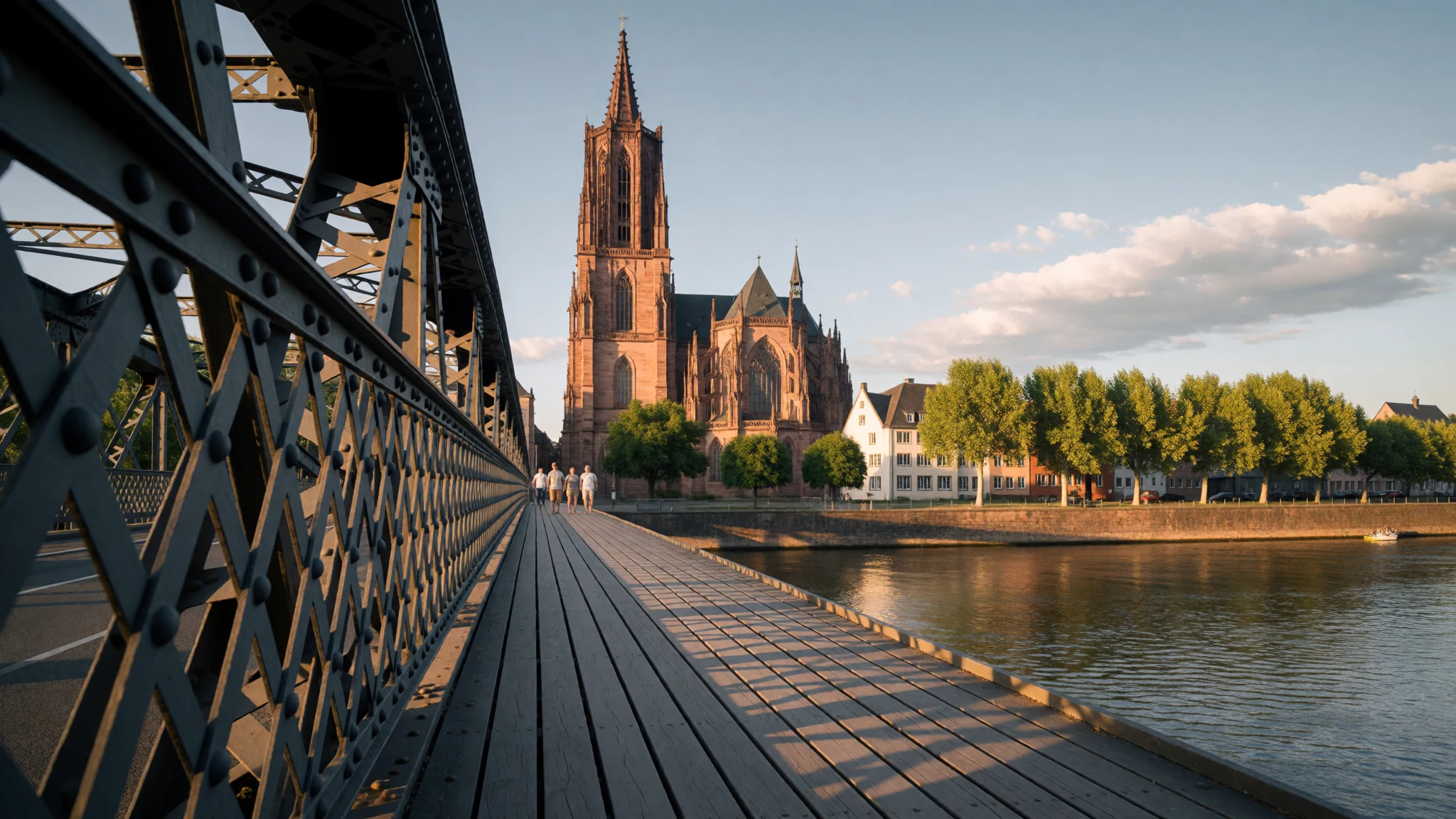
Frankfurt pairs a carefully rebuilt old centre with a glass-towered skyline on the River Main, plus excellent museums and tart apple wine.
The place
Frankfurt sits on the River Main in the foreland of the Taunus hills, about 112 metres above sea level, and has roughly 760,000 inhabitants, which makes it the largest city in the state of Hesse. It runs into Offenbach without a visible gap, and the wider Rhine-Main region around it is home to several million people. The city's character comes from a few unlikely neighbours: a small medieval-style centre by the river, a cluster of bank towers a short walk away, and leafy residential districts such as Sachsenhausen and Bornheim. The European Central Bank is based here, which explains the suits on the U-Bahn on weekday mornings and the calmer weekends. Frankfurt is also a major transport junction, so many people meet it first as an airport and a railway station. That reputation undersells it. Museums line both banks of the river, the old town has been painstakingly reconstructed, and the Main itself is used for jogging, cycling and long summer evenings on the grass. The climate is continental: warm summers, cold and often grey winters, and spring and autumn that suit walking. Trade fairs fill the city's beds and push prices up, so crowds and costs swing with the fair calendar more than with the seasons. The centre is compact enough to cover on foot and by tram, and it works well as a base for day trips into the Taunus hills and the Rhine valley.
Its story
Frankfurt's story starts well before the name existed. Celts settled in the Taunus hills to the north, and Roman soldiers and settlers arrived under Emperor Vespasian, building a town called Nida beside the river Nidda, in what is now Heddernheim and Praunheim. Alemanni and Franks followed. In 794 Charlemagne held an imperial assembly and church synod here, and the settlement, written as Franconofurd, entered the written record. The name is usually read as a ford of the Franks, and the river crossing remained the reason for the town's importance. Charlemagne's grandson Louis the German made it one of his two capitals and founded the church that later became the cathedral. Over the following centuries Frankfurt became a place of imperial coronations within the Holy Roman Empire, and it was an imperial city from 1372. As a free city it governed itself for nearly five centuries, living off trade and fairs. That independence ended when the empire collapsed in 1806, returned in 1815, and was lost for good in 1866, when Prussia annexed the city after its war with Austria. Much of the old centre was destroyed in the twentieth century, and what visitors see around the Römerberg and the Hühnermarkt is largely reconstruction, which is worth knowing before expecting authentic medieval streets.
What to see
- Römerberg and the cathedral — Altstadt
The Römerberg is the old town's main square, lined with rebuilt gabled houses facing the town hall. A short walk away stands the cathedral, once a collegiate church founded by Louis the German, its sandstone tower rising above the river. Go early, because tour groups arrive by mid-morning and the square fills quickly in summer.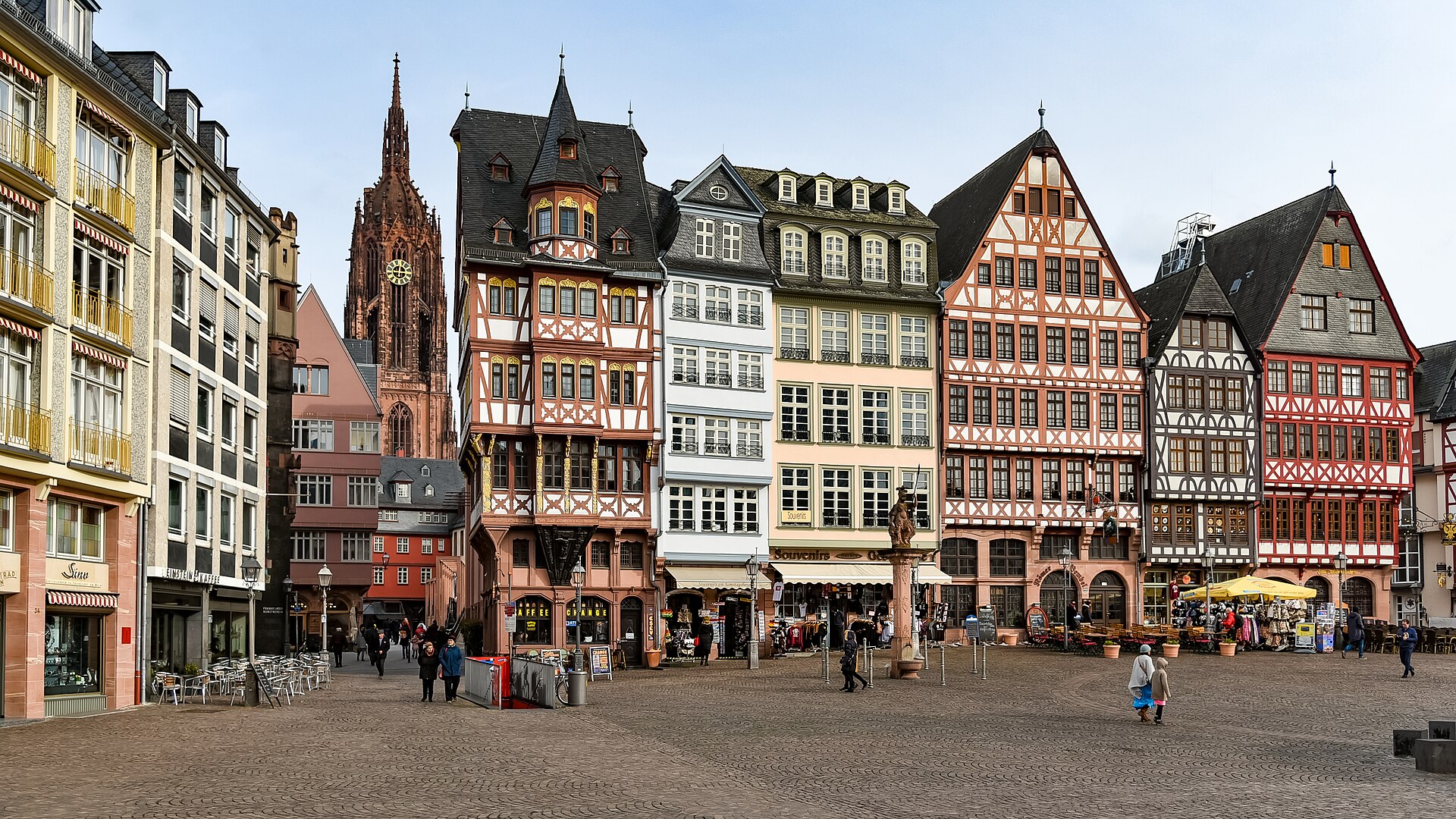
- Höchst Old Town — Höchst, western Frankfurt
Höchst, in the west of the city, keeps a medieval core of half-timbered houses and narrow lanes that escaped the rebuilding seen elsewhere. It feels like a small town folded into the metropolis. Allow a slow hour or two, and pair it with a walk beside the Main, which is close by. - Bornheim's half-timbered houses — Bornheim
Unlike the centre, Bornheim came through the war largely intact, so its medieval and baroque half-timbered houses survive in ordinary streets rather than in a museum set. It is a lived-in district of cafés, small shops and apple-wine taverns, best explored on foot without a fixed plan. - Goetheturm — Sachsenhausen, city forest
The Goetheturm is a 43-metre wooden tower in the city forest south of the river, with a viewing platform above the treetops. It burned down in 2017 and has since been rebuilt. The climb rewards with a view of the skyline; reach it on foot or by bike through the woods for a good half-day. - Frankfurt Zoo — Ostend, east of the centre
Frankfurt Zoo opened in 1858 and became widely known through its director Bernhard Grzimek, a pioneer of animal conservation. It sits close to the centre and suits a wet-weather plan with children, though weekends and school holidays bring queues. Check the official site for opening times and tickets before going.
Culture
Frankfurt's cultural life is built around its museums. More than 30 of them stand along or near the Museumsufer, the museum embankment, an idea pushed through by the cultural politician Hilmar Hoffmann. Ten sit on the southern bank in Sachsenhausen between the Eiserner Steg footbridge and the Friedensbrücke, and on some Saturdays the street called Schaumainkai is partly closed to traffic for a large flea market. Beyond the galleries, the city has a long civic tradition. The Paulskirche, a round-roofed church close to the old town, hosted a German national parliament in the nineteenth century and is still treated as a symbol of democracy. The Alte Oper, a rebuilt concert hall, anchors the evening scene near the shopping streets. Everyday habits are very German: punctual, orderly and quietly proud of good public transport. Sundays are calm, with most shops shut and cafés and museums doing the business. The city is also strongly international, shaped by banking, trade fairs and migration, so English works in most places and many neighbourhoods have a distinctly mixed character. Apple-wine taverns in Sachsenhausen are the most local social institution, with long shared tables, simple food and plenty of talk. In those taverns, ask "Ist hier noch frei?" before taking a seat at a shared table, and wait for the green pedestrian light even on an empty street.
What to wear
Frankfurt has little city-specific traditional dress, but the surrounding Hesse region has its own Tracht, or regional costume. It is made from wool, linen and printed cotton, with embroidered bodices, layered skirts and aprons for women and waistcoats and knee breeches for men. It appears at folk festivals, local parades and village celebrations rather than in the city, and the dirndl and lederhosen seen at some events belong more to Bavaria. What people wear day to day is plain and practical. In the Bankenviertel, dark suits and crisp shirts are common on weekdays, while elsewhere smart-casual rules: dark jeans, trainers, light jackets and a lot of cycling gear. Dress is understated, and loud logos or beachwear stand out. A visitor should plan for four seasons in a year. Layers and a light waterproof suit spring and autumn, a proper coat, hat and gloves are needed from December to February, and a sun hat and light cotton help in July and August heat. Comfortable closed shoes matter more than anything, because the old town has cobbles and the best of the city is walked. There is no strict dress code for churches, but covering bare shoulders and removing a hat when entering the cathedral is a courteous habit. Smarter clothes help at the opera and in upmarket restaurants.
What to eat
- Currywurst — Snack kiosks near the station and main shopping streets
Sliced sausage served with ketchup and curry powder, eaten standing up with chips or a bread roll. It is a cheap, quick German fast-food standard and easy to find at street kiosks and snack stands around the station and shopping streets. - Grüne Soße — Traditional taverns in Sachsenhausen, best in spring
A cold sauce of fresh herbs stirred into yoghurt or sour cream, served over boiled potatoes and hard-boiled eggs. It is the city's signature spring dish, and is usually meat-free, so it suits vegetarians too. - Handkäse mit Musik — Apple-wine taverns across Sachsenhausen and Bornheim
A small, sour curd cheese marinated in oil, vinegar and chopped onions, eaten with dark bread. The "music" is the jokey name for the digestive consequences of the onions. It is a classic tavern snack, sharper than it looks. - Apfelwein (Ebbelwoi) — Apple-wine taverns in Sachsenhausen and Christmas markets
Tart, still cider made from local apples, poured from a grey stoneware jug into ribbed glasses. It is drier and sharper than most British ciders and is usually drunk with food. Ask for it mixed with sparkling water if the first sip is too sour. - Frankfurter Rippchen — Traditional taverns and brewery-style restaurants
Salt-cured pork rib or chop, gently simmered until tender and served with sauerkraut, mustard and bread. It is a hearty tavern main course that suits cold months, and portions are generous enough that a lighter eater might share one with a glass of apple wine.
Plan it
Best time. May–June and September for mild weather, long evenings and riverside life; late May to early June also brings the Fressgass Fest. July and August can be hot, while winters are cold and grey, though December brings Christmas markets.
How long. 2–3
Getting there. Frankfurt Airport (FRA) is a major international hub with direct rail links into the city; the last leg is a short train ride to Frankfurt Hauptbahnhof, the central station, which has fast services across Germany. Check the official transport sites for current times and tickets.
Budget. mid
Tips
- Check the trade-fair calendar before booking a stay, as fair weeks fill the city's beds and raise prices
- Start at the Römerberg and cathedral early in the morning, before tour groups arrive
- Cards are widely accepted, but carry some cash for small taverns, markets and kiosks
- Plan Sundays around museums and cafés, as most shops are shut
- Walk or cycle along the Main for the best views of the skyline
Etiquette
- Wait for the green pedestrian light, even on an empty street
- Ask before sitting at a shared tavern table
- Keep voices low and phones quiet in churches and concert halls
Nearby
Sources
- Wikidata Q1794 (CC0)
- Wikipedia: Frankfurt (rev 1384457459) (CC BY-SA 4.0)
- Wikivoyage: Frankfurt (rev 5402244) (CC BY-SA 4.0)
- Photo: Historical city centre with skyline, Thomas Wolf (CC BY-SA 3.0 de)
- Photo: Bankenviertel, Dr. Thomas Liptak (CC BY-SA 4.0)
- Photo: Frankfurter Dom and Eiserner Steg, rupp.de (CC BY 3.0)
- Photo: Paulskirche south view, DXR (CC BY-SA 4.0)
- Photo: Hühnermarkt, Dr. Thomas Liptak (CC BY-SA 4.0)
- Photo: Alte Oper, Thomas Wolf (CC BY-SA 3.0 de)
- Photo: Römerberg, Jorge Franganillo (CC BY 2.5)
- Photo: Die Frankenfurt (Public domain)


