Einsiedeln Abbey
Einsiedeln Abbey, Switzerland
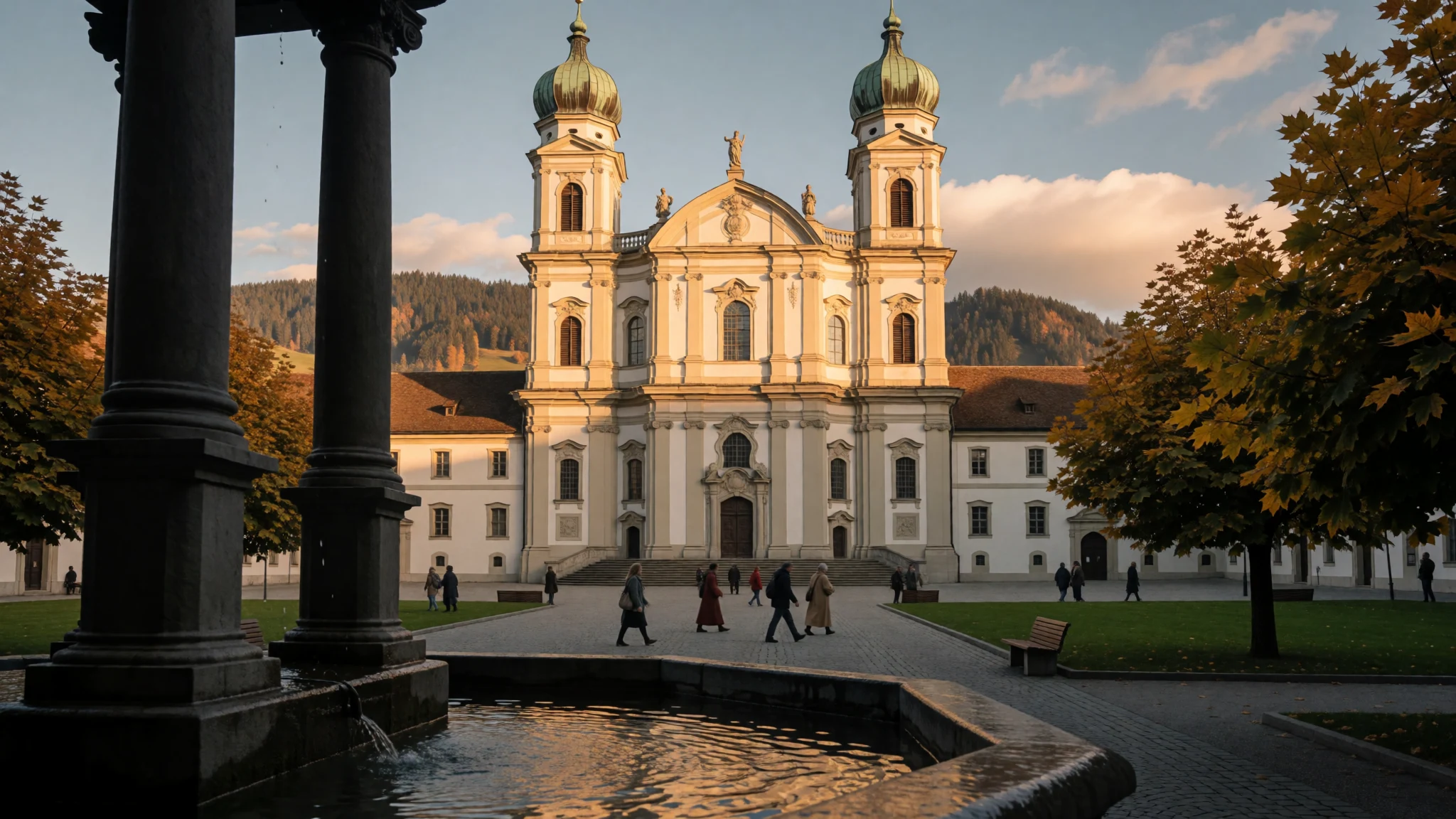
Einsiedeln Abbey is a working Benedictine monastery where a baroque church shelters a Black Madonna and pilgrims have arrived for centuries.
The place
Einsiedeln Abbey (Kloster Einsiedeln) stands at the edge of the small town of Einsiedeln in the canton of Schwyz, in central Switzerland. It is a Benedictine monastery and it is still lived in: a community of around 40 monks keeps the daily round of prayer here. The church is baroque, and the broad forecourt in front of it, with a fountain dedicated to Mary at its centre, makes the whole complex feel like a stage set for pilgrims. Seen from above, the buildings gather around four courtyards with the church in the middle.
What surprises many first-time visitors is how much the abbey does besides pray. It runs a private high school, a winery, a sawmill and a restaurant, along with other small businesses, to pay its own way. It is also a territorial abbey, which means it answers to no local bishop or diocese.
The reason most people come is the Black Madonna in the Chapel of Grace, a shrine built inside the church. Around 800,000 pilgrims and tourists arrive in a year, so the forecourt and church can be busy, especially at weekends and on religious feast days. The setting is an upland plateau of meadow and woodland, cooler and often snowier than the lake shores and Zurich. The abbey is a baroque monastery and the focus of pilgrimage in Switzerland, and the steady flow of visitors bears that out. It works as a short stop from Zurich or as a slow half-day in its own right, with time for the church, the square and a wander through the town.
Its story
Einsiedeln Abbey begins with a hermit. Meinrad, a monk and priest born in 797 and schooled at Reichenau, settled alone in the forest here in 828, looking for quiet. His reputation for miracles followed him, and two robbers killed him in January 861. Other hermits kept his cell going for decades afterwards.
In 934 Eberhard, formerly a provost at Strasbourg, built a monastery and church on the hermit's site and became its first abbot. Tradition claims Christ himself blessed the church in 948, dedicating it to his mother, and that tale turned the place into a destination. Pilgrims first came to the Chapel of the Saviour; over the Middle Ages the devotion shifted towards Mary.
Status followed devotion. In 965 the third abbot, Gregory, was made a prince of the Holy Roman Empire by Emperor Otto I, and later abbots kept the rank until the empire's end in 1806. After a fire, the church was enlarged in 1226 and the old chapel was enclosed within the new building, a shrine nested inside a church, an arrangement later restorations have preserved. By the 13th century pilgrimage was better organised, and an abbey seal of 1239 already shows an enthroned Madonna with the child on her left knee, regarded as the earliest known image of the shrine's miracle-working figure.
The abbey stayed Catholic through the Swiss Reformation, although Huldrych Zwingli, who went on to lead reform, had once studied here. The present church was rebuilt between 1704 and 1719 under Abbot Maurus, and its baroque decoration was finished in 1734.
What to see
- The abbey church — Einsiedeln, Klosterplatz
The baroque façade rises behind the forecourt and anchors the whole visit. Inside, the church was rebuilt in the early 18th century and its decoration finished in 1734, so stucco, painting and gilding read as one scheme. Allow time to look up as well as ahead, and to sit for a while.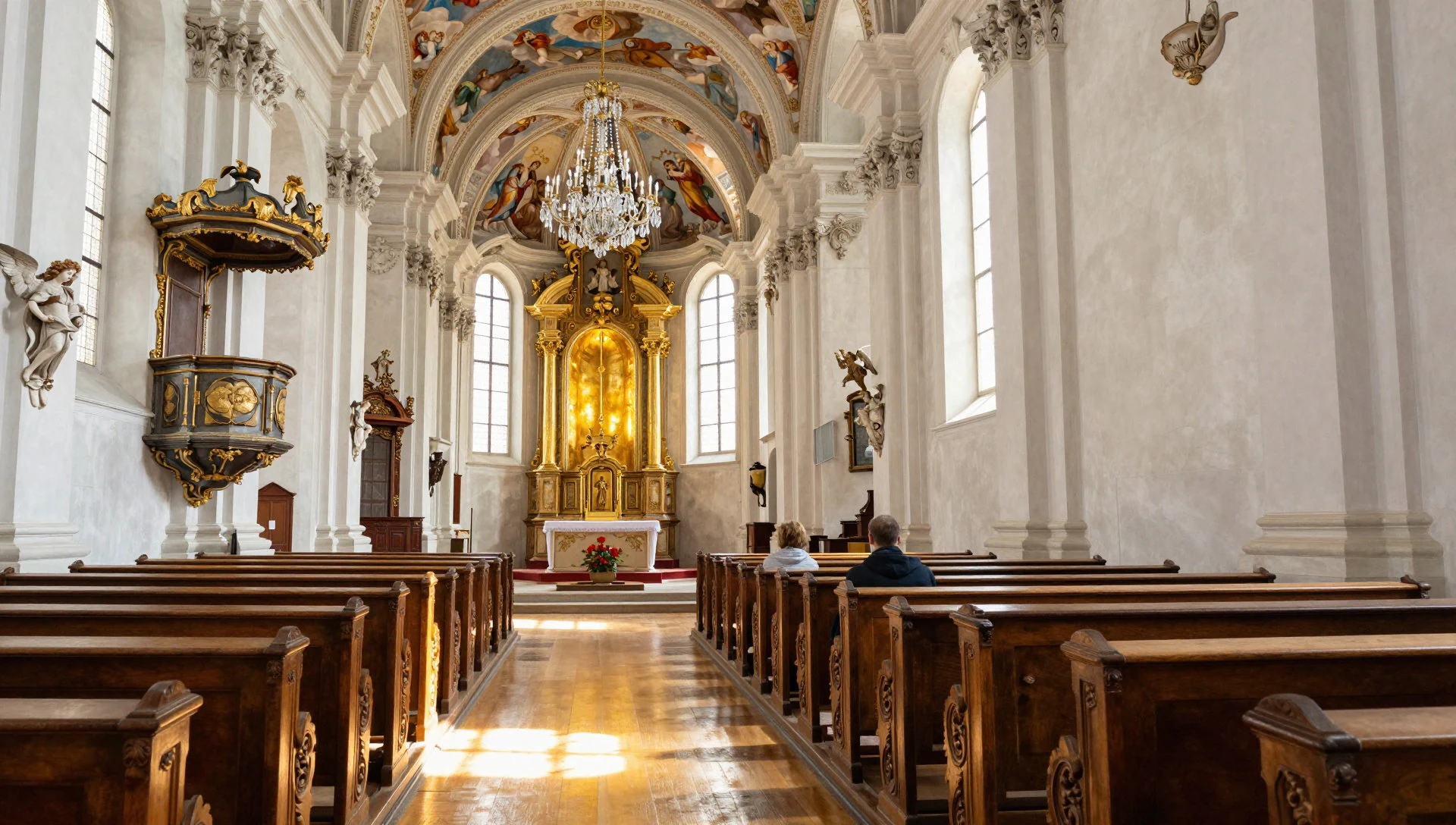
- Chapel of Grace and the Black Madonna — Inside the abbey church
A shrine stands inside the church, and in it sits the Black Madonna holding the child. Pilgrims wait quietly to pray before her, so the mood is devotional rather than touristy. It fills up on feast days; off-peak hours and a low voice make the visit far easier.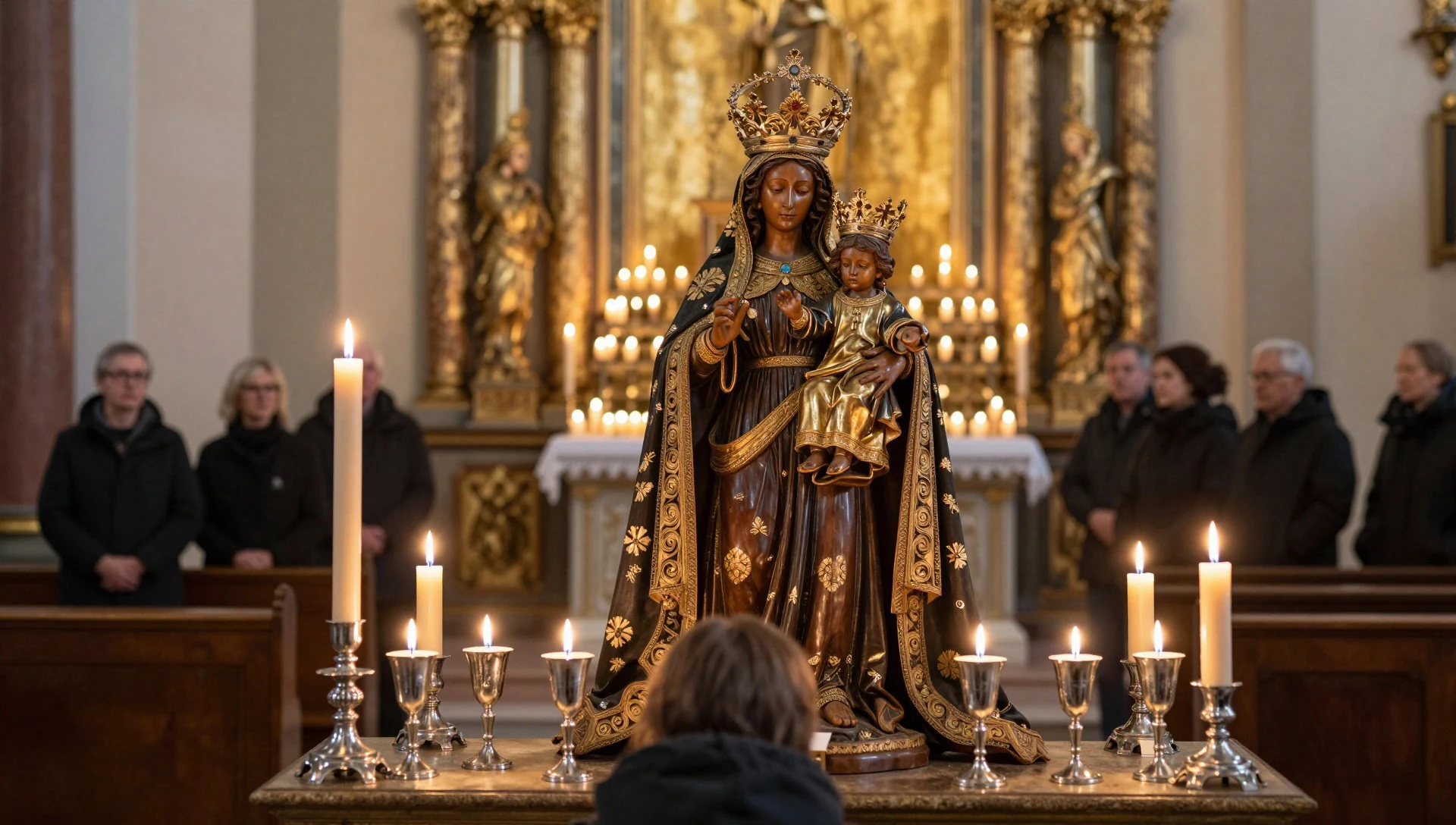
- Klosterplatz and the Marienbrunnen — Forecourt in front of the abbey
The wide forecourt holds the Marian fountain (Marienbrunnen) and is the best place to take in the façade's symmetry. Visitors gather here before going in, and photographers favour it at low sun. Snow softens the scene in winter, while in summer the town's cafés make lingering easy.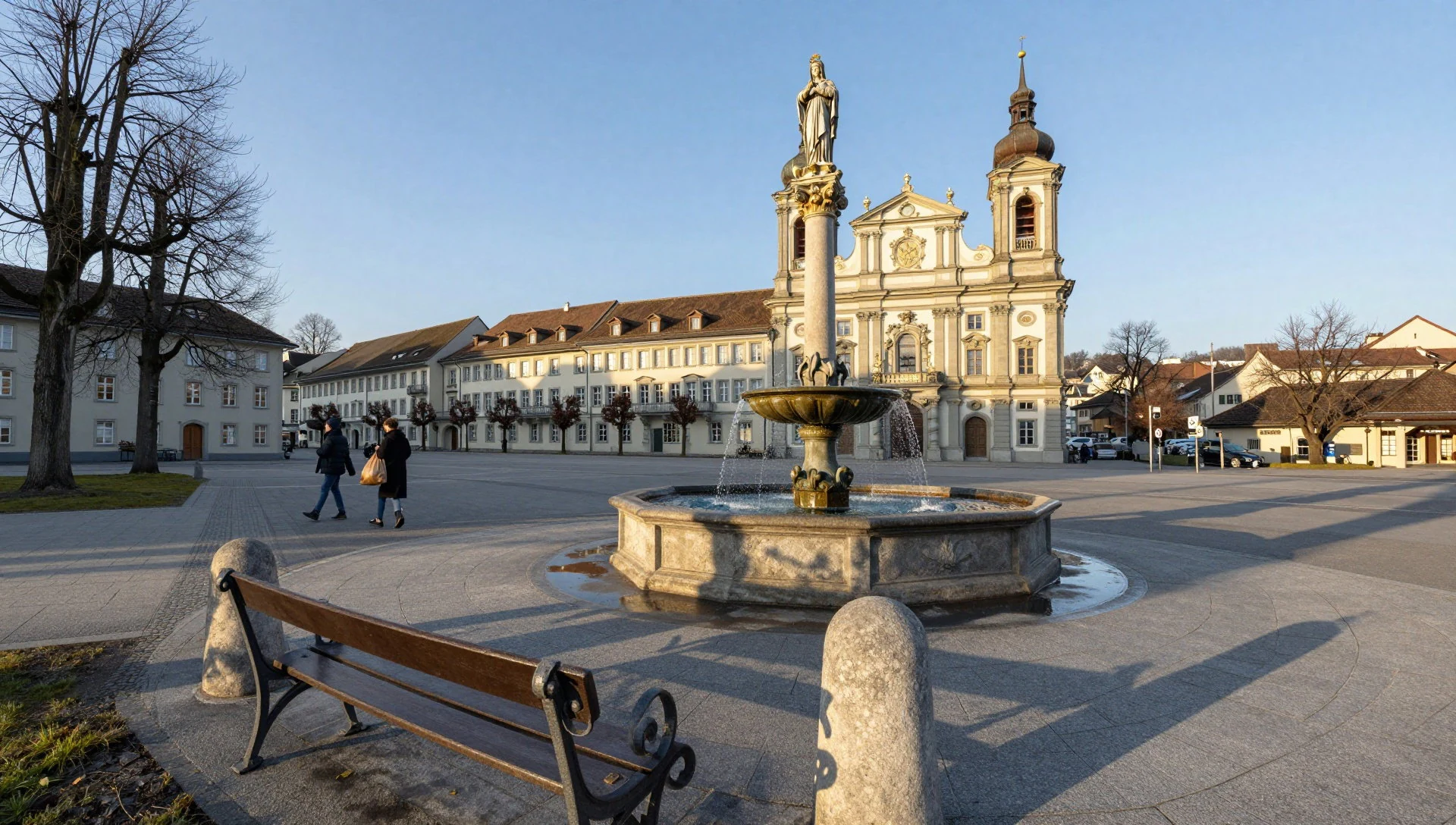
- The courtyards and working abbey — Abbey buildings around the church
Aerial photographs show four courtyards wrapped around the church. Much of this is private, since monks live here and a school teaches here, but the outer buildings show the scale of an institution that also runs a winery and a sawmill. Respect signs marking areas closed to visitors.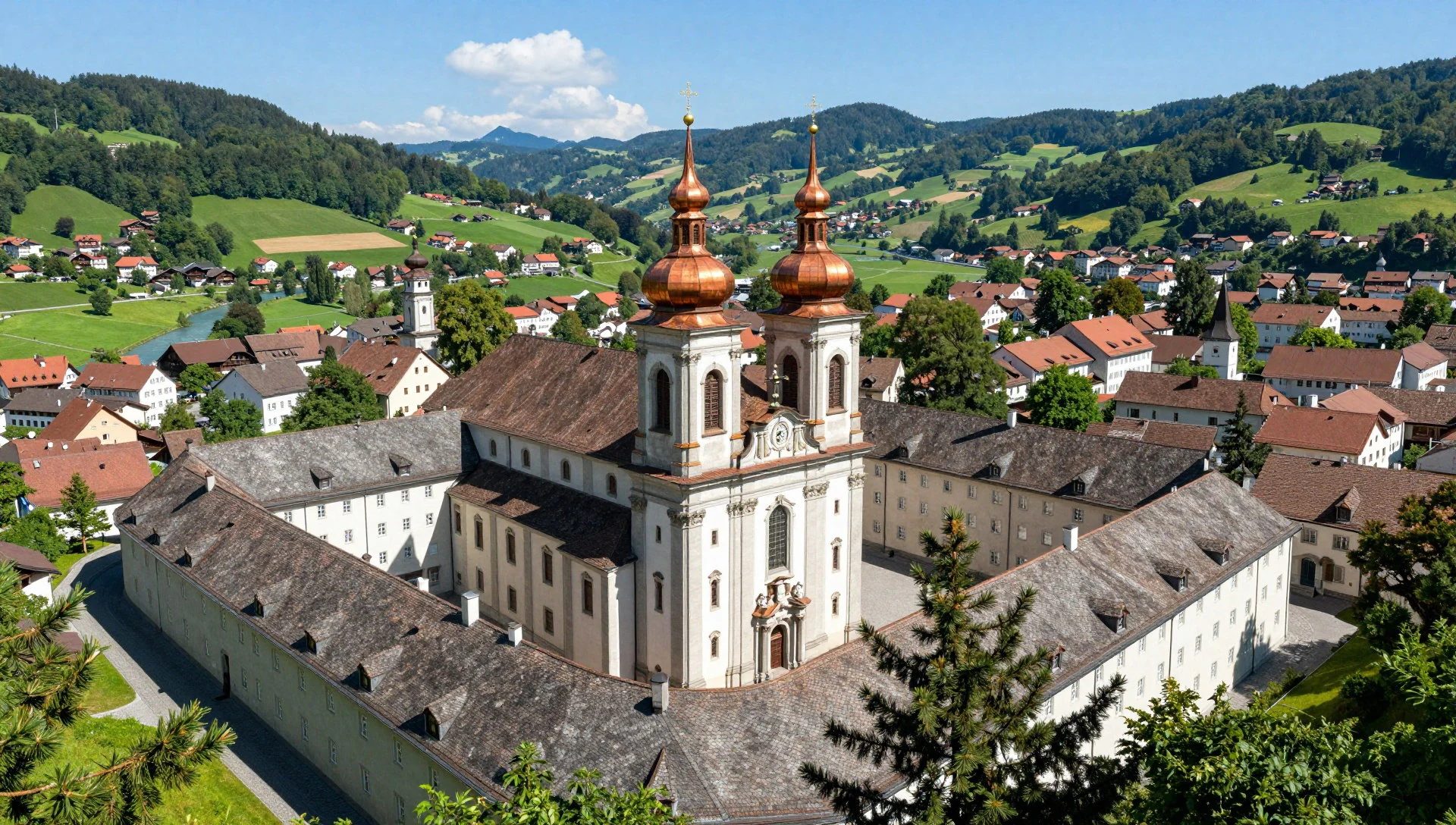
- The town of Einsiedeln — Streets leading from the abbey square
Beyond the abbey, the small town has shops selling devotional items and local sweets along the street leading from the square. It makes a gentle half-hour wander after the church, with meadows a short walk away for fresh air before the train home.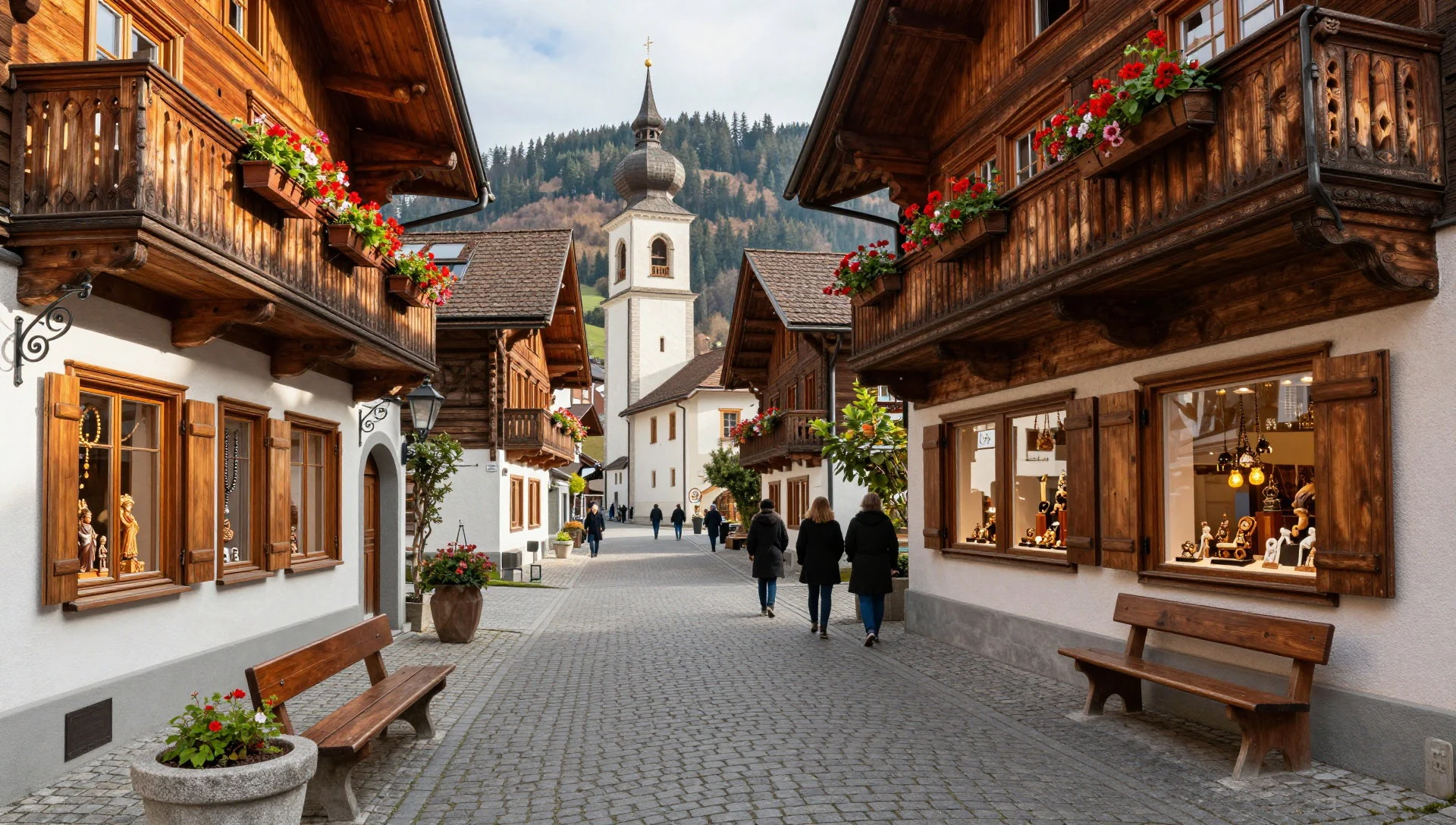
Culture
Einsiedeln Abbey is first a place of worship and only then a sight. Benedictine life here follows the old pattern of shared prayer, work and study, and the monks' school and workshops show how closely the community mixes faith with everyday labour. Pilgrims come from across Switzerland and beyond, often to ask for help, give thanks or simply sit before the Black Madonna.
The devotion has deep roots. A hermit's cell became an abbey, a legend of divine blessing drew the first pilgrims, and over the centuries the focus settled on Mary. That is why the fountain on the forecourt, the shrine in the church and the chapel built inside it all point to her. The abbey stayed Catholic through the Reformation, and it carries that weight still: people light candles, kneel and speak softly even when a tour group walks past.
Services are the heart of the day, and visitors can often listen to the monks sing, but timings change with the season and feast days, so check the official site (http://www.kloster-einsiedeln.ch/) before planning around them. The abbey is also a school and a business, which gives it a lived-in, practical feel quite unlike a museum.
In the church and the Chapel of Grace, keep your voice low, switch off flash and do not photograph people who are praying.
What to wear
Traditional dress around Einsiedeln belongs to central Swiss folk costume (Tracht), which differs from canton to canton. Women's versions typically combine a fitted velvet or wool bodice, a full skirt, a silk or cotton apron and silver chains or filigree; men's use a waistcoat, linen shirt and dark wool trousers. These are worn for processions, weddings, folk music events and church festivals rather than every day. The monks wear the black Benedictine habit, the most common formal dress at the abbey itself.
Day to day, locals dress practically for a cool, changeable upland climate: jackets, knitwear, jeans and sturdy shoes, with waterproofs close to hand. On feast days pilgrims often dress a little smarter, and some wear their Sunday clothes.
For visitors, layers are the answer. A fleece and a waterproof shell cover most weather, and in winter a warm hat, gloves and shoes with good grip are needed for snowy pavements and the open forecourt. Cobbles and stone floors make closed, comfortable shoes better than sandals. Because the church is active, cover shoulders and knees and take off caps on entering. Summer can be warm, so a light scarf or shawl is handy to pull over a sleeveless top before going inside.
What to eat
- Älplermagronen — Traditional inns and restaurants in the town centre
Macaroni baked with potato, cream, cheese and onion, usually served with apple sauce. It is a mountain-farmer staple across central Switzerland and very filling, which suits a cold morning on the forecourt followed by a long lunch.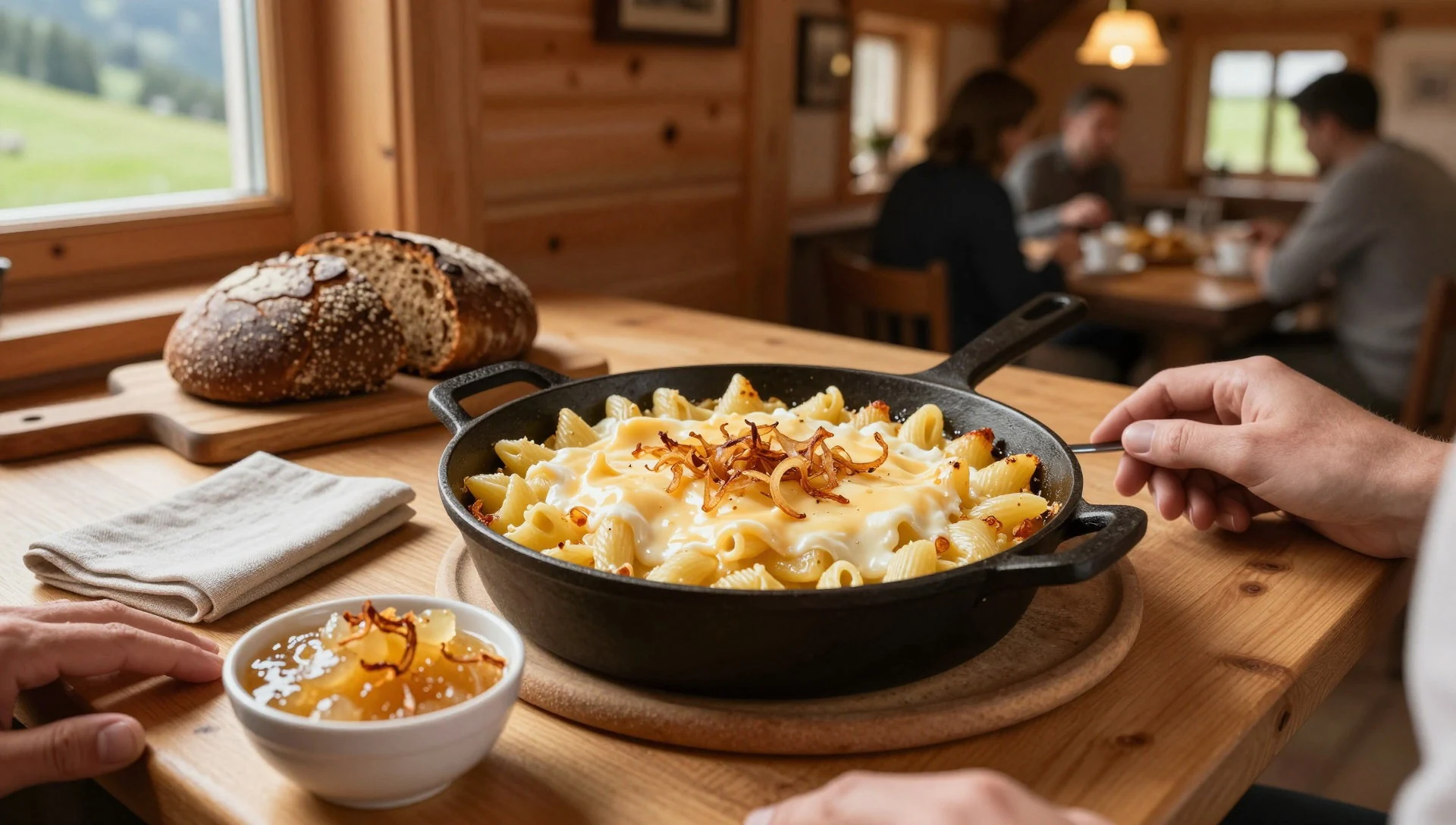
- Rösti with sausage — Inns and cafés along the main street
Grated potato fried into a golden cake and served with bratwurst, a fried egg or both. It is a dependable, plain lunch, and the portions are generous enough to share if appetites are modest.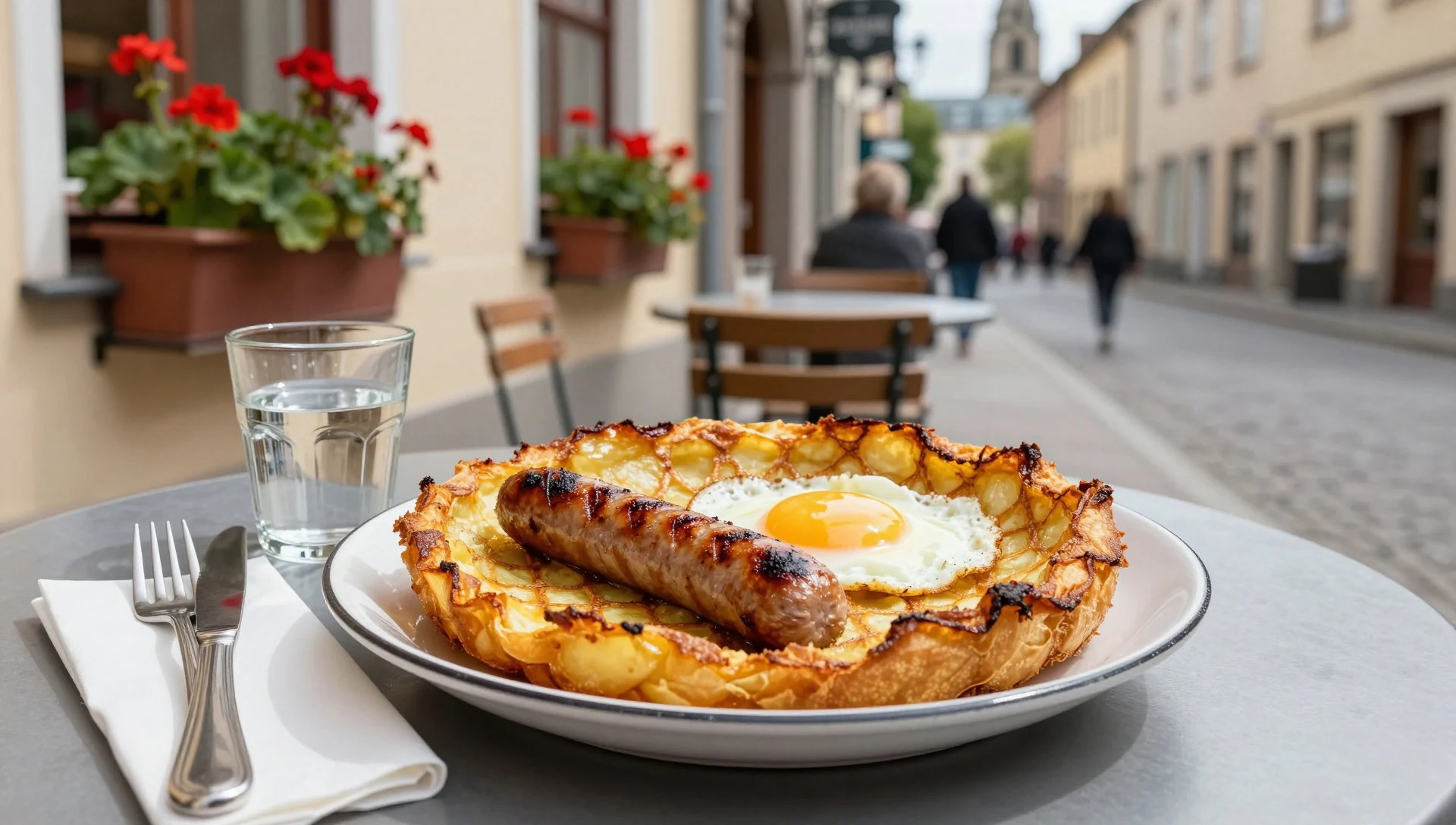
- Schafböcke — Bakeries and confectioners near the abbey square
A local sweet baked in the shape of a ram and closely associated with Einsiedeln. Ask a baker which versions are made in the town. It is a good small gift to carry home from a pilgrimage stop. - Abbey wine — The abbey's own shop or restaurant; check the official site
The monastery runs its own winery, so a glass or bottle of its wine ties the visit together. Availability varies by season and stock, so ask on the spot rather than counting on a particular vintage. - Mountain cheese and fondue — Dairy counters, farm shops and inns around the town
Alpine cheese from the surrounding pastures, eaten sliced with bread and pickles or melted as fondue or raclette on cold days. Ask for the local cheese; it is often the best-value choice in an expensive country.
Plan it
Best time. May–June and September–October for green meadows, easier walking and manageable crowds. Winter is cold and can be snowy, which is atmospheric but demands proper footwear. Summer weekends and church feast days are the busiest times.
How long. 1
Getting there. Zurich Airport is the nearest major airport. Take a train towards Wädenswil or Pfäffikon SZ and change for the line to Einsiedeln; the station is a short walk from the abbey square.
Budget. high
Tips
- Go early or on a weekday to avoid the crowds at the Black Madonna
- Check the official site (http://www.kloster-einsiedeln.ch/) for service times, openings and any closures before travelling
- Pack waterproofs and layers, as upland weather can turn quickly
- Carry some cash for bakeries and candle boxes, though cards are widely accepted in Switzerland
Etiquette
- Keep voices low and phones silent in the church
- Do not photograph people who are praying, and avoid flash in the Chapel of Grace
- Cover shoulders and knees, and take off hats inside
Nearby
Sources
- Wikidata Q125072234 (CC0)
- Wikipedia: Einsiedeln Abbey (rev 1375419804) (CC BY-SA 4.0)
- Photo: Einsiedeln Abbey with Lady Fountain, Markus Bernet (CC BY-SA 2.5)
- Photo: Trachslau, Schweiz, Martin Sattler (CC0 1.0)
- Photo: Schwarze Madonna von Einsiedeln, Beat Ruest (CC BY-SA 4.0)
- Photo: Kloster Einsiedeln mit Marienbrunnen, Beat Ruest (CC BY 4.0)
- Photo: Aerial view of Einsiedeln Abbey, Beat Ruest (CC BY 4.0)
- Photo: Einsiedeln Abbey, Markus Bernet (CC BY-SA 2.5)
- Photo: Kloster Einsiedeln, Roland zh (CC BY 3.0)
- Photo: Marienbrunnen, Hauptplatz Kloster Einsiedeln, Roland zh (CC BY 3.0)
- Wikivoyage (CC BY-SA 4.0)


