Delphi
Delphi, Greece
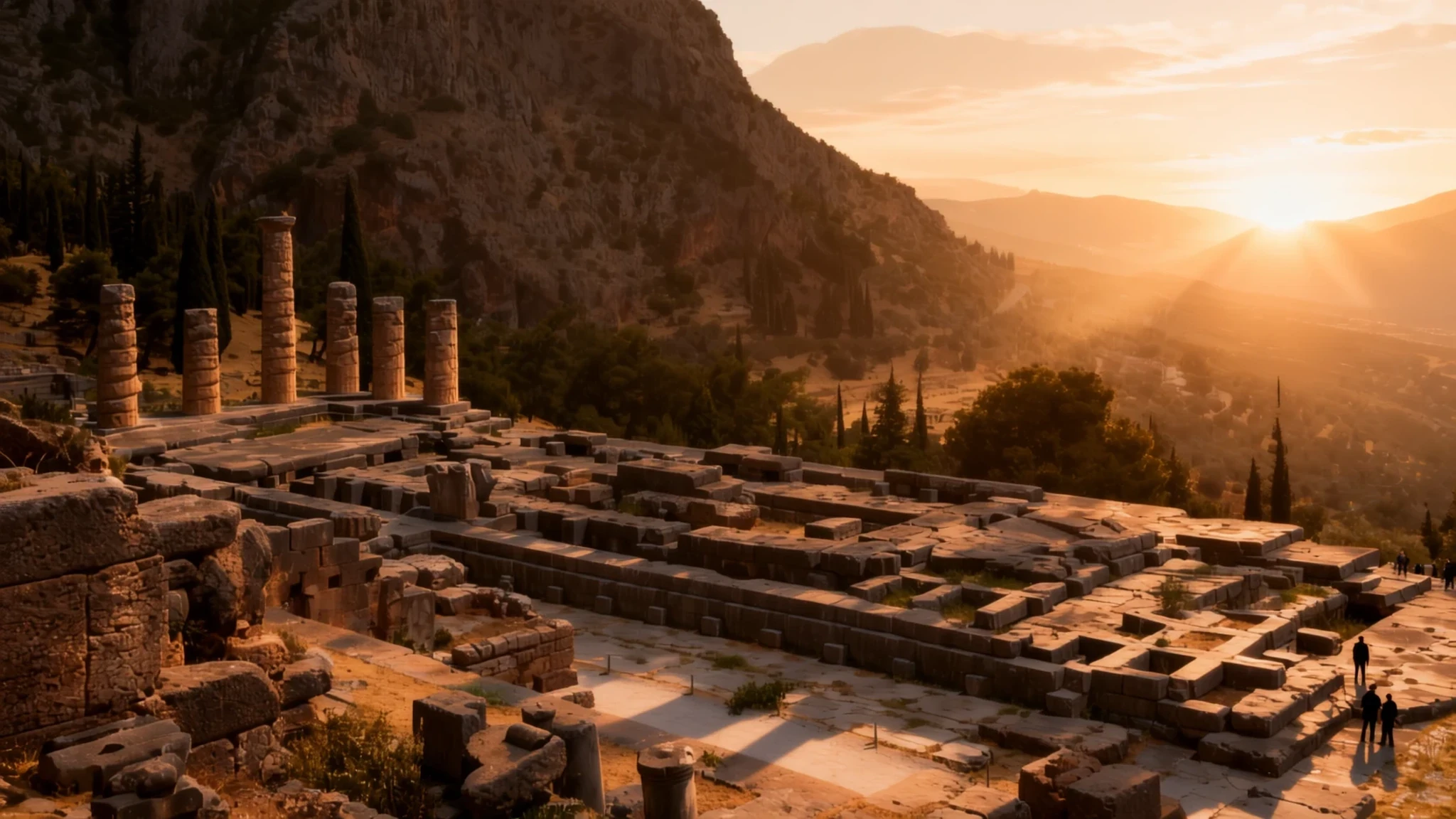
Go to Delphi for the sanctuary where ancient Greeks came to ask the god Apollo about the future, set on a dramatic mountain slope above the valley.
The place
Delphi sits on a steep hillside on the south-western flank of Mount Parnassus, at about 570 metres above sea level, in the Fokida region of central Greece. For the ancient Greeks it was the home of the Pythia, the priestess who delivered answers from Apollo to cities and individuals who came with questions about war, colonies, marriage and money. Pilgrims who climbed up from the valley did not simply consult her. They walked a sacred precinct crowded with treasuries, statues and temples put up by almost every important city-state, each one a bid for prestige in front of the other Greeks.
The site is large and spread across terraces, so plan for walking rather than a quick look. The main ruins cluster along one processional route: the temple of Apollo at the centre, the theatre and stadium above it, and the round Tholos further along towards the sanctuary of Athena. Much of what survives is foundations and column bases, but the scale makes sense once you reach the upper terraces and look down over the valley.
Below the ruins, the modern village is small and practical. It has plenty of eating places, a handful of guesthouses and hotels, and a museum devoted to finds from the site. The surrounding Parnassos National Park is mountainous, with narrow roads that suit walking and cycling in spring and autumn.
Delphi is not a place to rush. Go early, bring water, and give yourself time to sit on the stone steps and look out over the valley where the Greeks believed the centre of the world lay.
Its story
Delphi's story starts well before the famous temples. People settled the slope in the Neolithic period, and the place grew in importance during the Mycenaean age, when the nearby town of Krisa was a significant land and sea power. Krisa's influence faded after rival states from southern Greece fought over access to the sanctuary. Control of Delphi then passed to the Amphictyonic League, a federation of states with a stake in the shrine, which oversaw it in the early Classical period. The town of Krisa was razed after it was judged overbearing, and the gulf beside it took the name of Corinth, a city whose style leaned towards the ornate and inventive rather than the austere manner of Sparta.
Legend gives the shrine an even older life. Some traditions say an oracle already operated here before the classical age, and that the site was once dedicated to Gaia, the mother goddess linked with fertility. Other stories tie the name to a serpent that Apollo killed on the spot. In some versions the creature was female, in others male, and the tale explains why the god took over the place. Later the sanctuary was rededicated to Apollo and became the main centre of his worship in classical times.
The oracle's authority grew with the wealth of the cities that sent gifts. Treasuries, statues and offerings filled the terraces, and the Pythia's answers shaped colonies, wars and laws. Over time the role changed: early on the priestess was a young woman from a nearby village, and later she was an older woman, usually past childbearing age.
The sanctuary also reached into ordinary religious life. Cities that had let their hearth fires go out after a great battle sent to Delphi for fresh flame, and founders of colonies were often dedicated there before they sailed. Today the ruins tell that story through stone rather than oracles.
What to see
- Temple of Apollo — the centre of the site
The temple of Apollo is the heart of the site and the place where the oracle gave its answers. The surviving columns and foundations show the outline of the building, and the inner room where the hearth once burned is easy to pick out. Walk around the outside slowly, then stand at the front where the processional way approaches. Early morning, before the tour groups arrive, is the best time for photographs without crowds.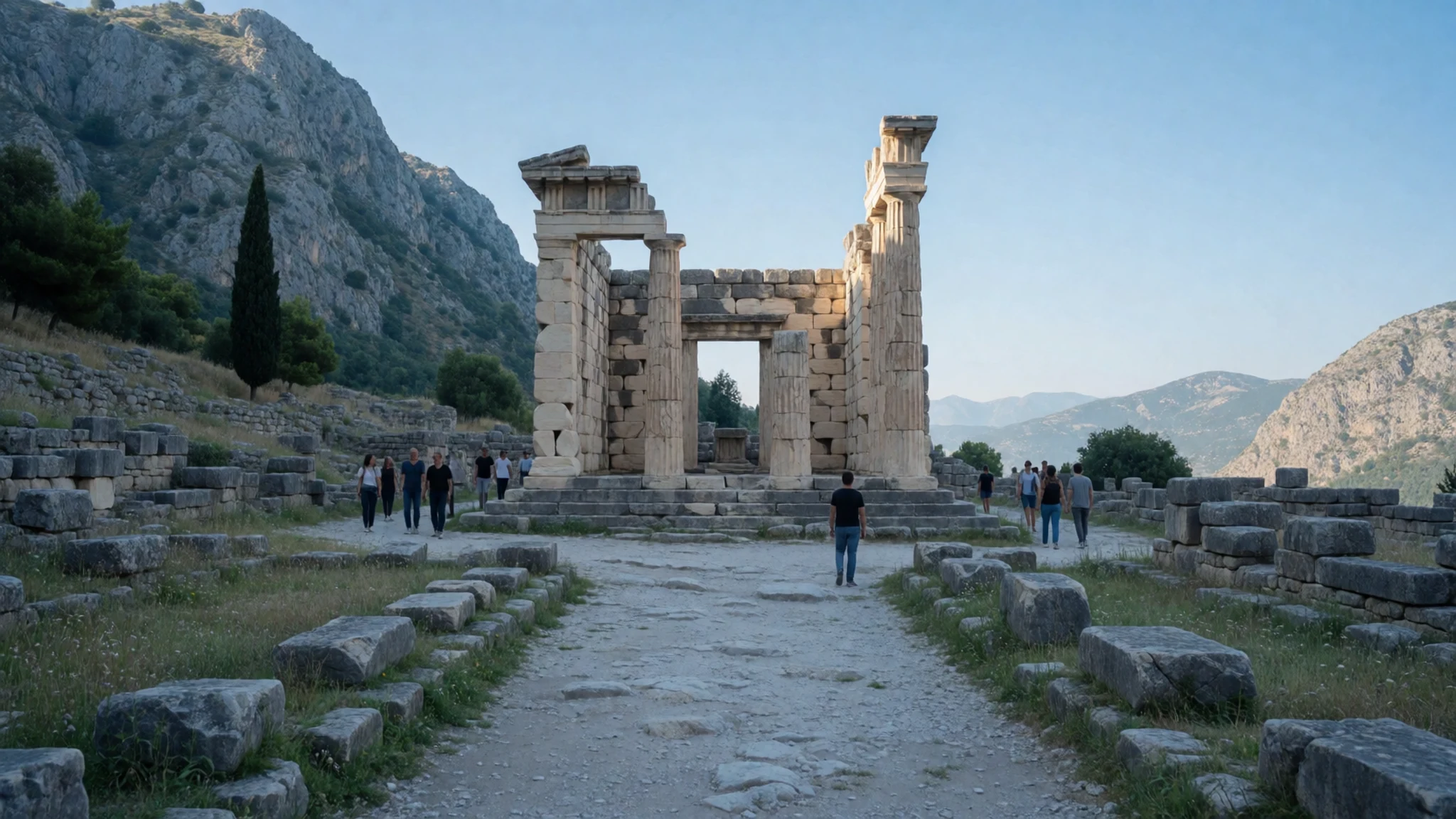
- Museum — the modern village
The museum sits in the modern village and holds many of the objects found in the sanctuary, including small offerings that show what pilgrims left behind. Allow at least an hour so the galleries are not rushed. Opening hours change with the season, so check the official site before planning your day around them. Visiting the museum first gives useful context for the ruins above.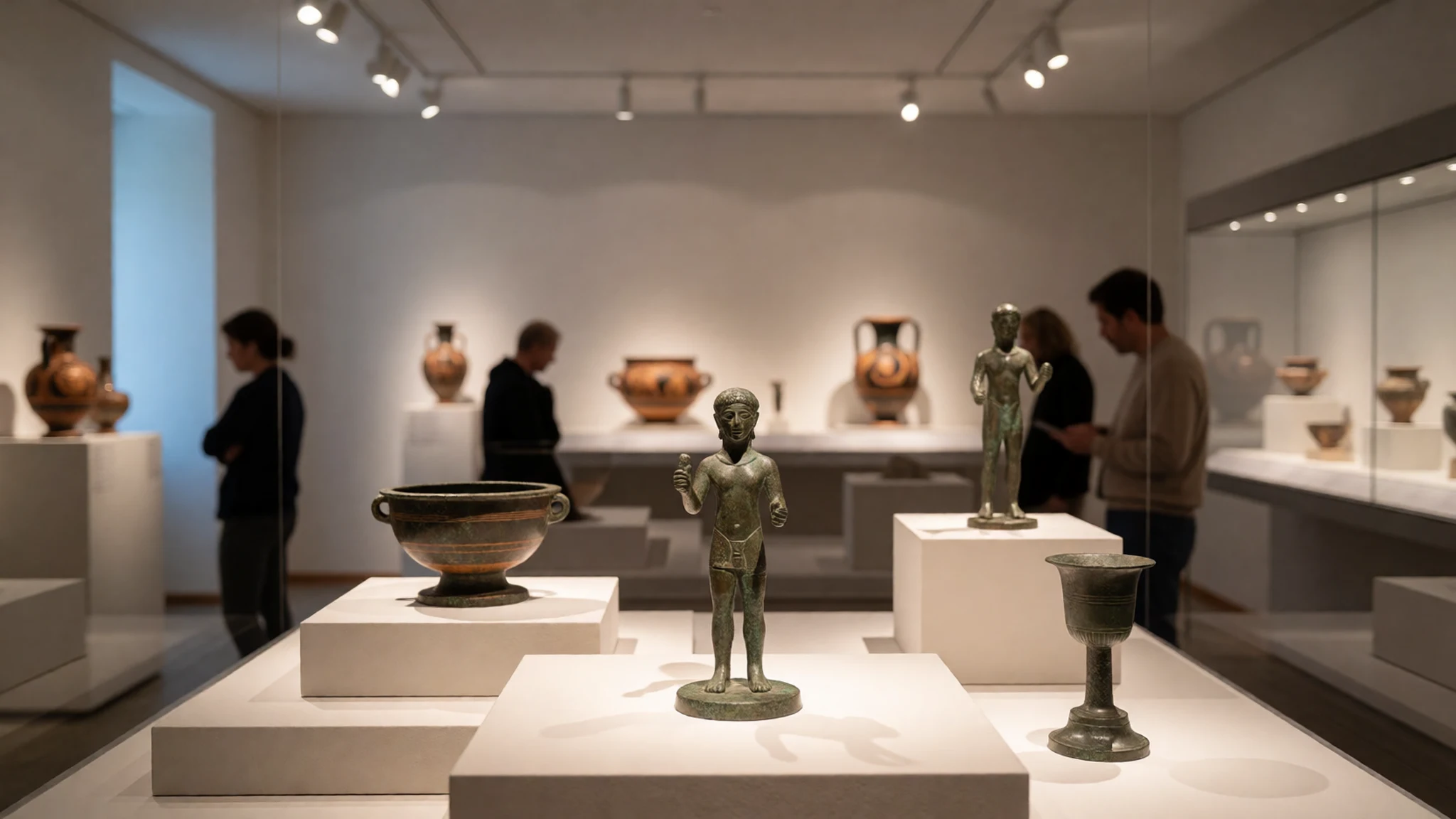
- Ancient Theatre — on the slope above the temple
The theatre sits above the temple, its rows of stone seats cut into the hill. Performances and contests once drew visitors from across the Greek world, and the seats give a clear view down to the temple and across the valley. The path up is steep and uneven in places, so climb slowly and wear shoes with good grip.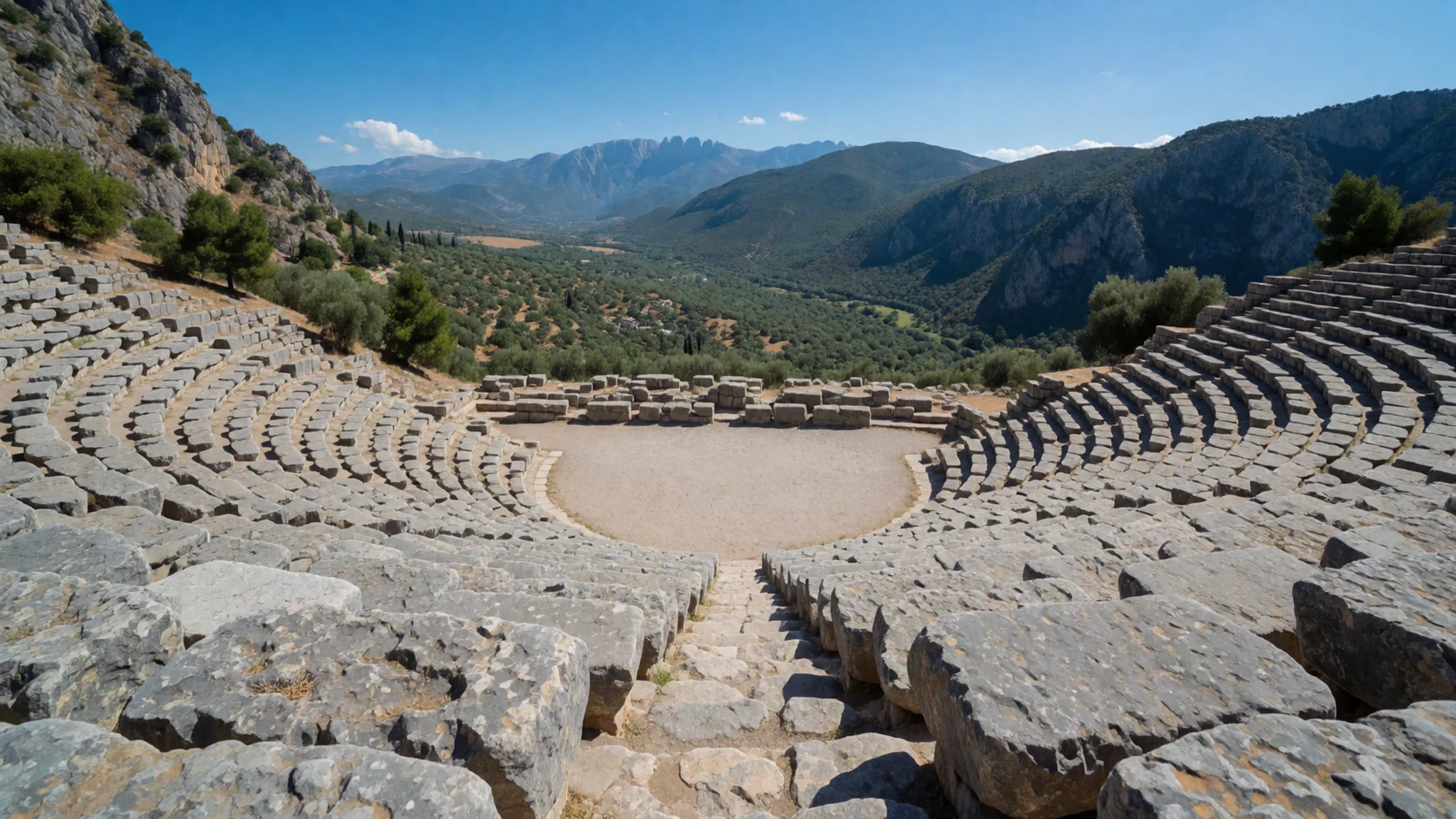
- Delphi Stadium — a short walk from the temple
The stadium lies a short walk from the temple and hosted the athletic contests held in honour of Apollo as part of the Pythian Games. Its long, narrow track is cut into the slope, with stone seating along one side. Walking the length of it gives a real sense of how the games were staged. Shade is limited, so visit in the morning or late afternoon and carry water.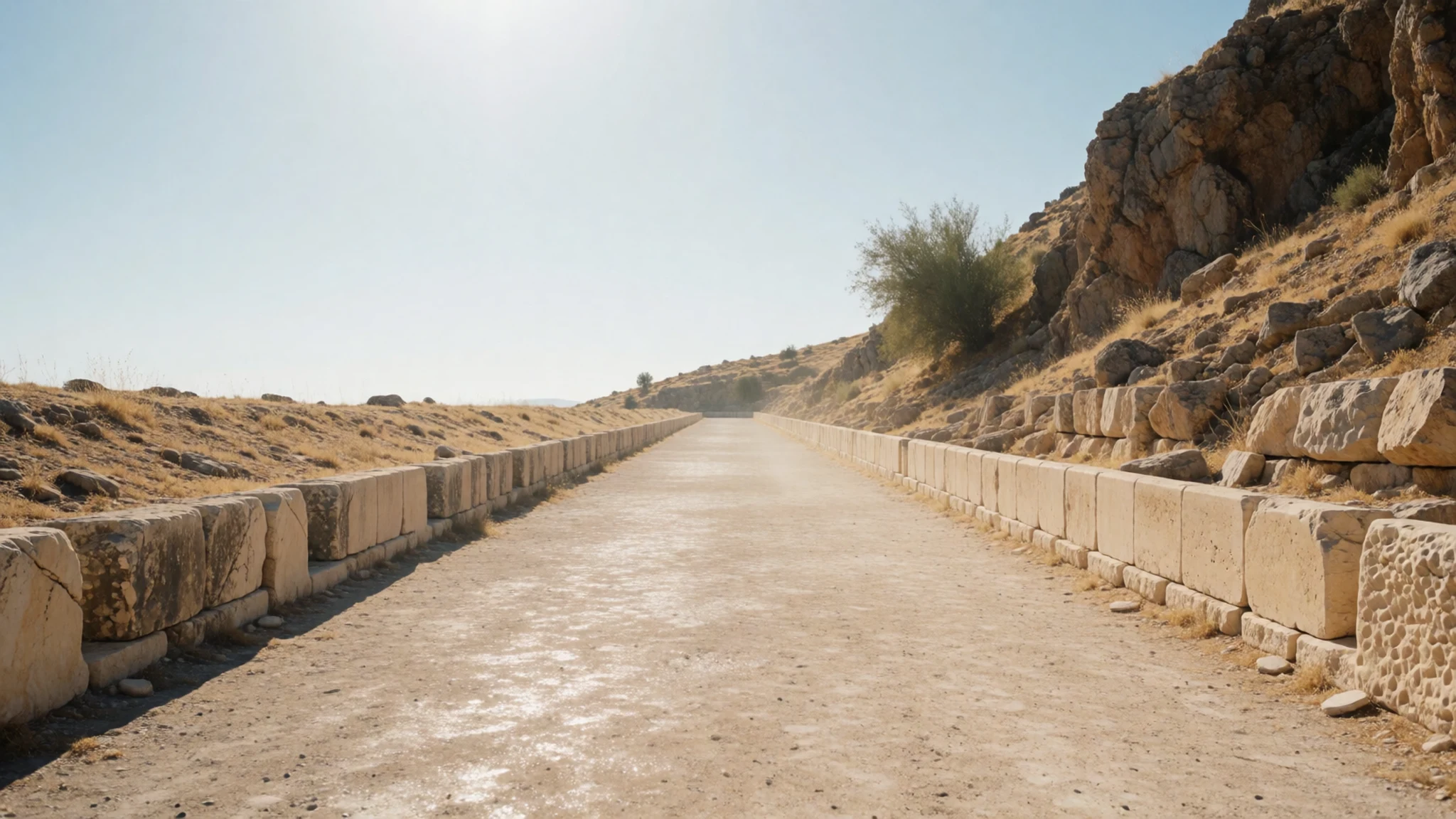
- Sanctuary of Athena with the Tholos — further along the road
Further along the road lies the sanctuary of Athena, where the Tholos stands among its ruined foundations. The round building is one of the best-known features of the site, its circular columns still arranged in a ring. Scholars continue to debate what the Tholos was used for, so treat any single explanation with some caution. It is a quieter corner, away from the main temple crowds.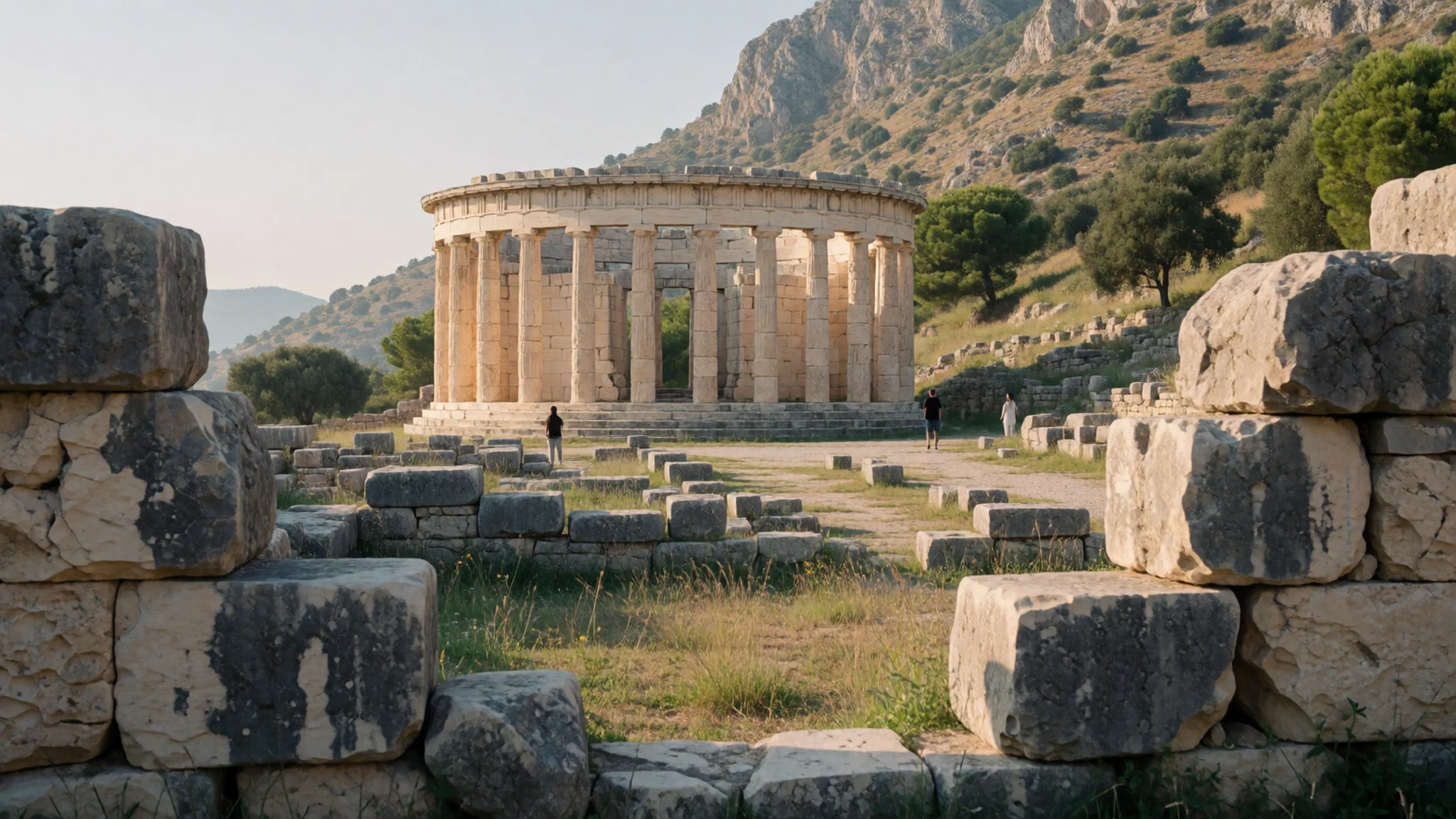
Culture
Delphi is a working archaeological site as well as a tourist stop, and the modern village that serves it keeps its own rhythms. Greek social life revolves around family and food, and the people who run guesthouses and tavernas tend to be friendly and direct. Meals are taken late, so a table at a taverna can be busy well into the evening in summer. Most people in the area are Orthodox Christian, and the ancient god Apollo is long gone from worship, but the site still carries real weight for many Greeks as a symbol of their history. Hospitality often includes an offer of coffee or a small sweet, and a polite thank-you is the right response. Ask before photographing people in the village, especially anyone working or in church. Keep to the marked paths and do not climb on fallen stones or the ancient seats, even when no one appears to be watching.
What to wear
Delphi's traditional dress comes from the mountain villages of central Greece, where women's costume traditionally used woven wool and linen, embroidered aprons and sleeveless bodices, while men wore wool vests and heavy woollen cloth. Patterned textiles, often in red, black and white, marked the wearer's village and status. Today these costumes appear mostly at festivals, weddings and folk dance groups, not in daily life. Most people in the village wear ordinary European clothes, with jeans, t-shirts and trainers for the day, and smarter linen or cotton in the evenings. Older women still often wear black, particularly for church and mourning. For your own visit, choose breathable layers, since the mountain air can turn cold in the evening even on a hot day. Pack a sun hat and sunscreen for the open terraces, and wear comfortable closed shoes with good grip, because the paths are stony and sloping. Cover shoulders and knees if you plan to enter a church or chapel in the village.
What to eat
- Souvlaki — street grills and village tavernas
Skewers of grilled pork or chicken, often wrapped in warm pitta with tomato, onion and tzatziki. Eat them standing at a street grill or sit down at a village taverna. They are quick, filling and a good choice before or after a long morning on the site.
- Spanakopita — village bakeries
Flaky filo pastry folded around spinach and feta, sold warm and cut into squares. The bakeries in the modern village are a good place to pick one up as an early snack before the walk up to the ruins.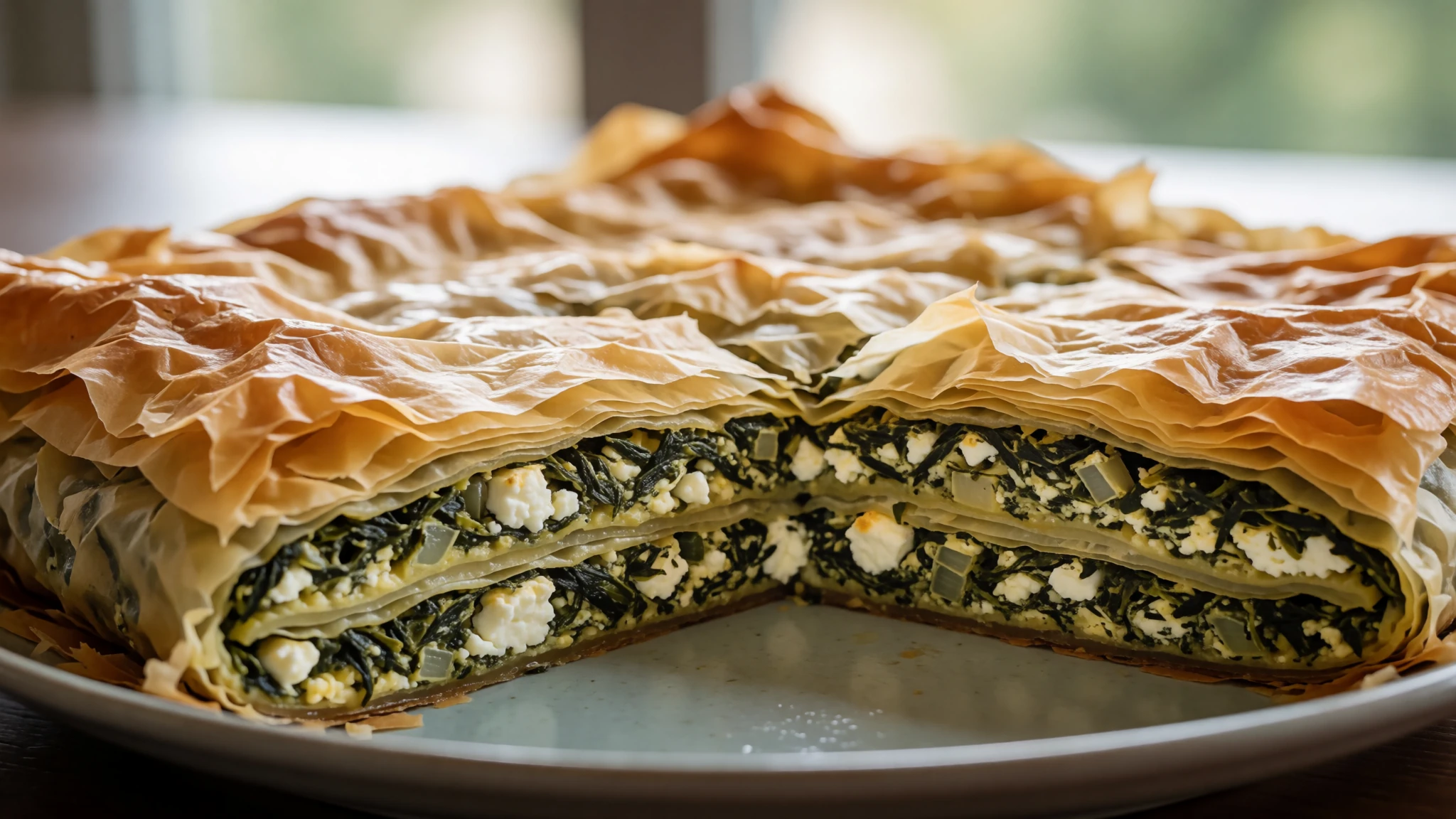
- Greek salad with local cheese — tavernas with a terrace
Ripe tomato, cucumber, onion, olives and a thick slab of feta, dressed with olive oil and oregano. Order it at any taverna with a terrace, where the cheese is often sharp and sourced from local producers. It makes a light lunch after the morning on the site.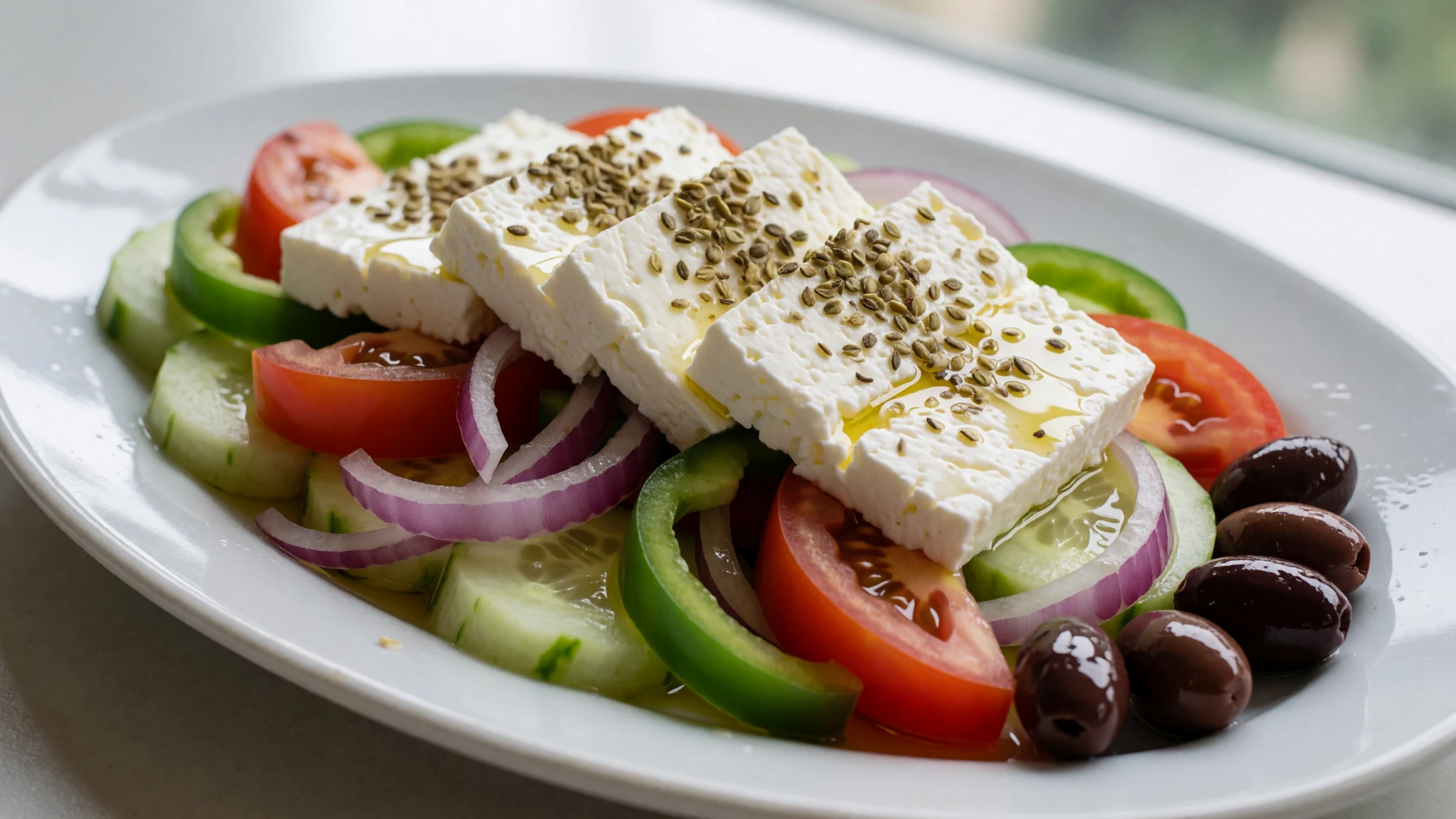
- Frappé — cafés with terraces in the village
Instant coffee shaken with ice, water and milk until frothy, served in a tall glass with a straw. It is the default cold drink in summer, and the cafés with terraces in the village are the easiest place to order one while you plan the afternoon. - Honey and yoghurt — village guesthouse breakfasts and tavernas
Thick strained yoghurt drizzled with local honey and sometimes topped with walnuts. It makes a light breakfast or dessert, and you will find it on the tables of village guesthouses and tavernas, often served with bread.
Plan it
Best time. Spring brings green hillsides, but April and May are already hot, with highs near 30°C and 34°C, so March and the autumn months suit walking best, and October and November are cooler and quieter after the summer crowds. Summer is really hot on the open terraces, and winter can bring cold, wet weather and quieter roads.
How long. 2–3
Getting there. Athens is the usual starting point. Long-distance buses leave from Athens several times a day and take about three hours. Coming from further north, expect to change buses at Lamia, and check the timetable because services there are limited.
Budget. mid
Tips
- Book your Athens bus a day ahead, as seats can sell out
- Start on the site early, before the tour groups arrive
- Carry cash for small purchases in the village, and water for the walk
- Stay overnight in the village, or in nearby Arachova or Galaxidi for better value
- Check the official site for opening hours, which change by season
Etiquette
- Stay on the marked paths and off the ancient stonework
- Dress modestly when visiting churches in the village
- Speak quietly among the ruins and give other visitors room for photographs
Nearby
Sources
- Wikidata Q75459 (CC0)
- Wikipedia: Delphi (rev 1378220428) (CC BY-SA 4.0)
- Wikivoyage: Delphi (rev 5241751) (CC BY-SA 4.0)
- Delfi Apollons tempel, Helen Simonsson (CC BY 3.0)
- Delphi, Greece, tamara semina (CC BY 3.0)
- Delphi, Christopher Steinle (CC BY 3.0)
- Greece, Delphi, Temple of Apollo, Berthold Werner (CC BY 3.0)
- Δελφοί 15.Δελφοί GR-H07-0007, NikosFF (CC BY-SA 4.0)
- Δελφοί (Delfoi8), Golfisaggelos (CC BY-SA 4.0)
- Treasury house of Athens in Delphi (July 2018), Szymon Kobalczyk (CC BY 3.0)
- Treasury of the Boeotians at Delphi, Davide Mauro (CC BY-SA 4.0)


