Dadivank Monastery
Dadivank Monastery, Azerbaijan
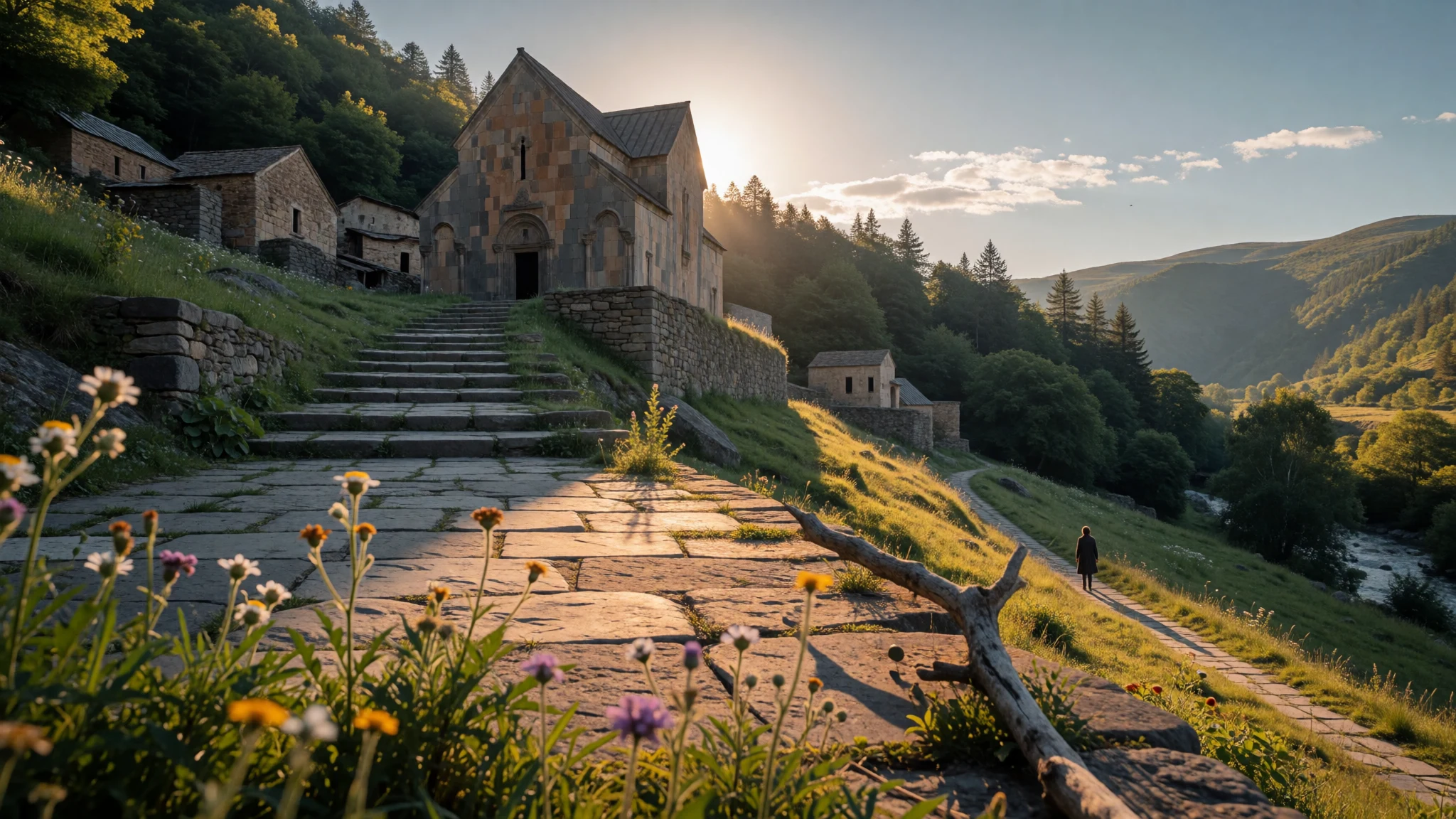
Dadivank is a medieval Armenian monastery on a forested Caucasus hillside, rich in carved crosses, inscriptions and fresco fragments, but access needs checking first.
The place
Dadivank Monastery, also called Khutavank, is an Armenian Apostolic monastic complex in the Kalbajar District of western Azerbaijan, set in the forested uplands of the Lesser Caucasus. The Armenian name Khutavank means roughly 'monastery on the hill', and it suits the site: the buildings sit on a wooded slope above a river valley, with grey and honey-coloured stone stepping down between the trees. Azerbaijani sources call it Dadivəng or Xudavəng, so all of these spellings turn up on maps, signs and in guidebooks.
The complex is a cluster rather than a single building. There is a main church, smaller chapels, a bell tower and service quarters, arranged around courtyards and terraces. Building went on across several centuries, which is why the stonework and style change from one structure to the next. Carved crosses, inscriptions and fragments of painted plaster survive on walls and in niches. Wikidata gives the foundation as around 801, although written mention of the monastery comes somewhat later.
The setting is quiet and remote. The nearest towns of any size are a long way off by mountain road, and the climate is that of high wooded country: cool, often damp, with proper winters. Access is the first thing to settle. At the time of writing, Azerbaijan's land borders are largely closed to ordinary travellers, and the district has a troubled recent history. Any plan should begin with current official guidance rather than a map.
Its story
Dadivank Monastery carries a founding story that reaches back to the first century. Tradition says it was established by St Dadi, a follower of Thaddeus the Apostle, who is remembered as an early preacher of Christianity in eastern Armenia. Historians are more cautious. The earliest written mention of the monastery dates only to the ninth century, which sits comfortably with the foundation date of around 801 recorded in Wikidata, and leaves a long gap between the legend and the documents.
Such gaps are common at old holy places, where a saint's name gives a younger foundation an ancient pedigree. Yet the legend received an unexpected boost in recent years, when a grave believed to be St Dadi's was reported beneath the altar of the main church. Whether or not that identification holds, it shows how alive the tradition remains for Armenian believers, who treat the site as the resting place of its patron.
Over the medieval centuries the complex grew by addition rather than to a single plan. Princes, local lords and clergy paid for new chapels, carved stones and painted walls, and many left their names in inscriptions. That is why Dadivank reads as a record of patronage as much as a place of prayer: each structure shows who could afford to build, and what they wanted remembered.
The district around it has changed hands and administration within living memory, and the monastery's care and the rules for visiting have shifted with it. Anyone planning a trip should treat the present access conditions as part of the story, and check them before anything else.
What to see
- The main church — Central courtyard
The main church is the heart of Dadivank Monastery, and the altar beneath it is where the grave attributed to St Dadi was reported. Look at the proportions of the stone walls, the steep roofline and the way later additions crowd around the older core. Early morning light suits the grey masonry best.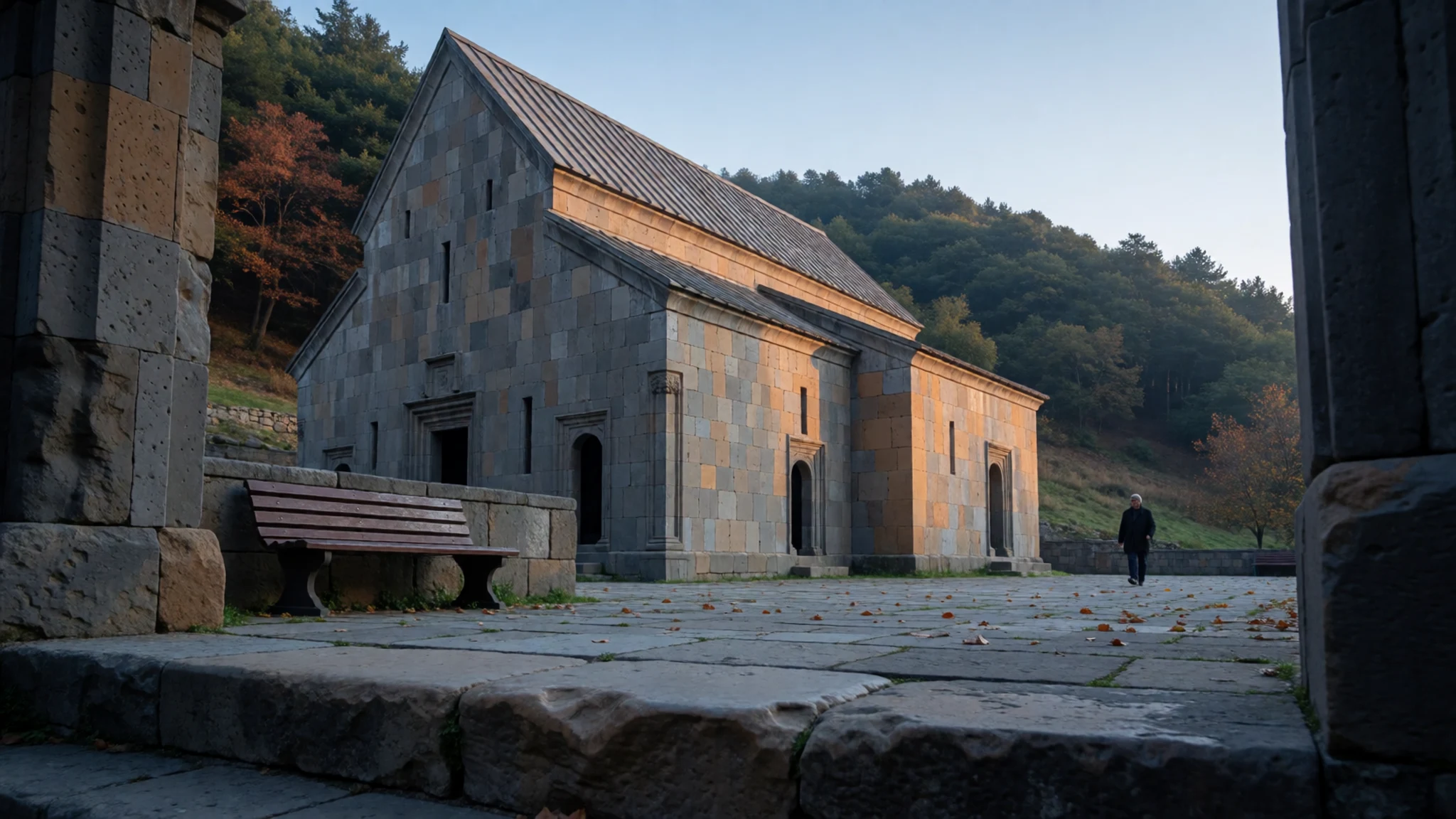
- Khachkars and carved crosses — Courtyards and terraces
Khachkars are upright stone slabs carved with a cross surrounded by interlaced patterns, an Armenian tradition. Dadivank has a large one among its stones. Stand close enough to see the chisel work, then step back to see how the lacework of vines and rosettes frames the central cross.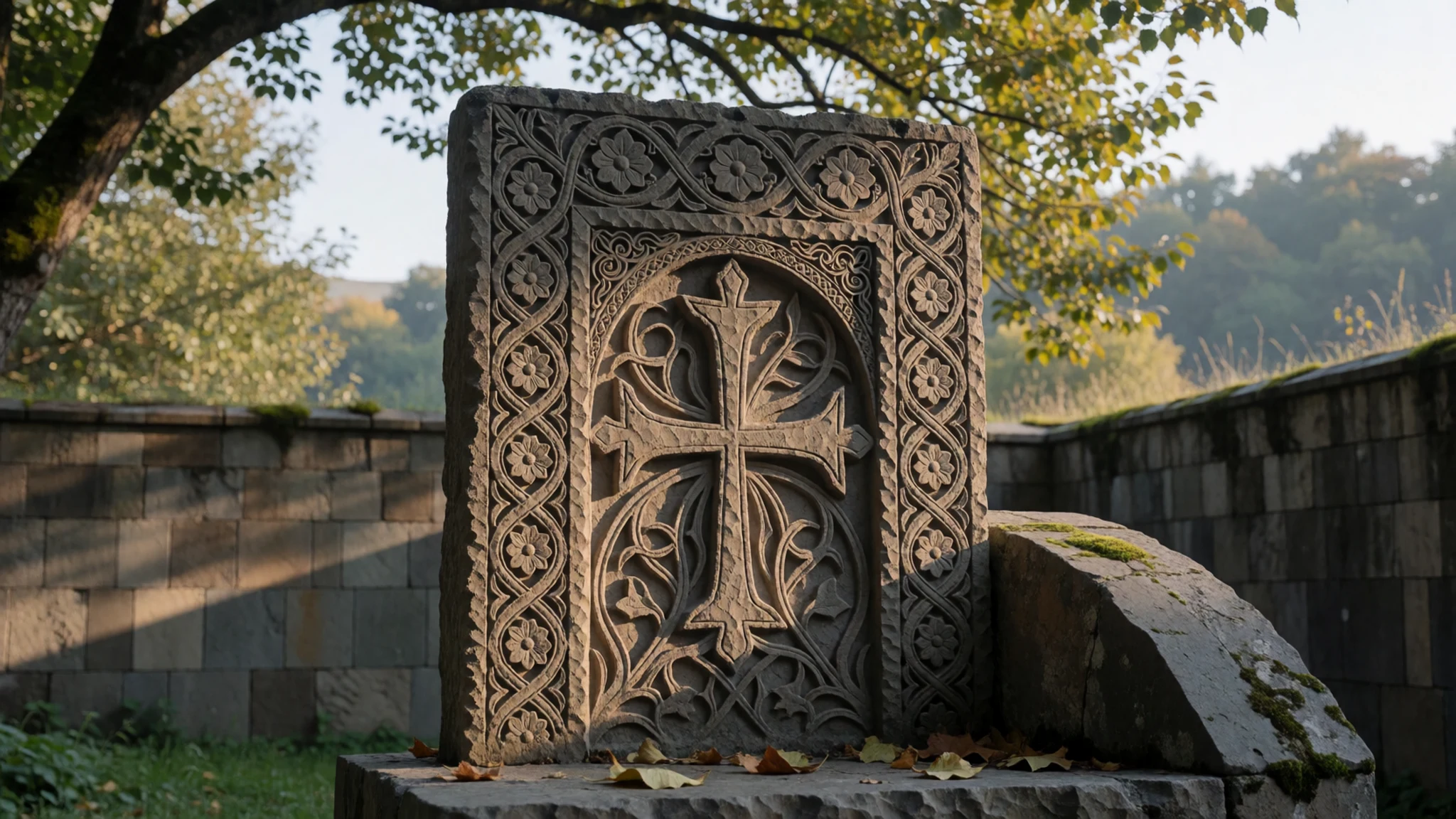
- Fresco fragments — Interior of the main church
Painted plaster survives in patches inside the church, mostly faded figures and colour fields rather than full scenes. They are fragile, so do not touch or use flash. What remains is enough to picture the interior as brightly painted once, and to appreciate how much has weathered away.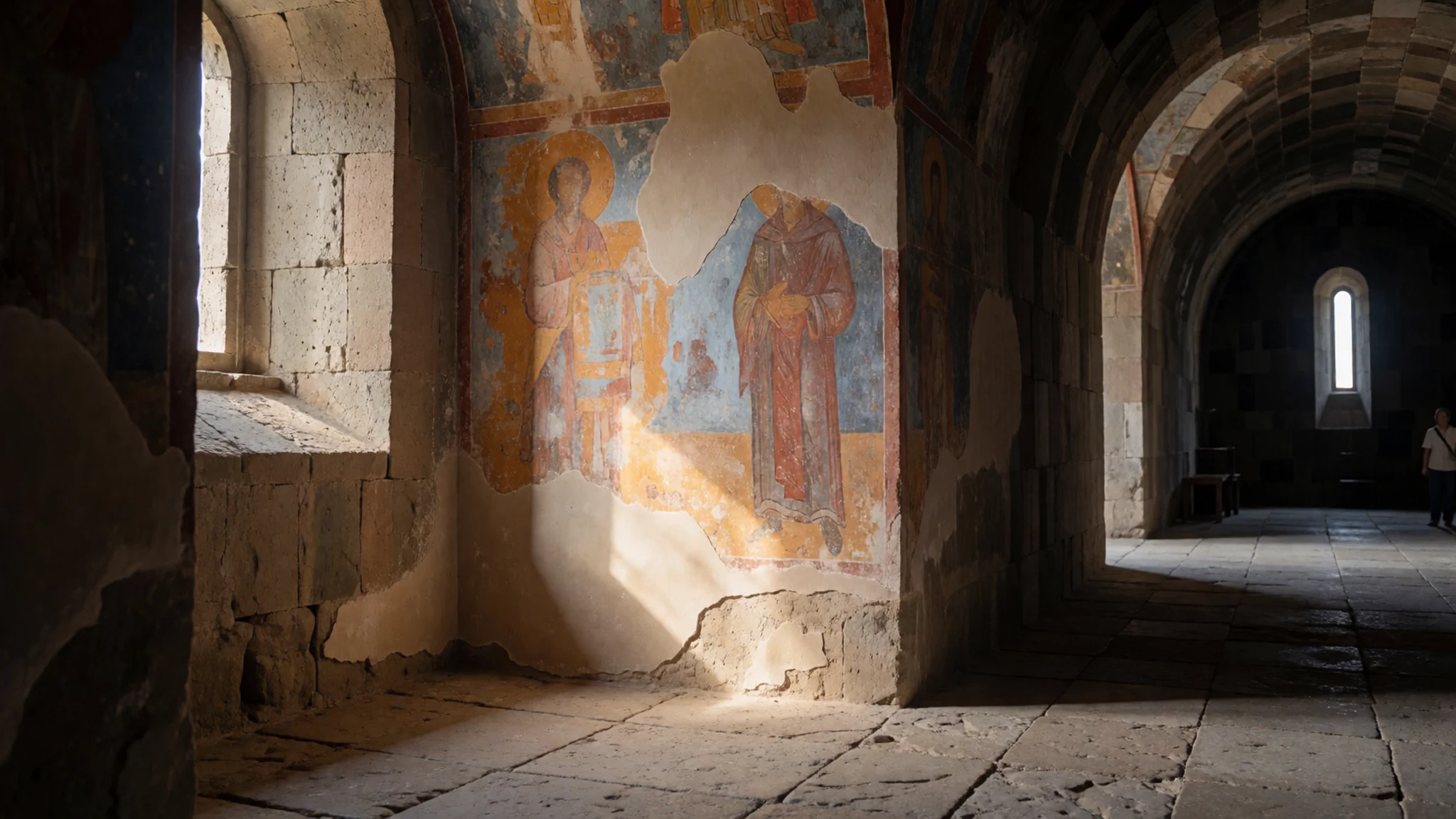
- Wall inscriptions — Exterior church walls
Dadivank's walls carry long carved inscriptions in Armenian script. Many record gifts, building work and the names of the people who paid for them, which is why historians value them. Even without reading Armenian, the rows of letters make the age of the place easy to feel.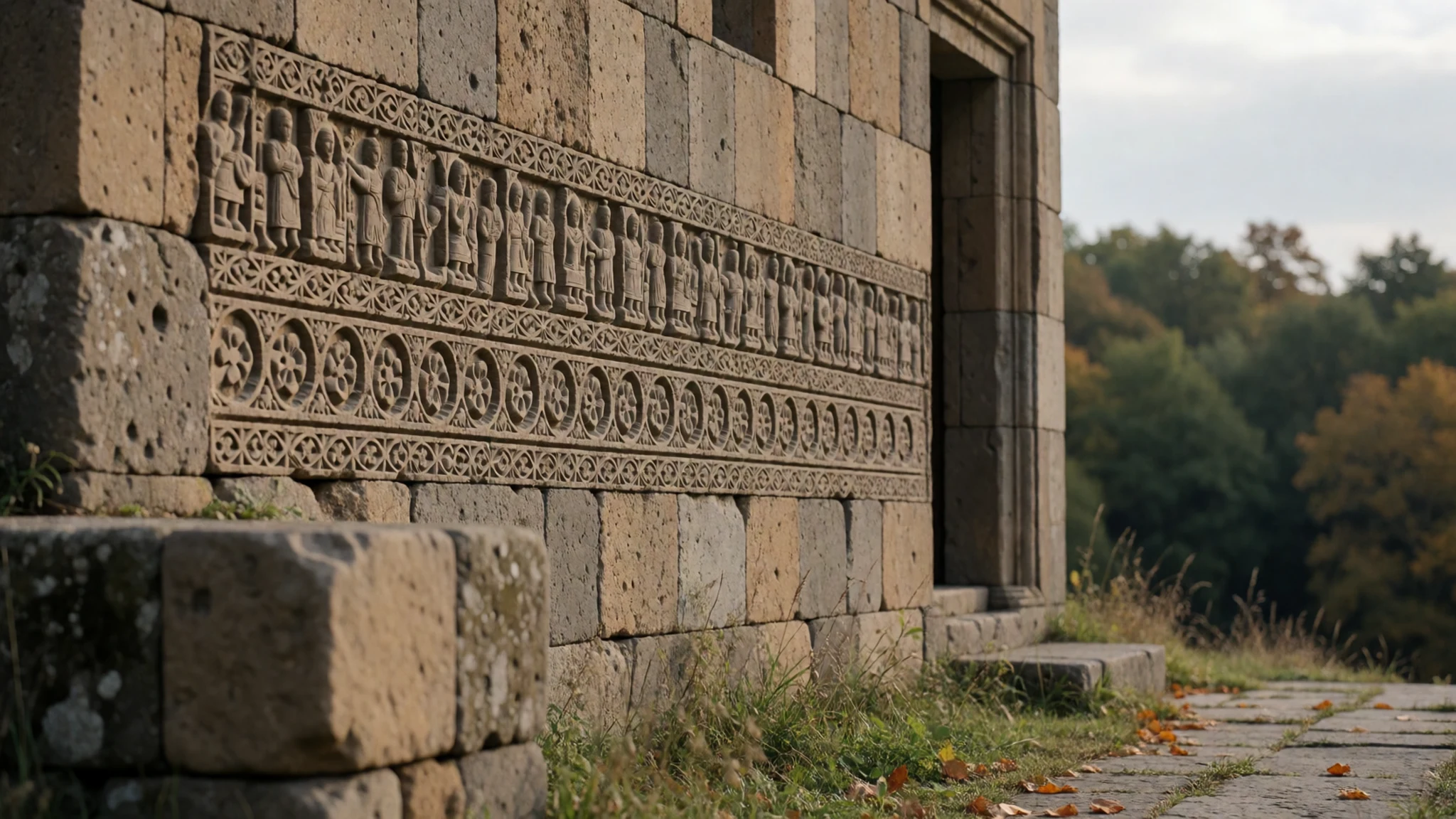
- The wooded hillside — Approach and surrounding slopes
The monastery's setting deserves time of its own. Paths and the approach road give views of the buildings against dense forest and the valley below. Mist in the morning and after rain softens the stone, while clear autumn days show the whole complex stepped down the slope.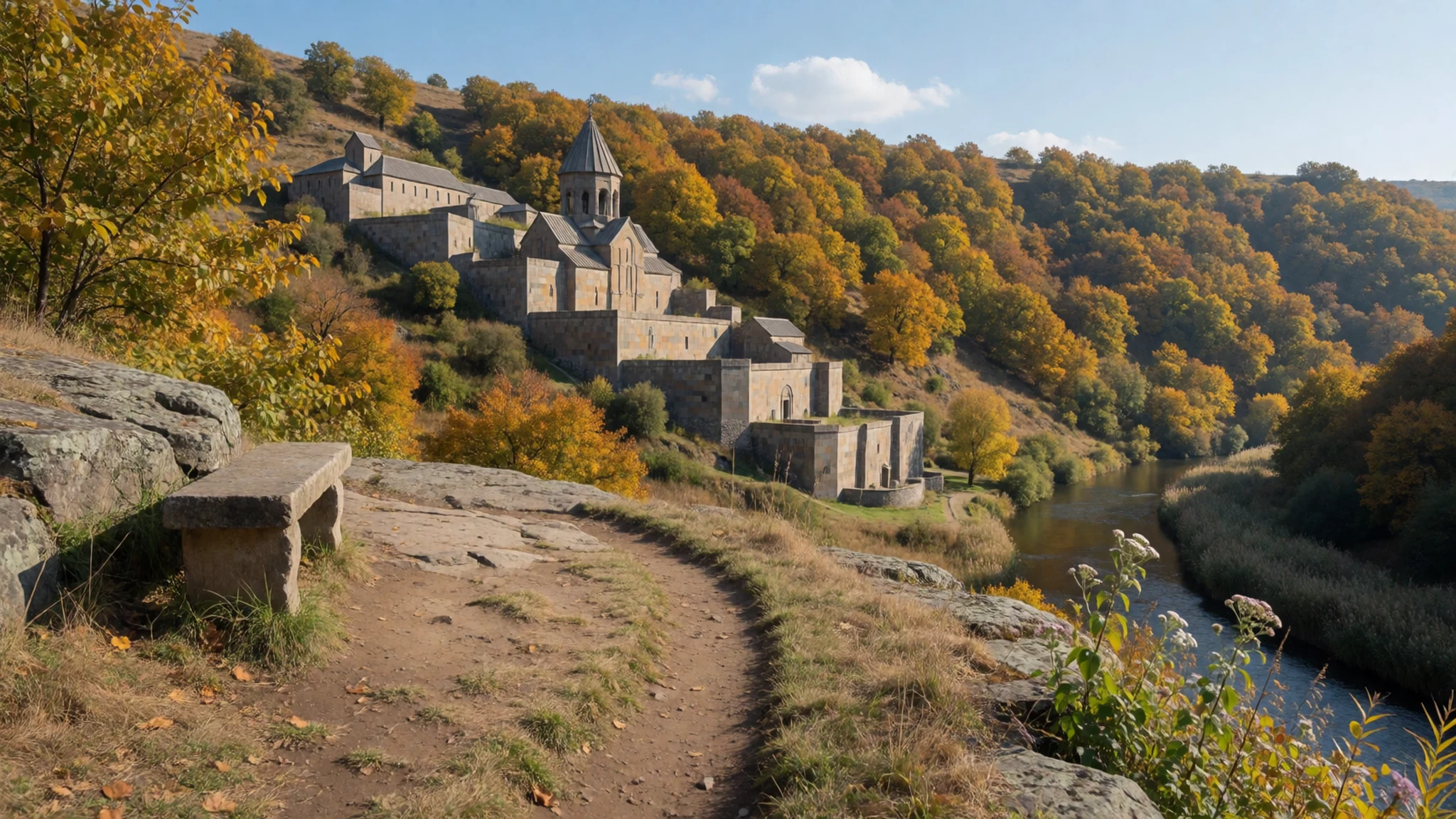
Culture
Dadivank Monastery sits where two cultures meet. It is an Armenian Apostolic foundation, and it stands in Azerbaijan, a country whose people are often described as reserved but very polite and well mannered. Both sides of that picture matter to a visitor. The monastery belongs to a living Christian tradition, with saints' graves, carved crosses and inscriptions that Armenian believers hold dear, so it deserves the quiet that any active holy place does, even when no service is under way.
Hospitality is a strong value across Azerbaijan. If an invitation to a home comes, bring a gift. Flowers are welcome, but give an odd number, because an even number is linked with funerals. Chocolate is a safe choice, while wine and other alcohol are better left out. Tea is offered readily and refusing it outright can seem curt, so accept a glass and take your time over it.
Because the district around the monastery has a sensitive recent history, conversation about who owns the place, or what it should be called, is best left to local people to raise. Listen more than you opine. Names differ by language, and that is simply a fact of the map, not a quarrel to settle over tea.
Dress modestly, speak softly inside the church, and ask before photographing any worshipper, caretaker or priest.
What to wear
Dadivank Monastery lies in a region where several clothing traditions overlap. Among Armenians, traditional dress for women centred on the taraz, a long embroidered gown worn with a headcovering, and men wore a belted coat with a woollen cap. Azerbaijani tradition has the chokha, a long fitted wool coat with cartridge pockets, worn with a tall sheepskin papakha, and women's kalaghayi, a lightweight silk scarf printed by hand in patterned borders. Such garments now appear mostly at weddings, festivals, folk performances and in museums.
Day to day, people in the towns of Azerbaijan wear what people wear in most cities: jeans, shirts, jackets, and for women dresses or trousers, with headscarves more common in some families than others. In the countryside, practical layers, sturdy boots and wool knitwear are normal because the highlands turn cold quickly, and a waterproof is part of local sense.
For a visit to the monastery, dress for mountain weather first and the church second. Wear sturdy shoes with good grip, since paths and courtyard stones are uneven and slick after rain. Bring layers, a waterproof and a hat, because forested slopes shift between sun, mist and showers within an hour. Out of respect for the church, cover shoulders and knees. Women may like to carry a light scarf to cover their hair when entering, and men should remove hats indoors.
What to eat
- Piti — Traditional eateries in regional towns
Piti is a national dish of Azerbaijan: a slow-cooked mutton and chickpea stew, traditionally served in an individual clay pot. Diners usually pour off the broth and eat it with bread, then mash the meat and chickpeas. Look for it in traditional eateries in towns.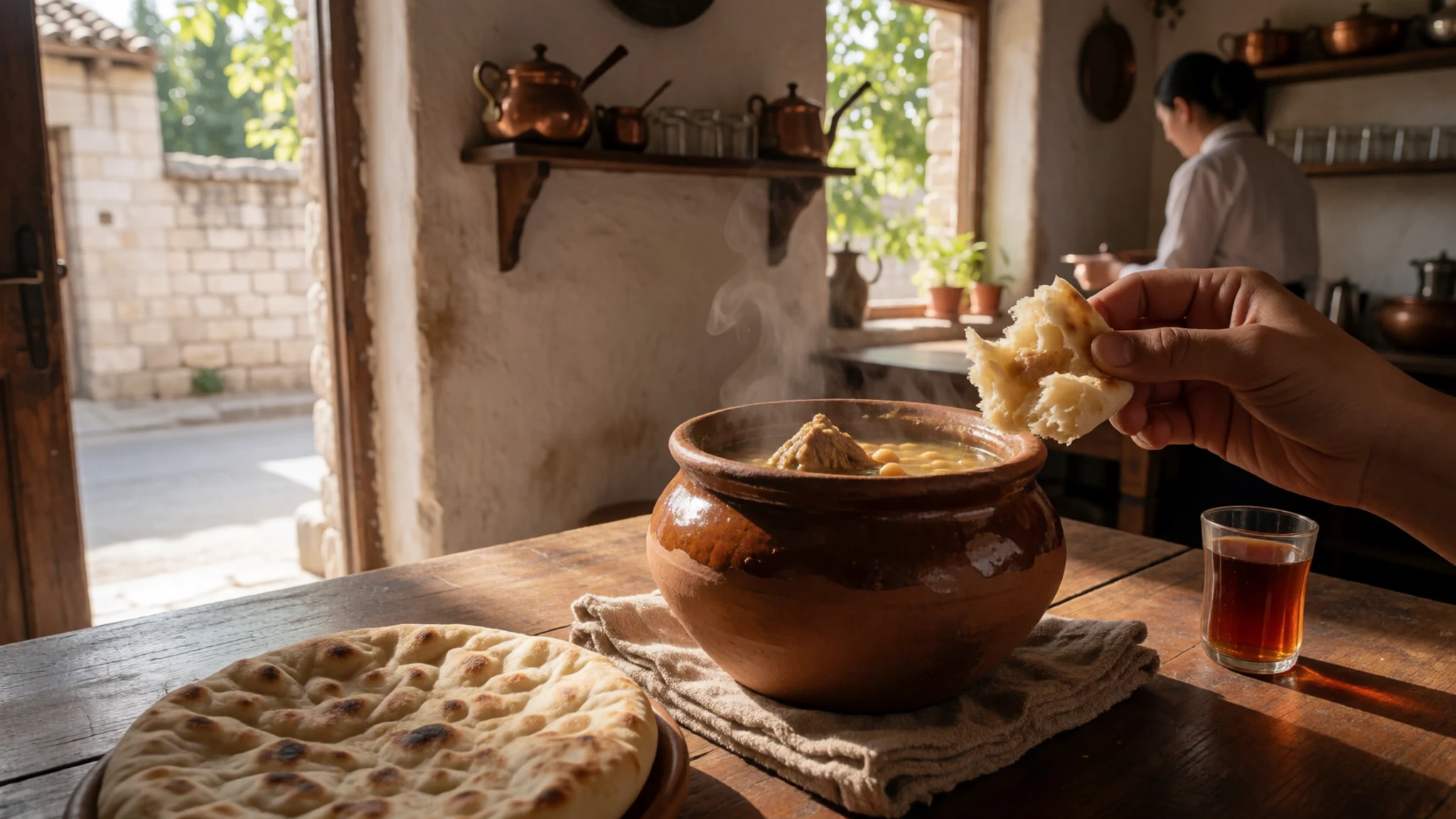
- Plov — Family-run eateries and teahouses
Plov is fragrant rice, often saffron-coloured, served with dried fruit, chestnuts or lamb on the side. It is a dish for gatherings and celebrations, and portions are generous. Order it in a family-style eatery, and expect it to come with tea and plenty of bread.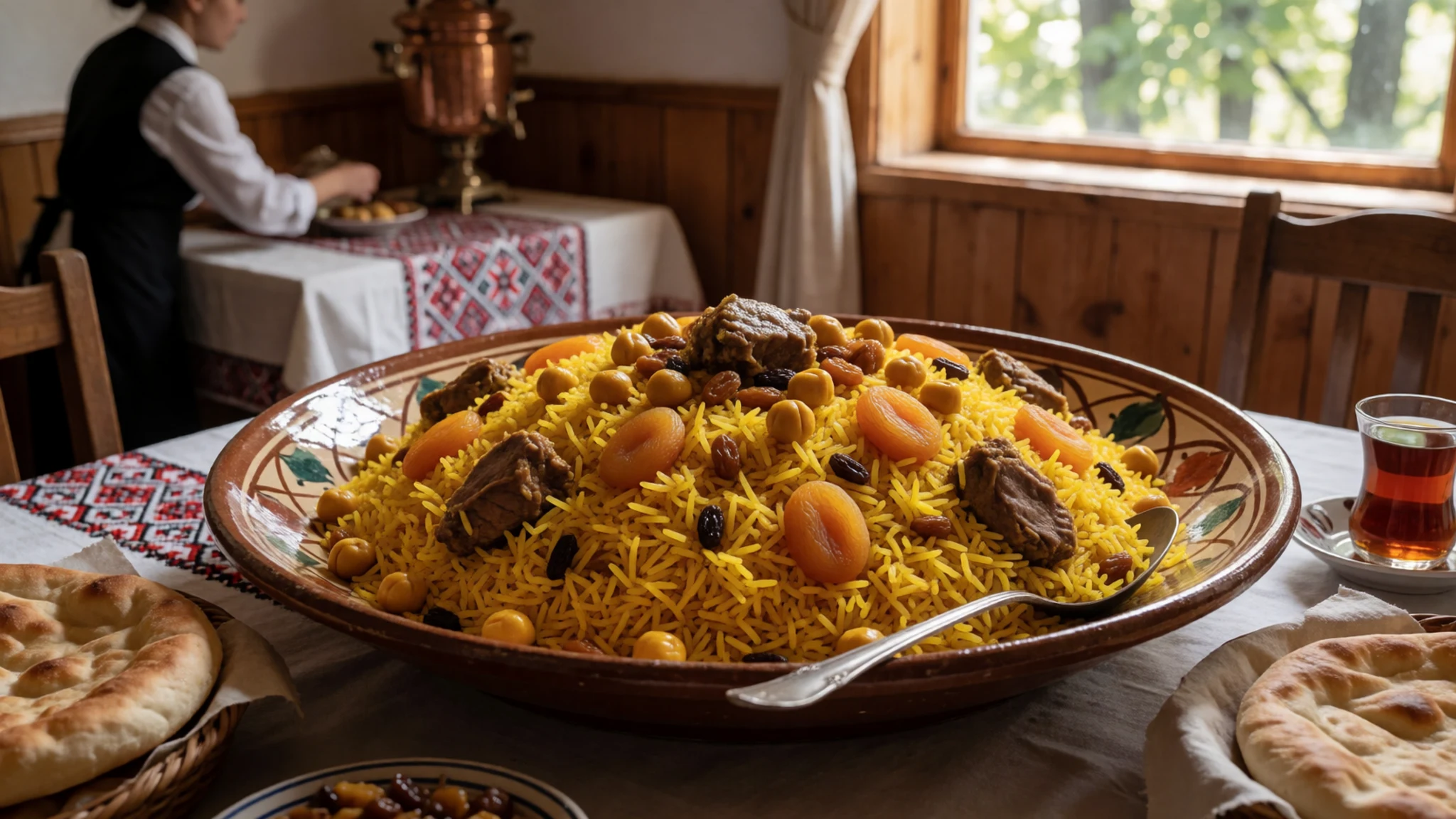
- Qutab — Roadside stalls and small cafés
Qutab are thin flatbread pancakes folded over a filling, usually herbs, spinach, pumpkin or minced lamb, then cooked on a griddle. They are eaten hot with yoghurt or a squeeze of sumac. A sensible road snack for travellers heading into the hills. - Dolma — Home-style restaurants and local markets
Dolma is minced meat and rice wrapped in vine leaves, or stuffed into aubergines, tomatoes and peppers. Many Azerbaijani households make it for guests. The vine-leaf version tastes best in early summer, when the leaves are tender. Yoghurt with garlic is the usual accompaniment. - Fresh bread — Neighbourhood bakeries and market stalls
Bread is a staple in Azerbaijan and treated with respect. Flat loaves baked in clay ovens arrive hot from neighbourhood bakeries and go with nearly every meal. Tear it rather than cut it, and never leave it face down or dropped on the floor.
Plan it
Best time. Late May to June and September to early October, when the mountain weather is mild and the forest is green or turning. Winters in the highlands are cold and snowy, and roads can be difficult, while spring thaw and summer storms can turn tracks muddy.
How long. 1–2
Getting there. Fly to Baku, as the only legal way into Azerbaijan for most visitors at the time of writing is through an international airport; land borders are largely closed. The last leg is a long road journey into the Kalbajar District. Before booking, confirm with official Azerbaijani sources whether the site is open to visitors and whether permits or organised transport are required.
Budget. mid
Tips
- Check current access, permits and security guidance with official sources before planning anything
- Arrange transport in advance, since the roads are long and public options are limited
- Carry water, snacks and cash, as services near the site are scarce
- Start early to allow for travel time and the best light on the stone
- Pack for weather change: a waterproof, warm layer and sturdy shoes
Etiquette
- Cover shoulders and knees, and keep your voice low inside the church
- Do not touch fresco fragments, carvings or inscriptions
- Ask before photographing people, and avoid political discussion about the site's ownership
Nearby
Sources
- Wikidata Q980497 (CC0)
- Wikipedia: Dadivank (CC BY-SA 4.0)
- Wikivoyage: Azerbaijan (CC BY-SA 4.0)
- Klášterní komplex Dadivank, Martin Cígler (CC BY 3.0)
- Dadivank Monastery, Nagorno-Karabakh, Alaexis (CC BY 3.0)
- Fresco in Dadivank monastery, Khachen (Public domain)
- Dadivank Monastery, D'Arahchjan (Public domain)
- Dadivank Monastery Inscription, Verjakette (Public domain)
- Dadivank Monastery (general view), Psalm Tours (CC BY 3.0)
- A part of a huge khachkar in Dadivank, sedrakGr (CC BY 3.0)
- Armenian monastery Dadivank, Albert Voskanyan (CC BY 3.0)


