Clermont-Ferrand
Clermont-Ferrand, France
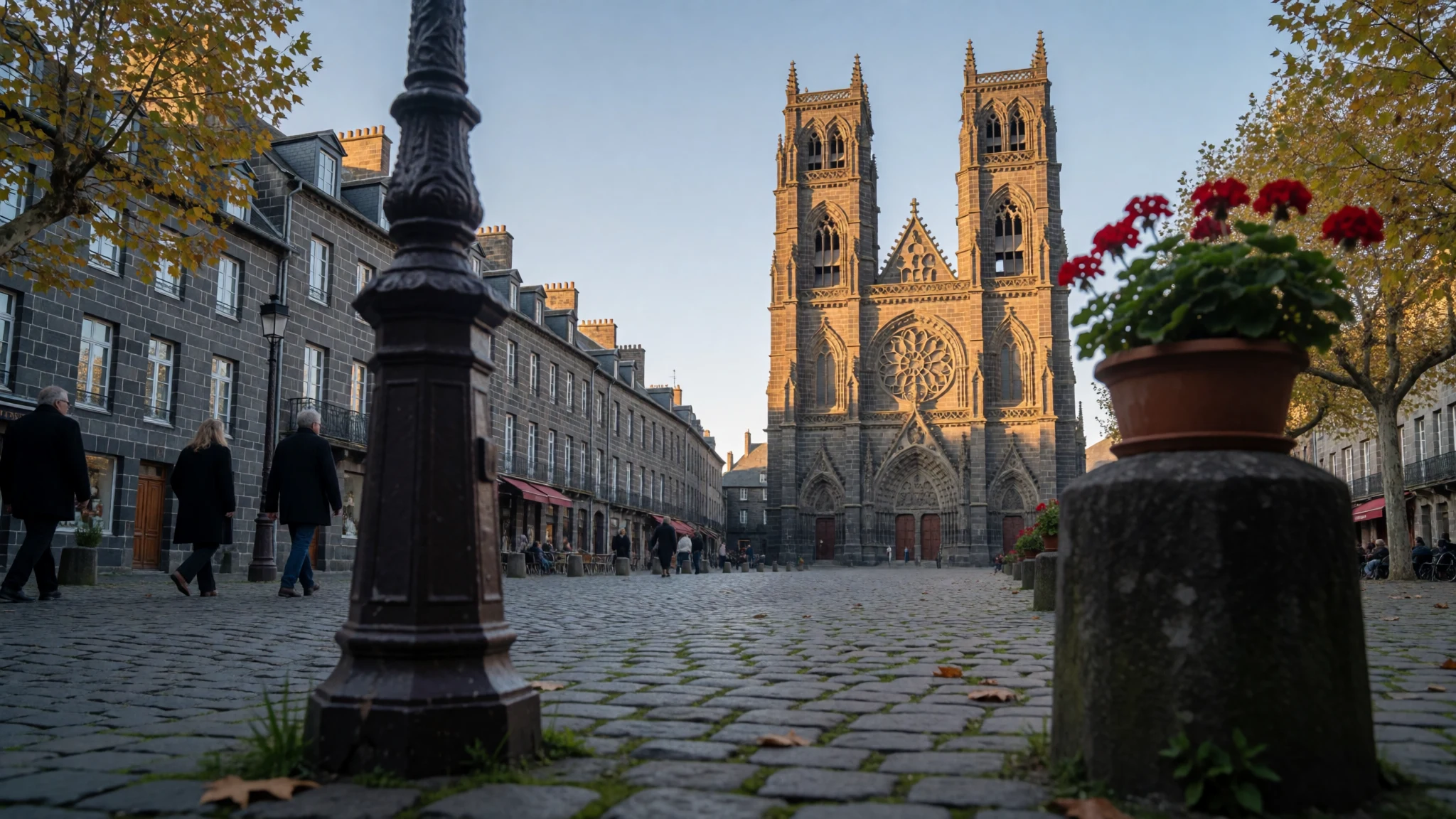
Clermont-Ferrand is a dark-stoned Auvergne city ringed by dormant volcanoes, with a Romanesque basilica, a black Gothic cathedral and a film festival.
The place
Clermont-Ferrand sits on the Limagne plain in the Massif Central, at 358 metres above sea level, and its character comes from the rock beneath it. Streets, churches and town houses are built from dark volcanic stone, so the old centre looks sombre in rain and handsome in low evening light. The city has a population of 146,351, and the wider urban area is several times larger, at 510,685 people. It is the prefecture of the Puy-de-Dôme département, and it works like a regional capital: universities, hospitals, offices and a lively student crowd. Industry has long shaped it too. The tyre maker Michelin grew here into a global firm, and food processing, engineering and research still employ many people around the edges. To the west, the Chaîne des Puys rises as a line of old volcanic cones. The best known, the Puy de Dôme, stands about 10 km from the centre and is easy to spot from the streets, crowned with communications masts. The city has been tied to that landscape since 2018, when the area gained a UNESCO listing for its tectonic features. Expect a working French city rather than a polished resort. It is quieter than the big-name destinations, cheaper than Paris, and a good base for walking in the hills, with grey, damp stretches in winter and warm, bright summers.
Its story
Clermont-Ferrand's history starts on the central mound where the cathedral now stands. Before Rome arrived, this was a hilltop centre of the Arverni, a Gaulish people, and the Greek writer Strabo described it as their capital. Its Gaulish name, Nemessos, referred to a sacred grove. The best-known Arvernian is Vercingetorix, born in the surrounding country around 72 BC, who later led a united Gaulish revolt against Julius Caesar. Under Roman rule the town became Augustonemetum, a name meaning a sanctuary of Augustus, and its forum occupied the top of the mound. As imperial power faded, the city was raided repeatedly by Vandals, Alans, Visigoths and Franks, and later by Vikings. The medieval name Clarus Mons, meaning bright hill, was applied to the whole settlement by 848 and gradually became Clermont. Next door lay Montferrand, a separate small town with its own bishop's walls and its own character. In 1731 the two were joined, and the double name has stuck ever since. Their old quarters still feel distinct: Clermont climbs around the cathedral, while Montferrand keeps a quieter, more provincial grid of old houses. Later centuries added thinkers and makers. The mathematician and philosopher Blaise Pascal was a native, and rubber and tyres turned a regional market town into an industrial centre.
What to see
- Cathédrale Notre-Dame-de-l'Assomption — The old centre, on the central mound
The cathedral's dark volcanic stone gives it a severe look that suits its hilltop. Work began in 1248, but the building was not completed until 1902, so Gothic ambition and later restoration sit side by side. Climb the tower if it is open, and check the official site first.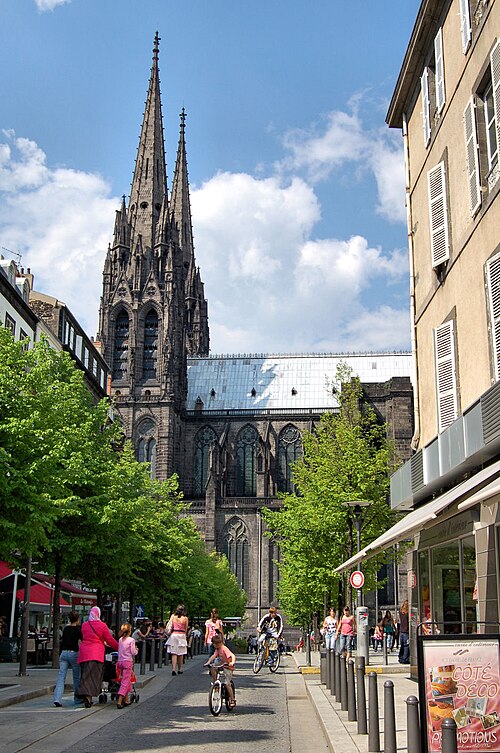
- Notre-Dame-du-Port — North-east of Place de Jaude
This Romanesque basilica was built in the eleventh and twelfth centuries from yellow sandstone, which makes it a warm contrast to the dark cathedral. Its main draw is the carved capitals on the pillars inside, crowded with figures. Give your eyes a minute to adjust to the gloom before you look up.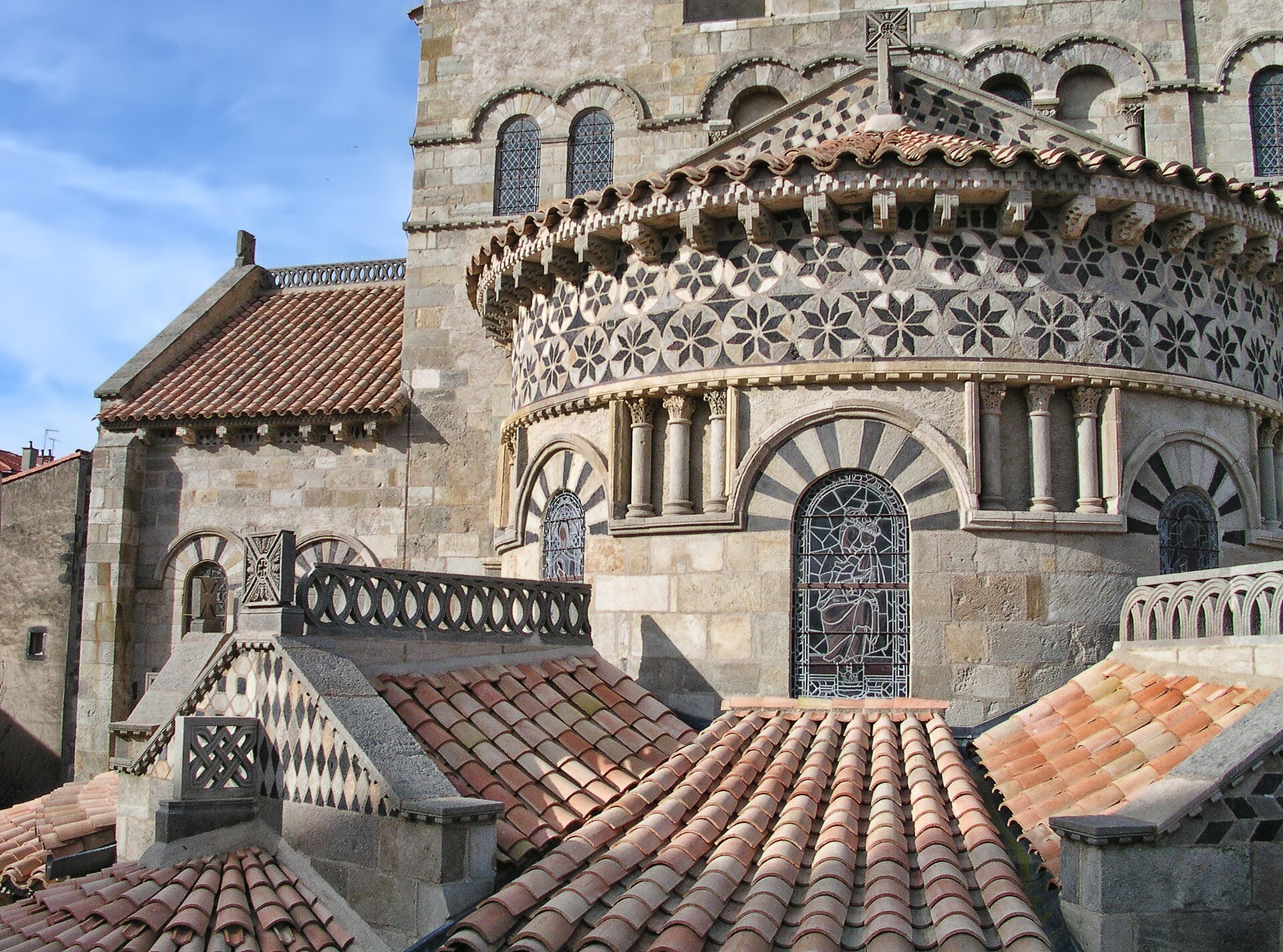
- Fontaine d'Amboise — Old town
Dated to 1515, this Renaissance fountain is a small, elaborate piece of civic decoration set among narrow old streets. It takes ten minutes, not an afternoon, but it fits well into a walk between the cathedral and the basilica, and the stone detail rewards close looking. - Place de Jaude — City centre
The big open square is the city's everyday living room, ringed by cafés, shops and a shopping centre. On match days or festival evenings, people gather around giant screens. It is not a sight in the usual sense, but it shows how locals spend their time.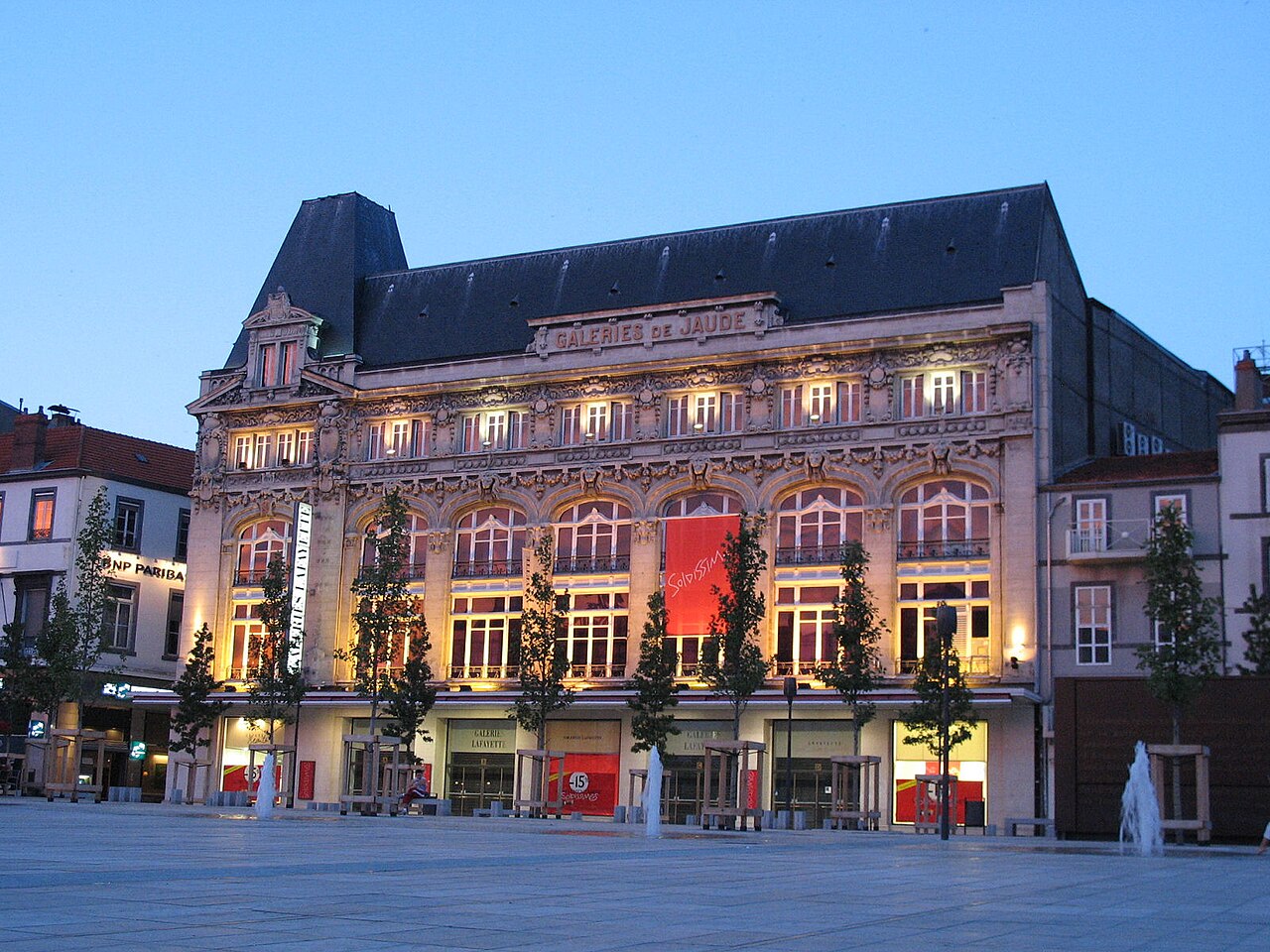
- Parc Montjuzet — Northern edge of town
A short uphill walk from the northern edge of the centre brings you to a hillside park with views over the valley and rooftops. It is a good consolation if the weather rules out the Puy de Dôme, and it works well for a late-afternoon pause with a picnic.
Culture
Clermont-Ferrand wears its intellectual history lightly. Blaise Pascal was born here, and the local university took his name. In his famous experiment on air pressure, a barometer was carried up the Puy de Dôme to test how pressure changes with height, so the nearby volcano is part of science history as well as scenery. Cinema is the other cultural claim. The Clermont-Ferrand International Short Film Festival began in 1979, and it draws large audiences to ordinary cinemas and halls around town, with many locals as well as industry guests. Book early for the festival period, because accommodation tightens. Beyond that, the city's culture is the quiet, practical culture of the Auvergne: a region of farmers, cheesemakers, students and factory families, with a reputation for reserve that usually warms into generosity once you have been greeted properly. Mealtimes are structured, shops often close for a long lunch outside the centre, and Sundays are quiet. Churches here are active places of worship as well as monuments, and local people use the basilica for prayer. When you enter a shop, café or restaurant, say bonjour first, and when you enter Notre-Dame-du-Port or the cathedral, keep your voice low and do not photograph worshippers during a service.
What to wear
Auvergne's traditional dress belongs mostly to folklore groups now. Rural women once wore long wool skirts, aprons, shawls and white linen or lace caps, while men wore dark wool jackets, waistcoats, felt hats and clogs or heavy boots. These outfits appear today at festivals, at dance performances of the bourrée (a regional folk dance), and in museum displays, rather than in daily life. Everyday dress in Clermont-Ferrand is plain, practical and French in a low-key way. Students and office workers wear jeans, trainers, knitwear and a waterproof jacket, and darker colours are common. People dress a little smarter for dinner or a theatre evening, but it is rarely formal. Sportswear is normal around the park and hill trails. Visitors should dress in layers, because mornings and evenings are cool even in summer, and rain can arrive quickly. Winter needs a proper coat, hat and gloves. Comfortable shoes with grip matter more than style: the old centre has uneven paving and slopes, and volcanic trails can be loose and slippery. For churches, covered shoulders and knees are polite rather than strictly enforced. Bring sun protection for the hills in summer, where there is little shade.
What to eat
- Truffade — Traditional Auvergne bistros in the old town
Sliced potatoes are fried slowly in fat and mixed with fresh Cantal-style cheese until the whole thing turns soft and stringy. It is filling, rustic and best in cooler months. Look for it in a traditional Auvergne bistro in the old town. - Aligot — Regional restaurants around the cathedral
Mashed potato is beaten with fresh cheese and garlic until it stretches in long ribbons. It is usually served beside sausage or roast meat. Order it at a regional restaurant, and expect a large portion. - Potée auvergnate — Brasseries in the city centre
A slow-cooked pot of pork, cabbage and root vegetables, this is cold-weather home cooking. It tastes of broth and smoke rather than spice. Brasseries often list it as a seasonal dish on winter menus. - Saint-Nectaire and other Auvergne cheeses — Covered market and cheese shops in the centre
The region makes several distinctive cheeses, including the semi-soft Saint-Nectaire and the blue-veined Bleu d'Auvergne. Buy a small piece with bread and fruit for a picnic in Parc Montjuzet, and ask the stallholder what is ripe. - Lentilles vertes du Puy — Bistros and market stalls around the old town
These small green lentils from the nearby Velay area keep their shape when cooked, and are often served warm with sausage or as a salad. They are an everyday side dish rather than a showpiece.
Plan it
Best time. May–June and September–October for mild days and clear views of the volcanoes; July and August are warm and busy with walkers; winter is cold, grey and often damp.
How long. 2–3
Getting there. Trains run from Paris to Clermont-Ferrand station on the eastern edge of the centre, taking about three and a half hours; the city also has a small airport with European links, and motorways meet here from several directions. Check the official site for current services.
Budget. mid
Tips
- Check the weather before going up the Puy de Dôme, as cloud can hide the view
- Book accommodation early during the short film festival
- Carry some cash for small market stalls, though cards work in most shops
- Wear shoes with grip for the old streets and volcanic trails
- Plan meals around local hours, since many kitchens close in the afternoon
Etiquette
- Greet staff with bonjour before asking anything
- Keep voices low and avoid flash inside churches
- Do not photograph worshippers during services
Nearby
Sources
- Wikidata Q42168 (CC0)
- Wikipedia: Clermont-Ferrand (rev 1381846393) (CC BY-SA 4.0)
- Wikivoyage: Clermont-Ferrand (rev 5264525) (CC BY-SA 4.0)
- Photo: Grande roue, Clermont-Ferrand (bebatut) (CC BY-SA 2.0)
- Photo: Mur des Sarrasins (Pymouss) (CC BY-SA 4.0)
- Photo: Inauguration statue Vercingétorix (CC BY-SA 2.0 fr)
- Photo: Galeries de Jaude (CC BY-SA 2.0 fr)
- Photo: Hôtel de ville de Clermont-Ferrand (Basvb) (CC BY-SA 1.0)
- Photo: Notre-Dame-du-Port (Romary) (CC BY 3.0)
- Photo: Place de la Victoire et la Cathédrale (Fabien1309) (CC BY-SA 2.0 fr)
- Photo: Jardin Lecoq (Fabien1309) (CC BY-SA 2.0 fr)


