Catania
Catania, Italy
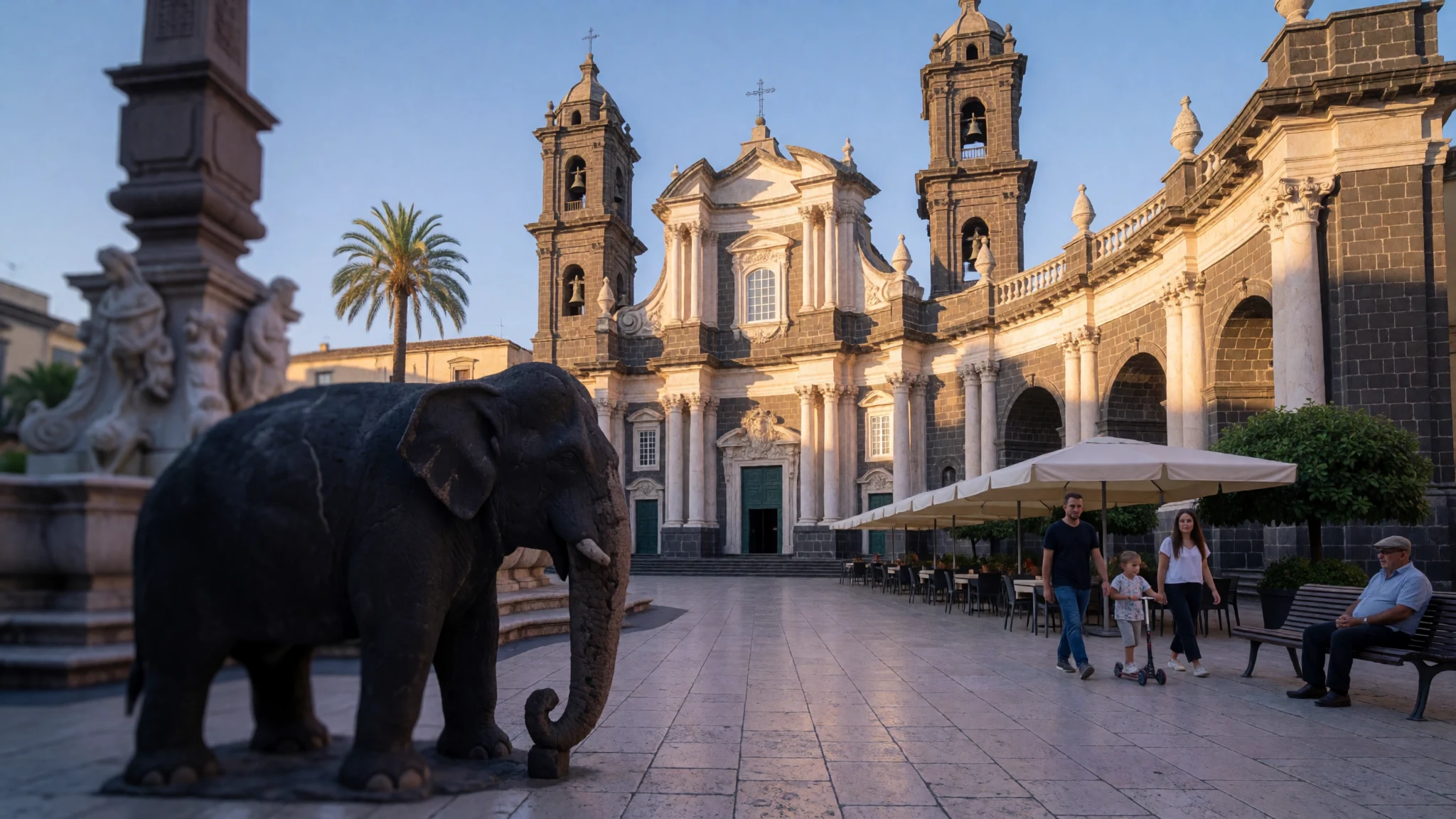
Catania is a working Sicilian port rebuilt in black lava stone beneath Mount Etna, with loud markets, baroque squares and very good food.
The place
Catania sits on Sicily's east coast, facing the Ionian Sea, with the bulk of Mount Etna rising behind it. The city stands only about 7 metres above sea level, and that low position matters, because Etna is an active volcano and its past eruptions are written into the streets. Much of the old centre is built from dark volcanic stone, which gives the baroque façades a sooty, serious look against the pale sky. About 311,600 people live in the city proper, with many more in the towns around it, so the place feels like a working port rather than a museum. Scooters, market stalls, students and office workers share the same narrow streets. The main axis is Via Etnea, a long straight avenue running north from the cathedral square towards the volcano, and on a clear day it frames the summit at its far end. The fish market behind the square is loud and wet from early morning. Catania also has the airport that most visitors to eastern Sicily use, so many people pass through without staying. That is a pity, though honesty helps: the city is gritty in places, with graffiti, patchy pavements and traffic that ignores crossings. Summers are hot, and August can be punishing. Spring suits walking far better. Catania rewards people who like cities that are lived in, eat well, and treat a volcano as a neighbour rather than an attraction.
Its story
Catania began as a Greek colony. Around 729 BCE settlers from nearby Naxos took over a native village here, called it Katane, and placed their acropolis on the hill of Monte Vergine, just west of today's centre. The harbour shipped out grain grown on the plains inland, and the local population gradually took on Greek ways. An old legend from this period tells of two men, Amphinomos and Anapias. When Etna erupted, they abandoned their belongings and carried their elderly parents to safety on their shoulders, and the lava was said to part around them. The tale shows how long the city has lived with the mountain. The record since has been harsh. A powerful earthquake destroyed most of Catania in 1169. In 1669 a major eruption sent lava towards the city and nearly swamped it. Then the earthquake of 1693 devastated much of what had survived. The rebuilding that followed gave Catania the baroque face it shows today, with churches and palaces in dark local stone. Learning carried on through all of this: Sicily's first university opened here in 1434. The layers explain the walk through the centre today. Ancient remains lie below street level, a medieval royal castle stands among later squares, and every era has been built on top of the one before, often with material from the last disaster.
What to see
- Piazza del Duomo — Historic centre
Catania's main square is where the city shows itself: baroque façades in dark and pale stone, café tables, and the elephant fountain known locally as U Liotru, the city's emblem. Come early for quiet light, and again in the evening, when families and students fill it. - Cattedrale di Sant'Agata — Piazza del Duomo
The cathedral honours Agatha, the city's patron saint, and its curving baroque front dominates the square. Inside is a calm, cool space that is worth a slow lap. The diocesan museum next door holds church treasures, and access to the Achillean baths is arranged through it; check the official site for details.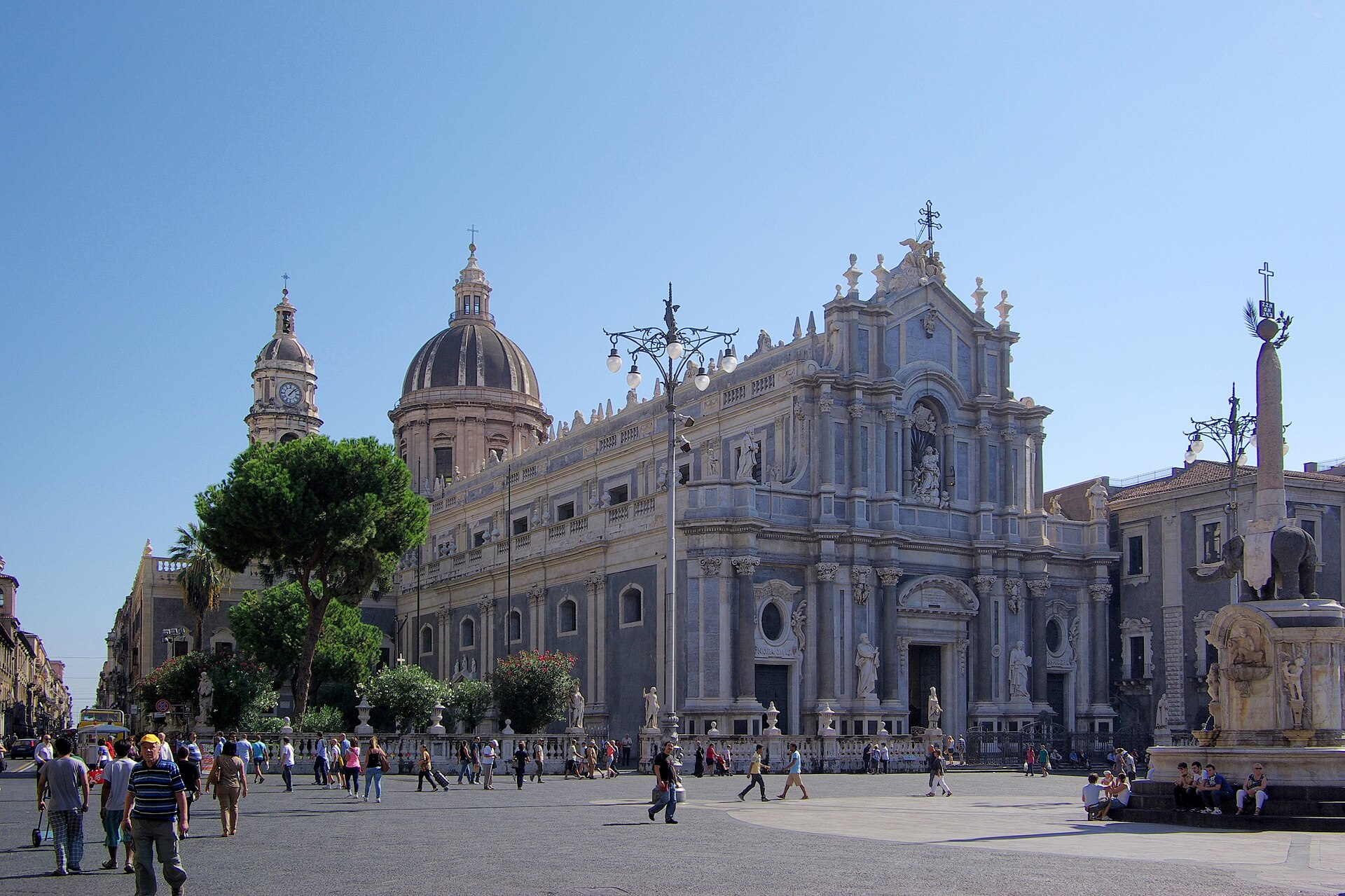
- Badia di Sant'Agata terrace — Behind the cathedral
The domed abbey church beside the cathedral has a terrace that gives a view across the rooftops of the old centre, with Etna filling the horizon on clear days. It is the best place to understand how the city sits against the mountain. Check access before going, as arrangements change.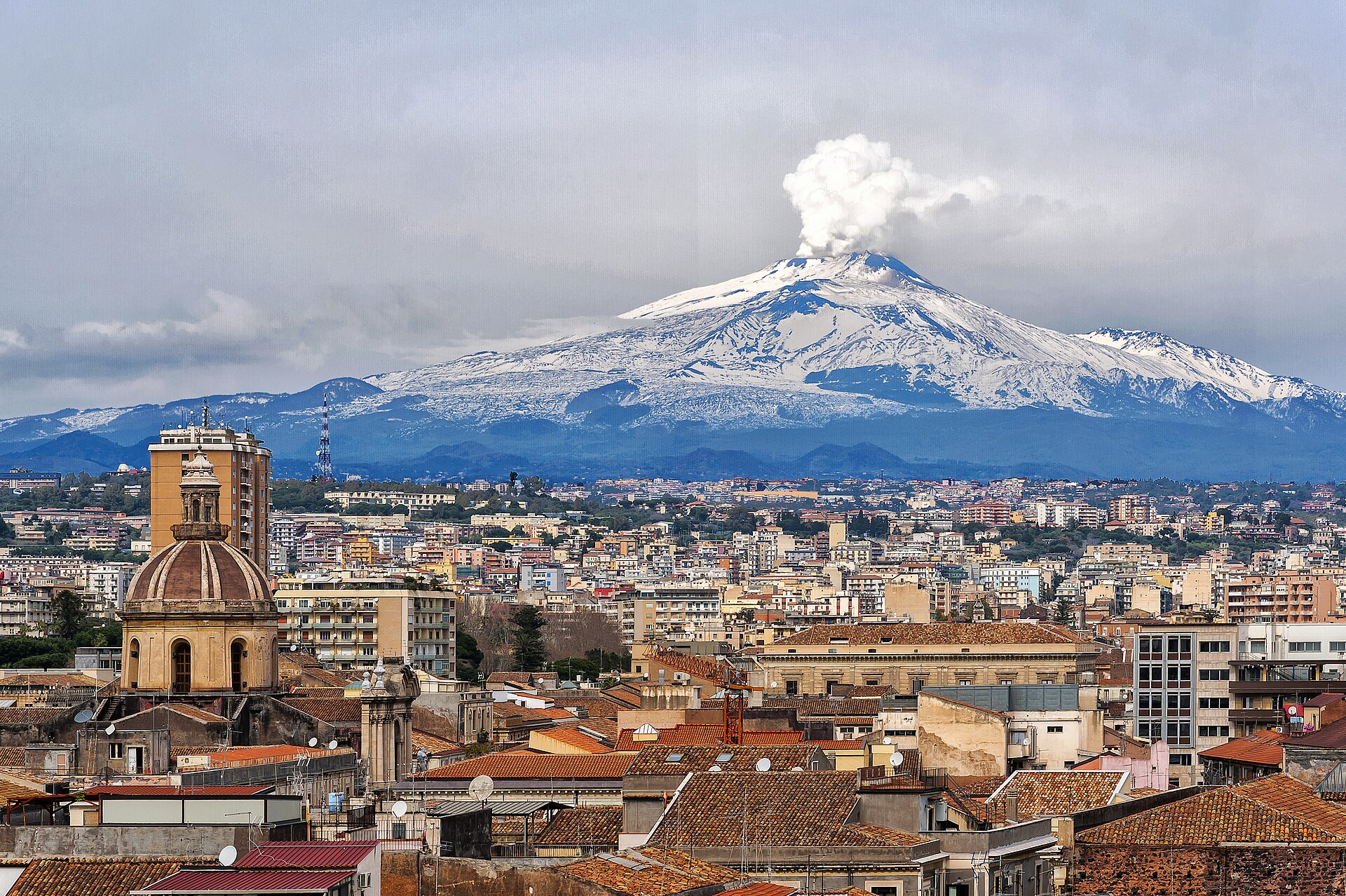
- Castello Ursino — South of the centre
This squat medieval fortress was built as a royal castle of the Kingdom of Sicily in the 13th century, and later hosted the Sicilian Parliament. It once stood on the shoreline, but lava and later land changes left it inland. Inside is a civic museum; confirm opening times on the city's website. - Monastero dei Benedettini di San Nicolò l'Arena — Western edge of the centre
A vast Benedictine monastery now used by the university. The scale is the point: big cloisters, long corridors and courtyards that feel more like a small town than a religious house. Wander in during the day to see how the city reuses its grand buildings for ordinary life. - Teatro Romano — Historic centre
The Roman theatre is tucked among ordinary apartment blocks, so you come upon it almost by surprise. Its curved tiers of dark stone survive in the middle of the old town, a reminder of how much of ancient Catania lies beneath the baroque city. Check the official site for visiting arrangements.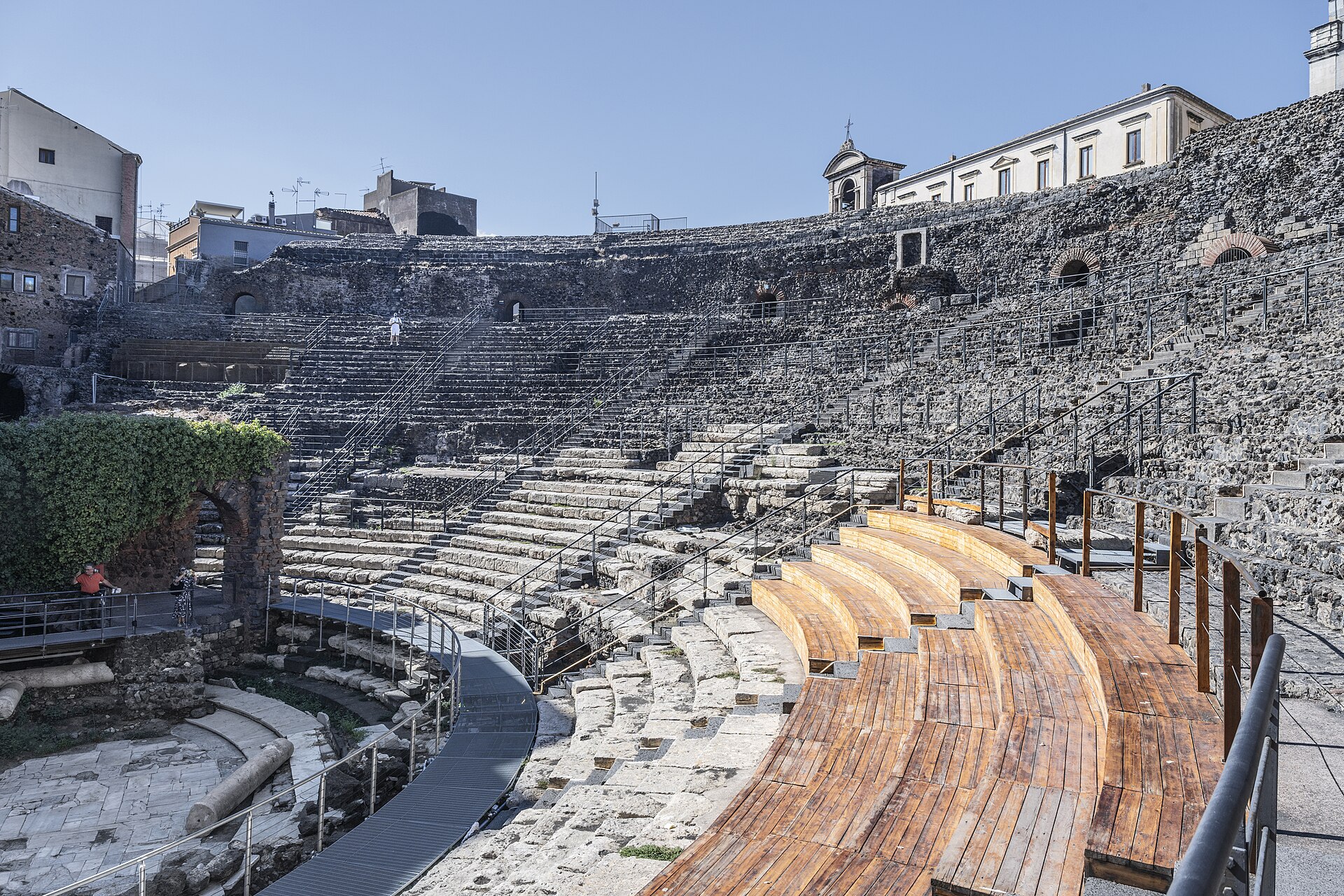
Culture
Catania has a strong local pride, and it centres on music, writing and one saint. Vincenzo Bellini, the opera composer, was born in the city, in Palazzo Gravina-Cruyllas, which now houses a museum about his life. The Teatro Massimo Vincenzo Bellini, opened in 1890, stages a season from December to May that includes his own works. Giovanni Verga, born here in 1840, became the leading voice of Verismo, an Italian literary movement close to Naturalism. His novels follow fishermen, stonemasons and other working people, written in a blend of literary Italian and the local dialect. That mix is still audible: Sicilian is spoken in markets and bars, and locals often switch between it and Italian. The great public event is the feast of Sant'Agata in early February, when the city fills with devotees, candles and a long procession that goes through the night. Even outside the festival, her image is on shop shrines and church doors. Daily life follows a southern rhythm: coffee standing at the bar in the morning, a long lunch, an evening stroll on Via Etnea, and dinner late. Conversations are animated, and raised voices are usually friendly. People are generally patient with visitors who try a few words of Italian. Cover your shoulders and knees before entering the cathedral or any church, and keep your voice low if a service is under way.
What to wear
Catania's most distinctive traditional dress belongs to the feast of Sant'Agata. Devotees wear a plain white cotton tunic called a sacco, a black cap and a white handkerchief or gloves, and the long lines of white figures in early February are among the strongest images of the city. Rural Sicilian costume also survives in the coppola, the flat wool cap worn by older men, and in embroidered bodices and wool skirts seen at folk festivals, but these are now mostly ceremonial. On an ordinary day, people in Catania dress neatly and casually: linen shirts and cotton dresses in summer, jackets and scarves in the cooler months, and clean leather shoes or trainers. Evening walks on Via Etnea call for a little more care than a beach town would. Visitors should pack light, breathable cotton or linen, a sun hat and sunglasses for the heat. Carry a scarf or shawl, plus something with sleeves, to cover shoulders and knees at churches. The lava-stone pavements can be polished and slippery after rain, so shoes with grip matter more than style. In winter bring a waterproof layer. For any trip up Etna, add sturdy boots and a warm layer, since it is much colder at altitude.
What to eat
- Pasta alla Norma — Family-run trattorie in the historic centre
Catania's signature dish: macaroni in tomato sauce topped with fried aubergine, grated salted ricotta and fresh basil. It is simple and rich at once, and it appears on almost every traditional menu, so compare a few places before choosing. - Arancino — Bars and rosticcerie around the centre
A fried ball of rice with a savoury filling, such as meat ragù or ham and cheese. It is a standard quick lunch, eaten hot from a counter. Locals have strong opinions on shape and filling, so ask what the bar makes. - Fresh fish and seafood — The fish market and trattorie near the port
Catania is a port, and fish is a point of pride. Visit the morning market to see the catch laid out on ice, then eat grilled or fried fish in a nearby trattoria. Choose places busy with locals. - Caponata — Traditional trattorie and home-style eateries
A sweet-and-sour Sicilian dish of aubergine cooked with tomato, celery, olives and capers. It is served as a starter or side, often at room temperature, and suits hot days when you want something lighter before the main course. - Granita with brioche — Neighbourhood cafés, mainly at breakfast
A semi-frozen sweet ice, often made with lemon, almond or coffee, eaten with a soft brioche. For many locals it is a summer breakfast. Order it at a café counter and take it slowly; the heat will not wait.
Plan it
Best time. March and April are the most comfortable, with mild days that suit walking. July and August are hot, and winter is mild but can be wet and windy. Etna ash has disrupted flights in some summers, so keep your schedule flexible.
How long. 2–3
Getting there. Catania Fontanarossa airport is close to the centre. A regional train runs from Catania Aeroporto Fontanarossa station, a short walk or shuttle ride from the terminal, to Catania Centrale, and buses also serve the airport. Intercity buses and trains connect the city with the rest of Sicily.
Budget. mid
Tips
- Visit the fish market early in the morning, when it is liveliest
- Carry some cash for market stalls and small cafés
- Wear shoes with grip, as the lava-stone pavements are slippery when wet
- Drink plenty of water in summer and plan indoor visits for the afternoon
- Check the city's official site, https://www.comune.catania.it/, for museum and monument opening times, and check flight status if Etna is active
Etiquette
- Cover shoulders and knees in churches and keep your voice down during services
- Greet shopkeepers and café staff before ordering
- Take care with phones and bags in crowded markets and on buses
Nearby
Sources
- Wikidata Q1903 (CC0)
- Wikipedia: Catania (rev 1384247839) (CC BY-SA 4.0)
- Wikivoyage: Catania (rev 5425293) (CC BY-SA 4.0)
- stefan_fotos, Catania panorama (CC BY-SA 2.0)
- Dariolp83, Catania vista dall'alto e il vulcano Etna a sovrastarla (CC BY-SA 4.0)
- Effems, Catania - Chiesa di San Giuliano (CC BY-SA 4.0)
- Jeanne Griffin, Basilica della Collegiata Catania (CC BY-SA 4.0)
- Jeanne Griffin, Teatro Massimo Vincenzo Bellini (CC BY-SA 4.0)
- Cayambe, Teatro Romano di Catania (CC BY-SA 4.0)
- Berthold Werner, Catania cathedral Sant'Agata (CC BY 3.0)
- Giovanni, Catania vista aerea (CC BY-SA 2.0)


