Calanais Stones
Calanais Stones, United Kingdom
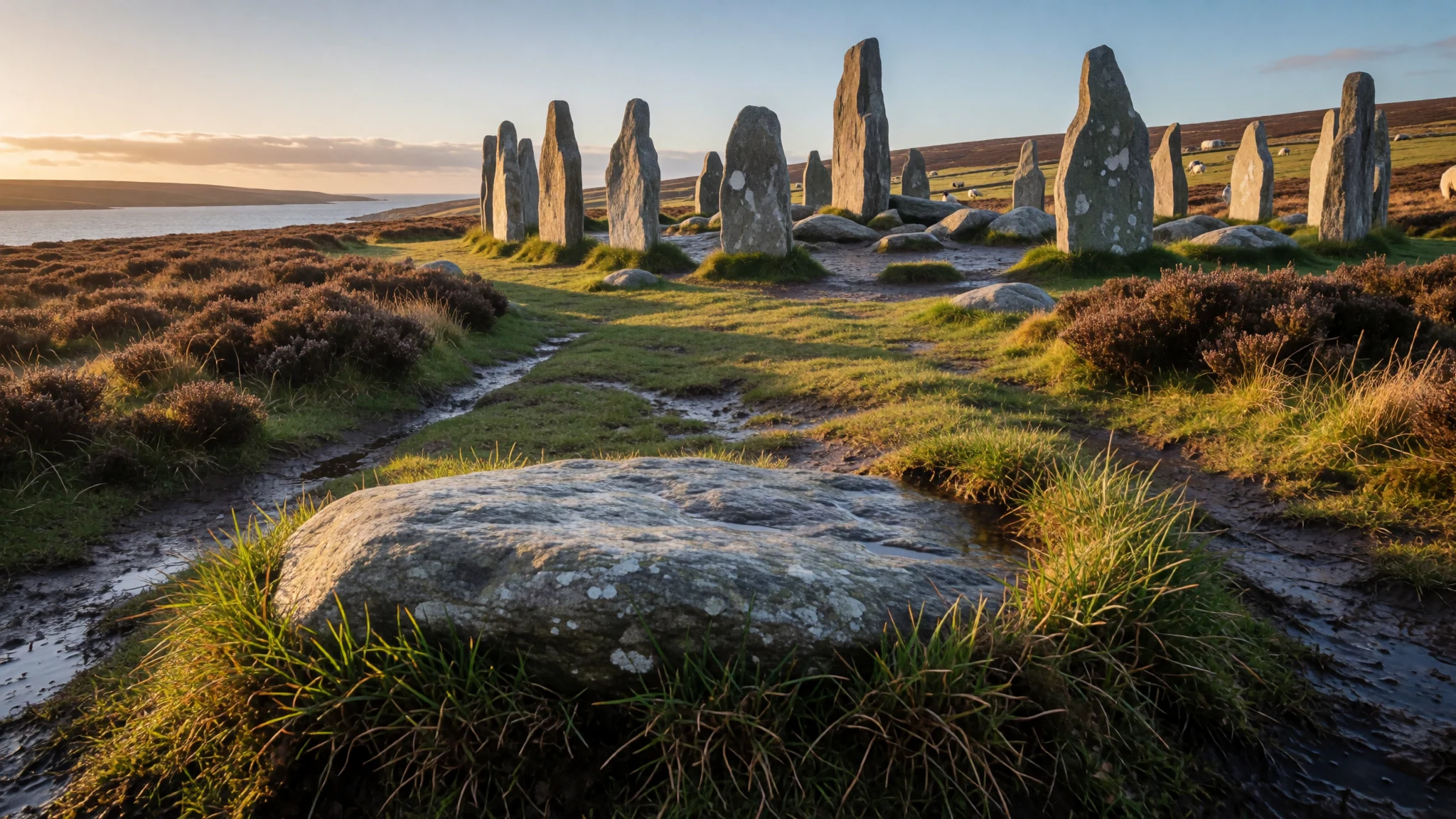
Calanais Stones are a Neolithic stone circle on a windy Hebridean ridge, with a cross-shaped plan, a tall central stone and the sea all around.
The place
Calanais Stones stand on a low ridge on the west coast of the Isle of Lewis, in the Outer Hebrides of Scotland, looking over the sea inlet of Loch Roag with the hills of Great Bernera behind. The Gaelic names are Clachan Chalanais and Tursachan Chalanais, and the monument is also called Calanais I, or Callanish in older English spelling. It is a ring of standing stones with a tall central monolith, and from the ring long rows of stones run out in different directions, which gives the whole a rough cross shape on a plan. It was raised in the Neolithic, around 2750 BC. The village of Calanais lies close by, and the stones are a scheduled monument looked after by Historic Environment Scotland. Calanais I is the centre of a wider ritual landscape. Callanish II, III, IV and VIII, along with other circles, arcs and single stones, are scattered around it, and several can be seen from the main site. Callanish II and III lie just over a kilometre to the south-east. The setting matters as much as the stones: peaty moor, big sky, water on several sides, and weather that can change within the hour. Lewis sits at the same latitude as northern Labrador, so even a summer day can feel cool and brisk, with sharp showers coming in off the sea. Numbers of visitors are modest compared with mainland landmarks, though midday can be busier when coach parties arrive, and early or late light is kinder to photographs and to the nerves.
Its story
Calanais Stones were raised around 2750 BC, in the Neolithic, and the evidence suggests people kept coming for ceremonies through the Bronze Age as well. The scatter of smaller circles, arcs and single stones around the main monument points the same way: this stretch of Lewis stayed a focus of ritual life for at least 1,500 years. Archaeologists therefore speak of a Calanais complex rather than a single monument, with the cross-shaped ring on the ridge at its heart and the sites known as Callanish II, III, IV, VIII and X spread around it. Nobody can say for certain what the builders believed. The tall central stone, the rows running out from it and the open view over Loch Roag all invite theories, and visitors will meet several, from ancestor rites to alignments with the sky. They are best treated as ideas rather than findings. What the ground does show is long, repeated use, and care taken over where each stone was set. The survival of so many prehistoric sites across the Western Isles owes a good deal to the small population and to farming methods that did not plough them out. Today the circle is a scheduled monument in the care of Historic Environment Scotland, and its Gaelic names keep it tied to the language of the people who live beside it.
What to see
- Calanais I, the main circle — Calanais village, west Lewis
The circle with its tall central stone is the heart of the site, and the rows radiating from it form the cross shape. Walk the full ring slowly, then stand at the end of the northern avenue and look back along the line of stones towards the centre.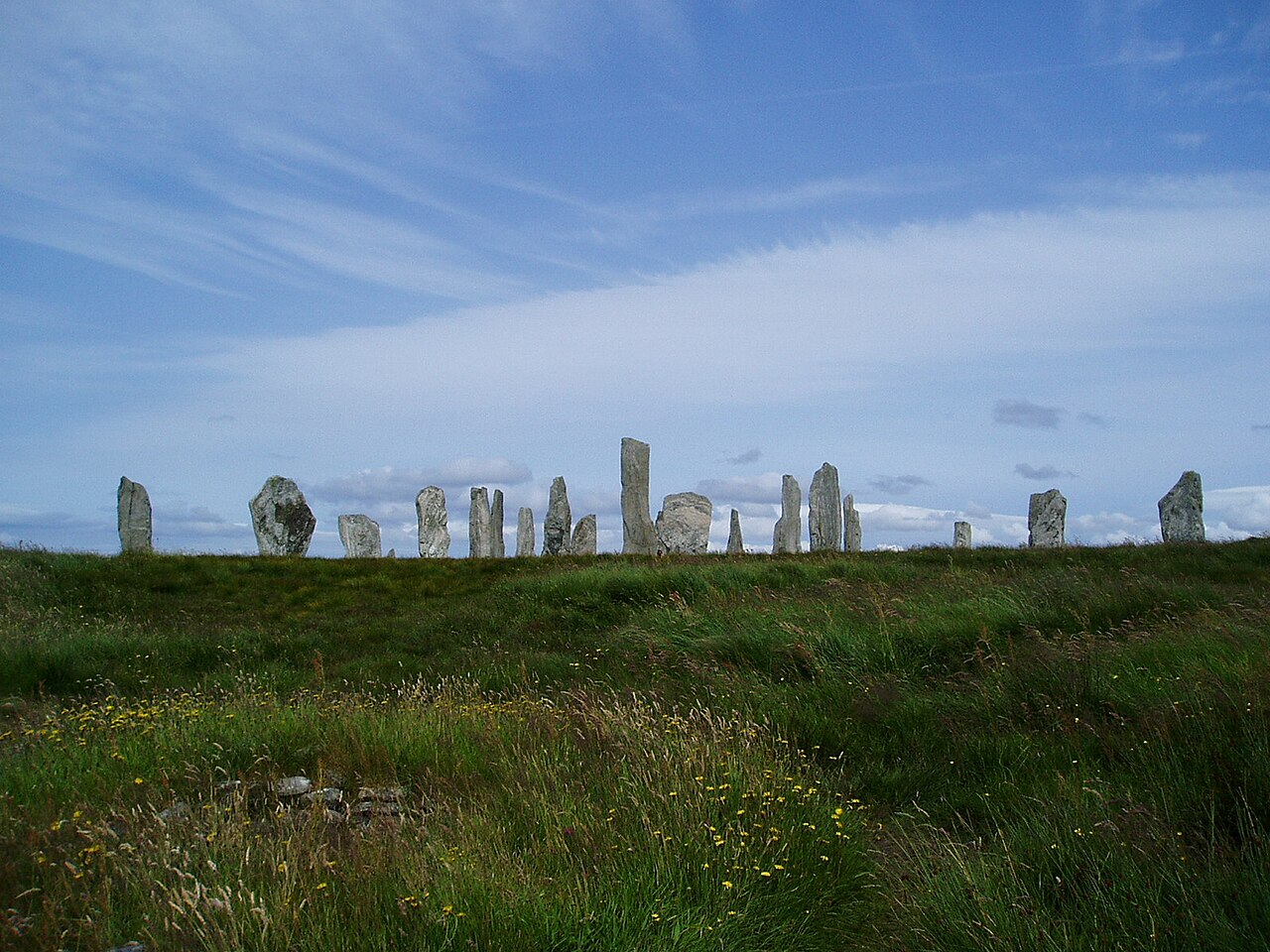
- The northern avenue — Calanais I, north side
A double row of stones leads out from the circle, and it is the part that most surprises first-time visitors, because the rows seem to funnel the eye towards the centre. Late in the day, low light picks out the texture of the rock and the lichen. - Callanish II and III — South-east of Calanais I
These smaller circles lie just over a kilometre south-east of the main site, close to the road and often almost empty. They show how many monuments crowd this small area, and they give a sense of the wider ritual landscape without any crowd. - Dun Carloway broch — Carloway, north-west Lewis
A broch is a sturdy Iron Age fortress, and Dun Carloway is the Lewis example. Its drystone walls still rise on a rocky knoll, and the view over moor and loch explains why people built here. It is a good companion to the older stones. - Arnol blackhouse — Arnol, north-west Lewis
Blackhouses were the traditional Hebridean homes, with cattle at one end and peat smoke drifting through the thatch, since there was no chimney. At Arnol one has been restored as a museum, and the smell and gloom say more than any description.
Culture
Calanais Stones sit in a Gaelic-speaking part of Scotland, and the living culture around them is as much part of a visit as the monument. Place names on road signs appear in Gaelic, and the two local names for the stones, Clachan Chalanais and Tursachan Chalanais, are in everyday use. Lewis and Harris are sabbatarian: Sunday is a day of rest and church services, many businesses close, and even Saturday-night live music in the bars ends promptly by midnight. Many islanders still work crofts, small farms with shared grazing, and sheep wander the roads and sometimes the stone site itself. The old blackhouses, low homes with cattle at one end and peat smoke and no chimney, are preserved at Arnol, and the village of Garenin has another group. Folk tales about the stones circulate too, including stories of giants turned to stone, and they are told as stories rather than as history. For the people who live nearby the stones are a local landmark with deep roots, not a theme park, and the mood on a quiet morning is one of space, wind and some reverence. Keep to the worn paths, never climb or lean on the stones, and keep Sunday plans quiet and flexible, since Lewis observes the day of rest.
What to wear
Around Calanais Stones the best-known traditional textile is Harris Tweed, a wool cloth woven by hand in the Outer Hebrides and used for jackets, caps, bags and skirts. Hebridean knitting is another long tradition, with thick wool jumpers made to cope with wind and sea spray. Tartan and the kilt belong to formal occasions, weddings and Highland events rather than to daily life, and they appear at ceilidhs, the evenings of Gaelic music and dancing. What people wear now is practical: waterproof jackets, fleeces, wool jumpers, jeans and sturdy boots or wellingtons, with a tweed cap or a good jacket kept for church or a night out. Crofters work in overalls and waterproofs in all weathers. A visitor should dress for the weather rather than the occasion. Lewis lies at the latitude of northern Labrador, so the breeze is cool and showers are sharp even in summer. Wear layers, a proper waterproof coat and waterproof trousers if rain is forecast, and stout footwear, because island footpaths are boggy and the ground around the stones can be wet and uneven. A hat and sunglasses help on bright days, and a midge net is worth packing for summer evenings. There is no formal dress code at the stones, but modest, quiet dress is the norm for church services.
What to eat
- Stornoway black pudding — Breakfast menus at cafes and places to stay in Stornoway and across Lewis
A blood sausage that is the island's best-known food and turns up on breakfast menus across Lewis. It is rich, peppery and filling, and a sensible start before a morning on the open moor and ridge. - Scallops and other shellfish — Seafood restaurants and harbour-side eateries around Stornoway and the west coast
Local seafood is excellent, and shellfish such as scallops are the one to look for. They are usually simply pan-seared or grilled, so the sweetness of the catch comes through, and they suit a cold evening after the stones. - Bakery bread and baking — Local bakeries in Stornoway town
Stornoway has its own local bakeries, and there are others on islands further south. Rolls, buns and cakes make good picnic food for the stones, where the wind makes sitting out short but welcome. - Abhainn Dearg whisky — Abhainn Dearg Distillery, north-west Lewis
Abhainn Dearg Distillery in the northwest of Lewis makes single malt whisky, and a dram is a fitting way to end a day on the island. Check the distillery's own site before going, as visiting arrangements can change. - Isle of Harris gin — Isle of Harris Distillery, Tarbert, and island bars
The Isle of Harris Distillery in Tarbert makes gin as well as whisky, and the gin is widely poured in island bars. It is a simple souvenir, and a pleasant drink after a long drive.
Plan it
Best time. May to September is the easiest stretch, with the longest daylight and the mildest weather, though showers come in at any time and midges can be a nuisance in summer. Spring and early autumn are quieter. Winter is dark, wet and windy, and ferry and flight timetables thin out.
How long. 2–3
Getting there. Fly to Stornoway Airport on Lewis, which has direct Loganair flights from Aberdeen, Edinburgh, Glasgow and Inverness, or take the CalMac ferry from Ullapool to Stornoway, about two and a half hours. From Stornoway the stones are reached by road across the island to the west coast, and a hire car is the simplest way to do it.
Budget. mid
Tips
- Book ferries, flights and a hire car well ahead for summer, as the island has few of each.
- Pack waterproofs and stout footwear, because island footpaths are boggy and showers come in sharply.
- Carry a midge net or repellent for summer evenings, and think twice about camping if midge bites affect you badly.
- Book evening meals ahead outside Stornoway, as few places serve dinner and small kitchens buy in for known numbers.
- Check the Historic Environment Scotland site for visitor centre opening times and any ticket details before you go.
Etiquette
- Keep to the paths and never climb on or lean against the stones.
- Expect Sunday to be quiet, with many services closed, and plan around it.
- Close gates and keep clear of sheep on the roads.
Nearby
Sources
- Wikidata Q3242938 (CC0)
- Wikipedia: Callanish Stones (rev 1375820865) (CC BY-SA 4.0)
- Wikivoyage: Outer Hebrides (rev 5266284) (CC BY-SA 4.0)
- Photo: Callanish I 2011 17, Nachosan (CC BY 3.0)
- Photo: Callanish circle, Netvor (CC BY 3.0)
- Photo: Callanish Stones 3, LornaMCampbell (CC BY-SA 4.0)
- Photo: Callanish Stones in summer 2012, Chmee2 (CC BY 3.0)
- Photo: Blackface ram at the Callanish Stones, Donald Macleod (CC BY 2.5)
- Photo: Calanais / Callanish I, central area southwards, Rob Farrow (CC BY-SA 2.0)
- Photo: Calanais / Callanish I, general view, Rob Farrow (CC BY-SA 2.0)
- Photo: Calanais / Callanish I, northern avenue, Rob Farrow (CC BY-SA 2.0)


