Bydgoszcz
Bydgoszcz, Poland
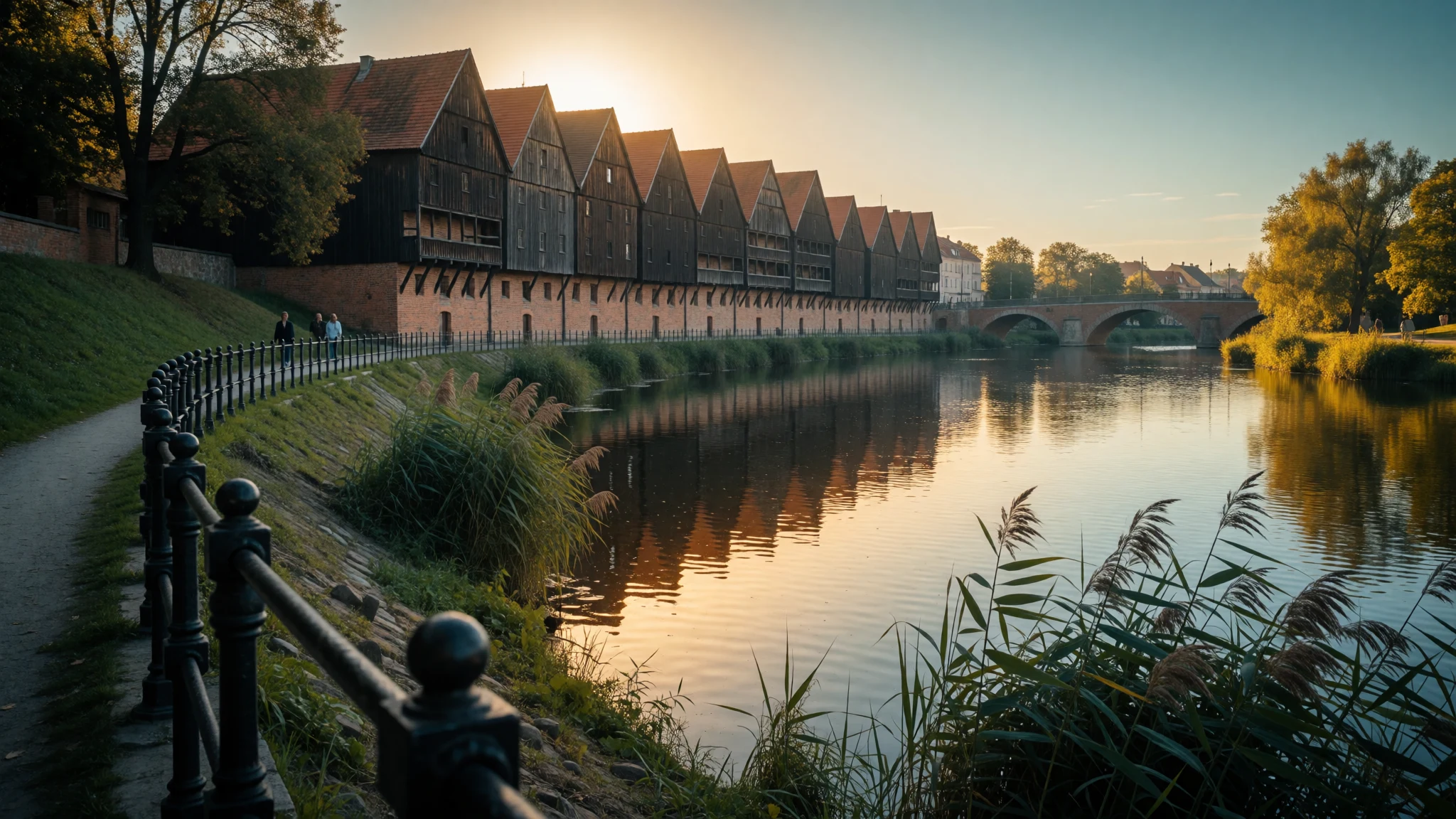
Bydgoszcz is a calm, canal-threaded Polish river city with granaries, a lively opera and music scene, and far fewer tourists than its famous neighbours.
The place
Bydgoszcz sits in north-central Poland, 60 m above sea level, on the River Brda not far upstream from where it meets the Vistula. That position made it an inland port and a trading and transport town, and water still shapes the centre: granaries, footbridges, boat landings and a canal run right through the middle of the city. Roughly a third of a million people live here, so it works as a proper regional capital rather than a preserved museum town. It shares the role of regional seat in the Kuyavian-Pomeranian area with Toruń, a short train ride away, and the two cities together form a wider metropolitan region. Bydgoszcz is also a university and music city, with a university, a technology university, a music academy, a philharmonic and the modern Opera Nova. Visually it is a mixture: a compact old market square, brick and stucco townhouses from the German-ruled era, and glassy riverside buildings added in recent decades. It draws far fewer foreign visitors than Kraków or Gdańsk, so queues are rare, but English is less common outside the centre and midweek evenings can be quiet. Summers are warm and winters properly cold, as a humid continental climate suggests. The best way to see the city is on foot along the river, using a tram or bus for the outer museums.
Its story
Bydgoszcz has been a settlement site for a very long time. Traders carrying amber from the Baltic towards the Roman world passed through this part of the Vistula country, and a fishing settlement later grew into a fortified stronghold watching over the river routes. The facts give 1038 as the founding date, and the stronghold itself went up under Casimir I the Restorer. By the thirteenth century the town had a castellany and its first church, dedicated to Saint Giles, which German authorities pulled down in the late nineteenth century. In the early fourteenth century it became the capital of a small duchy together with nearby Wyszogród, now a district inside the city. That ended badly: during the war between Poland and the Teutonic Knights the city was captured and destroyed. It recovered as a royal town of the Polish kingdom and stayed one until the partitions of Poland, after which it passed to Prussia, briefly to the Napoleonic Duchy of Warsaw, and then to Prussia again. A canal built in the late eighteenth century gave industry a push. Rule by the German Empire and the Weimar Republic followed, then a return to Poland between the wars, the Nazi occupation, and finally the modern Polish state. The street names, churches and architecture still carry traces of every one of those layers.
What to see
- Old Market and Town Hall — Old Town
Bydgoszcz's old market square is small enough to cross in minutes, lined with restored townhouses and café terraces. The town hall dates from the seventeenth century and was extended a few decades later. It is a good starting point, and the riverside lies just a short walk downhill.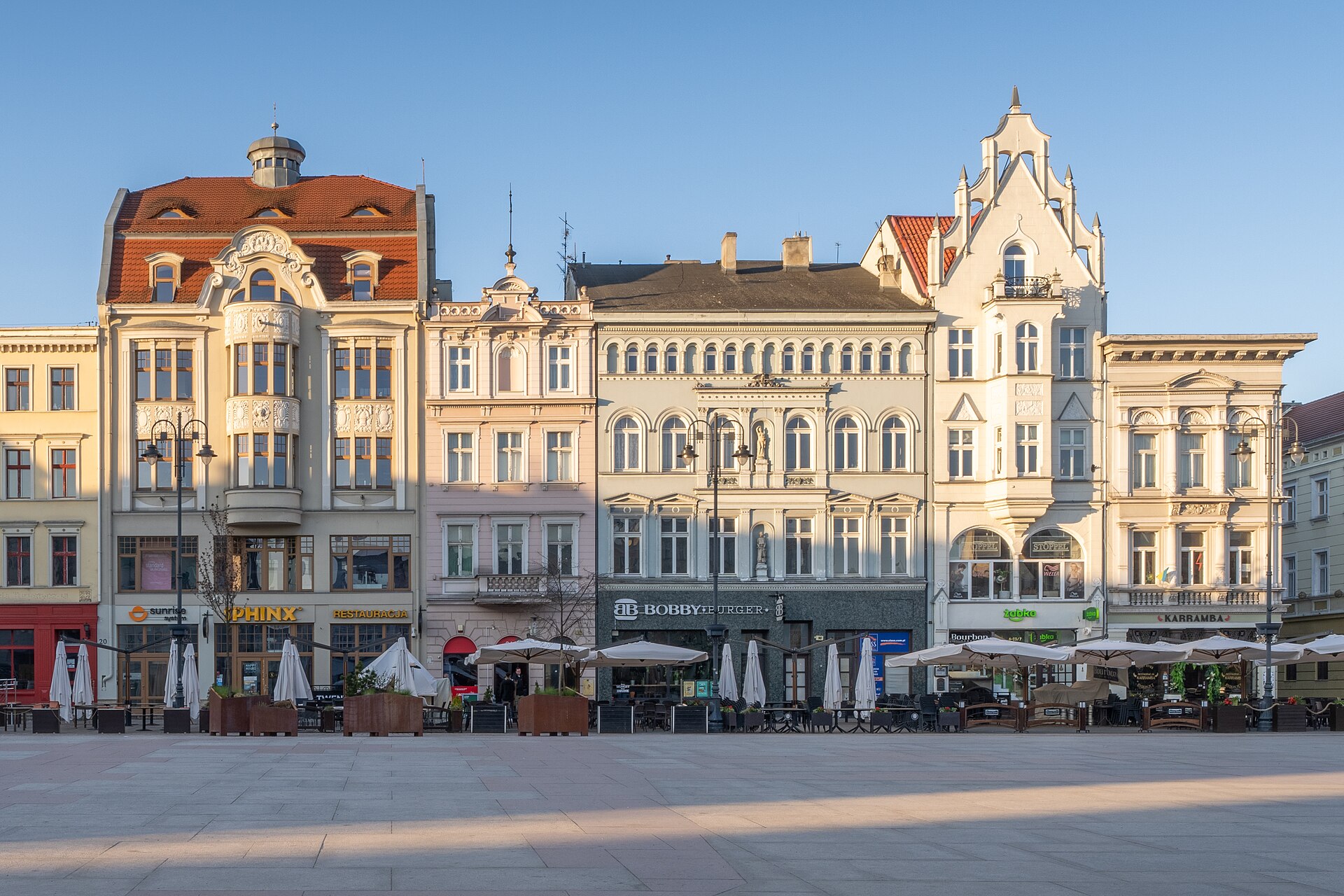
- Main Post Office — City centre
Bydgoszcz's main post office is a neo-Gothic building from the turn of the twentieth century, packed with ornament in brick and stone. It is still a working post office, so step inside during opening hours and look up at the details. Check the city website for current hours.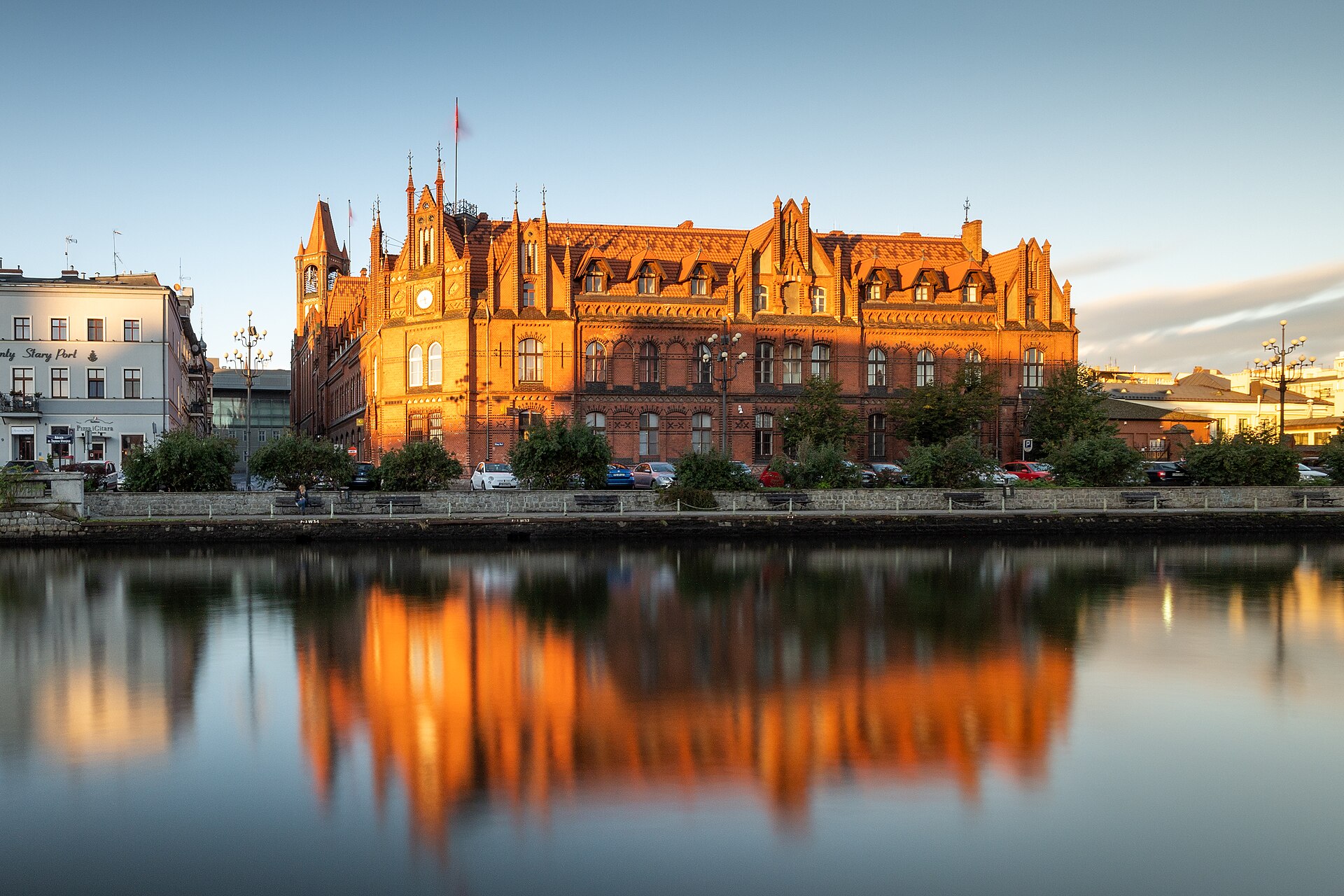
- The granaries (Spichrze) — Brda riverside
Bydgoszcz's granaries stand on the Brda, built in the late eighteenth century to store grain moved by river. Their timber and brick frontages are the city's best-known skyline, and one building houses a gallery devoted to the painter Leon Wyczółkowski. Seen from the Old Town bridge, they glow at dusk.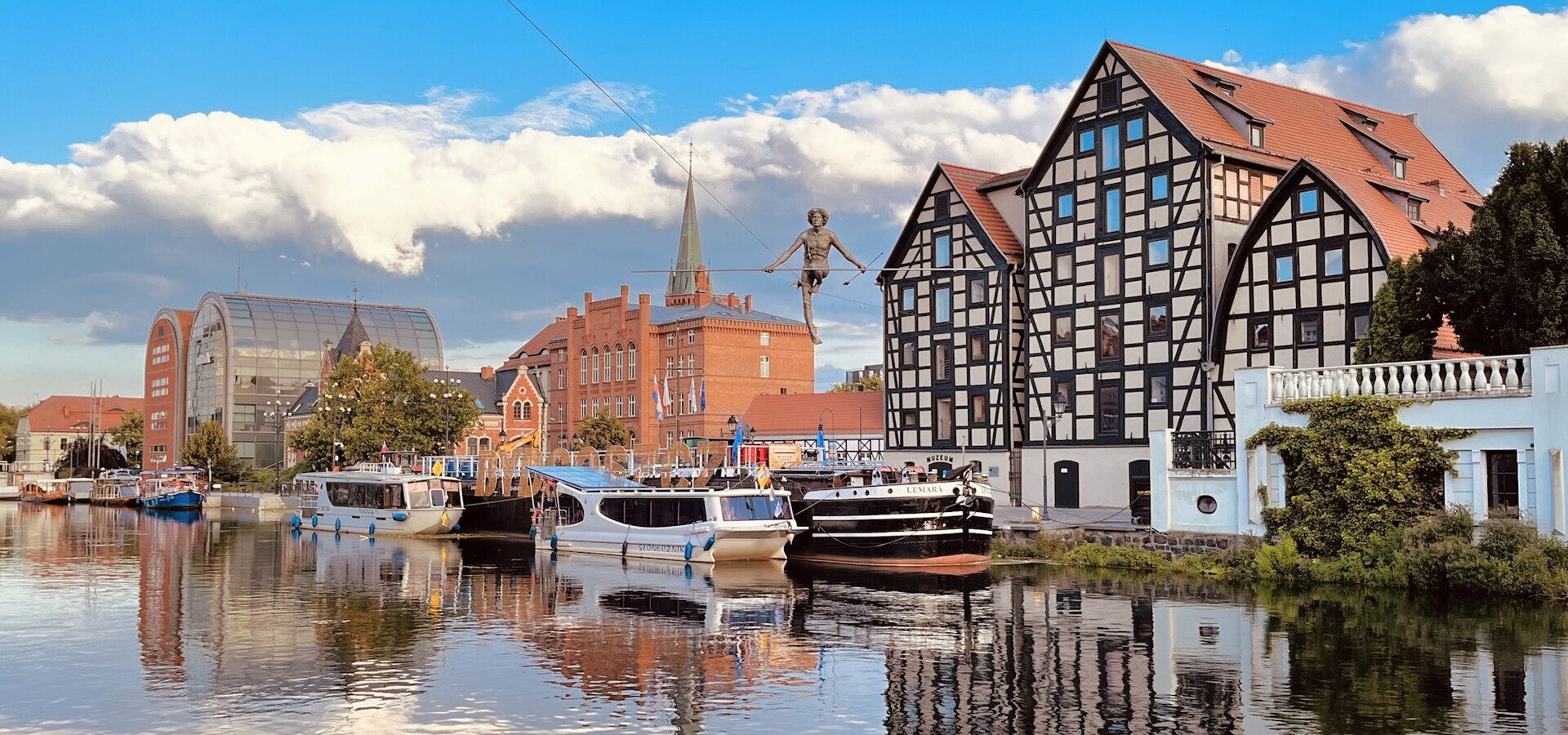
- Mill Island museums — Mill Island
Bydgoszcz keeps its district museum on Mill Island, spread over several buildings in a park among canal channels. Art, history and ethnography each have their own displays, and the modern art museum is the one most worth making time for. Allow a relaxed half day with a coffee break. - Opera Nova — Brda riverside
Bydgoszcz's opera house is one of its modern landmarks, built at the water's edge on the Brda. Its glass and concrete shapes contrast with the old granaries nearby. Check the official programme for opera, ballet and concerts, and book ahead for popular evenings. The riverside walk outside is free.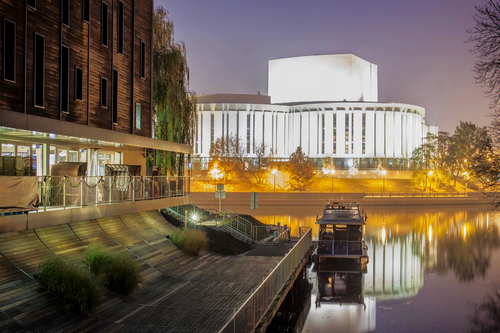
- Man Crossing the River — Brda riverbank
Bydgoszcz has a sculpture of a man balancing on cords across the Brda, put up to mark Poland joining the European Union. It is one of a few such figures placed around the centre, and some remain. It makes a good photo stop on the river walk.
Culture
Bydgoszcz is a city where music matters. Its theatre tradition goes back to the seventeenth century, when a Jesuit college staged plays, and a permanent theatre building followed in the nineteenth century before being rebuilt on a grand scale by the Berlin architect Heinrich Seeling. A music school opened in the early twentieth century with close ties to the piano maker Bruno Sommerfeld, and the city became home to many choirs and orchestras, both German societies and Polish ones named after composers and patron saints. Today the Academy of Music, the Pomeranian Philharmonic and the Opera Nova keep that tradition alive, and concerts are a normal part of local life rather than a tourist show. The city's mixed history shows in its churches, street names and family stories. Poland is mostly Roman Catholic, and religious life is visible in processions, feast days and well-attended Sunday Masses. Poles tend to be reserved at first and warm once conversation starts, and punctual hospitality matters, so a small gift of flowers or sweets is welcome if invited home. When visiting a church such as the cathedral, keep your voice low, cover bare shoulders if you can, and do not photograph worshippers during a service.
What to wear
Bydgoszcz lies in Kuyavia, a region with its own folk dress, as most Polish regions have. As a rule, such costume is made from wool and linen, with embroidered bodices, layered skirts and decorated aprons for women, and waistcoats and felt hats for men. Today it appears mostly on dance ensembles and at harvest festivals, weddings and regional celebrations rather than on the street. What people wear day to day is plain modern European clothing: jeans, jackets, trainers, and smarter outfits for the opera or a restaurant evening. Locals dress for the weather, so expect long coats, scarves and boots in winter. Visitors should pack layers, because summers are warm but evenings can cool, and winters are cold and damp. A light waterproof is useful in any season. Comfortable shoes matter more than style, since the Old Town has cobbles and the riverside paths are long. Churches have no strict dress checks for visitors, but covered shoulders and knees are the polite choice, especially during services. For concerts, smart casual is fine and nobody will expect formal wear.
What to eat
- Pierogi — Milk bars and traditional restaurants around the Old Town
Bydgoszcz serves pierogi, dumplings filled with potato and cheese, meat or seasonal fruit, as everywhere in Poland. They are cheap and filling, and the simple versions are best. Look for them in a bar mleczny (milk bar) or a family-run Polish restaurant near the Old Town. - Żurek — Traditional Polish restaurants by the canal
Bydgoszcz restaurants serve żurek, a sour soup made from fermented rye, often with sausage and egg and sometimes in a bread bowl. It is warming in the cold months and a good test of any kitchen. Try it at a traditional canal-side restaurant. - Kotlet schabowy — Polish restaurants and lunch eateries in the centre
Bydgoszcz kitchens do the national classic well: a breaded pork cutlet, usually served with boiled potatoes and a pile of cabbage or beetroot salad. Portions are generous. It is standard lunch fare in most Polish restaurants and in simple eateries in the city centre. - Placki ziemniaczane — Milk bars and casual restaurants
Bydgoszcz menus often list potato pancakes, fried until crisp at the edges and served with sour cream, mushroom sauce or goulash. They are a good vegetarian option when ordered plain. Look for them in casual restaurants and milk bars. - Sernik and coffee — Cafés around the Old Market and the riverside
Bydgoszcz cafés serve sernik, a dense baked cheesecake made with curd cheese, alongside strong coffee or tea. It is a classic afternoon stop after a museum visit. Café terraces around the Old Market and along the river are good places to sit.
Plan it
Best time. May to September is the easiest stretch, when the humid continental climate brings warm days and long evenings for riverside walking. September is calmer and cooler. Winters are cold and grey, though the city is quiet and good for concerts.
How long. 2
Getting there. Bydgoszcz has its own small airport with limited services. Most visitors fly into Warsaw Chopin, Gdańsk or Poznań and continue by train. Direct trains link Bydgoszcz with all the major Polish cities, and Toruń is a short ride away. There is also a direct train from Berlin. The long-distance bus station is in the city centre. From the station, the Old Town is reachable on foot or by tram.
Budget. low
Tips
- Walk the Brda riverside at dusk, when the granaries and Opera Nova are lit
- Check the Opera Nova and Pomeranian Philharmonic programmes before you travel and book popular evenings ahead
- Pair Bydgoszcz with Toruń as an easy day trip by train
- Carry a card, but keep a little cash for small cafés and market stalls
- Look at the official city website for event dates and museum opening times
Etiquette
- Keep your voice low in churches and do not photograph worshippers during services
- Greet staff with a polite 'dzień dobry' and say 'dziękuję' when leaving shops and cafés
- Switch off your phone during concerts and performances
Nearby
Sources
- Wikidata Q41252 (CC0)
- Wikipedia: Bydgoszcz (rev 1383200700) (CC BY-SA 4.0)
- Wikivoyage: Bydgoszcz (rev 5396258) (CC BY-SA 4.0)
- Jan Paweł Bochen, Stary Rynek w Bydgoszczy edit (CC BY 4.0)
- Mariusz Guć, Kamienica przy placu Wolności 1 (CC BY-SA 4.0)
- Mariusz Guć, Stary Rynek, fragment (CC BY-SA 4.0)
- Mariusz Guć, Poczta Główna w Bydgoszczy (CC BY-SA 4.0)
- Wikibenchris, Opera Nova przystań edit (CC BY 4.0)
- Mariusz Guć, Katedra w Bydgoszczy (CC BY-SA 4.0)
- Ciastkoo, Spichrze w Bydgoszczy (CC BY-SA 4.0)
- Pit1233, Bydgoszcz logo (CC0 1.0)


