Branicki Palace
Branicki Palace, Poland
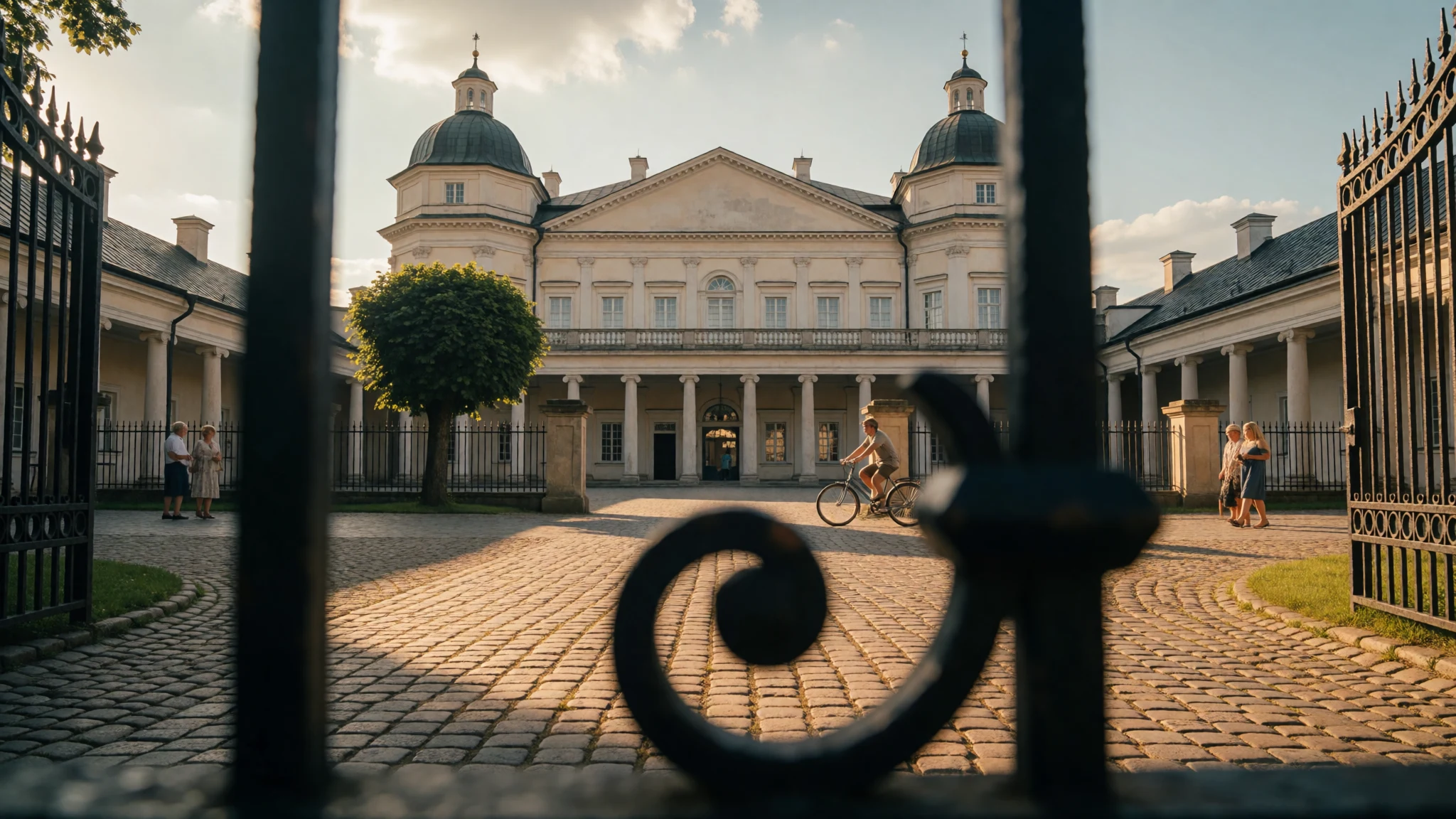
Branicki Palace in Białystok is a baroque magnate's residence with French-style courtyards and gardens, set in a calm north-eastern Polish city.
The place
Branicki Palace stands in the centre of Białystok, a city in north-eastern Poland not far from the Belarusian border. It began as a fortified house and was grown by one ambitious family into something closer to a princely court. The main block sits at the back of a horseshoe-shaped forecourt, with wings reaching forward on each side and an ornamental gate closing the open end. Behind it, formal gardens with pavilions and statues were laid out on French lines. The town around the palace was planned in step with it: a triangular market, churches, a town hall and a monastery, all rising within a short span of years. That coordinated planning is why eighteenth-century admirers nicknamed the place the Versailles of Poland, or of Podlasie, the region it belongs to. The comparison flatters a little. This is a provincial palace rather than a royal one, and it is modest beside the French original. But the layout is easy to read, because palace, garden and town square still feel like one scheme. The grounds also work as an everyday city park, where locals cut through, sit on the grass and walk the gravel paths. Crowds are light compared with Kraków or Warsaw, which suits a visit built around strolling and sitting rather than queueing. The palace is best treated as a half-day stop within a longer look at Białystok and its nineteenth-century streets.
Its story
Branicki Palace has a layered past. A wooden manor once stood on the site, and a brick castle with a moat and earth ramparts later replaced it, designed in a Gothic-Renaissance mix for the Wiesiołowski family. When the property passed to the Branickis, Stefan Mikołaj Branicki had the castle remodelled as a baroque mansion in the late seventeenth century. His architect, Tylman Gamerski, turned one tower into a stairwell and added a columned porch over the entrance. The man who gave the palace its present character was Jan Klemens Branicki, a senior military commander of the Polish–Lithuanian Commonwealth, brought up among aristocrats who admired France. He had ambitions to wear a crown, and the scale of the project reflects that. From 1726 he and his wife, Izabella Poniatowska, pushed the rebuilding forward. Johann Sigmund Deybel designed the main façade and added the pediment and the tower domes. Earlier pavilions and outbuildings were joined to the central block as wings around the horseshoe court. After Deybel's death, Jakub Fontana oversaw the work for about two decades and gave the interior its rococo finish, including the entrance hall and a grand stair decorated with sculpture by Jan Chrysostom Redler. Redler also carved two Hercules groups, one with a dragon and one with a hydra, for the fence between the outer and inner courts. The gate to the honour court was completed in 1758. Jan Klemens also shaped the middle of Białystok itself, including its triangular market.
What to see
- The palace and honour court — Białystok city centre
The main block of Branicki Palace has a pediment and domed towers, and its wings run forward to enclose a horseshoe court. Standing in the middle of that court gives the clearest sense of the French-style plan. The rococo interiors are the other draw; check the official site for which rooms are open and when.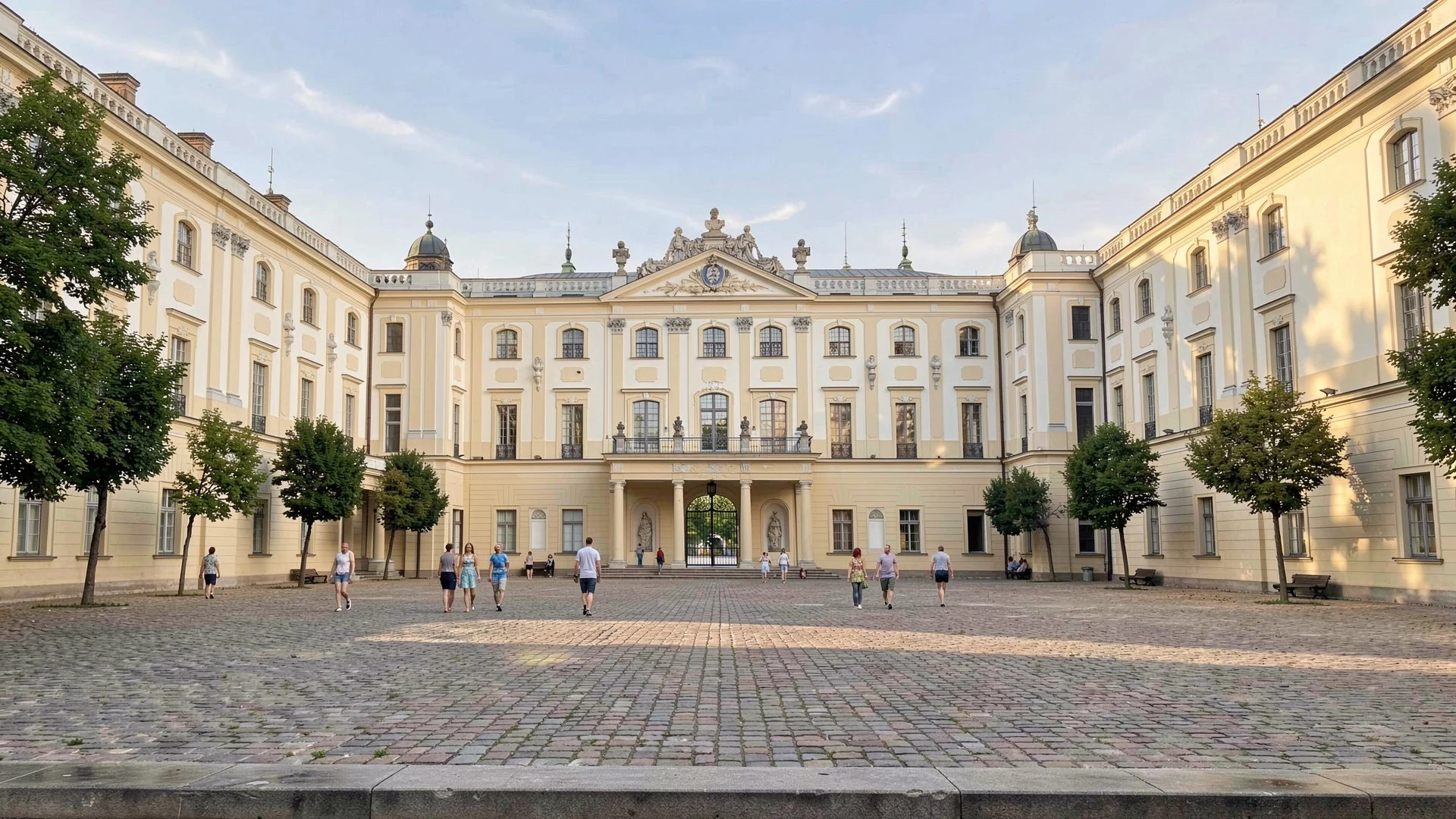
- Entrance gate and Hercules statues — Front court
The ornate gate closing the front court dates from 1758. The two Hercules sculptures by Jan Chrysostom Redler stand along the fence between the outer and inner courts, one wrestling a dragon and the other a hydra. They reward a slow look from the pavement, especially in low light when the carving throws deep shadows.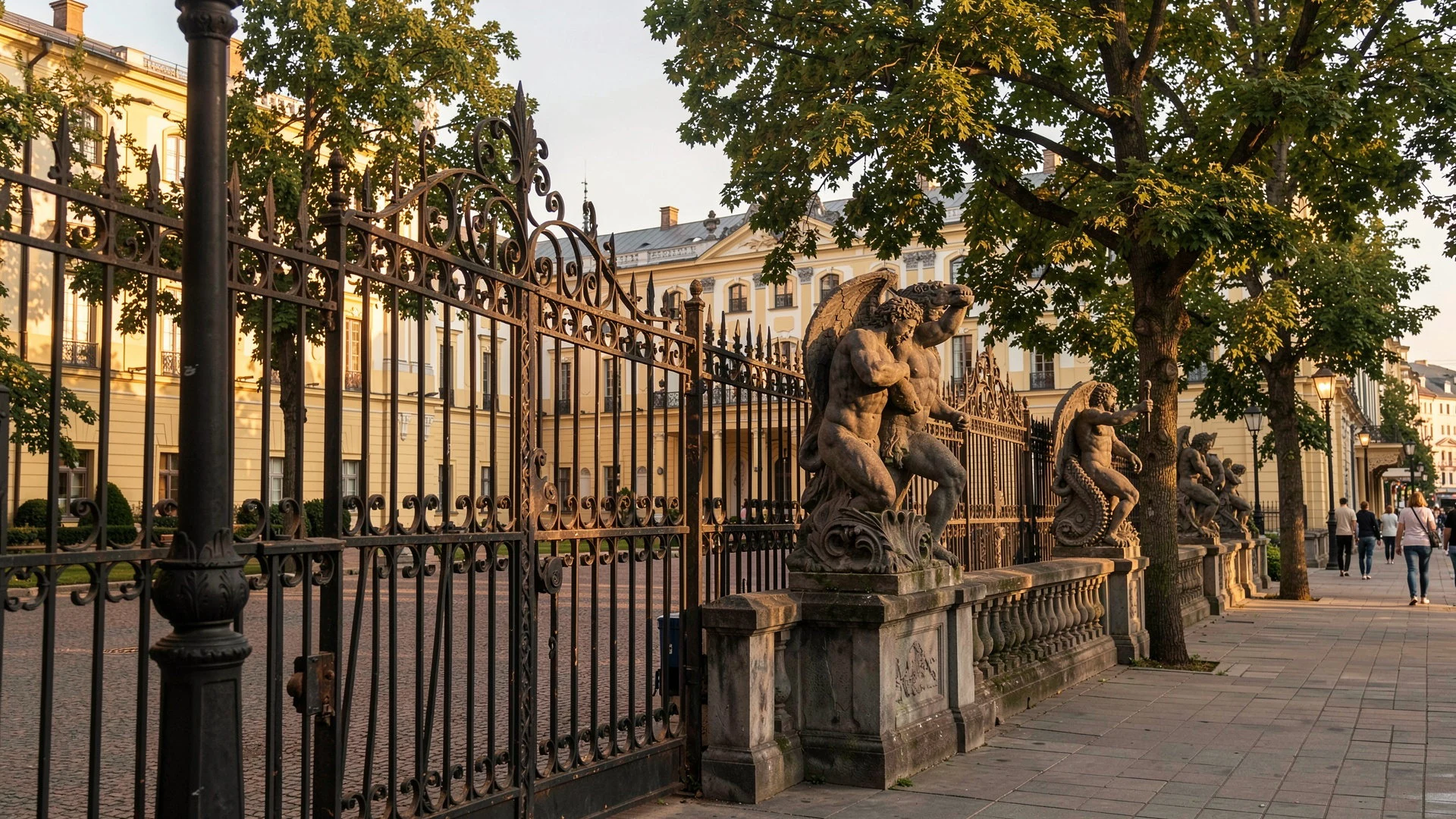
- Gardens and Eagle Pavilion — Behind the palace
Behind the palace, the gardens follow a formal French pattern of straight paths and clipped lines, with sculpture and small pavilions, among them the Eagle Pavilion. An eighteenth-century print of the original layout shows a far more elaborate scheme than survives, so treat today's version as a restful walk rather than a full restoration.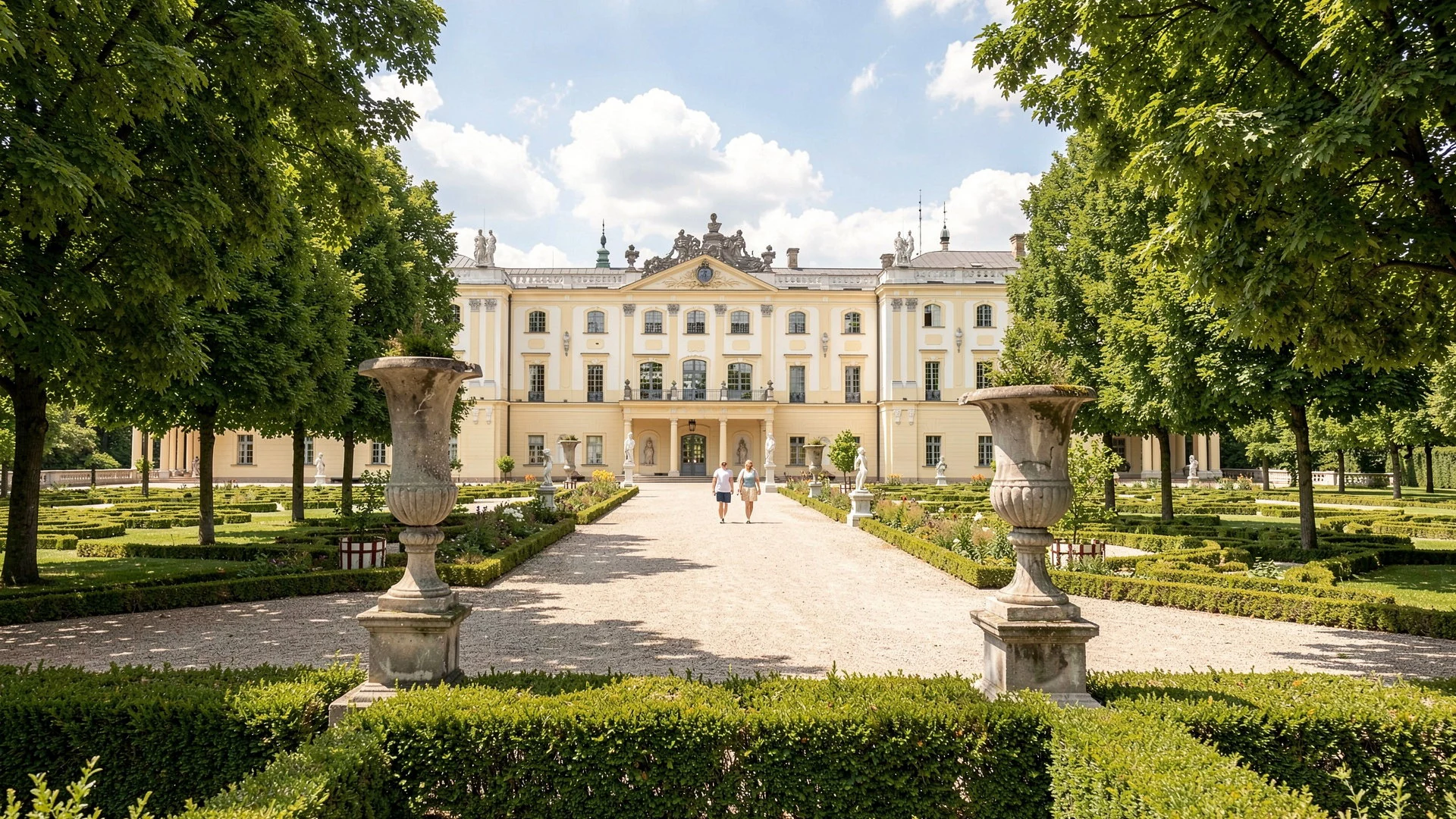
- Former Prussian governor's residence — North of the palace
A short walk north of the palace stands a large pale-pink building, now a school, built as the residence of the Prussian governor when the region came under Prussian rule in the early nineteenth century. It is worth a look from the street, and shows how the town's rulers changed after the Branicki era.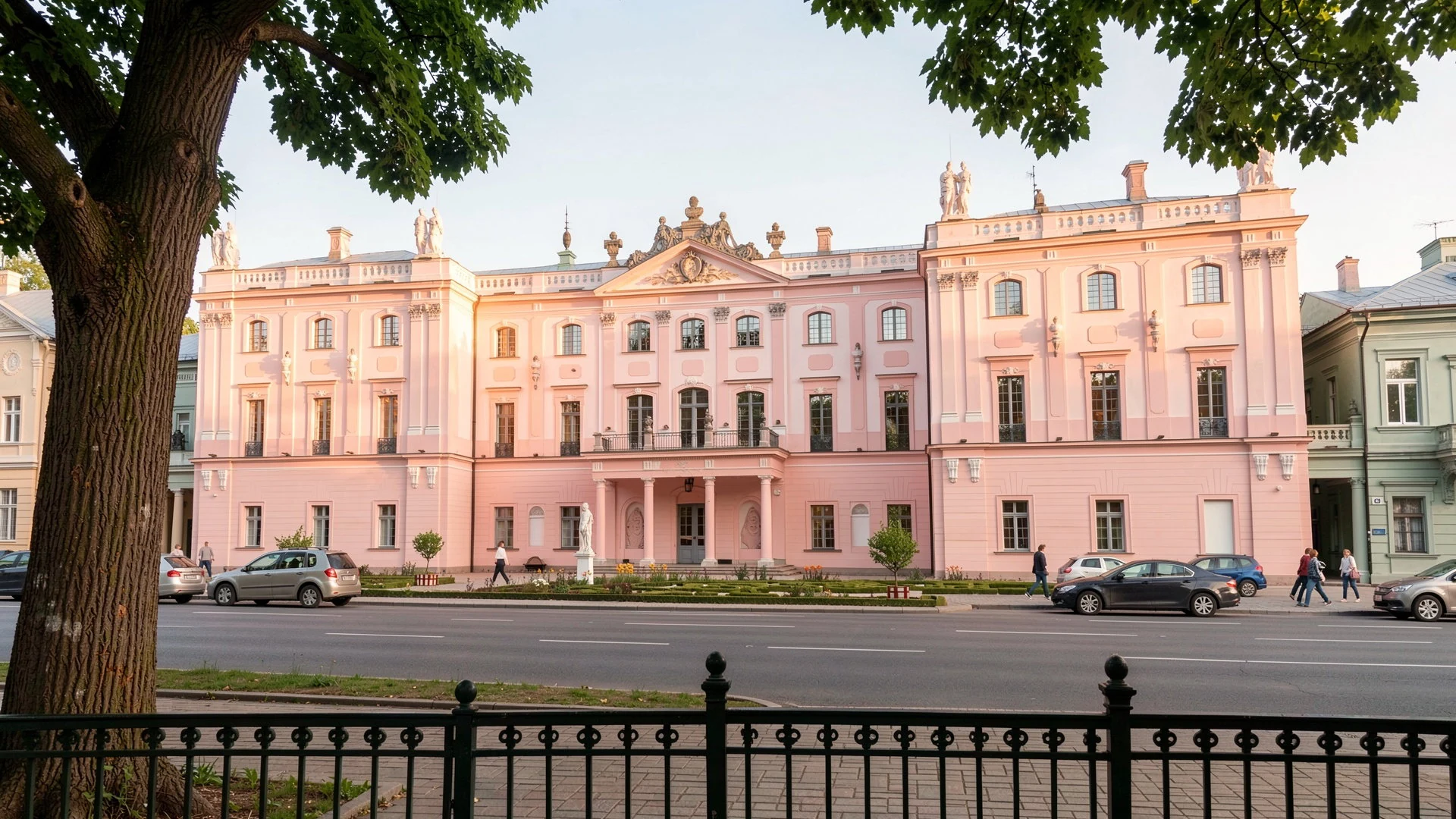
- Historical Museum — East of the palace
The Historical Museum, a few minutes' walk east of the palace, is the place to follow Białystok's story beyond the Branickis. Displays change over time, so check the official site before going. It also makes a sensible wet-weather fallback when the gardens are too muddy or cold to enjoy.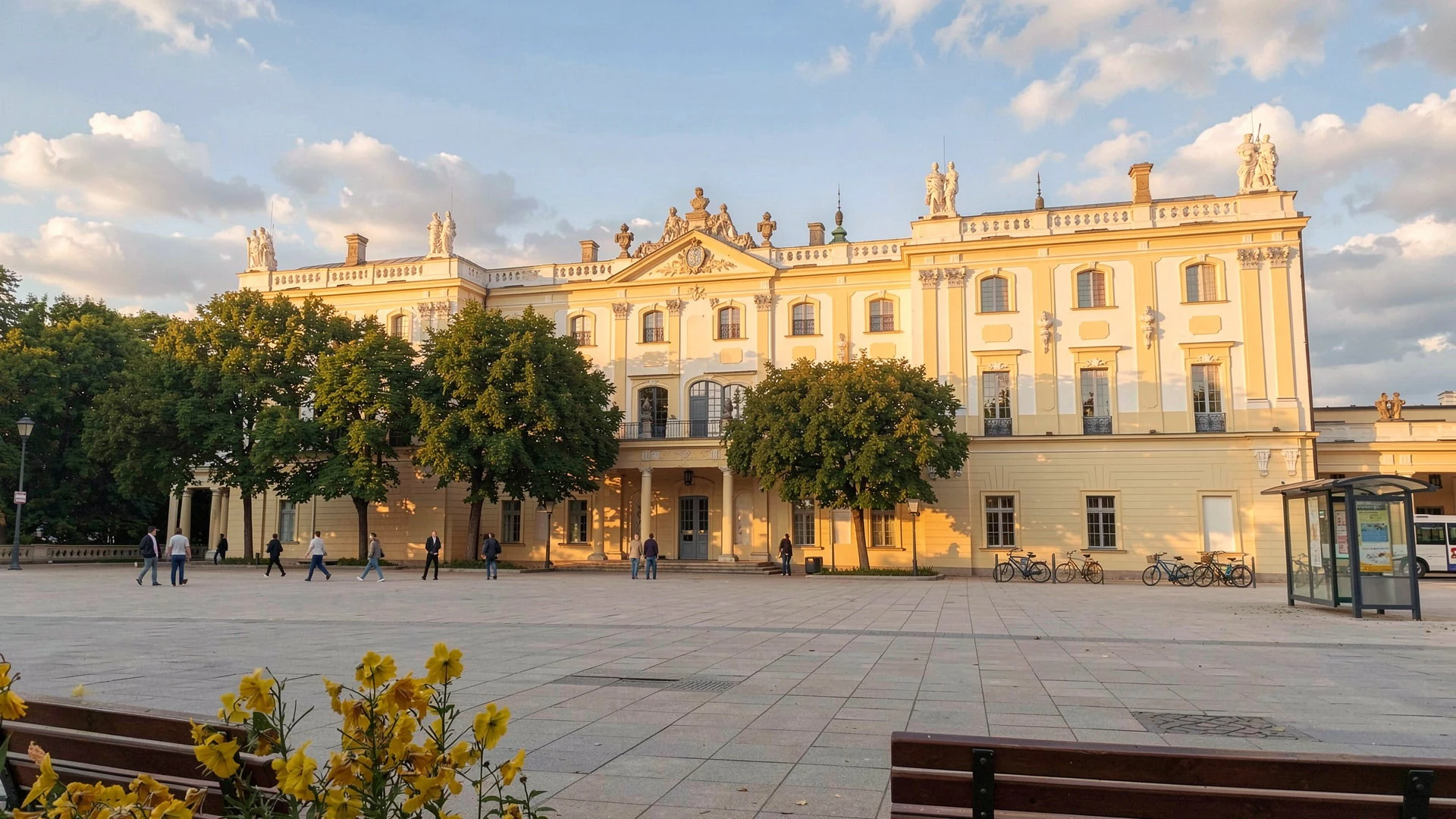
- Lipowa and Warszawska streets — Town centre
Lipowa and Warszawska streets are lined with nineteenth-century buildings that have survived largely unspoiled, and they make an easy wandering route from the palace into the town. Cafés and bookshops along the way give reasons to stop, and the pace is that of a regional city rather than a tourist centre.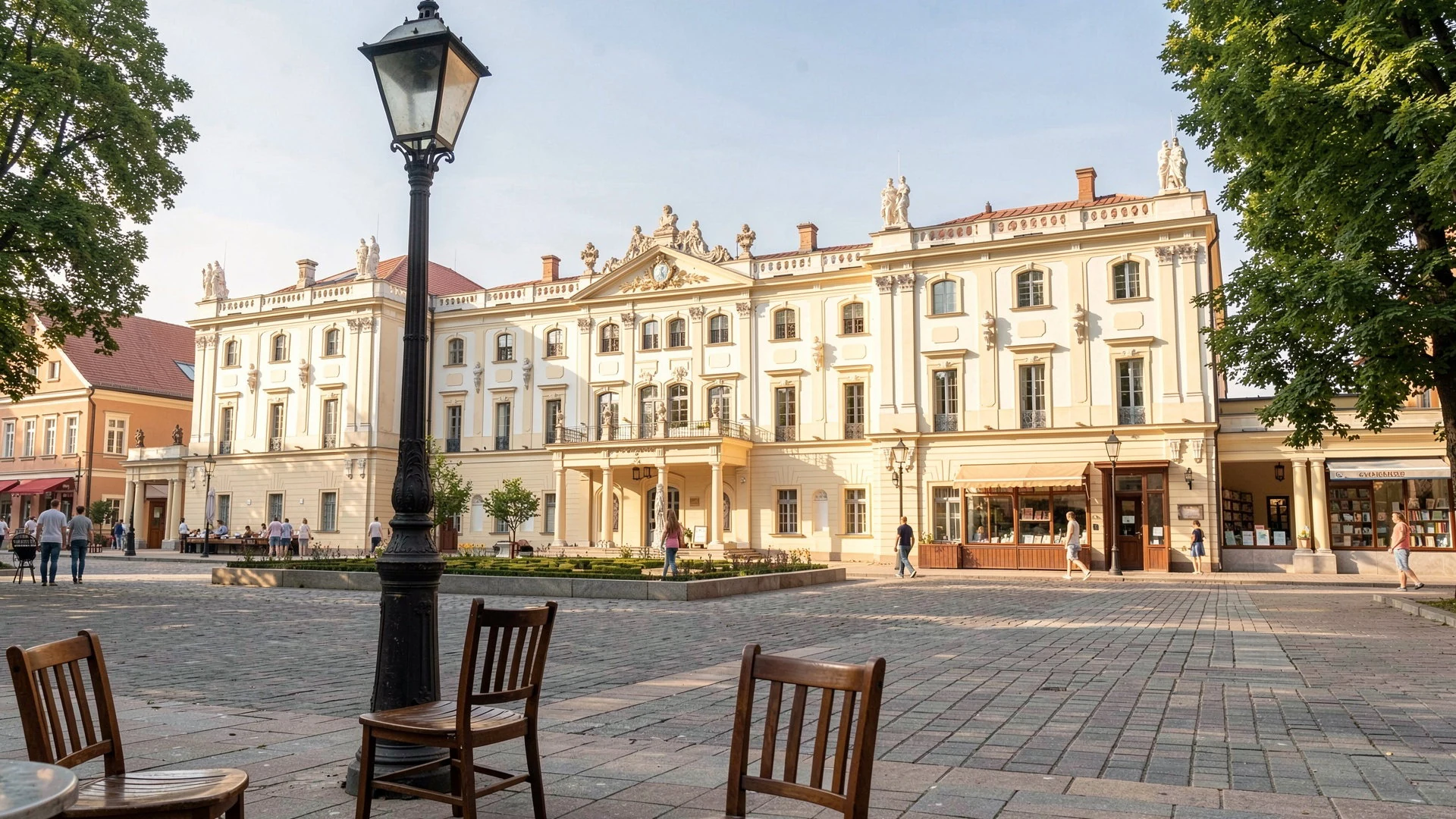
Culture
Branicki Palace belongs to the world of the Polish–Lithuanian Commonwealth's great magnates, who competed in building, hosting and patronage, and who looked to France for taste. That is why a palace in a provincial town carries French planning, rococo interiors and a garden designed for display. The Branickis also supported art and learning, and the palace is best read as a statement about status as much as comfort. Białystok today carries other layers of memory. The Podlasie borderland has long been mixed in faith and language, and the city has a marked Jewish Heritage Trail that records a community once central to its life. A museum devoted to Poles deported to the Soviet Union during the Second World War keeps another painful chapter in view. Locals are proud of the region's wildlife, above all the bison of nearby Białowieża, which gives its name to the town's best-known beer and its grass-flavoured vodka. Everyday life is quiet and orderly: people greet shop staff, queue patiently and tend to dress neatly for church on Sundays. The palace grounds are used as a public park, and good manners there mean staying on the paths, keeping music and voices low, and leaving the statues and fences alone. Keep your voice down in the gardens and churches, do not climb on the sculptures or fence plinths, and ask before photographing people.
What to wear
In Białystok and across Podlasie, traditional dress belongs mainly to festivals, folk ensembles and church occasions. Regional costume was made from linen and wool, often with embroidered trims, and the area has a long tradition of woven linen. In the Commonwealth period, nobles such as the Branickis wore the long coat called a kontusz over a under-robe, the żupan, tied with a woven sash. Portraits of the era show them in heavy silks and furs, matching the palace's rich interiors. Today people wear what they would in any mid-sized European city: jeans, trainers, practical jackets and plain knitwear, with smarter outfits for weddings and Sunday services. Students and families fill the gardens in casual clothes, and nobody will look twice at ordinary travel wear. A visitor should dress for the weather and the ground. Summers are pleasant but can turn showery, so a light rain jacket helps, while colder months call for a proper coat, hat and gloves because the gardens are open and exposed. Comfortable closed shoes are best for the gravel paths and cobbled streets. If stepping into a church near the market square, cover shoulders and avoid very short shorts, and carry a light scarf for that purpose.
What to eat
- Pierogi — A milk bar in the city centre
Pierogi, dumplings stuffed with potato and cheese, meat or seasonal fruit, are the easiest introduction to Polish home cooking. Milk bars in the centre serve them plainly and cheaply to a mixed crowd of students, families and office workers, so a table-sharing lunch is normal.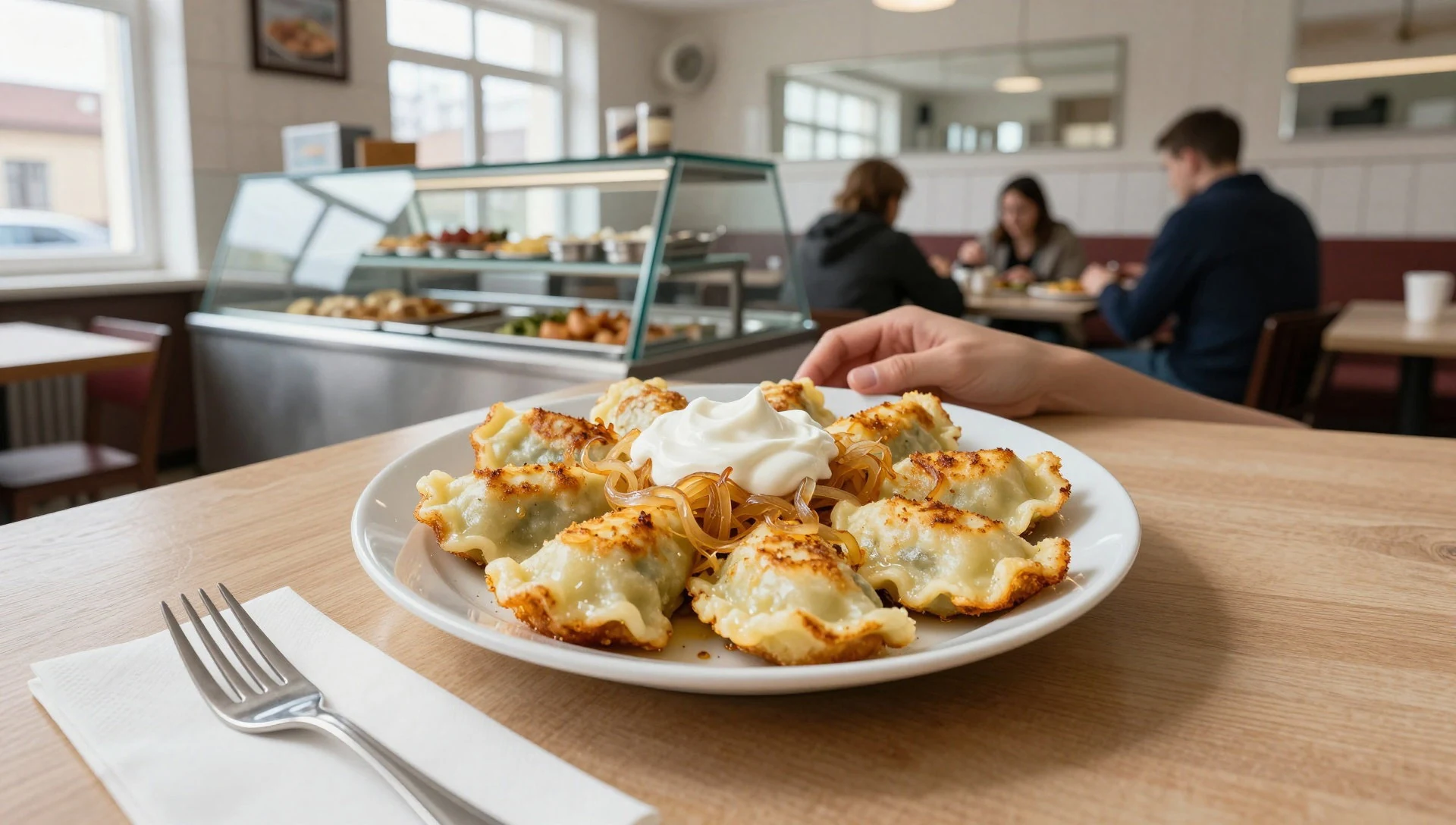
- Babka ziemniaczana — Regional eateries in Białystok
Babka ziemniaczana is a baked grated-potato cake, usually served with fried bacon or sour cream, and is a staple of the Podlasie table. It is filling and plain rather than elegant, and tastes best on a cold day. Look for regional eateries that advertise local dishes.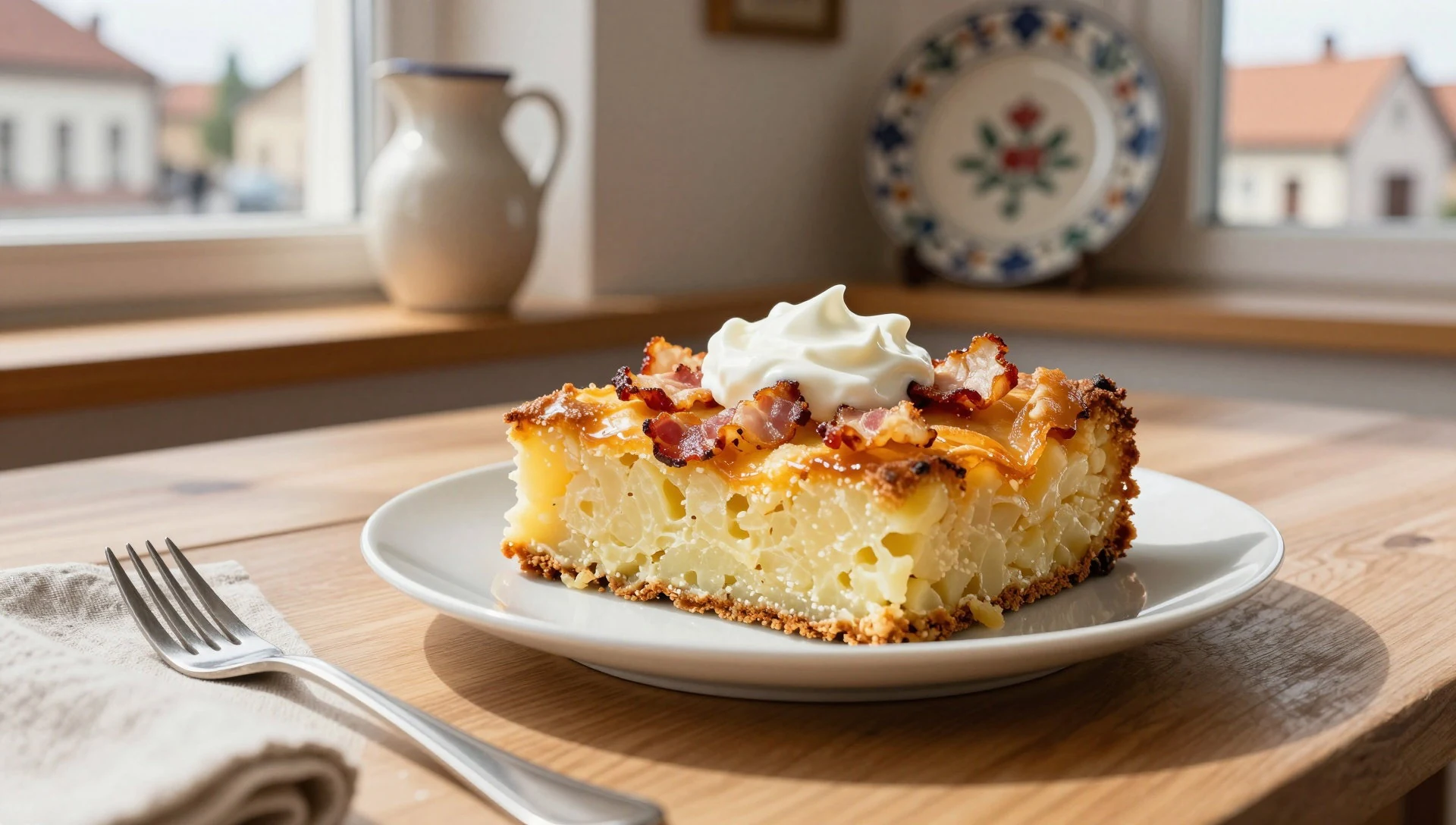
- Zapiekanka — Stands near the railway and bus stations
Zapiekanka is a toasted length of bread topped with mushrooms, cheese and sauces, sold at stands near the stations and elsewhere in the centre. It is a quick, cheap snack for between sights or after a late arrival, and some stands stay open around the clock. - Żubr beer — Pubs around the city centre
Żubr is the typical beer of Białystok, named after the bison of Białowieża National Park. Many pubs in the centre pour it with a decent choice of other drinks, and it is generally inexpensive by western European standards. It pairs well with a plate of something fried. - Żubrówka — Bars and shops in town
Żubrówka, or Bison Grass vodka, is the regional spirit, flavoured with a blade of grass inside the bottle. It is often mixed with apple juice or sipped neat and cold. A bottle from a shop is a cheap, easily packed souvenir.
Plan it
Best time. May to September for green gardens, long days and comfortable walking; winters are cold and the grounds look bare, though the palace is still worth seeing.
How long. 1–2
Getting there. Warsaw Chopin Airport is the closest major Polish airport, about 200 km away: take bus 175 into the city centre, then a train or coach to Białystok. Kaunas in Lithuania is about 240 km away, and Hrodna Airport about 40 km. The palace is a short walk from the town centre.
Budget. low
Tips
- Check the official site for opening days and which interiors are open before planning your day
- Book the PlusBus coach from Warsaw airport in advance, as seats can sell out
- Combine the palace with Lipowa and Warszawska streets for a relaxed half-day
- Eat at a milk bar for an inexpensive and genuine Polish lunch
- Bring layers, since weather can change quickly and the gardens are open and exposed
Etiquette
- Keep voices low in the gardens and stay on the paths
- Do not climb on statues, fences or pavilion steps
- Dress modestly and ask before photographing people in churches
Nearby
Sources
- Wikidata Q2376970 (CC0)
- Wikipedia: Branicki Palace, Białystok (rev 1366748124) (CC BY-SA 4.0)
- Wikivoyage: Białystok (rev 5382371) (CC BY-SA 4.0)
- Photo: Sylwpak, Białystok, Pałac Branickich (CC BY-SA 4.0)
- Photo: Rakoon, Branicki Palace in Białystok (CC0 1.0)
- Photo: Pierre Ricaud de Tirregaille, Baroque Gardens of Branicki Palace (Public domain)
- Photo: Danuta Ruminowicz, gate and fence (CC BY-SA 3.0 pl)
- Photo: Scotch Mist, Branicki Palace Garden with Eagle Pavilion (CC BY-SA 4.0)
- Photo: Stanislaw.bochnak, palace panorama at night (CC BY-SA 4.0)
- Photo: Jolanta Dyr, Detail of Branicki Palace (CC BY 3.0)
- Photo: Karol508, Garden of the Branicki Palace, pavilion (CC BY-SA 3.0 pl)


