Bhopal
Bhopal, India
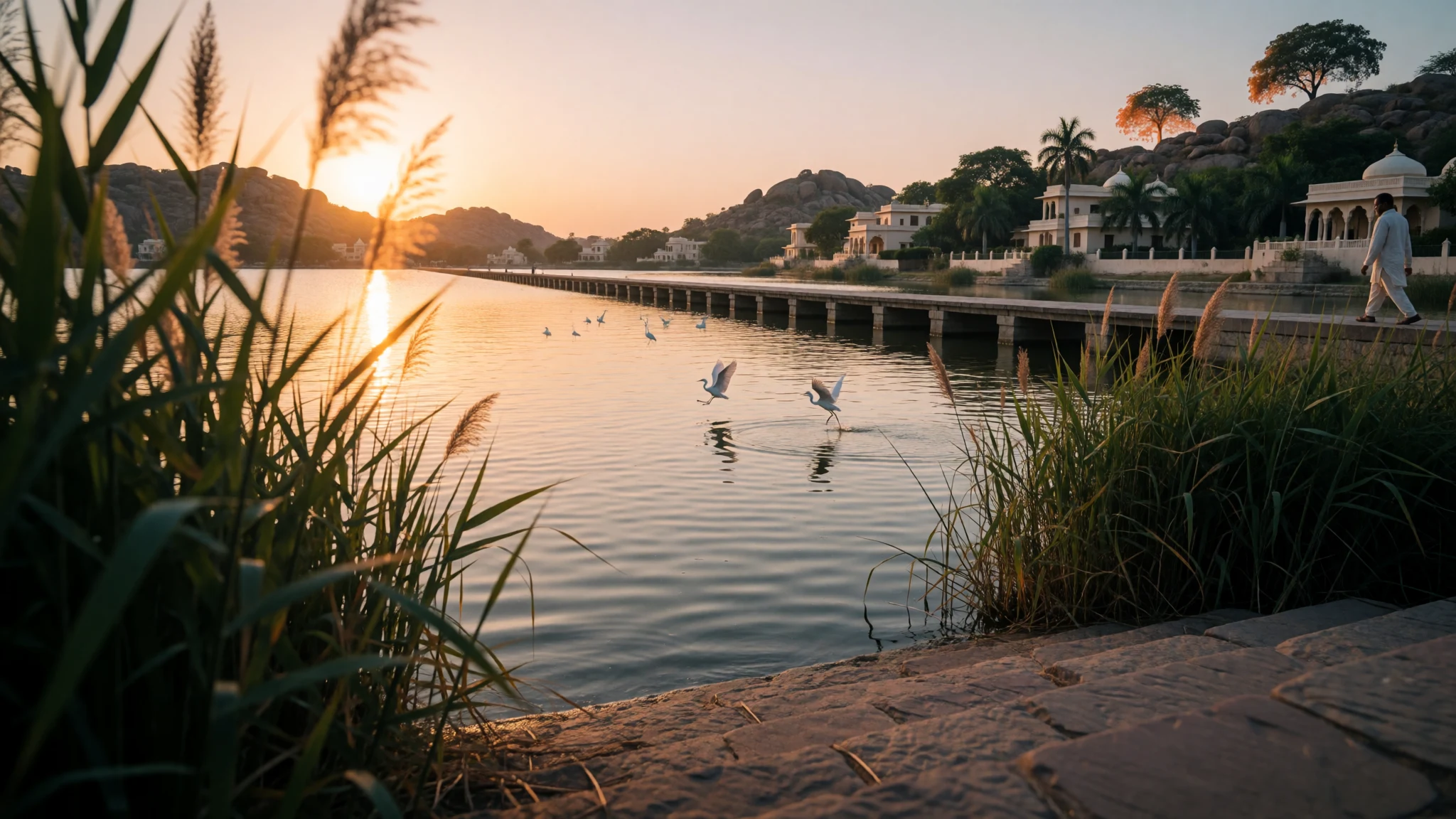
Bhopal suits a slow few days of lakeside evenings, mosques, tribal and art museums, and chaat, away from the usual tourist circuits.
The place
Bhopal is the capital of Madhya Pradesh, a city of about 1.8 million people at 427 m above sea level in the middle of India. Its nickname, the City of Lakes, comes from the reservoirs, some natural and some made by rulers, that press up against the built-up area. The Upper Lake, called Bada Talab locally, is the one most visitors meet first: boats on the water, a bridge across it, and families gathering on the banks as the day cools. The city feels leafy for an Indian state capital, especially in its newer districts.
Bhopal has two distinct moods. Old Bhopal, around the mosques and bazaars, is crowded, narrow and loud, and the traffic rewards patience. New Bhopal, to the south and east, has wider roads, government offices, museums and the shopping streets of New Market. The two railway stations, Bhopal Junction in the old city and Rani Kamalapati in the new, reflect that split.
It is also a working city. Space-agency, engineering and research institutions are based here, and together with Indore it anchors the state's economy. That gives it an unpolished, lived-in character with few tourist touts. Summers are hot, and in winter the air can turn hazy with dust and traffic fumes. Bhopal rewards a short, unhurried visit built around water, museums, mosques and food rather than a checklist.
Its story
Bhopal's recorded history begins in the early 17th century, when it was a small village inside a Gond kingdom. The Gond queen Kamlapati is remembered today in the name of the city's newer railway station. She handed the territory to Dost Mohammad Khan, a Pashtun soldier of the Mughal army, in lieu of payment for mercenary services, and he took over her kingdom after her death. Khan had turned to hiring out his men to local chiefs once the emperor Aurangzeb died and the Malwa region slid into instability.
He took a lease on the Berasia estate in 1709, added neighbouring lands, and in the 1720s built the Fatehgarh fort, around which the town slowly grew. The state is dated to 1707, and by 1723 it sat under the overlordship of the Nizam of Hyderabad. In 1737 the Peshwa Bajirao I defeated a combined Mughal, Nizam and Nawab army at the Battle of Bhopal, and Malwa, Bhopal included, stayed under Maratha control until 1818.
Afterwards Bhopal was a princely state ruled by Nawabs, in a subordinate relationship with the British, until independence in 1947. It was among the last princely states to sign the Instrument of Accession, joining India in 1949. Sindhi refugees from Pakistan were settled in Bairagarh, on the western edge. In 1956 Bhopal became capital of the newly formed Madhya Pradesh, and in 1972 it gained its own district, having previously belonged to Sehore.
What to see
- Upper Lake (Bada Talab) — Central Bhopal, along the lakeshore
The Upper Lake is Bhopal's front room. Locals walk, sit and watch boats drift by, and the light over the water is best in the late afternoon. Boating is the obvious activity, but the banks are just as good for people-watching. Go on a weekday if crowds bother you.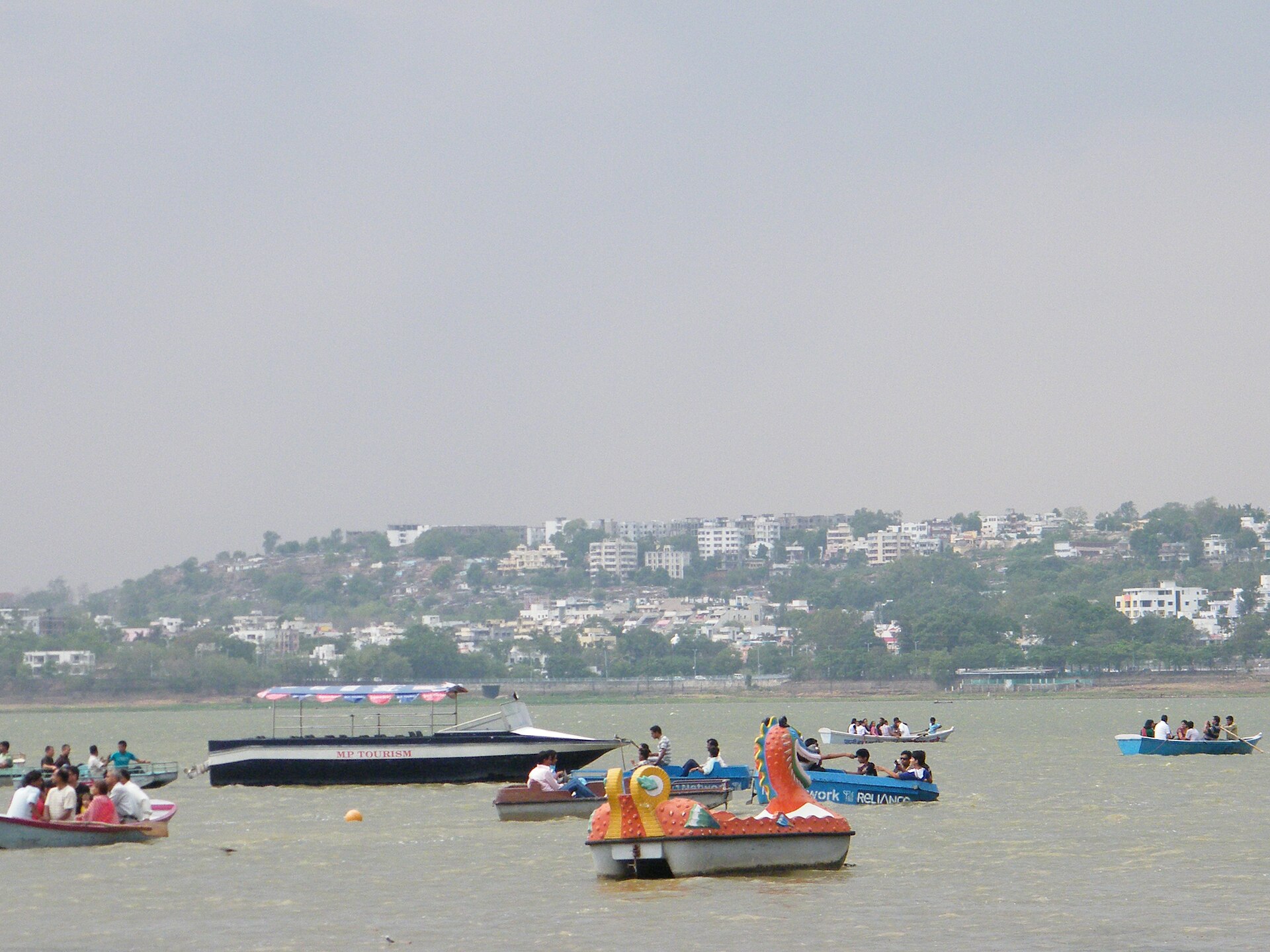
- Taj-ul-Masajid — Old Bhopal
This large mosque stands in the old city, where the bazaars crowd around it. Visit outside prayer times, with covered shoulders and legs, and be ready to leave your shoes at the entrance. Come early, before the lanes fill, and it is easier to take in the scale of the courtyard. - Bharat Bhavan — Near the Upper Lake
Bharat Bhavan is an arts complex with a museum, set close to the lake. It mixes galleries and performance spaces, so what is on depends on the day. Check the official listings before going, then allow a couple of unhurried hours to wander and see what is showing. - MP Tribal Museum and the Museum of Man — Shamla Hills area, west of the lake
These two museums stand almost side by side and look at how people in Madhya Pradesh and across India live: homes, tools, crops, rituals and art. The tribal museum is the more visual of the pair. Together they make a good half-day, particularly in the heat of the afternoon.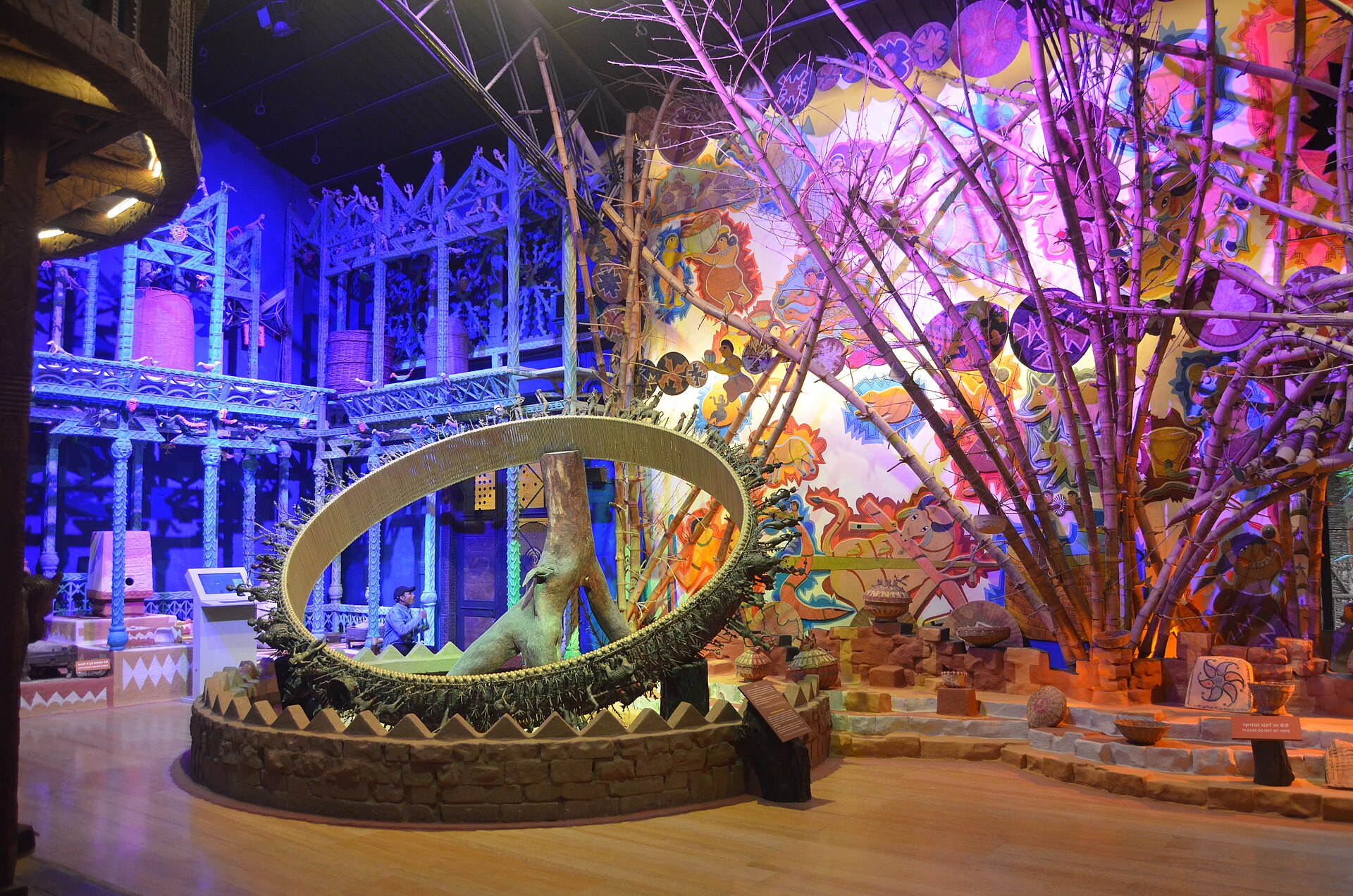
- Manua Bhan Tekari — Northern edge of the city
A hilltop with an old Shwetambar Jain temple and a wide view back over Bhopal and its lakes. A road runs up to the temple, but parking space is limited, so a taxi or auto-rickshaw is easier. Aim for the cool of early morning or the hour before sunset.
Culture
Bhopal's culture comes from its Hindu and Muslim traditions, its Nawabi past and later Sindhi and Bengali settlers, so the festival calendar is full. Diwali is the biggest family occasion: homes are lit, sweets and gifts change hands, donations go to the poor, and prayers are offered to Lakshmi, the goddess of wealth. New Market glows in the days before. During Ganesh puja and Navratri, idols of Ganesh and Durga are set up in decorated tableaux called jhankis and in pandals across the city, and crowds come out to pray.
Durga Puja is celebrated with particular energy by the Bengali community, with cultural programmes, bhog (shared food offerings) and further pujas for Kali and Saraswati. Navratri closes with Vijayadashami, also called Dussehra, when tall effigies of Ravan are burned in several neighbourhoods. Eid is the other great festival, and the city hosts the Bhopal Ijtema, an annual gathering of Muslim preachers held on the outskirts.
The mosques of the old city, including Taj-ul-Masajid, Jama Masjid and Moti Masjid, are living places of worship rather than monuments, and the call to prayer shapes the rhythm of the old quarter. The tribal and anthropological museums add another layer, showing the many communities of Madhya Pradesh whose crafts and rituals sit outside the city mainstream. Dress modestly and remove your shoes before entering any mosque or temple, and ask before photographing worshippers.
What to wear
Bhopal's traditional dress follows wider north and central Indian patterns. Women wear saris and salwar kameez with a dupatta, while men wear kurta-pyjama, and sherwani for weddings and Eid. Madhya Pradesh is known for Chanderi and Maheshwari weaves, light silk-cotton fabrics that appear at weddings and festivals. Zari and zardozi, embroidery in metallic thread, are linked with the old city's craft tradition and show up on festive wear and bridal pieces. Many Muslim women in the old quarter wear a burqa or abaya, and some men wear a skullcap for prayer.
Day to day, Bhopal dresses simply: jeans, shirts and kurtas for men, and kurtas, leggings, salwar suits and western separates for women, with plenty of cotton to cope with the heat. Students and office workers in New Bhopal dress much like those in any Indian city, and bright festival clothes come out at Diwali, Navratri and Eid.
Visitors should pack light cotton or linen that covers shoulders and knees; this works for the heat and for mosques and temples. Women may want a scarf to cover the head in mosques. Wear sandals or shoes that slip off easily, since shoes come off often, and add sturdy soles for the uneven lanes of the old city and for hill climbs. In winter evenings a light layer helps, and a mask is useful on dusty days.
What to eat
- Chaat — Street stalls in Old Bhopal and around New Market
Bhopal likes its chaat sweet, sour and spicy at once, usually built from crisp fried bases, yoghurt and chutneys. Evening stalls and snack lanes in both the old city and New Market are the places to try it, ideally somewhere busy with a quick turnover. - Thali — Local thali eateries in central Bhopal
A thali brings a spread of vegetables, dal, breads, rice and relishes on one plate, often refilled until you stop it. Simple family-run eateries near the centre are good value and a reliable lunch while museum-hopping. Ask what is cooked fresh that day. - Kebabs — Old city lanes near the mosques
Mughal and Nawabi cooking left its mark here, and kebabs are a clear example: minced or sliced meat, grilled over flames and eaten with bread and onions. The old city, particularly near the big mosques after dark, is where the smoke and the crowds gather. - Goat biryani — Biryani and kebab eateries in Old Bhopal
Rice layered with spiced goat, slow cooked until the grains carry the flavour of the meat. It turns up at Eid, at celebrations and in the older Muslim neighbourhoods all year. Go with company, since portions tend to be generous. - Jalebi and ras malai — Sweet shops and restaurant-cum-sweet counters across the city
Jalebi, crisp spirals soaked in syrup, are best eaten hot and fresh from the pan. Ras malai, soft cheese discs in sweet milk, makes the cooler counterpoint. Established sweet shops sell both, plus boxes of festival sweets around Diwali.
Plan it
Best time. October to February is the most comfortable stretch, with cooler days; November to February can bring hazy, dusty air, so October and March are the cleaner bets, though March is already hot. April to June is very hot. The monsoon from June brings greener lakes but wet streets.
How long. 2–3
Getting there. Raja Bhoj Airport serves Bhopal, with taxis and app cabs for the last leg into the city. By train, Vande Bharat and Shatabdi Express services link Delhi and Bhopal, arriving at Bhopal Junction in the old city or Rani Kamalapati station in the new city. National highways connect Bhopal to the rest of India.
Budget. low
Tips
- Do the lake, hilltop views and open-air spots in the early morning or late afternoon, as midday heat is strong.
- Carry some cash for markets, small eateries and auto-rickshaws, and use bottled or filtered water.
- Take care crossing roads in the old city and market areas, and avoid walking on main roads after dark.
- Check the official city site, https://bhopal.nic.in/, and museum pages for opening days before you go.
- Skip the abandoned Union Carbide site: it is contaminated and officially off-limits, whatever some guides suggest.
Etiquette
- Dress modestly and remove shoes before entering mosques and temples
- Ask before photographing worshippers or people at prayer
- Dress for festivals respectfully and keep noise down near places of worship
Nearby
Sources
- Wikidata Q80989 (CC0)
- Wikipedia: Bhopal (rev 1384616973) (CC BY-SA 4.0)
- Wikivoyage: Bhopal (rev 5395075) (CC BY-SA 4.0)
- Photo: Taj Mahal, Bhopal (Abhishek727) (CC BY 3.0)
- Photo: New Market on the eve of Deewali (Deepak sankat) (CC BY-SA 4.0)
- Photo: Rani Kamalapati Railway Station (Suyash Dwivedi) (CC BY-SA 4.0)
- Photo: Boats in the Upper Lake (Abhishek727) (CC BY 3.0)
- Photo: Madhya Pradesh Tribal Museum (NAZAARAEY) (CC BY-SA 4.0)
- Photo: Birla Mandir Bhopal side view (Suyash Dwivedi) (CC BY-SA 4.0)
- Photo: Raja Bhoj Bridge (Aman0208) (CC BY-SA 4.0)
- Photo: Shivaji statue, Shivaji Nagar Square (Suyash Dwivedi) (CC BY-SA 4.0)


