Bergamo
Bergamo, Italy
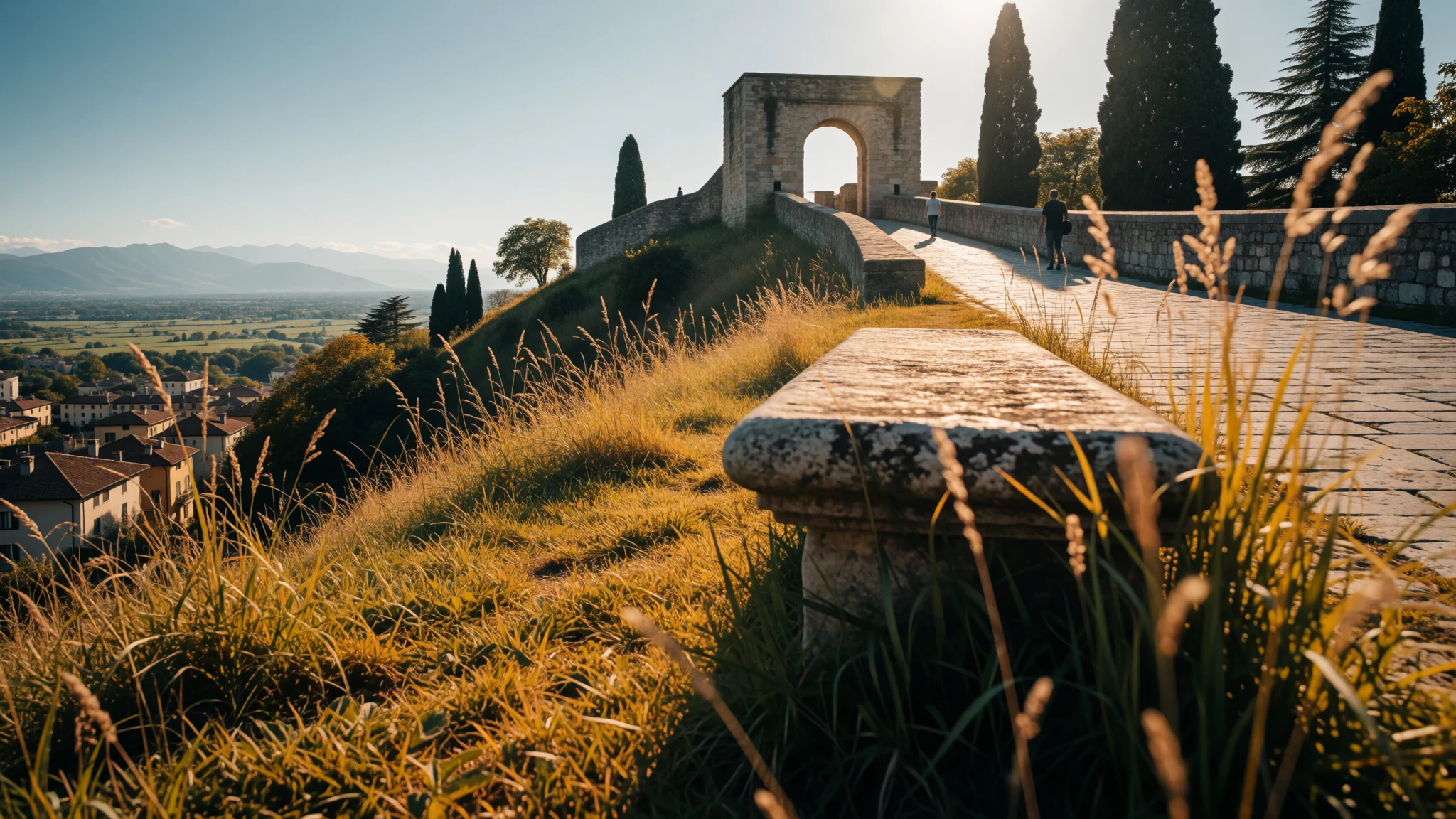
Bergamo is a medieval hill town inside Venetian walls, a short hop from Milan, that most air passengers skip and shouldn't.
The place
Bergamo sits in Lombardy, in northern Italy, a short way northeast of Milan, with the Alpine foothills rising directly behind it and the lakes of Como and Iseo within easy day-trip reach. The city is really two places. Città Alta, the Upper Town, is a walled medieval and Renaissance core on a hill, ringed by Venetian defensive walls that carry UNESCO World Heritage status. Below it, the modern city spreads across the plain with its shops, offices, railway station, stadium and the ordinary rhythm of Lombard working life. About 119,534 people live in the commune, which stands at an elevation of 249 m, and the surrounding built-up area is much larger and runs into Milan's wider sprawl. Most visitors arrive by air, because the airport, officially Il Caravaggio, is among the busiest in Italy and is served mostly by low-fare airlines that sell it as 'Milan Bergamo'. Many passengers board a coach straight to Milan and never see the town, which is a pity. Città Alta is compact, largely traffic-free in its heart, and rewards slow walking along cobbled lanes between stone houses, towers and churches. Locals speak Italian, and many also speak Bergamasque, in which the city is Bèrghem. The lower town is less photogenic but practical, with everyday restaurants, shops and the transport links. A funicular joins the two levels, and the views back over the plain, especially at dusk, are the real reason to make the climb.
Its story
Bergamo's story begins in the Iron Age, when a Ligurian people called the Orobii settled here. Celtic tribes, the Cenomani among them, took the hill soon afterwards. Rome made it a municipality and the Latin name Bergomum stuck; it served as a staging point on a military road running towards the Alpine provinces. Attila's forces destroyed the town in late antiquity, but the hill was too useful to abandon. Under the Lombards it became the seat of a duchy, one of the important ones in northern Italy, and after Charlemagne's conquest it passed to a count. By the high Middle Ages Bergamo had become an independent commune and joined the Lombard League, the alliance of northern cities that defeated the emperor Frederick Barbarossa. Later centuries brought a long rule from Milan's dukes and then from the Republic of Venice, whose engineers built the great defensive circuit that still wraps the Upper Town. After Venice came Napoleonic republics, Austrian administration, the Kingdom of Sardinia and finally the unified Kingdom of Italy. Each regime left something behind, which is why the old town mixes Lombard, Venetian and later civic architecture. A hoard of Lombard metalwork found nearby in the nineteenth century now sits in the British Museum, a reminder of how much of the area's early history lies beneath ordinary ground.
What to see
- Piazza Vecchia — Città Alta
Piazza Vecchia is the civic heart of the Upper Town, a square where medieval and Renaissance buildings face one another. Palazzo della Ragione, the Torre del Comune, Palazzo Nuovo and the Contarini Fountain all stand here. Come early or late for quiet; at midday it fills with tour groups and café tables.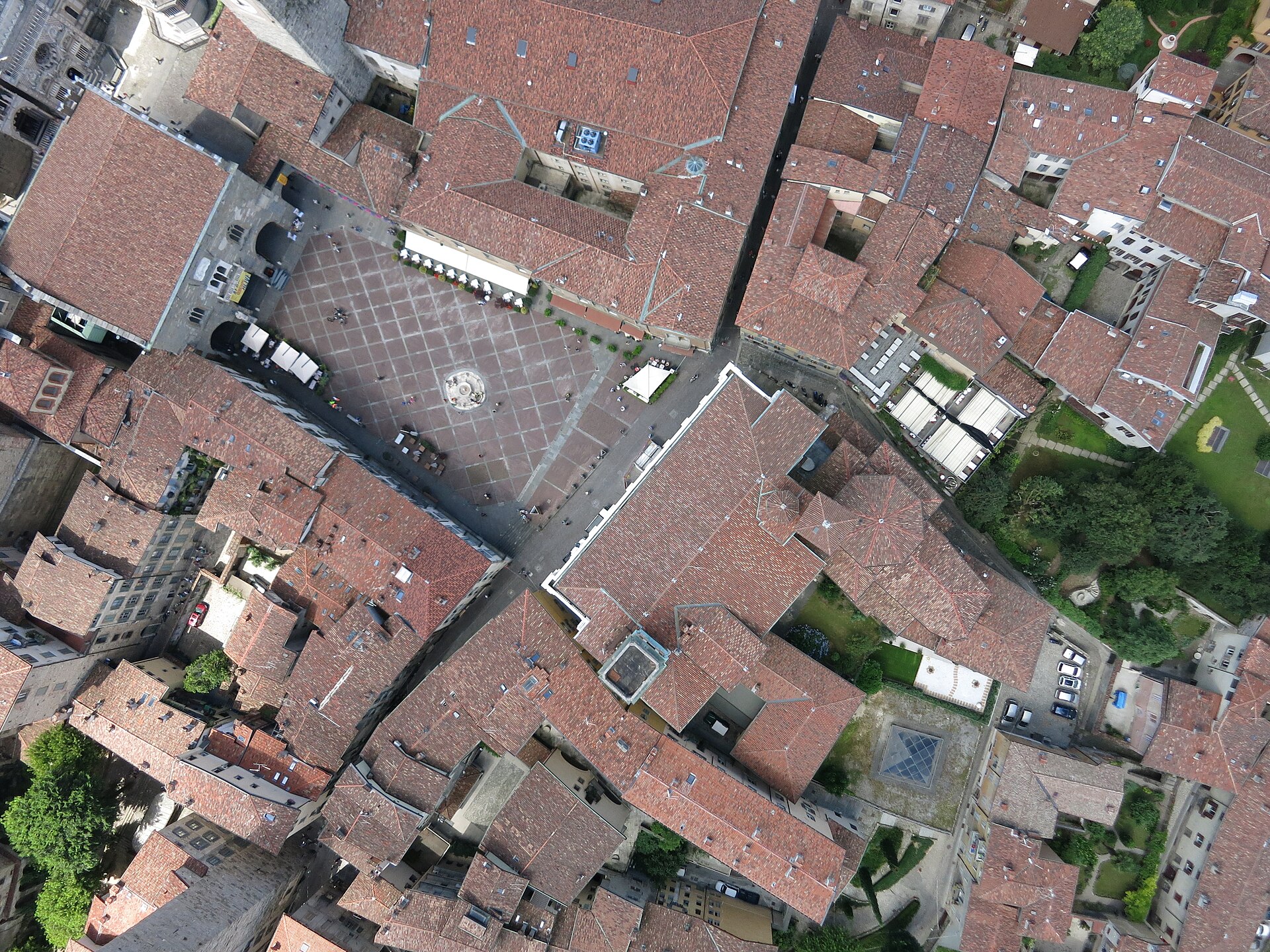
- Basilica of Santa Maria Maggiore — Città Alta
Santa Maria Maggiore is a medieval church that has been altered repeatedly, so its plain Romanesque exterior gives little warning of the crowded, ornate interior. Painters active in Bergamo, including Cavagna, Zucco and Salmeggia, made works for it. Check the official site for opening times and any ticketing. - Colleoni Chapel — Città Alta
The Colleoni Chapel is a Renaissance church and mausoleum attached to Santa Maria Maggiore, built in the fifteenth century. Its façade is clad in richly patterned polychrome marble, quite unlike the sober stonework around it. Photograph the outside in morning light, then step in for the tomb and decoration. - Venetian Walls — Around Città Alta
The Venetian Walls encircle the Upper Town in a ring of ramparts, bastions and gates, and they are the UNESCO-listed part of the city. Walking the top is free of traffic and gives wide views over the plain and towards the Alps. Wear shoes with grip, since the paving is worn and uneven.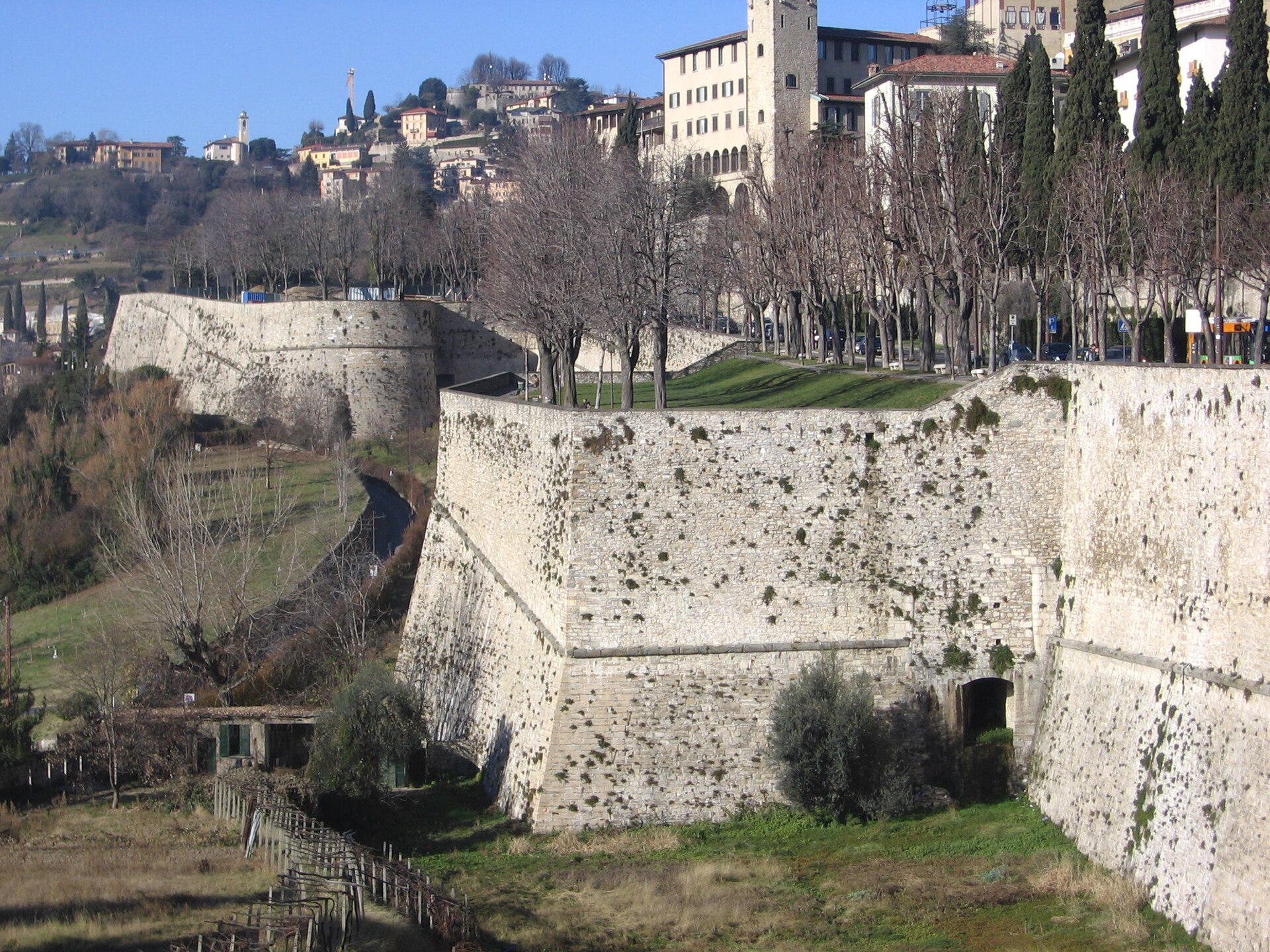
- Torre di Gombito — Città Alta, near Via Gombito
The Torre di Gombito is a medieval tower-house that rises over the street named after it. It belongs to the age of rival Guelph and Ghibelline factions, when families built tall to defend themselves and show power. It is best appreciated from below while strolling the main lane, with pastry shops close by.
Culture
Bergamo has a quietly proud local culture, shaped by centuries as a border city between Milan and Venice. Its dialect, Bergamasque, is still heard among older residents and in the surrounding valleys, and many locals identify strongly with the hills and the Alps beyond them. The city's best-known son is Gaetano Donizetti, born here in 1797, a leading name in bel canto opera alongside Rossini and Bellini; his work is still performed in the city and honoured with a festival and museum. Another native, the juggler Enrico Rastelli, gained international fame for his precise technique and is buried in the town, where a life-sized statue stands in his mausoleum. Painters including Cavagna, Zucco and Salmeggia filled the churches with altarpieces. Daily life in the Upper Town follows a familiar northern Italian pattern: a morning coffee standing at the bar, a long lunch, an evening passeggiata and aperitivo before dinner. Residents are reserved at first but warm when greeted in Italian, even with a few words. Shops often close in the early afternoon, and Sundays are slower. The city also carries recent grief from the pandemic, so respectful restraint around memorials is appropriate. In churches such as Santa Maria Maggiore, cover your shoulders and knees, keep your voice low, and do not photograph worshippers or use a flash.
What to wear
Bergamo has no everyday traditional costume today. Historically the surrounding Alpine valleys wore wool and linen garments typical of northern Italian rural life, with heavy woollen cloaks, felt hats and sturdy leather boots for shepherds and mountain farmers. Such outfits now appear only at folk festivals and in museum displays. In the city, people dress in the smart-casual way common across Lombardy: well-cut trousers, jackets, good leather shoes or clean trainers, and neutral colours, with scarves in cooler months. Dressing neatly matters more here than showing off, and the business crowd from nearby Milan sets a fairly polished tone, especially in the lower town on weekdays. Visitors should plan for layers. Summer is warm and can be humid, so light cotton or linen is sensible, while winter can be damp and cold enough for a proper coat, gloves and a hat. Footwear is the key choice, because Città Alta is cobbled and steep, and the wall paths are uneven; wear comfortable shoes with grip rather than smooth soles or heels. For churches, carry a light scarf or shawl, and wear tops and shorts or skirts that cover shoulders and knees. An umbrella or light rain jacket is useful in spring and autumn, when showers pass through frequently.
What to eat
- Casoncelli — Trattorias in Città Alta and the lower town
Casoncelli are half-moon filled pasta, a Bergamo staple, usually served with melted butter, sage and crisp pancetta. The filling varies between kitchens, often with meat, breadcrumbs and cheese. Order them at a traditional trattoria, and ask which version the house makes. - Polenta taragna — Mountain-style restaurants and trattorias
Polenta taragna is a hearty dish of maize and buckwheat flour stirred into a thick porridge, often with local cheese melted through. It suits cold days and comes alongside game, mushrooms or braised meat. Look for it on short, seasonal menus in older eateries. - Local cheeses — Delicatessens and cheese shops in Città Alta
The Alpine valleys around Bergamo produce several well-known cheeses, including Taleggio and Strachitunt, a blue-veined type. Delicatessens near the main lanes sell them by the slice with bread, honey or mustard. Ask the shopkeeper to suggest a mild and a strong one to compare. - Polenta e osei — Pastry shops along the main street of the Upper Town
Polenta e osei is a sweet disguised as a savoury: a small sponge-cake dome covered in yellow marzipan or icing, topped with chocolate 'birds' that imitate a traditional dish. It is easy to carry home as a gift from any good pastry shop. - Stracciatella gelato — Gelaterie in the Upper and lower town
Stracciatella is cream gelato with fine shards of chocolate running through it, and local gelaterie are proud of their link to the style. Eat a cone on the walls at sunset. Look for shops showing natural, uncoloured flavours.
Plan it
Best time. April–June and September–October, when days are mild and the hills are green or coloured. Summer is warm and can be humid, winter is cool and damp, and fog on the plain is common between late autumn and early spring.
How long. 1–2
Getting there. Fly into Il Caravaggio airport (Milan Bergamo), then take a bus or shuttle into the lower town; trains and a funicular or local bus continue up to Città Alta. Buses can be late, so leave generous time before a flight home. From Milan, regional trains and coaches also run to Bergamo.
Budget. mid
Tips
- Do the Upper Town early in the morning or at dusk to avoid day-trip crowds
- Check the official city website for church opening hours and any ticketing before you go
- Wear grippy, comfortable shoes for cobbles and the wall paths
- Carry some cash for small cafés and pastry shops, though cards are widely accepted
- Allow extra time for airport transfers, since buses can be unreliable
Etiquette
- Greet shopkeepers and café staff with 'buongiorno' before ordering
- Cover shoulders and knees in churches and keep voices low
- Do not sit on monuments or fountain edges in the main square
Nearby
Sources
- Wikidata Q628 (CC0)
- Wikipedia: Bergamo (rev 1383635581) (CC BY-SA 4.0)
- Wikivoyage: Bergamo (rev 5394919) (CC BY-SA 4.0)
- Photo: The Upper City of Bergamo. View from Via al Castello (Ввласенко) (CC BY 3.0)
- Photo: Bergamo, Città Alta (OpenStreetMap contributors) (CC BY-SA 2.0)
- Photo: Città Alta (Ptr11) (CC BY-SA 4.0)
- Photo: Mura Venete (Ago76) (CC BY 3.0)
- Photo: Cloudy day in Bergamo, view from Airport parking (Mykola Berkash) (CC BY 3.0)
- Photo: Bergamo Alta Panoramic View (Walkabout 88) (CC BY-SA 4.0)
- Photo: Bergamo de la drone, Piazza Vecchia (Anton00) (CC BY-SA 4.0)
- Photo: Bergamo, Palazzo Nuovo (Giorces) (CC BY 2.5)


