Amathus
Amathus, Cyprus
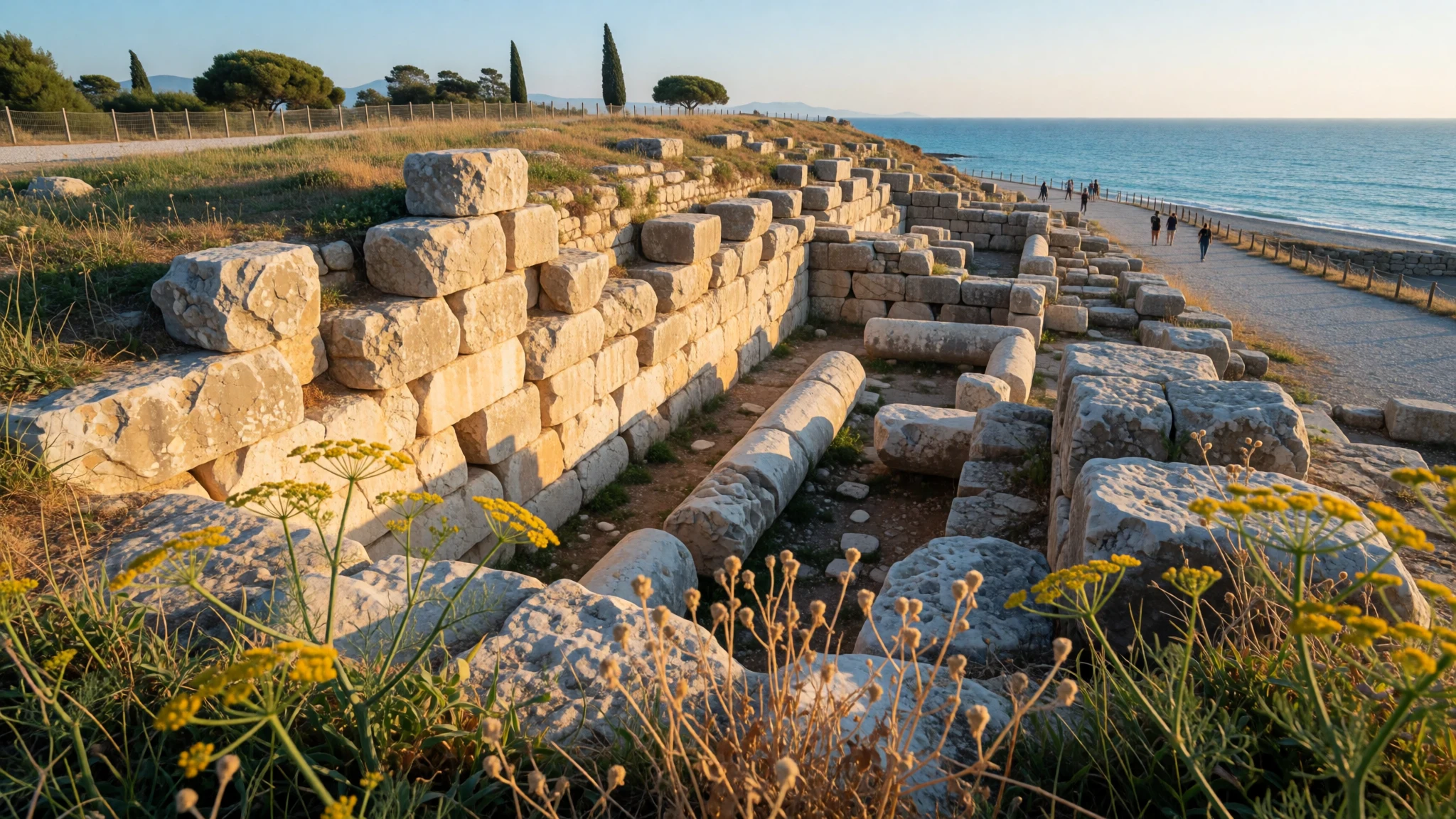
Walk among the sea-facing ruins of an ancient royal city-kingdom where myth intertwined with early Mediterranean trade and the cult of Aphrodite.
The place
Amathus sits on the southern coast of Cyprus, positioned upon elevated coastal cliffs that look out across the open expanse of the Mediterranean Sea. Situated near Agios Tychonas, the archaeological site lies approximately six miles east of Limassol and twenty-four miles west of Larnaca. This ancient polis was established as one of the primary city-kingdoms of the island, benefiting from a natural harbour that once welcomed merchant vessels from across the ancient world. Today, the landscape is defined by weathered stone blocks, fallen columns, and excavated foundations that stretch from the upper acropolis down toward the modern shoreline. Visitors wandering through the ruins encounter the enduring contours of an urban centre that traded extensively with the Levant and the Aegean. Archaeological fieldwork continues to uncover new layers of history across the terrain, while many of the most delicate portable artefacts recovered from the soil are preserved and exhibited in regional collections such as the Limassol Museum. The coastal position exposes the ruins to sea breezes and bright sunlight, making the site an atmospheric destination for travellers interested in the deep classical heritage of the eastern Mediterranean. The surrounding district blends ancient history with modern coastal development, offering easy access to the shore and nearby neighbourhoods where traditional Cypriot life continues alongside contemporary amenities.
Its story
The history of Amathus is deeply rooted in both archaeological evidence and classical mythology. Tradition holds that the settlement was founded by Cinyras, a legendary king linked with the birth of Adonis, who supposedly named the city after his mother Amathous. Another mythical strand attributes the foundation to Amathes, a son of Heracles. Classical accounts also connect the location to the Ariadne legend, recording that Theseus left Ariadne on the shore where she died and was buried within a sacred grove dedicated to Aphrodite Ariadne. Historical records indicate that the local population was largely autochthonous, preserving Eteocypriot speech and writing in the unique Cypriot syllabary long after the Bronze Age collapse. During the early Iron Age, foreign influences began to shape the community as Euboean Greeks left pottery on the site from the tenth century BC onward. By the eighth century BC, a palace and a port had been constructed to facilitate trade with Greek and Levantine merchants. High on the cliff, a prominent sanctuary was established to honour Aphrodite in her local manifestation as Aphrodite Amathusia, alongside a bearded male deity known as Aphroditos. The city eventually came under Ptolemaic rule in the three hundreds BC, marking another chapter in its political evolution. Throughout its long antiquity, Amathus served as a major religious and commercial node until natural changes, earthquakes, and shifting trade routes gradually led to its abandonment.
What to see
- The Upper Acropolis and Sanctuary — Upper terrace of the archaeological site
Perched high on the cliff overlooking the sea, the acropolis at Amathus contains the remnants of the ancient sanctuary of Aphrodite. Visitors can explore the foundations of the upper terrace, examine massive stone cisterns, and enjoy expansive panoramic views across the Mediterranean coastline. - The Lower Town and Agora — Lower archaeological zone
Sprawling toward the modern road, the lower city preserves the outlines of early public squares, grand columns, and ancient streets. Walking through these excavated sectors reveals the urban layout where daily civic life and commerce unfolded during the Hellenistic and Roman periods. - The Ancient Harbour Remains — Waterfront boundary of the site
Submerged and partially visible along the shoreline, the ancient port structures of Amathus demonstrate the city's maritime ambitions. Constructed to handle trade with the Levant and the Aegean, these stone breakwaters highlight the engineering skill of ancient Mediterranean builders. - Limassol Archaeological Museum — Limassol town centre
Located a short distance away in Limassol, this museum houses the portable treasures excavated from Amathus and surrounding sites. Visitors can inspect delicate pottery, terracotta figurines, coins, and monumental stone artifacts that bring the ancient city's material culture to life. - St. Raphael Marina and Coastal Path — Adjacent to the eastern edge of the site
Bordering the archaeological zone, the coastal pathway and nearby marina offer a pleasant walking route along the water. It provides an ideal spot to pause at a local cafe, look out over modern yachts, and reflect on the ancient maritime history of the shore.
Culture
Amathus and the surrounding Limassol district reflect the warm, hospitable character of contemporary Cypriot society, where influences from Greek and Middle Eastern traditions blend smoothly. Traditional community life often revolves around family gatherings, local parish festivals, and long-standing culinary customs passed down through generations. Hospitality is considered a fundamental social duty, and visitors are frequently welcomed with genuine warmth in village tavernas and neighborhood coffee shops. While the ancient site itself is an archaeological park open to quiet exploration, the surrounding region maintains a lively rhythm shaped by seaside living and seasonal tourism. English is widely spoken throughout the area, making communication effortless for international travellers navigating local transport or dining out. Traditional arts, including hand-woven textiles and pottery inspired by ancient motifs, are still practiced by local artisans who preserve the heritage of the island's long craft history. When visiting churches, monasteries, or sacred archaeological zones across Cyprus, dress modestly by covering shoulders and knees out of respect for local religious traditions.
What to wear
Traditional dress in the Amathus region historically reflected practical Mediterranean tailoring adapted to warm climates and rural labour. Men traditionally wore baggy trousers known as vraka, paired with cotton shirts, embroidered waistcoats, and cloth headscarves, while women wore woven cotton dresses adorned with intricate needlework and kerchiefs. Today, local residents dress in contemporary Western styles suitable for a warm coastal environment, favouring lightweight fabrics, linen shirts, and comfortable footwear for daily activities. Travellers exploring Amathus should pack breathable cotton and linen garments to stay comfortable under the strong Mediterranean sun. Sturdy walking shoes or trainers are essential for navigating the uneven stone terrain, rocky paths, and scattered ruins of the archaeological site. A hat, sunglasses, and high-factor sun protection are also necessary items for outdoor sightseeing, especially during the warmer months when midday temperatures rise significantly.
What to eat
- Souvla — Local tavernas and family-run grill houses
Large chunks of seasoned lamb, pork, or chicken slowly grilled over charcoal on long metal skewers. Found in traditional tavernas and village grills throughout the Limassol district. - Sheftalia — Traditional village tavernas and local food stalls
Traditional Cypriot pork sausages wrapped in caul fat rather than traditional casing, seasoned with finely chopped onions and fresh parsley. Best enjoyed hot from the charcoal grill at neighbourhood eateries. - Koupes — Local bakeries and morning street markets
Crispy fried bulgur wheat pastries stuffed with minced meat, onions, and aromatic spices, shaped into oblong cylinders. Commonly purchased as a savoury snack from bakeries and street food counters. - Halloumi — Any traditional taverna or breakfast café
The famous semi-hard, unripened cheese made from a mixture of goat and sheep milk, often grilled or fried until golden brown. Served across the island in salads, sandwiches, or as a meze starter. - Souvlaki — Local street-side grills and casual eateries
Tender pieces of marinated meat grilled on small skewers and served wrapped in soft flatbread with fresh salad, tomatoes, and tahini or yoghurt sauce. A popular quick meal found at neighbourhood takeaway shops.
Plan it
Best time. March to May and September to November offer pleasant warm weather ideal for exploring the open-air archaeological site without intense summer heat.
How long. 1–2
Getting there. Fly into Larnaca International Airport or Paphos International Airport, then take an airport shuttle, bus, or rented car along the coastal highway to the Limassol area.
Budget. mid
Tips
- Arrive early in the morning to explore the ruins before afternoon temperatures peak.
- Wear sturdy walking shoes suitable for uneven stone paths and rocky ground.
- Carry bottled water as shade is limited across the open archaeological site.
- Rent a car if you plan to explore surrounding archaeological sites along the southern coast.
- Check the official Department of Antiquities website for current opening hours and ticket details.
Etiquette
- Cover shoulders and knees when visiting active churches or religious shrines.
- Do not climb on fragile ancient walls or remove stones from the archaeological site.
- Ask permission before photographing local residents in nearby villages.
Nearby
Sources
- Wikidata Q2343313 (CC0)
- Wikipedia (rev 1379191594) (CC BY-SA 4.0)
- Wikivoyage (rev 5235363) (CC BY-SA 4.0)
- Photo photos/01-amathus.jpg (CC0 1.0)
- Photo photos/06-antigua-amatunte-chipre-2021-12-14-dd-16.jpg (CC BY-SA 4.0)

