Agadir
Agadir, Morocco
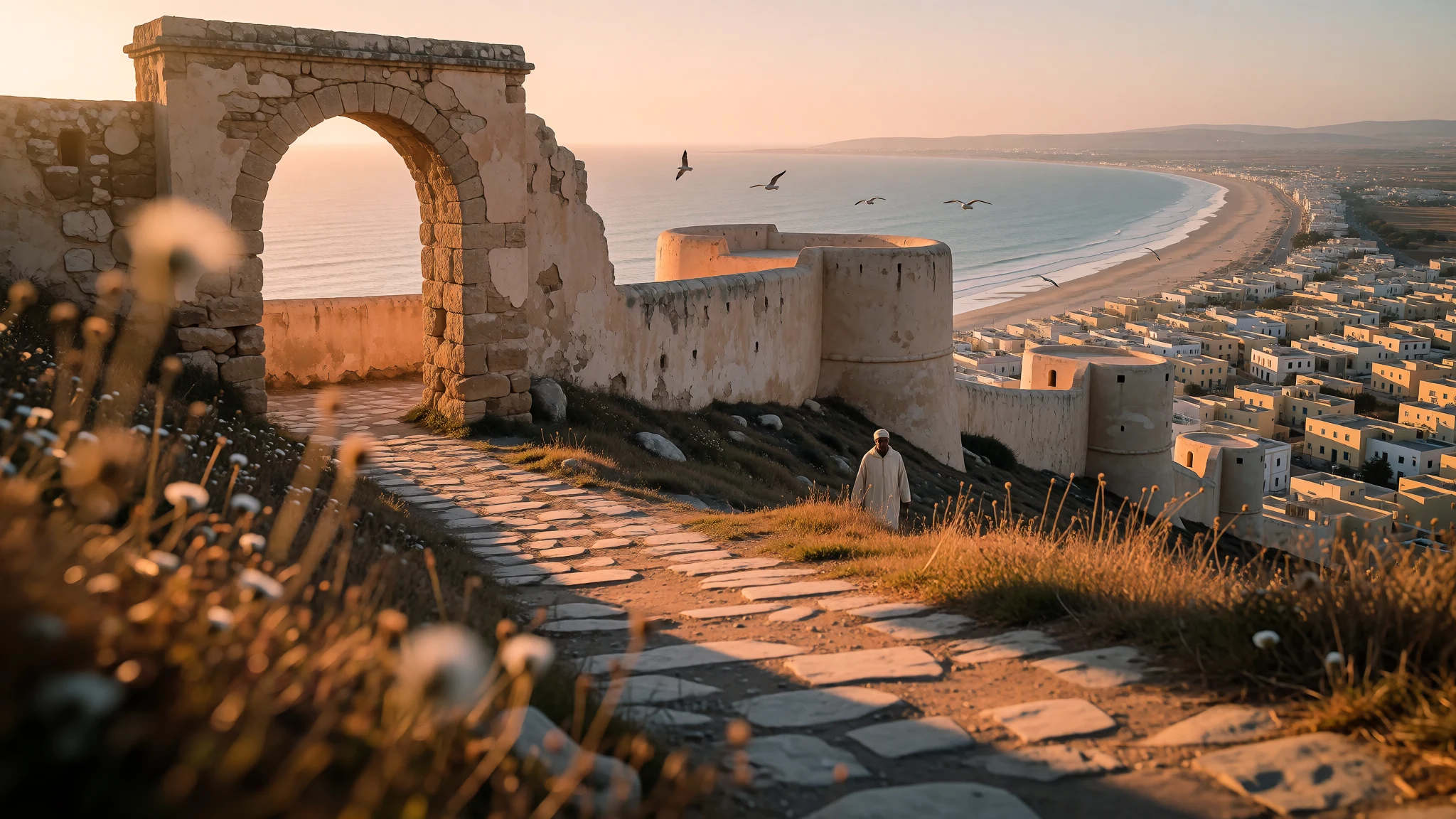
Agadir offers a wide Atlantic beach, a modern rebuilt city and a strong Amazigh identity, with surf villages and the Atlas close by.
The place
Agadir is a city on Morocco's Atlantic coast, where the foothills of the Atlas fall away to the sea and the Souss river meets the ocean a short way to the south. The commune counted 504,768 residents in the 2024 census, and the wider urban area, which runs into neighbouring towns such as Inezgane and Ait Melloul, is home to well over a million people. The centre sits about 74 m above sea level. Most of it is low-rise, pale and laid out on a grid, because the old town was largely lost in 1960 and the modern one was planned afterwards. A broad beach runs along the front, with a promenade, cafés and a marina behind it, while the hill to the north-west carries what remains of the old fortress, marked by a large painted inscription that can be read from town. Agadir is also the administrative seat of the Souss-Massa region, so it works as a regional hub for farming, fishing and tourism as well as for sun-seekers. Culturally it leans Amazigh: Tachelhit, the local Berber language, is heard in shops, taxis and markets more than in most big Moroccan cities, and the Amazigh New Year in January is marked across the centre. The sea breeze is steady and the weather mild, which suits walkers and surfers better than anyone hoping for still, scorching afternoons. Surf villages such as Taghazout and Aourir are close enough for easy day trips along the coast.
Its story
Agadir first shows up on a map from 1325, which labels the spot Porto Mesegina, after the Mesguina, a Berber tribe already on record in the 12th century. By the close of the medieval period the settlement had a name for itself, and the form Agadir al-harba was written down in 1510. In 1505 a Portuguese nobleman, João Lopes de Sequeira, claimed the site and put up a timber fort beside a spring below the hill. The colony was called Santa Cruz do Cabo do Gué, and the spring's name survives locally as Founti, from the Portuguese word for fountain. The Portuguese Crown bought the fort in 1513. The people of the Souss region did not accept the newcomers. They blockaded the port, economically and militarily, for years, and around 1510 Muhammad al-Qa'im, head of a Sharifian family settled in the region, was named leader of the local resistance. A map drawn in 1885 shows a much smaller place than today's city, and the modern character of Agadir comes from a single night: on 29 February 1960 an earthquake destroyed most of the town. The Memory of Agadir museum tells that story through photographs. Rebuilding gave the city its present wide streets, concrete frontages and low skyline. That is why Agadir feels young for a place with a Renaissance-era founding: very little survives from before the quake, and the older story is read from the fortress hill, a few walls, and old maps rather than from the streets.
What to see
- The Kasbah hill and fortress — Oufella hill, north-west of the centre
Agadir's old fortress stands on the hill above the city, beneath a huge painted inscription. What remains is mostly walls and a gateway, but the point of the visit is the outlook over the bay, port and grid of the rebuilt city. Walking up is possible; a taxi saves the climb. Go late in the day for softer light.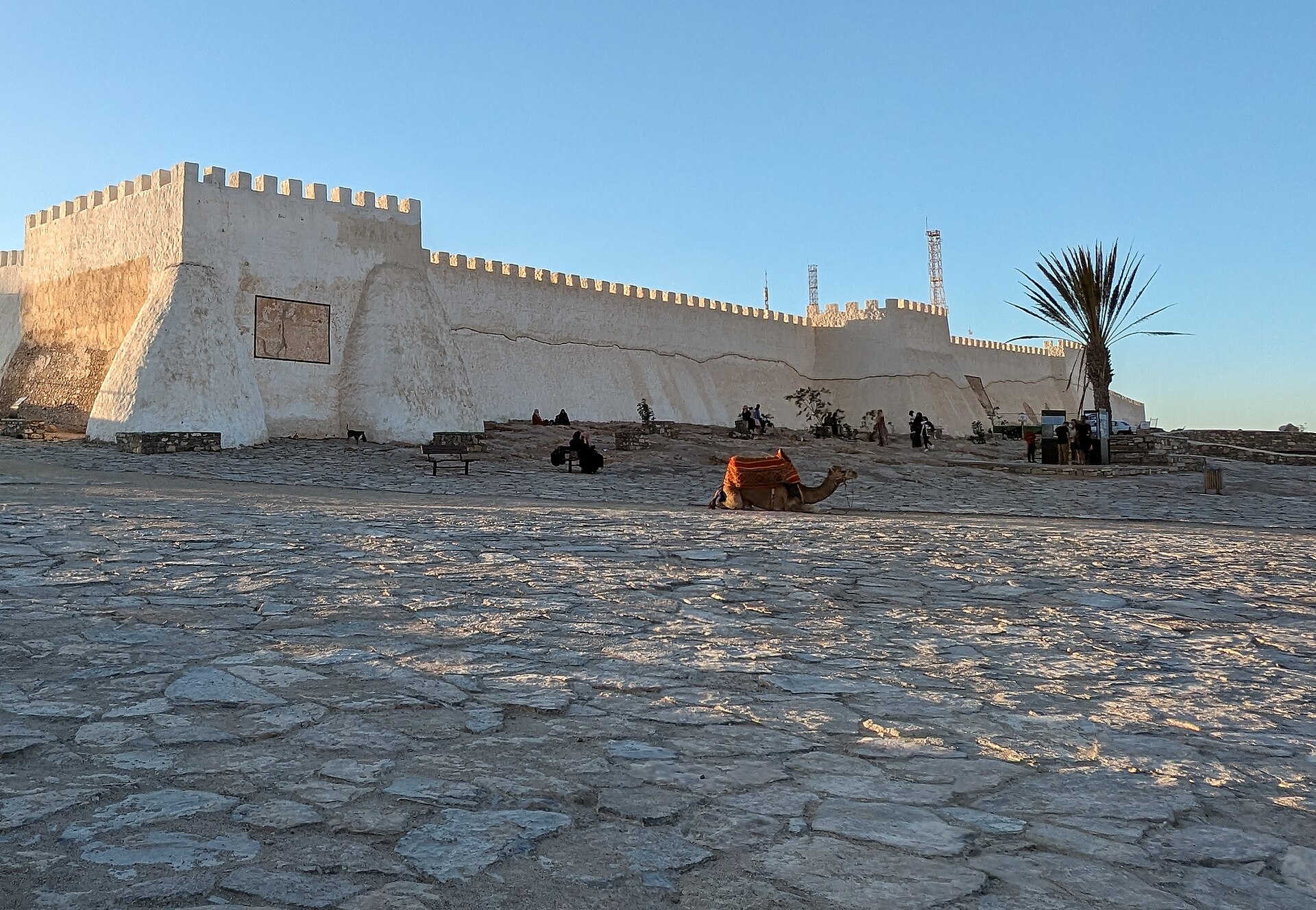
- The beach and promenade — Seafront, central Agadir
The beach is the city's main attraction: a long, open curve of sand that stays roomy even in busy weeks. The wind can be strong, notably in winter, so it suits walking, kite-flying and surfing more than quiet sunbathing. The promenade behind it has cafés and is pleasant at sunset.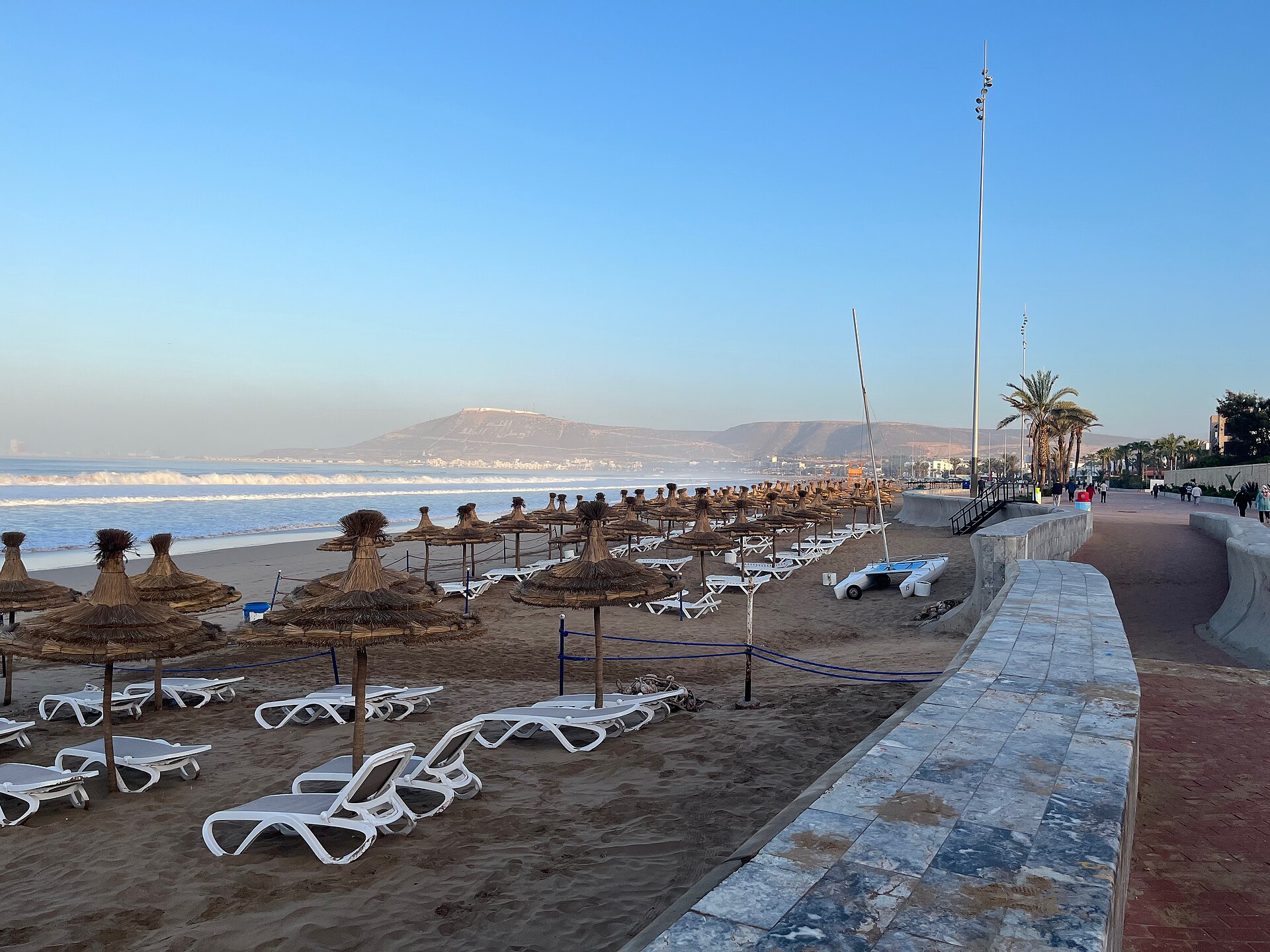
- Museum Municipal du Patrimoine Amazigh — Central Agadir
A small museum of Berber objects from the 18th and 19th centuries, including old musical instruments, silver jewellery, traditional clothing and manuscripts. It is a good first stop for making sense of the region's Amazigh identity, and it will not take more than an hour, which leaves the rest of the day free. - Memory of Agadir Museum — Central Agadir
A modest exhibition, mostly photographs, devoted to the earthquake of 29 February 1960 and the city it ended. The entrance is easy to miss, as the sign is missing and the way in is through iron gates on a corner. It explains why Agadir looks the way it does today. - Coco Polizzi's Medina — Bensergao, on the N1 south of the city
A recreated Moroccan medina built on the N1 road at Bensergao, south of the centre, as a stand-in for the old town that Agadir lost. It is an eccentric, made-up place, best treated as an outing rather than an authentic old quarter. Take a petit taxi and agree a pick-up time.
Culture
Agadir is often called the capital of Amazigh culture in Morocco, and the label holds up in daily life. Tachelhit, the regional Berber language, is spoken by more than half of the residents, and Tamazight is one of Morocco's two official languages, so Amazigh songs, greetings and Tifinagh lettering are part of the city's ordinary texture. The Amazigh New Year on 13 January is celebrated across the centre, and the Bilmawen festival, an older Berber tradition, belongs to the suburbs. The Timitar festival has brought Amazigh and world music to Agadir every summer since July 2004. The calendar also takes in documentary film in November (FIDADOC), a Concert for Tolerance, a university theatre festival, urban-music and break-dancing events, and a photography salon. Because the 1960 earthquake erased so much of the old city, the museums matter: the Amazigh heritage museum holds jewellery, instruments, manuscripts and clothing, and others tell the rebuilding story. Agadir is a resort as well as a working port, so it is relaxed with visitors, yet it remains a Muslim-majority city where family life, Friday prayers and Ramadan shape the rhythm of the day. Ask before photographing people, especially women and older residents, and keep voices and music low near mosques and during the call to prayer.
What to wear
Agadir's traditional dress is shared with much of southern Morocco, with Amazigh touches. Men and women wear the djellaba, a long hooded robe, in wool for winter and in cotton or lighter blends for warm months, most often on Fridays, feast days and family visits. The kaftan, a lighter ankle-length robe often in embroidered silk or brocade, is for weddings and celebrations. Pointed leather slippers called babouches are common, and Amazigh women's festive dress involves bold woven or embroidered cloth, headscarves and heavy silver jewellery, examples of which the Amazigh heritage museum displays. Day to day, most people in Agadir wear what any coastal city would: jeans, trainers, shirts and light jackets, with a djellaba pulled on over them for errands or prayers. Younger residents favour streetwear and surf labels, a nod to the coast. Visitors should pack for sun and wind together: light cotton layers, a windproof jacket for evenings and the beach, sunglasses and a hat. Swimwear is fine on resort beaches, but cover up in the city centre, in markets and near any mosque, with shoulders and knees covered. Wear sturdy trainers or sandals with grip for the climb to the fortress hill, where the ground is dry and stony.
What to eat
- Couscous — Traditional Moroccan restaurants in the centre, especially on Fridays
Steamed semolina piled with vegetables and lamb, beef or chicken, traditionally the Friday family meal. Many Agadir eateries serve it on that day, so a Friday lunch is the sensible time to try it. Portions are generous and meant for sharing. - Tajine — Family-run eateries around the old town and Talborjt district
Meat, fish or vegetables slow-cooked under a conical clay lid with olives, preserved lemon or dried fruit. Lamb with prunes and chicken with lemon are common versions. It arrives bubbling in the dish, with bread to scoop it up. - Brochettes — Grill restaurants near the seafront and around the central market
Skewers of marinated meat grilled over charcoal or wood, served with bread, salad and sometimes small bowls of relishes. A reliable, simple dinner, and the grill smoke is often the best signpost to a good place. - Grilled fresh fish — The fishing port and the fish stalls and restaurants beside it
As a fishing port, Agadir lands sardines and other Atlantic catch daily. Fish is usually grilled whole or fried, then served with lemon and salad. Choose a stall where the catch is on ice and busy with local diners. - Street sandwiches — Rotisseries and food counters around the central market
Roast chicken or grilled meat stuffed into fresh bread with salad and sauce, cooked at the counter and eaten standing. This is the quick Moroccan lunch, cheap and filling, and a good way to see how locals eat.
Plan it
Best time. April–May and October–November, when the weather is mild and the beach is comfortable. Winter days can be breezy and cool by the sea, and summer brings the most holiday crowds.
How long. 2–3
Getting there. Fly to Agadir's airport, then take an official taxi, the Alsa airport shuttle, or a bus or shared grand taxi via Inezgane; check current fares locally. There is no train to Agadir. Intercity buses connect from Essaouira, and from Marrakech, which also has many low-cost flights from Europe.
Budget. mid
Tips
- Agree the fare before getting into a taxi, or ask for the meter in a petit taxi
- Bring a windproof layer for the beach and evenings, even in sunny months
- Carry some cash for markets, small cafés and taxis
- Walk up to the fortress late in the afternoon for cooler air and softer light
- Use Agadir as a base for day trips to surf villages and the Atlas foothills
Etiquette
- Dress modestly away from the beach, covering shoulders and knees in markets and near mosques
- Ask before photographing people, especially women and older residents
- Keep alcohol and loud behaviour out of public streets
Nearby
Sources
- Wikidata Q170525 (CC0)
- Wikipedia: Agadir (rev 1384732012) (CC BY-SA 4.0)
- Wikivoyage: Agadir (rev 5423618) (CC BY-SA 4.0)
- Photo: Areal view of Agadir, Marco Riss (CC BY 3.0)
- Photo: South view sea side from Kasbah of Agadir Oufella, Abdeaitali (CC BY-SA 4.0)
- Photo: Kasbah of Agadir Oufella, Mwintirew (CC BY-SA 4.0)
- Photo: Marina Agadir yacht terminal 2020, Abdeaitali (CC BY-SA 4.0)
- Photo: Sea side in Agadir, Anthere (CC BY-SA 4.0)
- Photo: Belvedere Park in Agadir, SkyeyIncrease (CC0 1.0)
- Photo: Agadir, la porte de l'ancienne Kasbah, Daniel*D (CC BY-SA 1.0)
- Map of Agadir in 1885, Jules Erckmann (Public domain)


