Acrocorinth
Acrocorinth, Greece
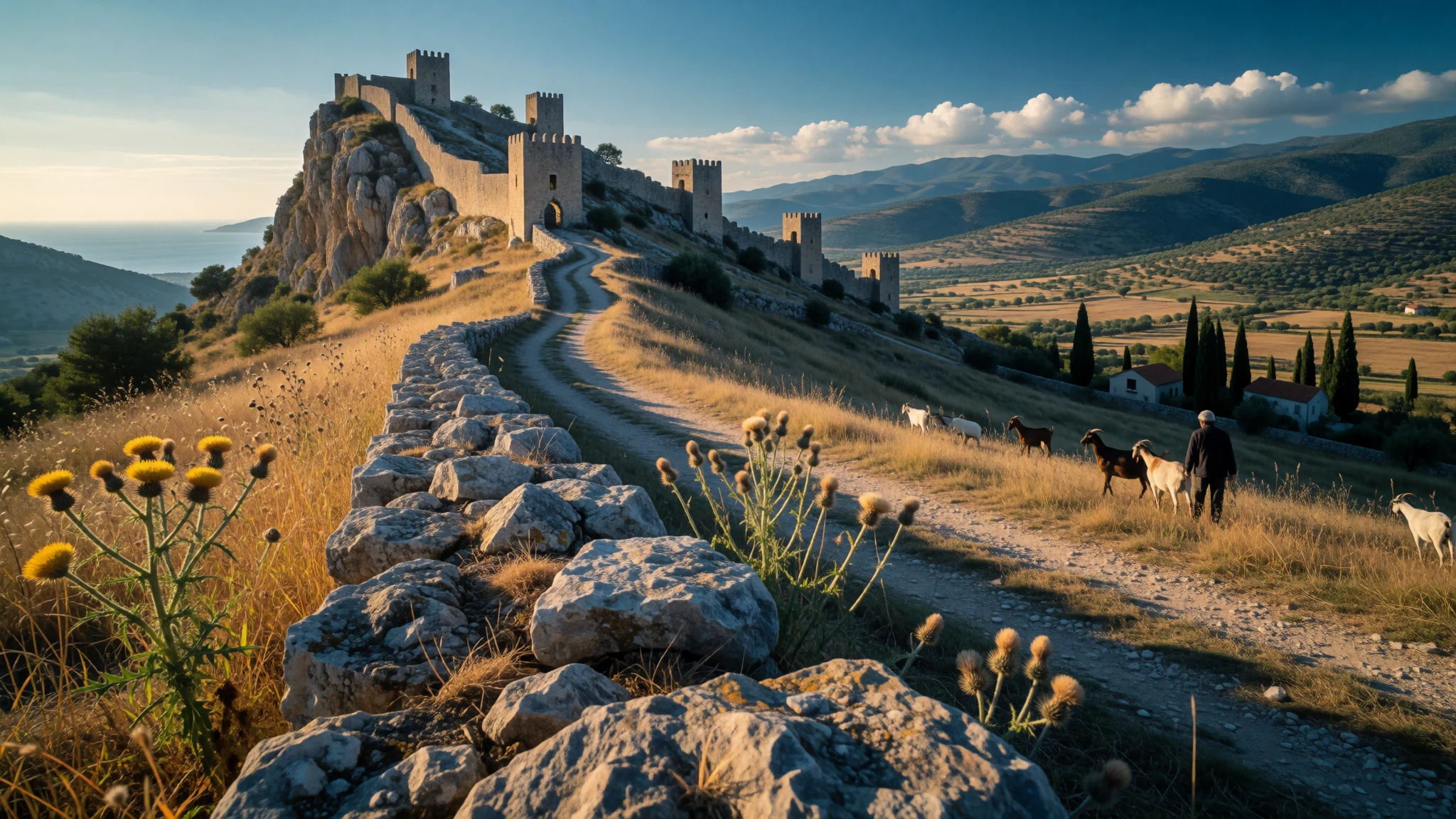
Acrocorinth is a walled rock above ancient Corinth, where a walk through layered fortifications ends with wide views over the isthmus and the Peloponnese.
The place
Acrocorinth is a great rock of a hill rising behind the modern town of Corinth in the Peloponnese, Greece, with its summit at 575 m. Its Greek name means 'Upper Corinth', and for the ancient city below it served as the acropolis, the high refuge and stronghold. From the walls the view runs across the Gulf of Corinth, the narrow isthmus that joins the Peloponnese to the rest of mainland Greece, and the plain of farmland and villages beneath. That position is the whole point of the place: whoever held the rock could watch and control the land route into southern Greece. A dependable water supply meant a garrison could sit out a long siege, which is why the fortress was used again and again as a last line of defence. Today it is a sprawling hilltop of walls, gateways, towers, cisterns and half-collapsed buildings from several eras, rather than one tidy monument. The ground is stony and steep, shade is scarce, and the summit is broad enough that a proper visit takes hours rather than minutes. Crowds are thin compared with Athens, and on a weekday morning outside summer the place can feel almost empty. The ancient site of Corinth lies at the foot of the hill, and the two are easily paired in a day, though the fortress is the more physical of the pair. The hill was settled from around 700 BCE, and the fortifications seen now are mostly medieval layers on far older foundations.
Its story
Acrocorinth was lived in continuously from archaic Greek times until the early 19th century, and almost every power that wanted the Peloponnese ended up holding it. In the Hellenistic period the Macedonians garrisoned it as one of three strongholds, along with Demetrias and Chalcis, that kept the Greek city-states under control; the trio was nicknamed the 'Fetters of Greece'. Later, in the Byzantine era, the rock became the seat of the military governor of the province of Hellas and then of the Peloponnese, and its defences were strengthened accordingly. When the Crusaders arrived, a defender named Leo Sgouros held out against them for three years. The fortress then passed to the Frankish Principality of Achaea, to the Venetians and finally to the Ottomans, each of whom left repairs and additions. The result is a hill ringed by three lines of wall, built and rebuilt across the centuries. At the highest point once stood a temple of Aphrodite. That building was turned into a church, and the church later into a mosque, a pattern of reuse that says much about how sacred ground changes hands. Systematic archaeology began in 1929, when the American School's Corinth Excavations started work on the hill, and the site is now studied as a major example of a medieval castle in Greece.
What to see
- The outer gate and walls — North side of the rock
The main approach climbs to the entrance in the outermost of the three circuit walls. Heavy masonry, towers and a sequence of gateways show how the defences were layered, each ring a fresh obstacle. The stonework changes from one phase to the next, with older Greek courses patched by medieval repairs.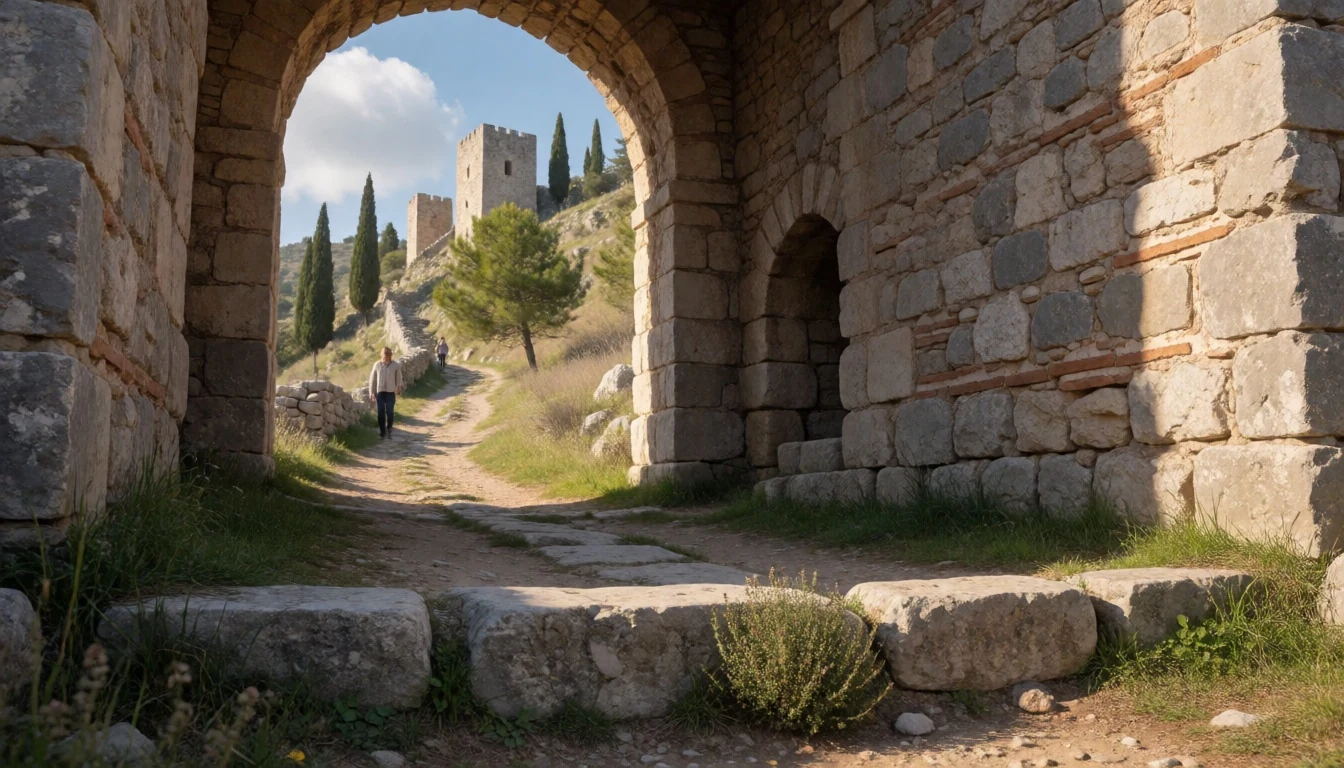
- The summit and the Aphrodite site — Highest point of the hill
The highest point of the rock once carried a temple of Aphrodite, later a church and then a mosque. Little stands today, but the summit gives a wide view over the Gulf of Corinth, the isthmus and the Peloponnese hills. Wind is common up here, so a layer helps even on warm days.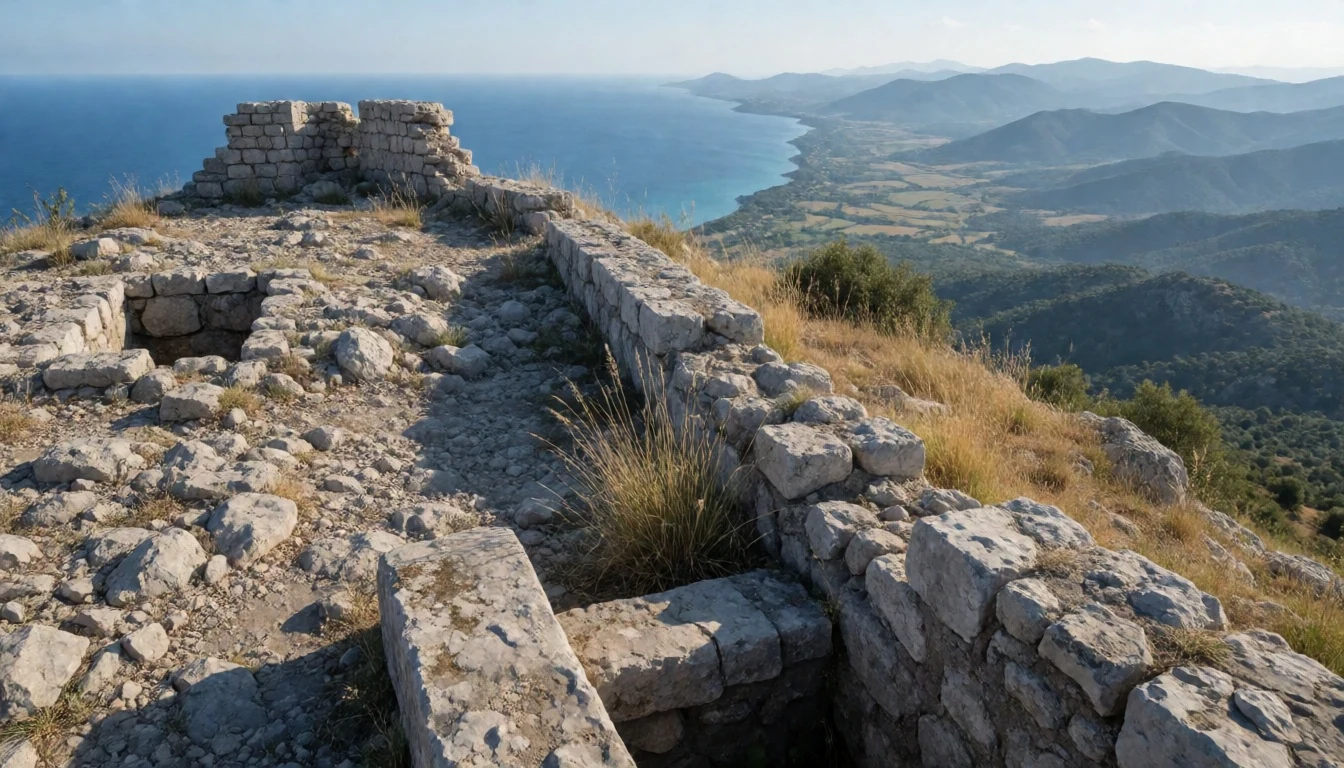
- The medieval interior — Within the circuit walls
Inside the walls lie scattered remains from later centuries: cisterns, small chapels, house foundations and Ottoman-era buildings. Walking the interior is like reading layers of Frankish, Venetian and Ottoman life. Paths are uneven and not always marked, so allow time and watch your footing on loose stone.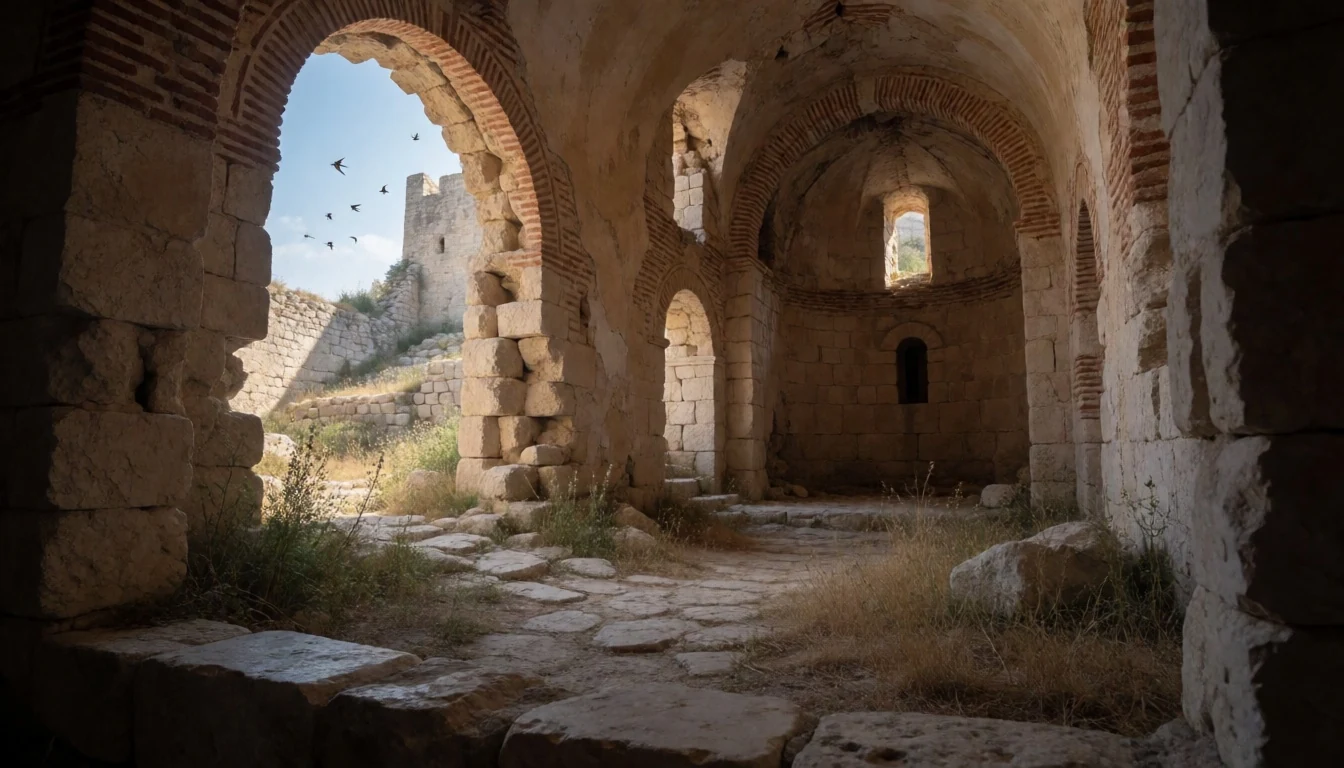
- Temple of Apollo at ancient Corinth — Ancient Corinth, below the rock
At the foot of the hill, the ancient city of Corinth keeps the columns of the Temple of Apollo, with the rock looming behind. Seeing town and fortress together explains why the acropolis mattered. Allow time for the museum and agora too, and check the official site for opening arrangements.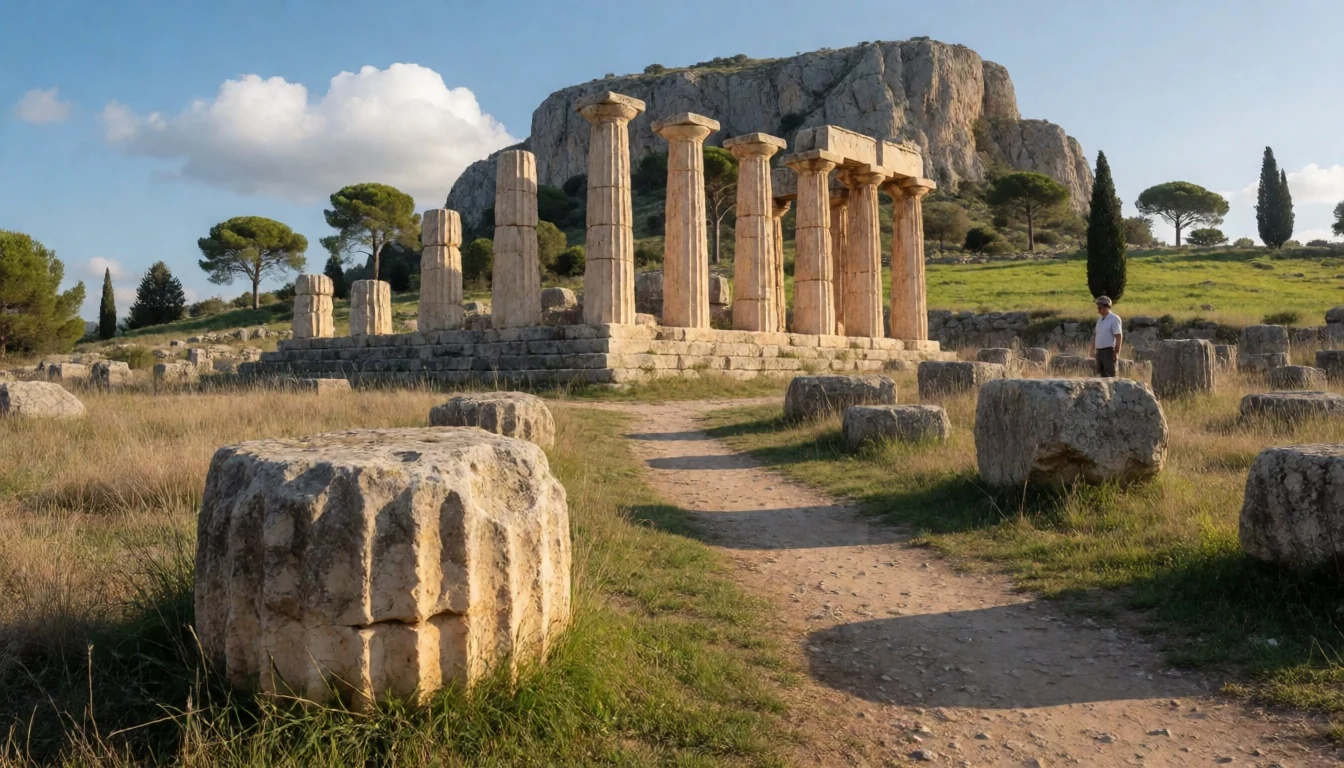
- The rock seen from below — Corinth town and the approach road
Looking up from the lower town or the approach road, Acrocorinth appears as an abrupt block of grey stone crowned with walls. It is a useful way to grasp its scale before the climb. Early morning and late afternoon light bring out the texture of the cliffs.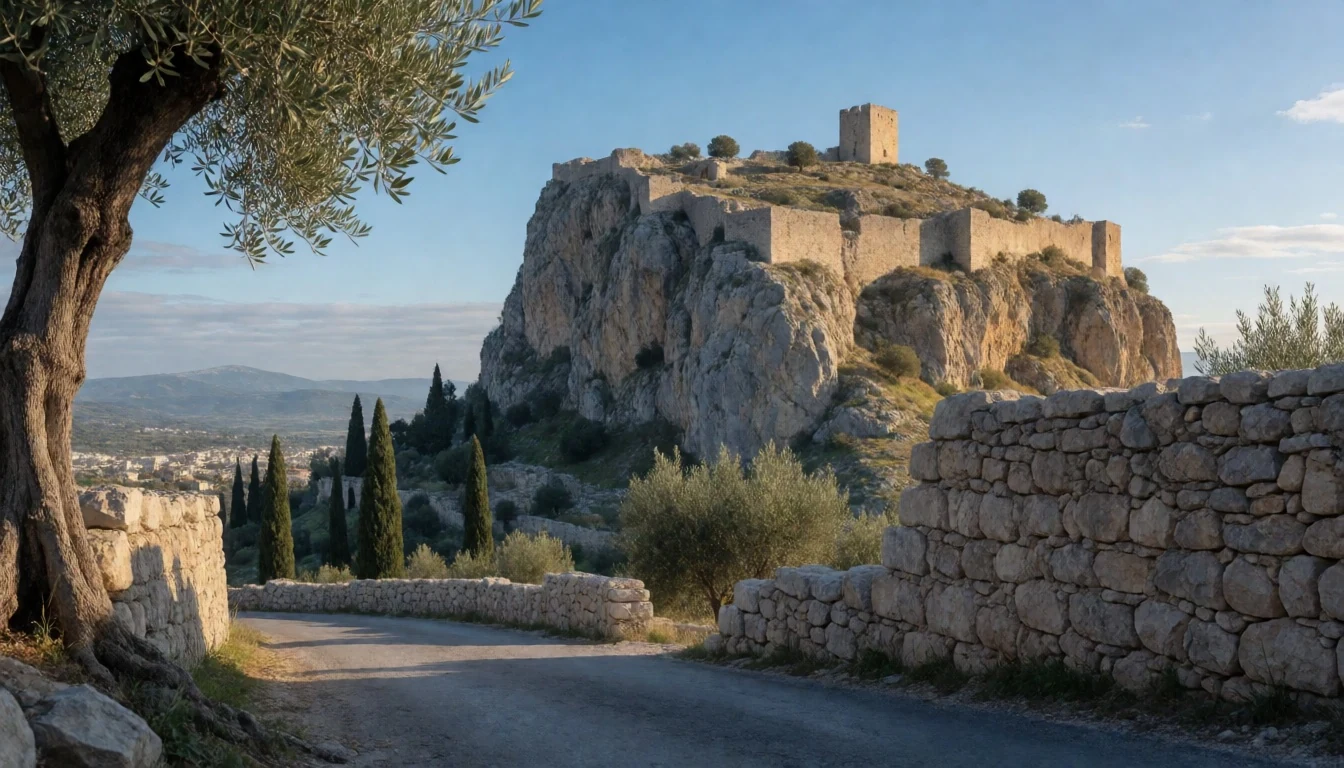
Culture
Acrocorinth sits in a part of Greece where layers of history are part of daily conversation. People in Corinth and the surrounding villages treat the hill as a familiar landmark rather than a museum piece. The site itself shows how worship moved with power: a temple of Aphrodite, then a church, then a mosque, each faith reusing the same summit. Orthodox Christianity remains central to Greek life, and small country chapels are tended by families, with candles and icons kept fresh. Hospitality shows in the village café, the kafeneio, where coffee and a spoon sweet arrive with unhurried conversation and nobody rushes a guest. Meals are late by British or Indian standards, often starting after dusk in summer, and the early afternoon is quiet. Greeks tend to be direct and warm with strangers, and a few words of Greek, such as kalimera for good morning and efharisto for thank you, are warmly received. Archaeological remains are treated as national heritage, so the stones on the hill are not souvenirs. Visitors should keep to the marked paths, never climb on the walls, and leave every stone and pottery fragment exactly where it lies.
What to wear
Acrocorinth lies in the Peloponnese, where traditional dress survives mainly as festival and ceremonial costume. The best-known piece is the foustanella, a pleated white kilt of cotton or linen, worn with an embroidered waistcoat and tasselled shoes by ceremonial guards in Athens and by dance groups on national days. Women's regional dress used layered chemises of linen or cotton, overdresses of wool or silk, and heavy embroidery that varied from village to village. These outfits appear at church festivals, parades and weddings. In everyday life, people in Corinth dress like most of southern Europe: jeans, light shirts, linen in summer and smart-casual clothes for the evening stroll. Some older villagers still favour dark, practical clothes. Visitors should dress for the terrain and the sun first. Wear sturdy shoes with good grip, since paths are loose stone and worn rock can be slippery. Bring a wide-brimmed hat, sunglasses and sunscreen, light long sleeves or trousers for the exposed summer walk, and a windproof layer for the summit. For any church or monastery nearby, cover shoulders and knees. Modesty norms are relaxed in town, but beachwear belongs at the beach.
What to eat
- Souvlaki — Grill shops around Corinth town centre
Skewered grilled pork or chicken, usually wrapped in flatbread with tomato, onion and yoghurt sauce, or served on a plate with chips. It is the standard quick meal in Greek towns and a sensible refuelling stop after the climb.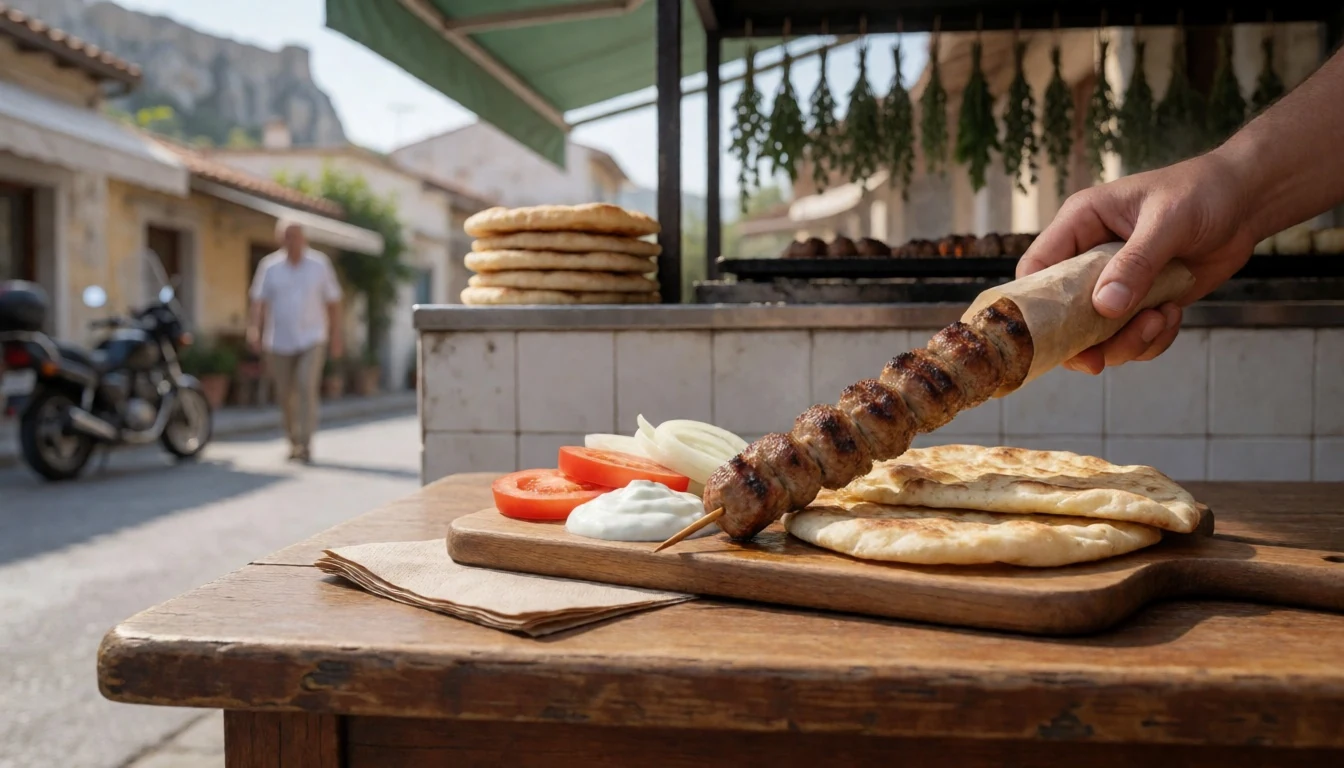
- Horiatiki salad — Any family taverna in Corinth or the villages below the rock
The village salad of ripe tomato, cucumber, onion, olives and a slab of feta, dressed with olive oil and oregano. Its quality depends on the season, and it is at its best in late summer, when tomatoes are fully ripe.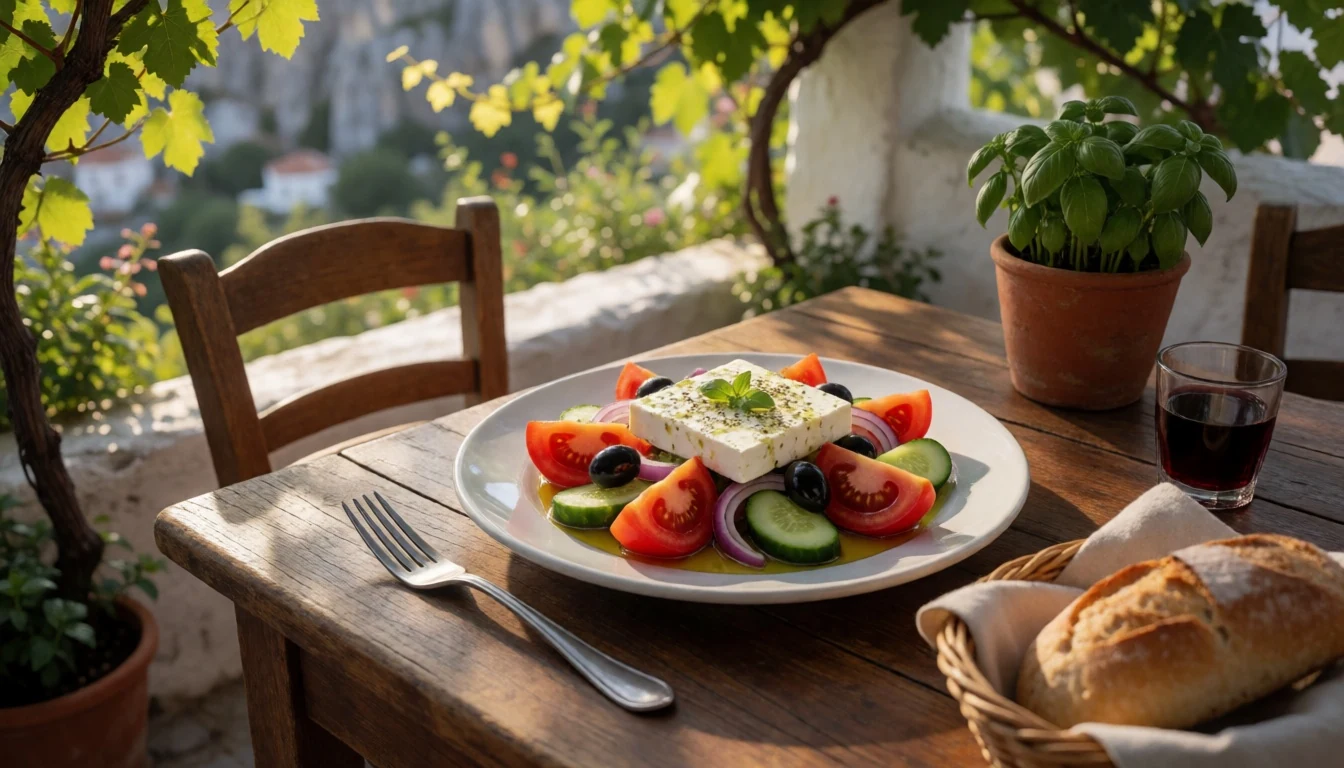
- Spanakopita — Neighbourhood bakeries in Corinth
Crisp filo pastry filled with spinach, feta and herbs, eaten warm as a breakfast or snack. It is easy to carry, vegetarian and filling, which makes it useful for a morning on the hill. - Corinthian currants — Grocery shops and the town market in Corinth
Small dark dried grapes, called stafida in Greek, long associated with the Corinthia region. They are sold loose or in bags, and work well as a trail snack or as a light, portable gift to take home. - Greek coffee — Any kafeneio or café on a town square
Strong, finely ground coffee boiled in a small pot and served in a small cup with the grounds left to settle. Sip it slowly and leave the last mouthful. It usually comes with a glass of water.
Plan it
Best time. March–April and November. Spring is green and mild, and autumn is warm without the peak heat. July and August are hot with almost no shade on the rock, and winter can be wet and windy on the summit.
How long. 1–2
Getting there. Fly into Athens International Airport, then take the suburban railway or an intercity bus to Corinth. The last leg to the fortress gate is by taxi or hire car, which is the easiest way to reach the entrance and to combine it with ancient Corinth.
Budget. low
Tips
- Start early in warm months, as the walk is exposed and shade is scarce
- Carry plenty of water, since you cannot count on buying any once you are up on the hill
- Check the official site for current opening arrangements and any entry charge before you travel
- Wear shoes with grip and allow a few hours, because the summit area is wide and the ground is uneven
- Pair the visit with ancient Corinth at the foot of the hill, and keep a layer for the wind at the top
Etiquette
- Stay on the paths and keep off the walls, which are old and can be unstable
- Never take stones, tiles or pottery fragments, as the site is protected heritage
- Cover shoulders and knees when entering any chapel or church nearby
Nearby
Sources
- Wikidata Q420810 (CC0)
- Wikipedia: Acrocorinth (rev 1361170923) (CC BY-SA 4.0)
- Wikivoyage: Corinthia (rev 3707835) (CC BY-SA 4.0)
- Castle of Acrocorinth — MM (Public domain)
- Acrocorinth. Entrance. (View to west) — elveoflight (CC BY 3.0)
- Akrokorinth — Vancouverquadra at English Wikipedia (Public domain)
- Map of the remains of Acrocorinth (english version) — Nicolas von Kospoth (Triggerhappy) (Public domain)
- Corinth with Akrocorinth — Carl Rottmann (Public domain)
- View of the Corinthian acropolis — Institute for the Study of the Ancient World (CC BY 2.5)
- Vue de la forteresse de l'Acrocorinthe en Grèce — Jean Housen (CC BY-SA 4.0)
- Temple Apollo, Corinth. Acrocorinth in the background — elveoflight (CC BY 3.0)


