Yungang Grottoes
Yungang Grottoes, People's Republic of China
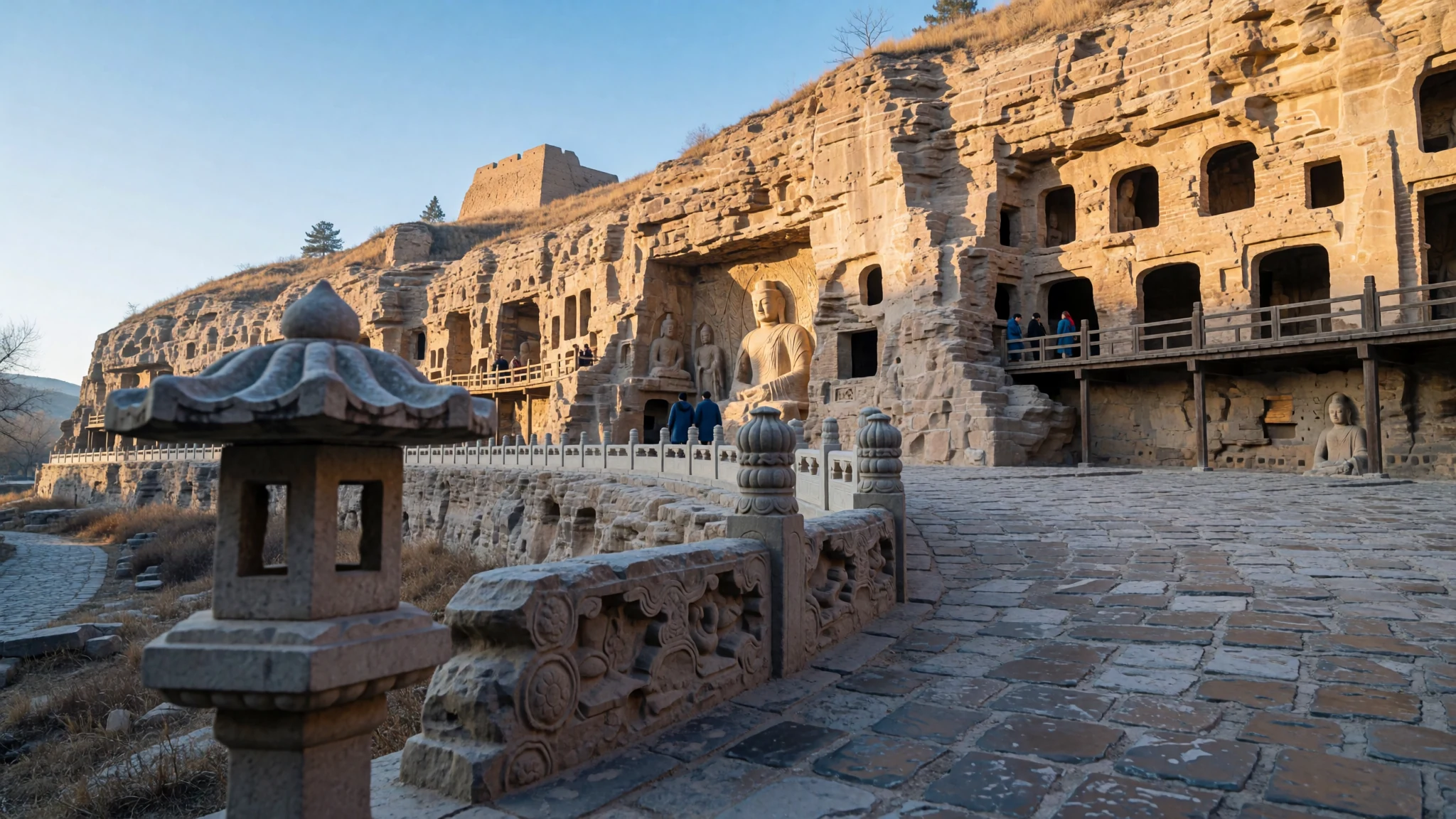
A vast cliffside of Buddhist carving outside Datong, best seen in October when the valley is mild and comfortable to walk.
The place
The Yungang Grottoes sit in the valley of the Shi Li river, about 16 km west of Datong in Shanxi province. The caves are hollowed from a rock wall facing south, a stretch of soft sandstone running along the foot of the Wuzhou Shan mountains. The approach is a flat walk beside the rock rather than a climb, and the cliff reveals itself as a continuous wall of niches, doorways and seated and standing figures. Across the site there are about fifty major caves and tens of thousands of niches holding Buddha images, along with many smaller grottoes. A Ming dynasty fort still stands on top of the cliff, a reminder that the hill has served as a military position as well as a shrine. The grottoes are one of three celebrated ancient Buddhist carving sites in China, alongside Longmen and Mogao, and UNESCO inscribed them as a World Heritage Site in 2001. Because the rock is soft, wind, rain and winter frost have worn many of the figures, and conservation work is visible in scaffolding and protective structures over some caves. Give yourself half a day at least. The stone is striking, but the scale rewards slow looking, and the temples in Datong city make a useful second stop.
Its story
The story starts with the Tuoba, a people who took control of northern China after the Western Jin dynasty declined and ruled as the Northern Wei. They chose Pingcheng, the city now called Datong, as their capital, and the city grew quickly on the back of that status. The Northern Wei adopted Buddhism as their state religion early on. The faith reached this region along the northern branch of the Silk Road, the trade route that linked the old capital at Chang'an with the western regions. Carving began in the valley during the fifth century. The first group of caves was finished by the middle of that century. A second wave followed in the late fifth century, with paired caves and larger halls commissioned with imperial support. That patronage ended when the court moved south to Luoyang, and the later caves were funded by private donors, families and officials seeking religious merit. Work continued into the early sixth century until unrest in the area brought it to a halt. Afterwards the cliff was no longer carved on the same scale. Centuries of exposure have worn the sandstone, and many carvings in the open air are now soft and blurred. Parts of the site have been stabilised, but the weathering is ongoing, and it is one reason the original paint and fine detail survive mainly in the sheltered caves.
What to see
- The cave cliff — Wuzhou Shan valley, about 16 km west of Datong
The main attraction is the carved cliff itself, where the caves run in a long line along the valley. Start at the western end if you want the oldest sections, then work eastward through the groups of larger caves. Look up as well as ahead, because some of the most intricate carving sits high on the rock face. Allow a couple of hours to walk the length of the site at a steady pace, with plenty of stops for the details.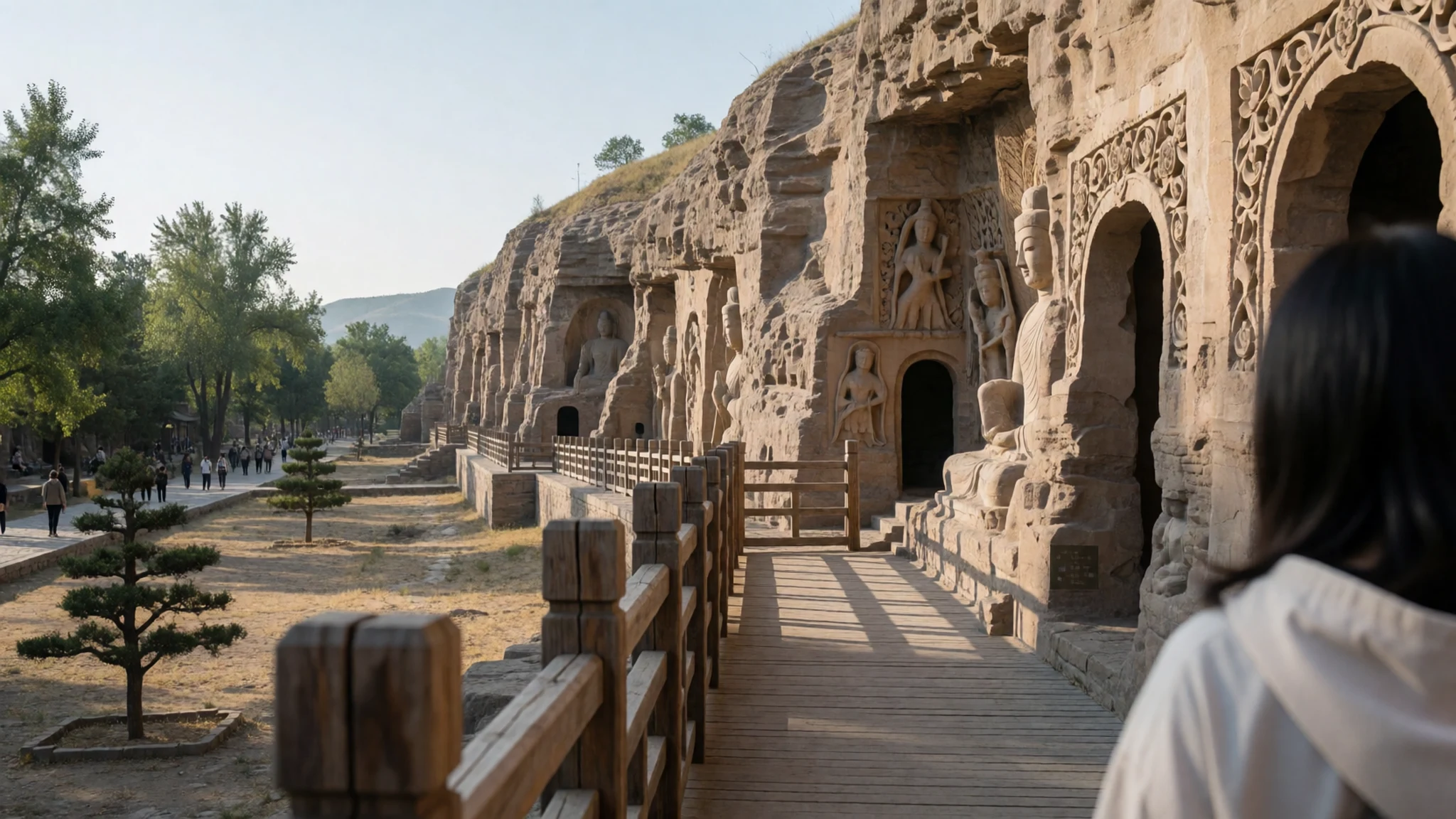
- Huayan Monastery — Datong city centre
Huayan Monastery, in the city, is widely described as the largest surviving Liao and Jin dynasty temple in China. It was built under the Liao and repaired in later dynasties, and its halls hold sculptures and a library-style building from the Liao era. The complex is large and formal, so it feels different from the rock-cut caves. Expect a walk through courtyards and a chance to see how Buddhist architecture developed in the north.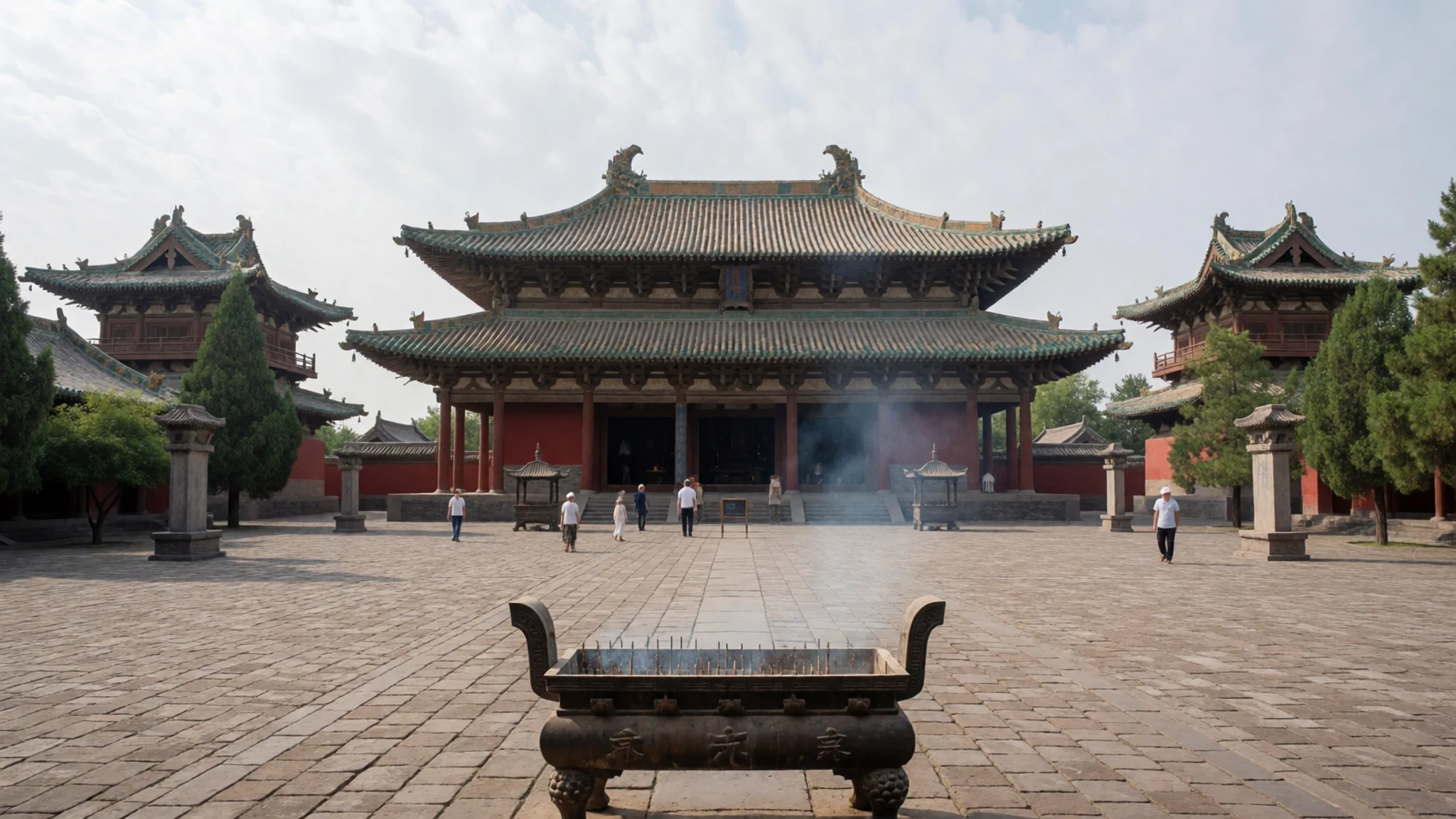
- Shanhua Ancient Monastery — Datong old city
Shanhua Ancient Monastery has a history of rebuilding. It was founded in the Tang dynasty, rebuilt under the Liao, badly damaged in war, and restored again in the Jin dynasty. The surviving halls are modest in scale, which makes the site quieter than the big temples in town. It suits a slower visit, with time to look at the timber structures and the mixture of periods they show.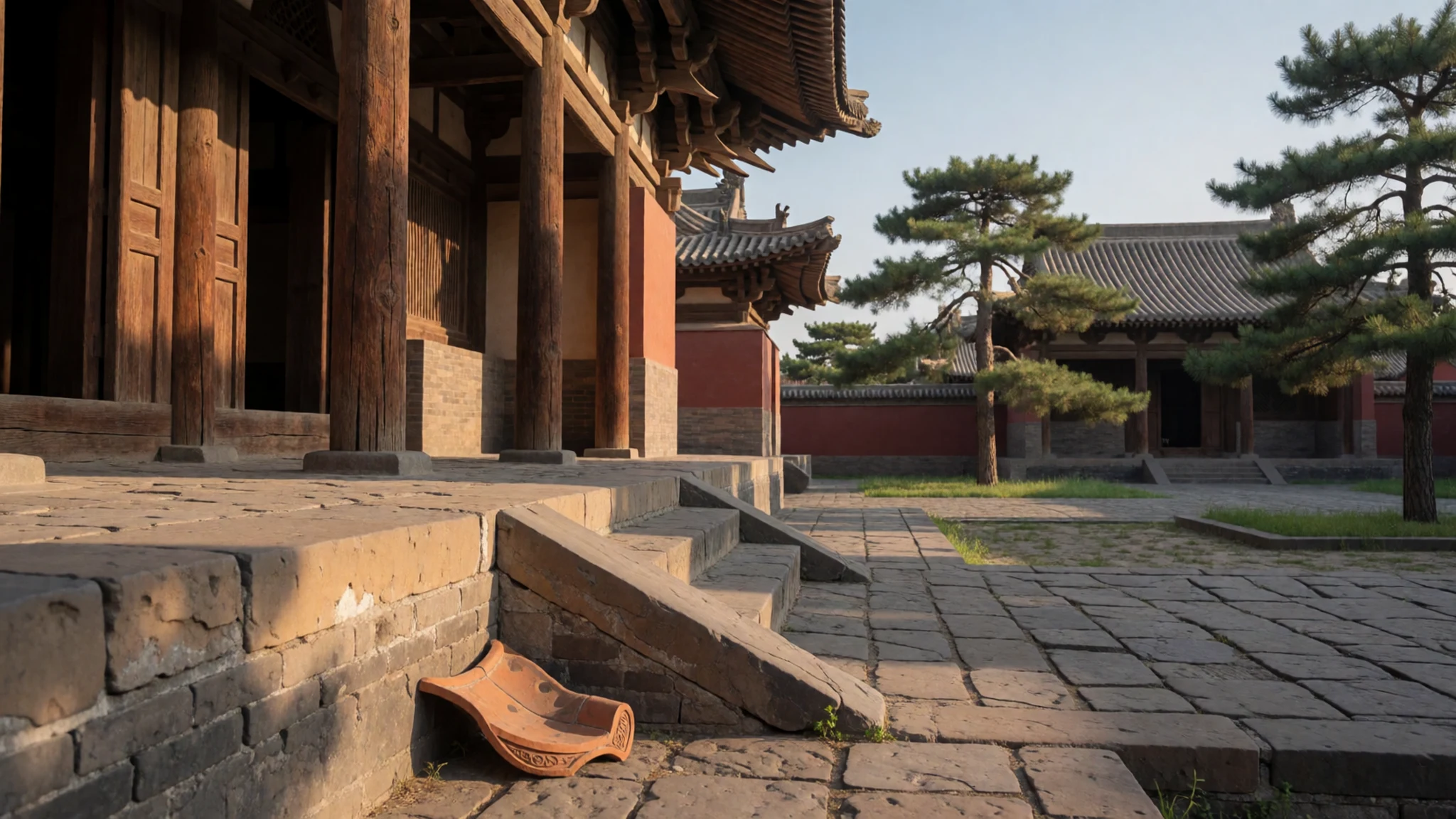
- Chunyang Taoist Temple — Datong city centre, near Huayan Monastery
Chunyang Taoist Temple is a small group of Daoist halls around a peaceful courtyard. It has a more human scale than Huayan Monastery, and it is a good place to slow down and sit for a while. The buildings were rebuilt in recent years, so they feel new, but the layout follows older Daoist practice. Visit in the late morning, when the courtyard is calm.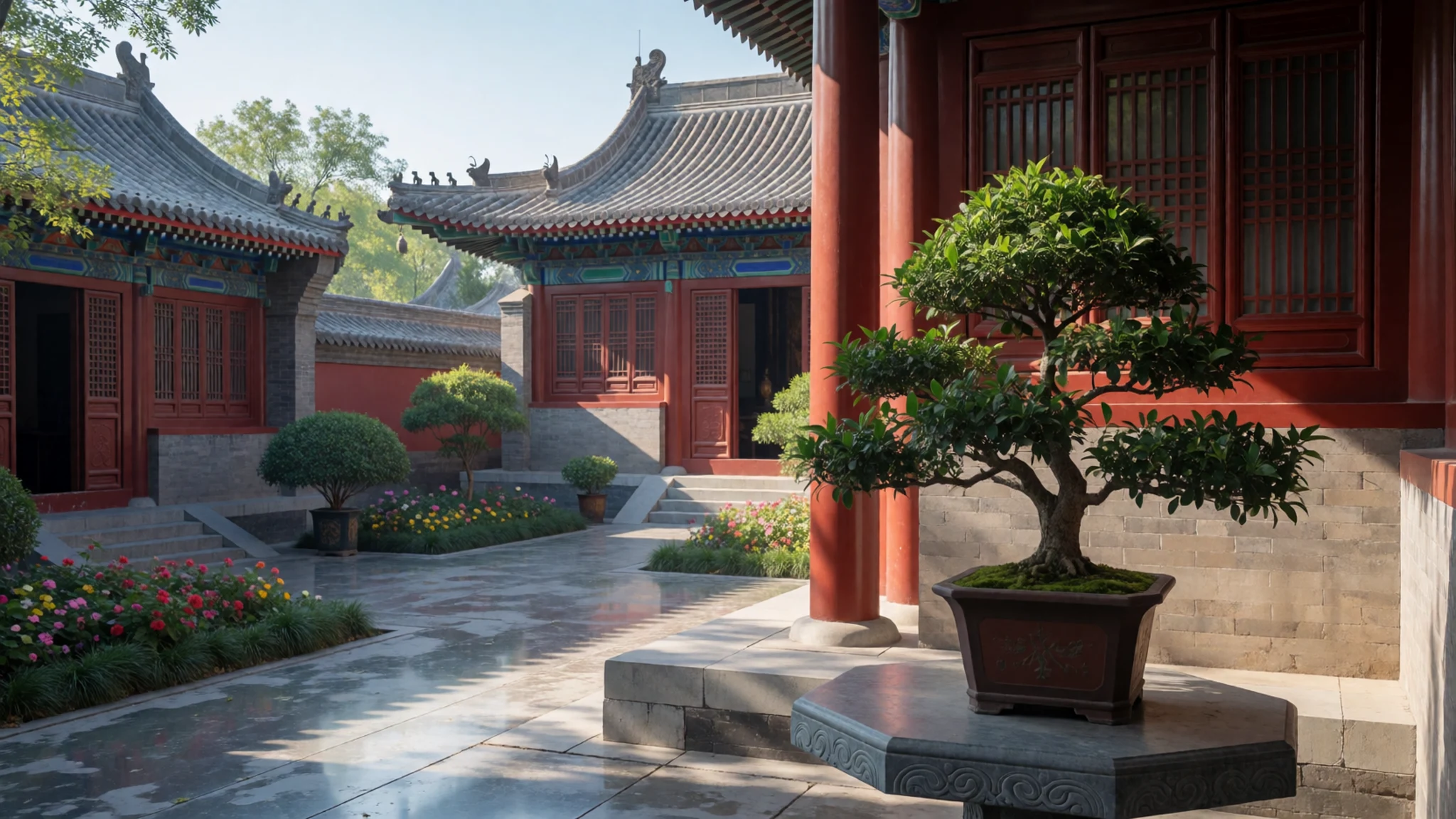
Culture
Datong is a working city that sees relatively few foreign visitors, so you may be the only non-Chinese face on the path. People tend to be friendly and curious rather than wary, and it is normal for strangers to ask where you are from. The caves and temples here are active places of worship as well as heritage sites. Some figures are still treated with reverence, and worshippers may leave incense or make offerings in front of them. Dress modestly, keep your voice low inside the caves, and step aside for people who are praying. Flash photography is often restricted in the caves because light can damage old pigments. The sandstone is soft and easily harmed, so keep your hands off the carvings and ask a guard before taking photographs inside any cave.
What to wear
Traditional dress around Datong follows the wider Han Chinese style of the north, with a strong influence from the neighbouring Mongolian grasslands. Han women historically wore cotton and silk jackets with long skirts or loose trousers, and winter clothing was padded with cotton wadding or lined with sheepskin. Mongolian herders in the surrounding region wear the long-sleeved deel, usually made from wool or brocade and tied at the waist with a sash. Silk and cotton were the main textiles for everyday wear, while embroidery and richly dyed cloth signalled status. Monastic robes at Buddhist sites are usually plain grey, brown or saffron. Today most people in Datong wear practical western-style clothing such as jeans, padded winter jackets and trainers, with some older residents still choosing tailored traditional jackets. For a visit, dress for a cold, windy valley in winter and late autumn, and for a hot, dusty one from April to September. Layers work best, since the caves are cool even on a warm day. Wear shoes with good grip, because the paths are uneven and include steps. Cover shoulders and knees when entering temples, and avoid revealing clothing inside working shrines.
What to eat
- Knife-cut noodles (dāoxiāomiàn, 刀削面) — Noodle houses across the old town and near the main bus stations
Knife-cut noodles are Shanxi's best-known dish. A cook shaves strips of dough with a blade straight into a pot of boiling water, so each noodle is thick at one edge and thin at the other. They are served in a broth or with a sauce and a few simple toppings. The texture is chewy and the flavour is clean.
- Oat noodles (qiaomian, 莜面) — Small family restaurants on side streets in the old town
Oat noodles are a regional staple of northern Shanxi, made from oat flour that is pressed or shaped and then steamed or cooked. They often come with a sauce of vinegar, garlic and chilli, which cuts through the earthy taste of the oats. They are filling and typical of home cooking in the countryside.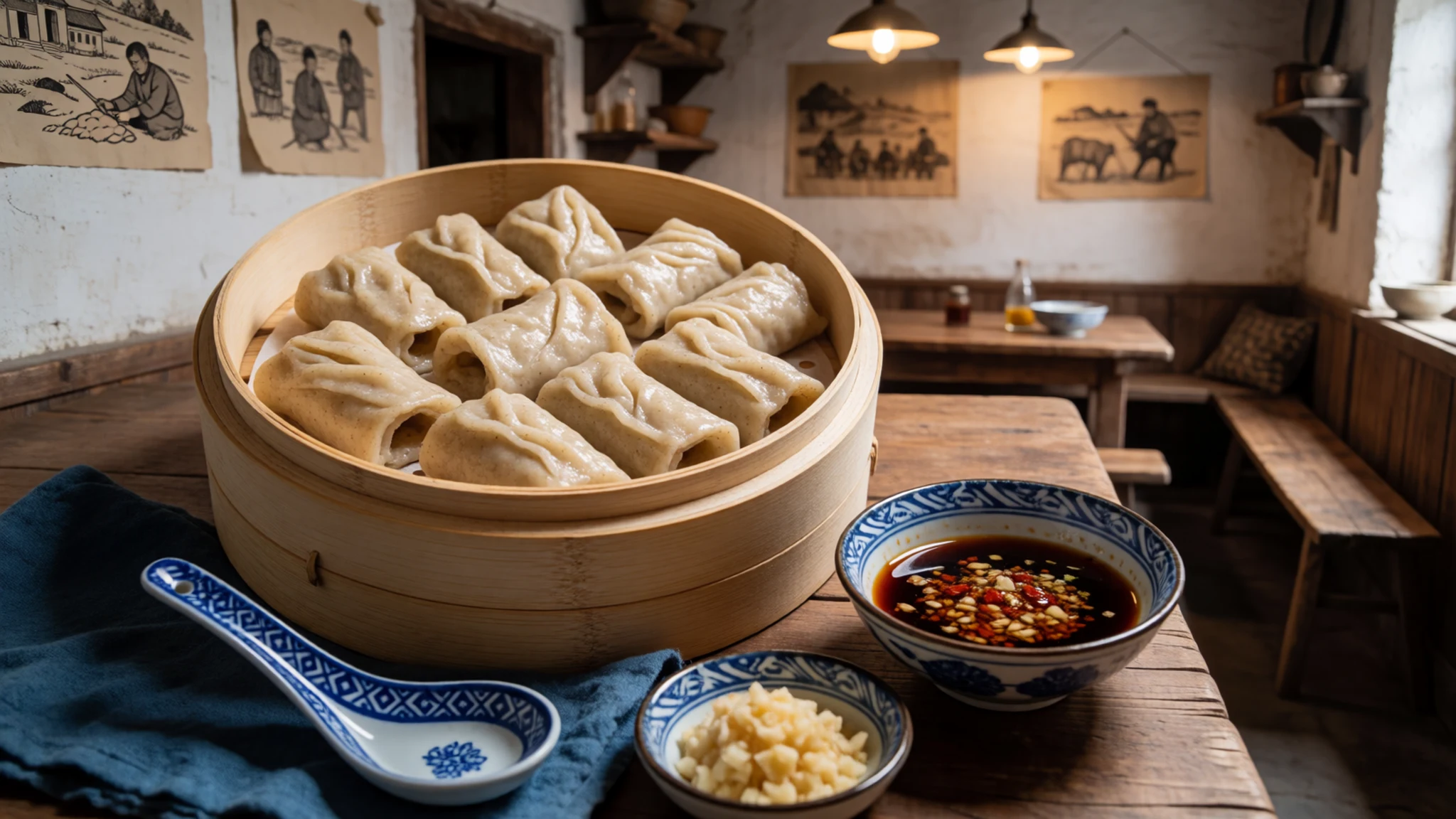
- Shanxi aged vinegar dumplings — Dumpling houses and breakfast stalls near the morning market
Shanxi is famous for its dark, aged vinegar, and it appears throughout local cooking. Dumplings are often dipped in it at the table, and soups may be sharpened with a splash. Eating them with a little extra vinegar is the local way to enjoy a plate of plain boiled dumplings. - Millet porridge — Breakfast stalls at the morning market by the river
Millet porridge is a simple, comforting breakfast in northern China, lighter than rice porridge and cooked slowly until soft. It is usually eaten with pickled vegetables and a steamed bun. It makes a good start before a long morning among the caves.
Plan it
Best time. October, when highs are around 26 C and rain is light, is the most comfortable time to walk the valley, while April, May and September run hot. Winters are bitterly cold and summers are hot, so those months are harder going.
How long. 2–3
Getting there. Fly into Datong Yungang Airport, or take a high-speed train from Beijing, which takes about 1.5 hours to Datong South Railway Station; trips from nearby Shanxi cities are under 2.5 hours. From either station, take a taxi or bus for the 16 km to the grottoes.
Budget. low
Tips
- Book high-speed train seats in advance for weekends and holidays
- Arrive early, when the caves are quieter and the light is better on the cliff
- Carry cash for small eateries and local taxis, as cards are not always accepted
- Bring water and a hat in summer, because there is little shade along the cliff path
- Combine the grottoes with the temples in the city centre on the same day
Etiquette
- Keep your voice low inside the caves
- Ask before photographing monks or worshippers
- Never touch the carvings
Nearby
Sources
- Wikidata Q308805 (CC0)
- Wikipedia: Yungang Grottoes (rev 1380297102) (CC BY-SA 4.0)
- Wikivoyage: Datong (rev 5400851) (CC BY-SA 4.0)
- Photo: Yungang Grottoes, Datong, China (Marcin Białek) (CC BY-SA 4.0)
- Photo: Caves 7-20 (xiquinhosilva) (CC BY 2.5)
- Photo: Yungang Grottoes 2019 (Charlie fong) (CC BY-SA 4.0)
- Photo: China - Yungang Grottoes 9 (McKay Savage) (CC BY 2.5)
- Photo: Top of the column, Yungang Grottoes (Marcin Białek) (CC BY 3.0)
- Photo: Buddhist paintings, Yungang (Floybix) (CC BY-SA 2.5)
- Photo: Yungang cave 9 dougong (Gisling) (CC BY 3.0)
- Photo: Cave 11, side wall statues (Floybix) (CC BY-SA 1.0)


