Voroneț Monastery
Voroneț Monastery, Romania
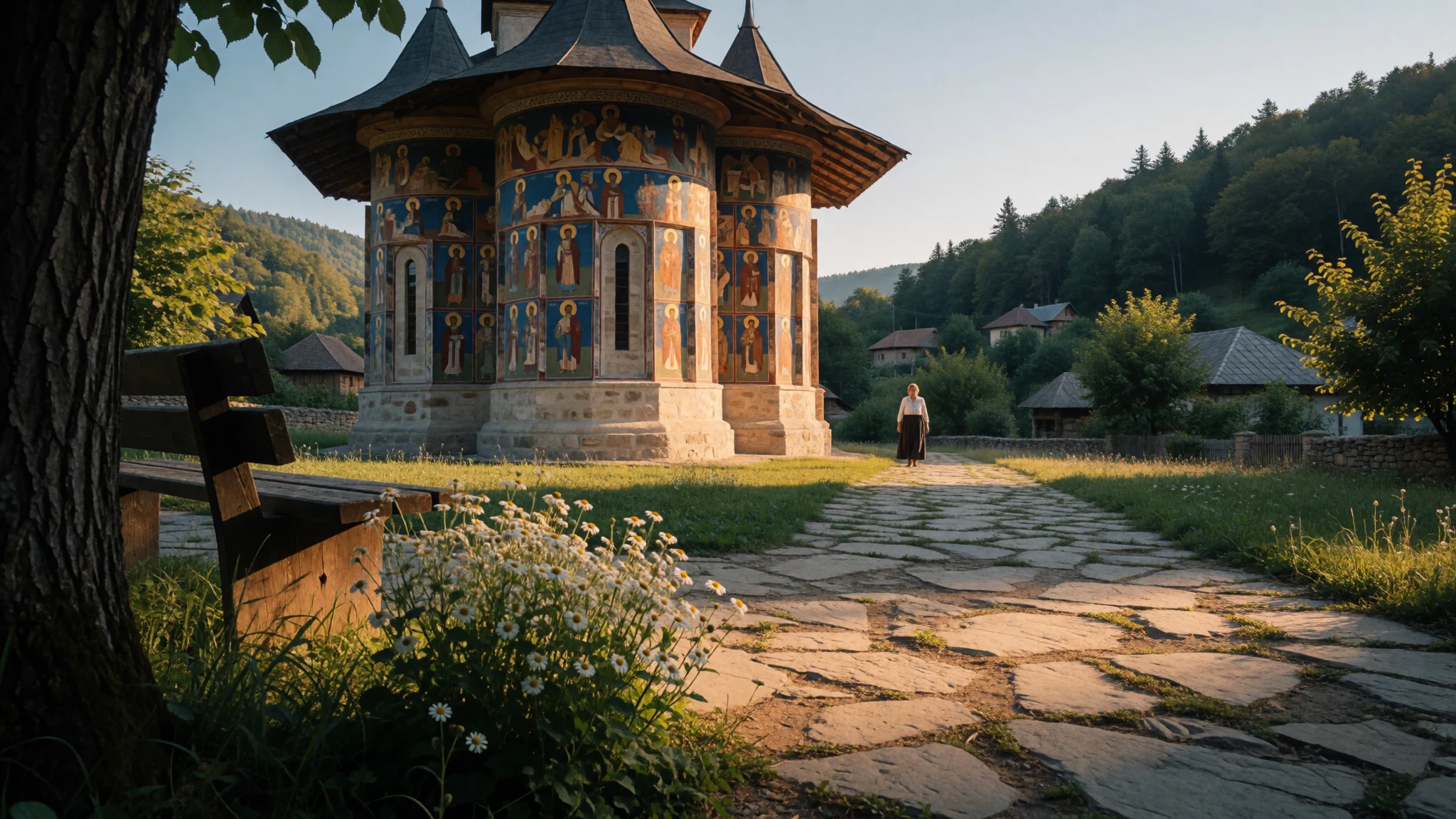
Voroneț Monastery is a small Bukovina church whose outer walls are covered in saints and a Last Judgement, set against a deep blue found nowhere else.
The place
Voroneț Monastery stands in the village of Voroneț, now part of the town of Gura Humorului in Suceava County, northern Romania. The site lies south of the town centre in the valley of the Voroneț River, with wooded hills close by. It belongs to the group known as the painted churches of Moldavia, which UNESCO lists as World Heritage (the Wikidata listing reference for this entry is 598-007). What defines these churches is that the pictures are on the outside. Saints, prophets, angels and scenes of judgement cover the walls beneath wide eaves, a sermon in colour for anyone passing through the gate. Voroneț is the one remembered for its blue. A deep, slightly greenish blue forms the background of the painted wall, and Romanians call it Voroneț blue, after the church itself. Writers sometimes nickname the place the Sistine Chapel of the East; the comparison is loose, but it shows how much weight the paintings carry. The church is compact, and the paintings reward close, slow looking, panel by panel. Around it lives a community of nuns, and the grounds now hold a chapel, fountains and a house for pilgrims, so the monastery is a place of worship first and an attraction second. Daniil the Hermit, the first abbot, is buried here, and his story is tied to the founding of the church. Gura Humorului, close by, supplies the rail and bus links, eateries and rooms.
Its story
Voroneț Monastery has a founding legend and a documented date, and the two sit comfortably together. The legend says Stephen the Great, ruler of Moldavia, was losing heart during a war with the Ottomans and went to the hermit Daniil, who lived in a small hermitage at Voroneț. Daniil's reply was to hold on, and to found a church to Saint George once the war was won. The inscription over the original doorway, now inside the porch, records that Stephen began the work in 1488 and finished it within the same year, a pace that astonishes even now. The plan is triconch, meaning three apses, with a nave beneath a tower and a chamber at the west end. The outer paintings came later. In 1547 Grigorie Roșca, Metropolitan of Moldavia, added the porch on the west side and had the exterior painted, as a second inscription beside the door states. Voroneț also had a school where monks learned to copy and translate religious books. Two surviving manuscripts, the Codex of Voroneț and the Psalter of Voroneț, were found in 1871 and 1882 and are now held by the Romanian Academy. After the Habsburgs took the northern part of Moldavia in 1775, the monastery was soon abandoned, and monastic life only returned in 1991. The nuns who came back built the housing, chapel and pilgrim house that stand beside the church today.
What to see
- The painted west wall — Voroneț village
The west wall carries a large Last Judgement, with the saved on one side and the damned on the other, framed by that blue. Look for the small figures: angels, demons, crowds rising from graves. Centuries outdoors have weathered the paint, so a slow walk with the light behind you shows the most.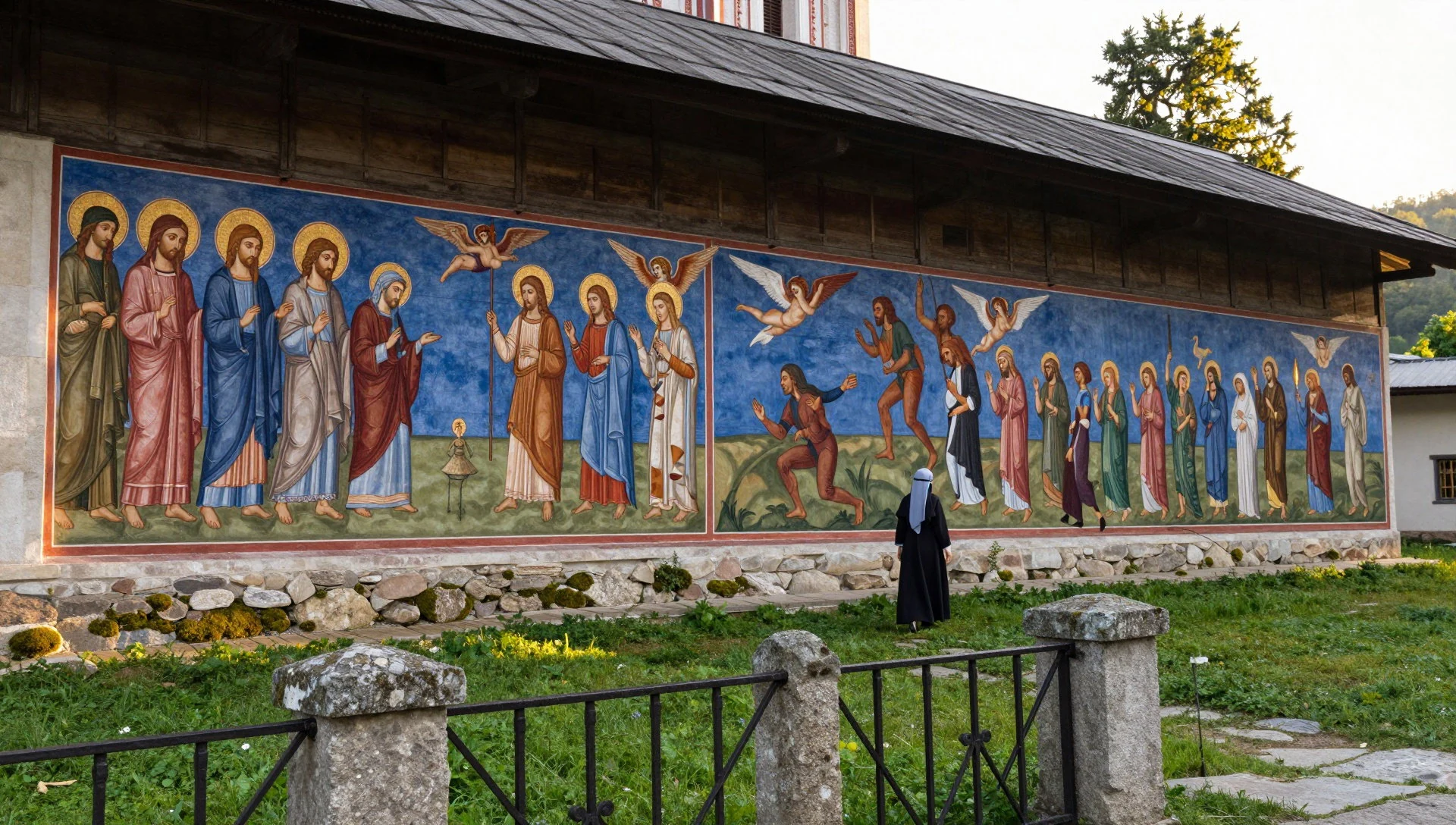
- The church of Saint George — Voroneț village
The church itself is small, with a tower over the nave and three rounded apses. Seen from the gate, the stone body, steep roof and deep eaves explain why the paintings survive at all: the overhang shelters the walls. Walk the full circuit, because every side is painted differently.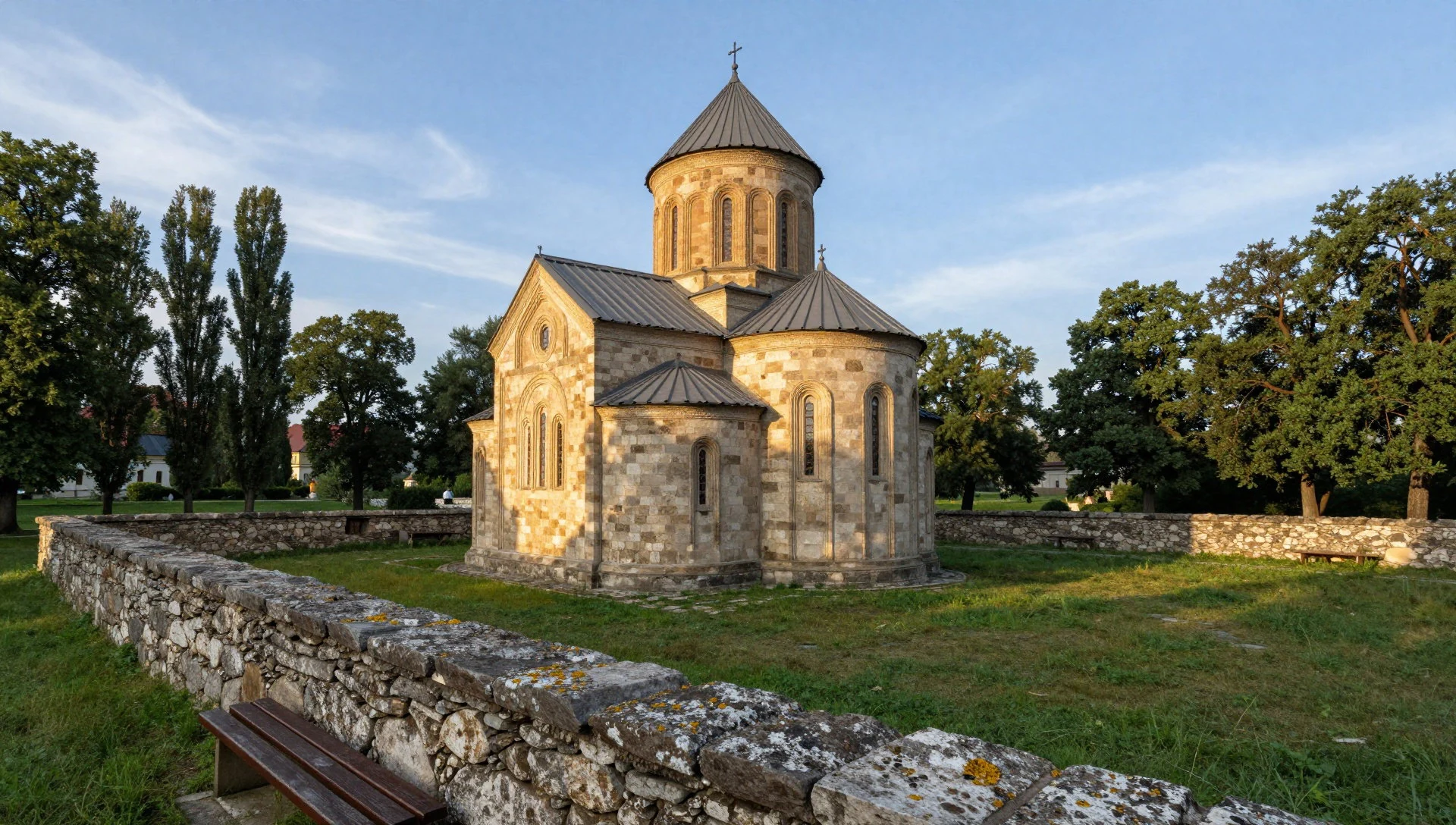
- Entrance porch and inscriptions — Voroneț village
The original doorway, now inside the porch, bears the inscription naming Stephen as founder and giving the 1488 date. Beside the present door, a second text credits Metropolitan Grigorie Roșca with the porch and the painting. Reading both ties the legend to the stones, and a nun or guide can help with the details.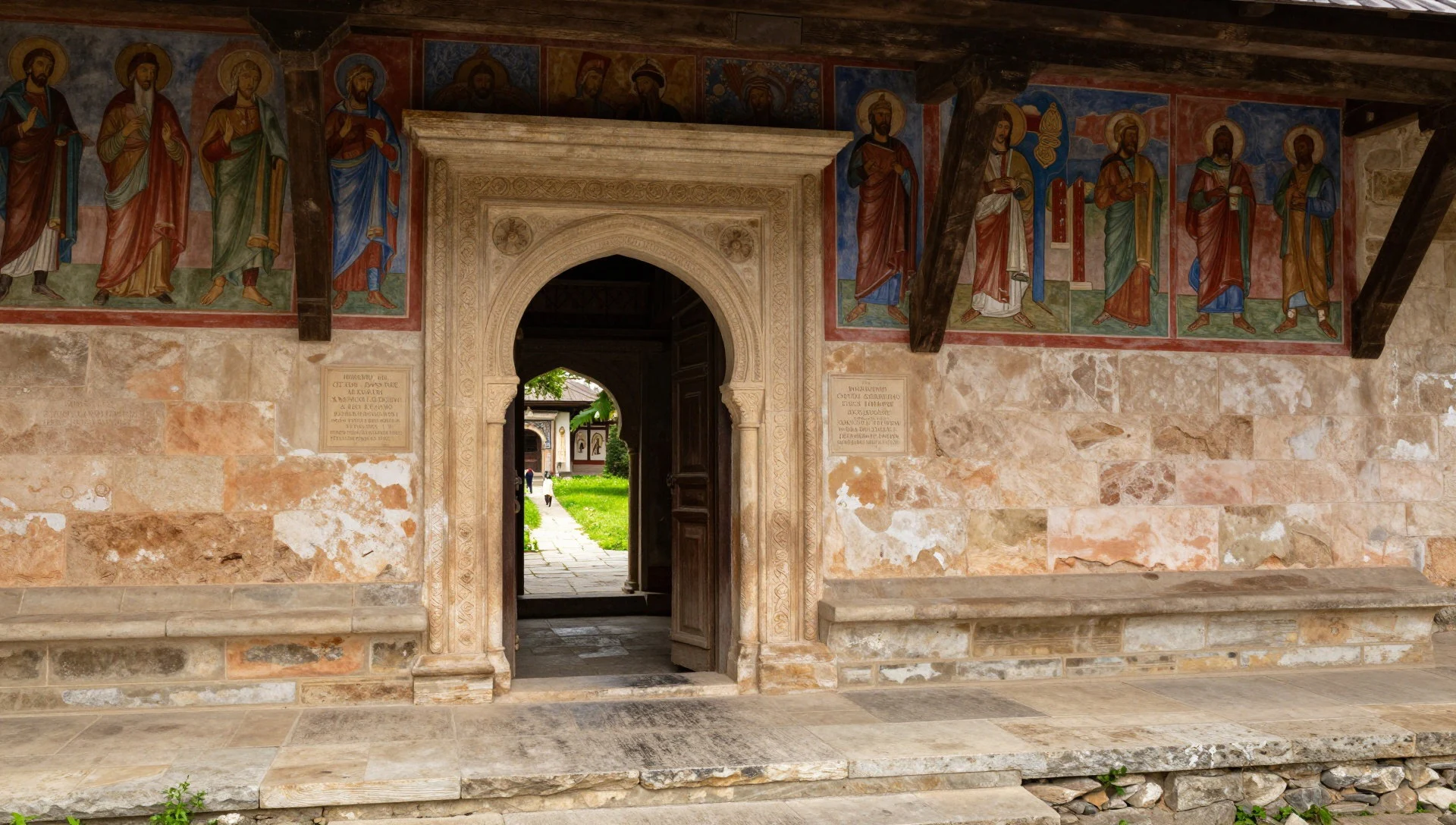
- Grounds and cemetery — Voroneț village
Beyond the church, the grounds hold the nuns' buildings, fountains, a small chapel and a cemetery with graves of the community's dead. It is a calm corner for a few minutes after the crowded wall. Keep to the paths, and remember that people live and pray here.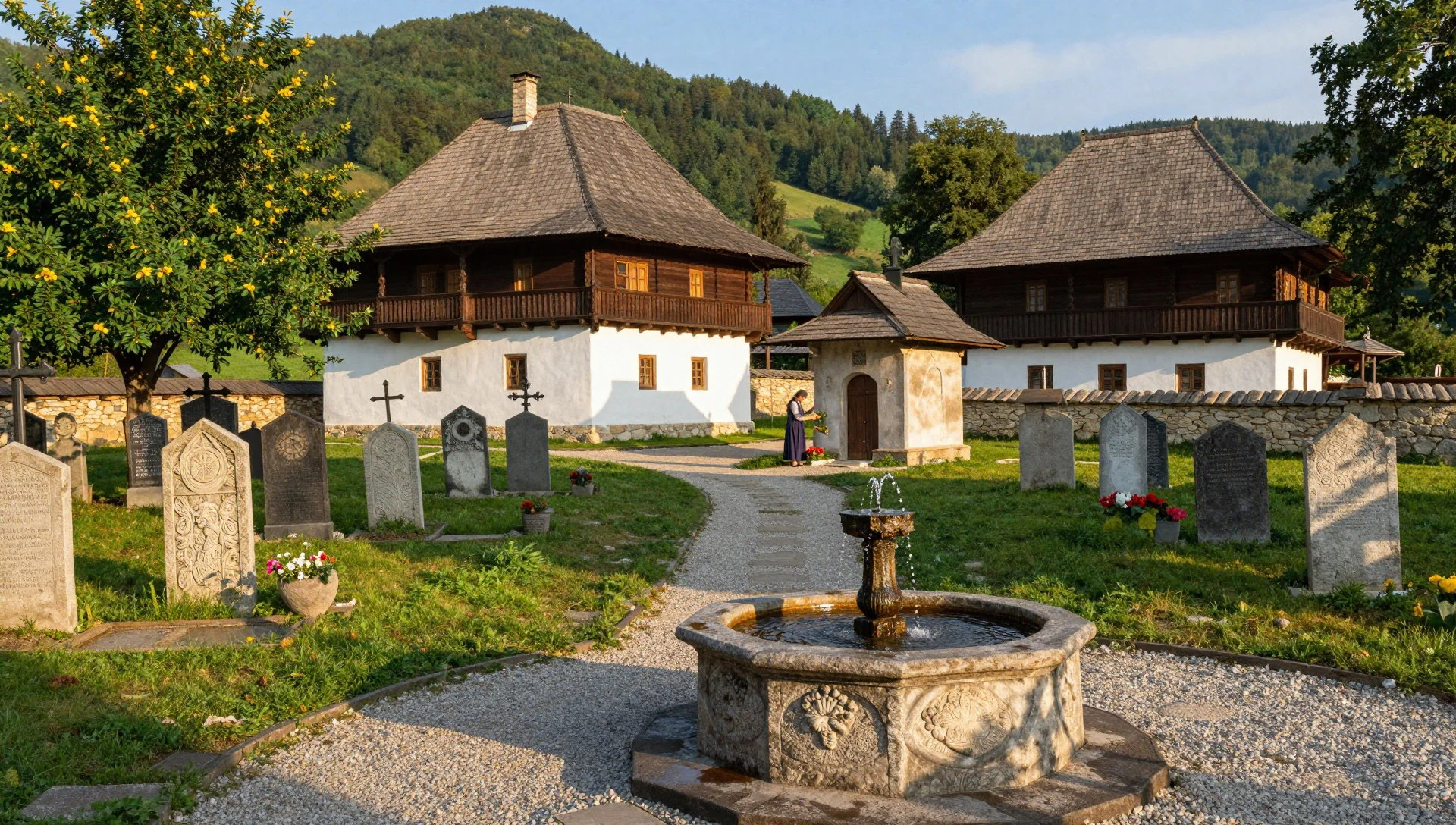
- Humorului Monastery — Near Gura Humorului
Humorului Monastery lies north of Gura Humorului. Its paintings are less well preserved than those at Voroneț, but it has a guard tower that visitors can climb for a view over the valley. It makes a sensible second stop on the same day, and shows how varied the painted churches are.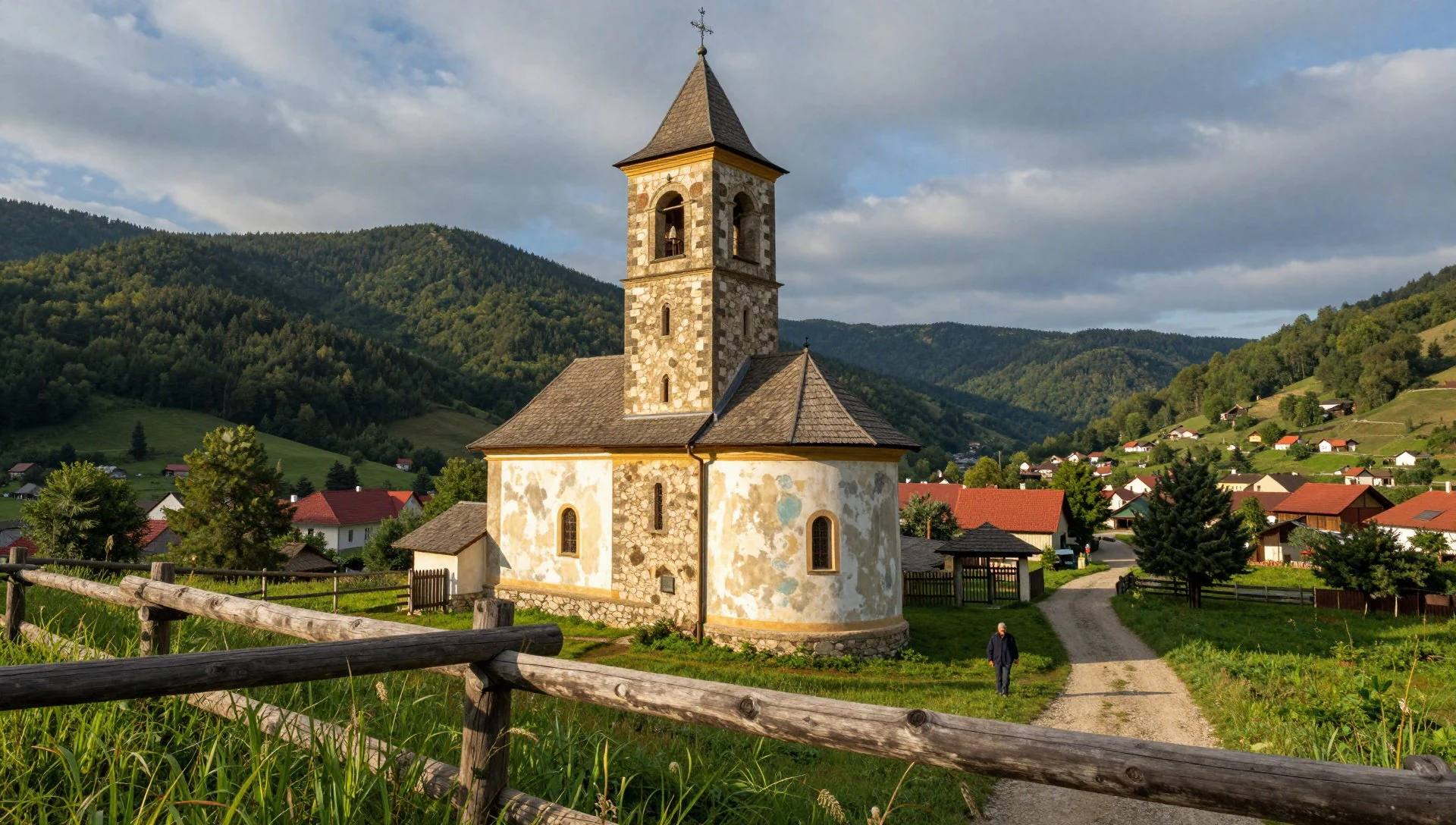
Culture
Voroneț Monastery belongs to the Romanian Orthodox tradition, and the painted walls were made as teaching as much as decoration. Scenes of the saints, the Last Judgement and the heavenly hierarchy were arranged so that anyone standing outside could follow the story of salvation without reading a word. That purpose still shapes how the place is used. Visitors come to look, but many also come to pray, light candles, cross themselves and kiss icons. The tomb of Saint Daniil the Hermit, the first abbot, gives the monastery a particular pull for pilgrims, who link it to the legend of Stephen the Great and the vow to build a church after victory. Monastic life stopped here after the late eighteenth-century Habsburg takeover and returned in 1991, so the present community of nuns is a revival rather than an unbroken line. They maintain the grounds and the church, and the rhythm of services sets the pace of the day. Bukovina as a whole has a mixed history of Romanian, Ukrainian and other communities, and crafts, painting traditions and feast days still matter in village life. Religious festivals bring larger crowds, and the quiet changes with them. Treat the monastery as a living convent, not an open-air museum. Dress modestly with shoulders and knees covered, speak quietly in the grounds, and ask the nuns before photographing them or taking pictures inside the church.
What to wear
Around Voroneț Monastery, traditional dress comes from the Romanian peasant wardrobe of Bukovina. Women's costume centres on the ie, a blouse of linen, cotton or hemp with embroidery at the neckline and sleeves, worn with a wrapped or woven skirt of wool and a decorated apron. Men wear a long white shirt with embroidered edges, narrow trousers, a broad belt and, in cold weather, a sheepskin waistcoat or coat. Embroidery colours and patterns vary by village. These clothes appear at weddings, church festivals, folk events and on Sundays in some villages, and the ie has become a popular fashion item in towns as well. Day to day, people in Gura Humorului dress like most of Europe: jeans, shirts, fleeces and jackets, with practical boots in wet or snowy months. Nuns at the monastery wear dark habits and head coverings. For a visit, cover shoulders and knees, and carry a light scarf, since women may be asked to cover their heads inside the church. Wear shoes with grip, because paths can be wet, muddy or icy depending on the season. Bring layers: mornings in the hills can be cool even in summer, and a rain jacket is more useful than an umbrella in a crowd. In winter, a warm coat, hat and gloves matter more than style.
What to eat
- Sarmale — Traditional restaurants in central Gura Humorului
Cabbage rolls stuffed with minced pork and rice, simmered slowly in a tomato and sour-cabbage broth. They are a staple of Romanian celebrations. Order them with polenta and a spoonful of sour cream at any traditional restaurant in Gura Humorului.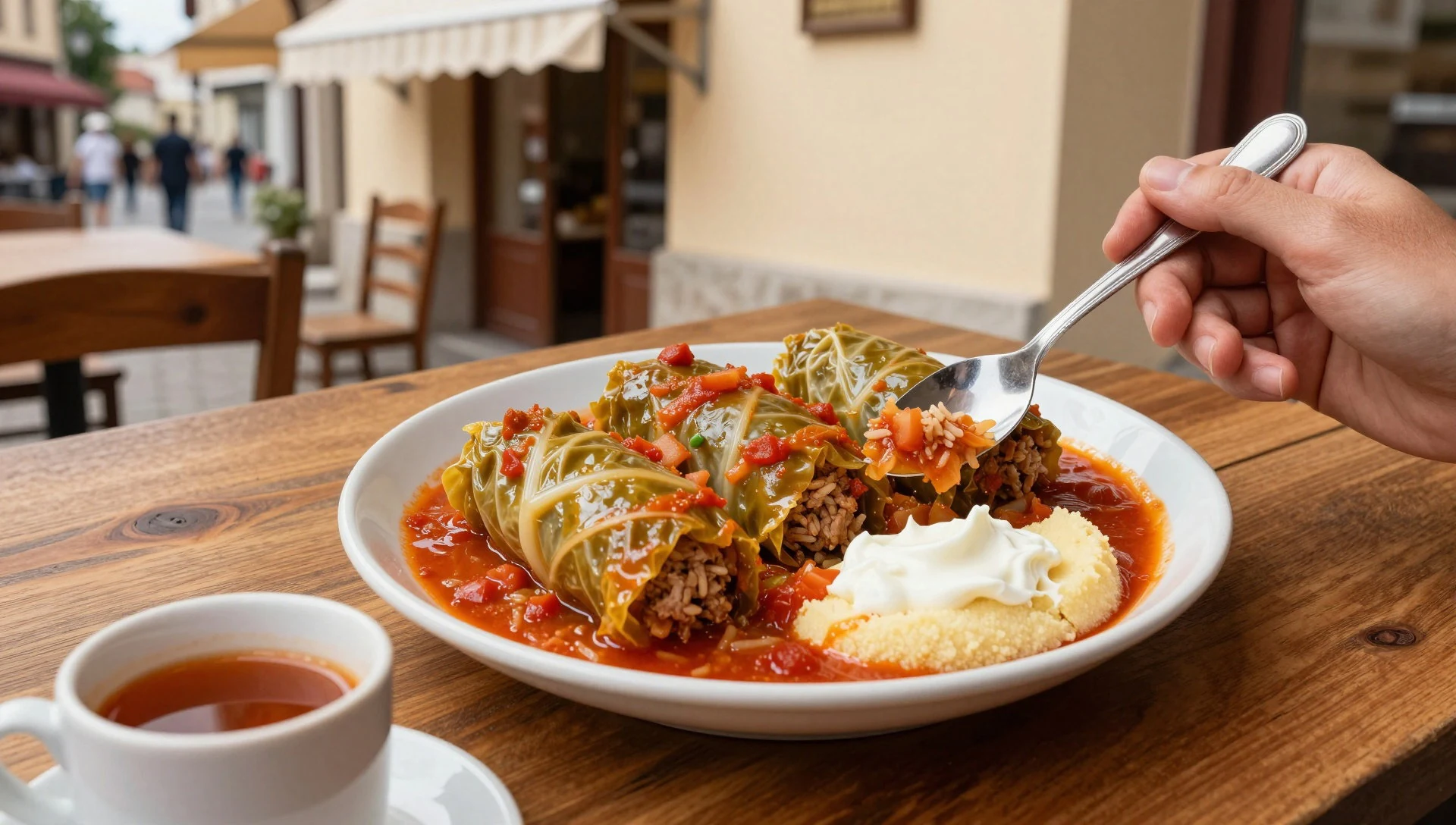
- Mămăligă cu brânză și smântână — Village guesthouses around Voroneț
Mămăligă is polenta, cooked until thick and served with salty cheese and sour cream. It is plain, filling and common across the region. Many guesthouse kitchens in the villages around Voroneț serve it beside meat or eggs.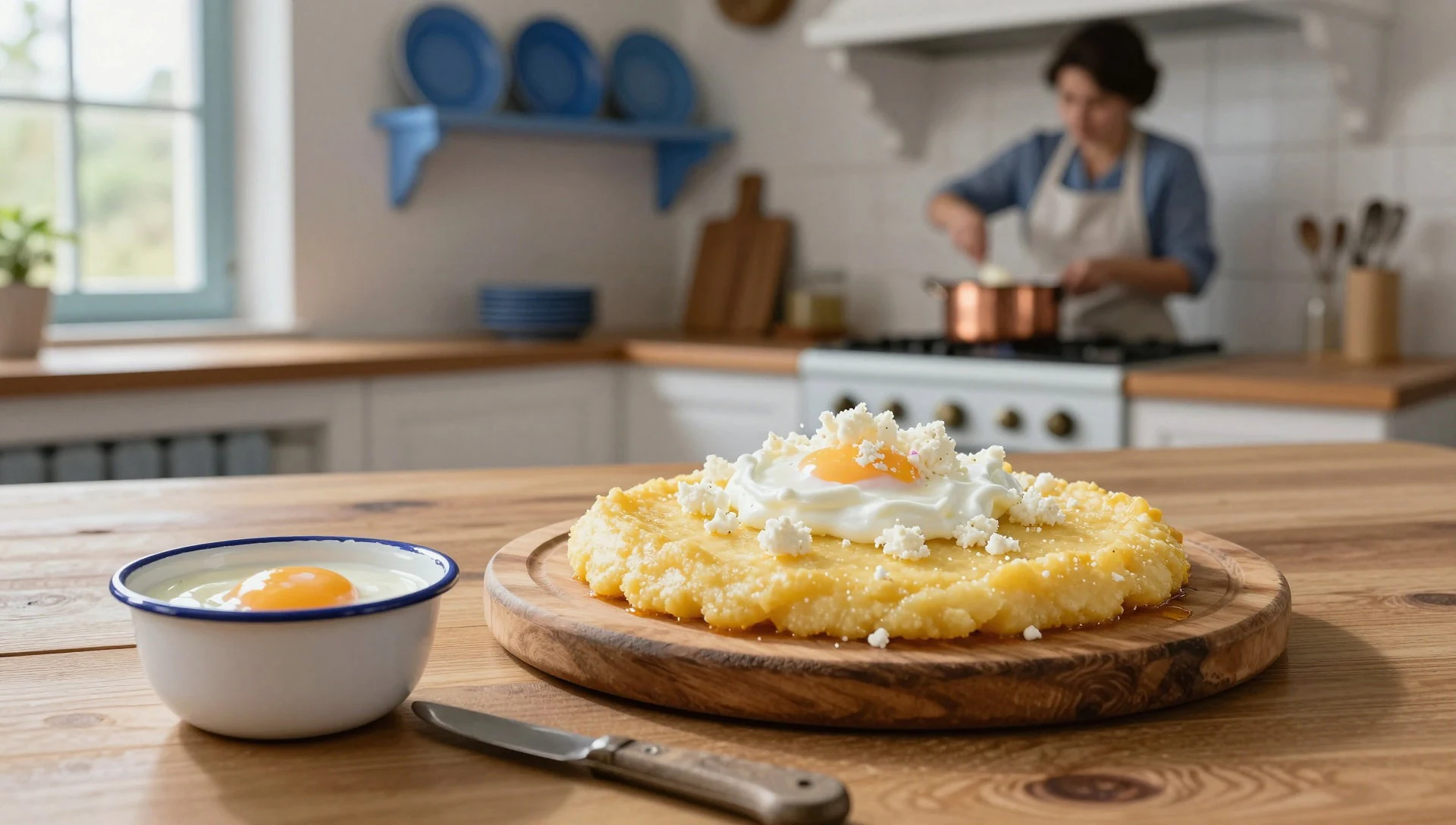
- Ciorbă — Local restaurants near the main square in Gura Humorului
Ciorbă is a family of soured soups, with vegetables or meatballs and a tang from fermented bran or lemon. A bowl makes a warming lunch after a cold morning at the monastery. Most local restaurants list several kinds each day. - Tochitură moldovenească — Traditional restaurants and guesthouse dining rooms in the area
A Moldavian stew of pork pieces and sausage cooked in a rich pan sauce and usually served over polenta, often with a fried egg and cheese on top. It is hearty, so share it or plan a light supper afterwards. - Papanași — Traditional restaurants in Gura Humorului
Papanași are fried or boiled cheese doughnuts with a hole in the middle, topped with sour cream and sweet cherry or berry jam. They are a rich finish to a meal, and most traditional restaurants in Gura Humorului keep them on the dessert list.
Plan it
Best time. April, May and October, when the hills are green or turning, the days are mild and the grounds are pleasant to stand in. July and August are busier and can be hot at midday, while winter is cold and snow can affect the roads and the paths around the church.
How long. 1–2
Getting there. The nearest major airport is at Suceava; from there take a train or bus to Gura Humorului, where the bus and railway stations stand close together near the centre. The last leg to Voroneț village, south of town, is by taxi, tour or a local arrangement. Check the CFR site for train times.
Budget. low
Tips
- Go early in the morning or late in the day to see the painted wall with fewer groups
- Check the monastery's official channels for opening times and any fee, as these can change
- Carry some cash for small purchases, candles and tips at local guesthouses
- Pair Voroneț with Humorului Monastery and other painted churches in the area, using a local tour if you lack a car
- Bring layers and a rain jacket, because weather in the hills changes quickly
Etiquette
- Cover shoulders and knees, and bring a scarf for covering the head inside the church
- Ask before photographing nuns or people at prayer, and follow any rule posted at the door
- Keep voices low in the grounds and do not walk around services
Nearby
Sources
- Wikidata Q384463 (CC0)
- Wikipedia: Voroneț Monastery (rev 1362413396) (CC BY-SA 4.0)
- Wikivoyage: Gura Humorului (rev 5403402) (CC BY-SA 4.0)
- Photo: Voronet Intrare, Dstefanescu (Public domain)
- Photo: Ihopulele EOS 30D0173 Voronet, Iulian Hopulele (CC BY 2.5)
- Photo: Mănăstirea Voroneț - Vedere de sus, Emil71 (CC BY 3.0)
- Photo: Biserica Voronet, Ione.pomana (CC BY-SA 3.0 ro)
- Photo: Moldaukloster Voroneţ Friedhof, Diether (CC BY 3.0)
- Photo: Voronet 2013-detaliu-a, Sîmbotin (CC BY-SA 3.0 ro)
- Photo: Voronet 2013-detaliu-c, Sîmbotin (CC BY-SA 3.0 ro)
- Photo: Voronet 2013-detaliu-d, Sîmbotin (CC BY-SA 3.0 ro)


