Tuzla
Tuzla, Bosnia and Herzegovina
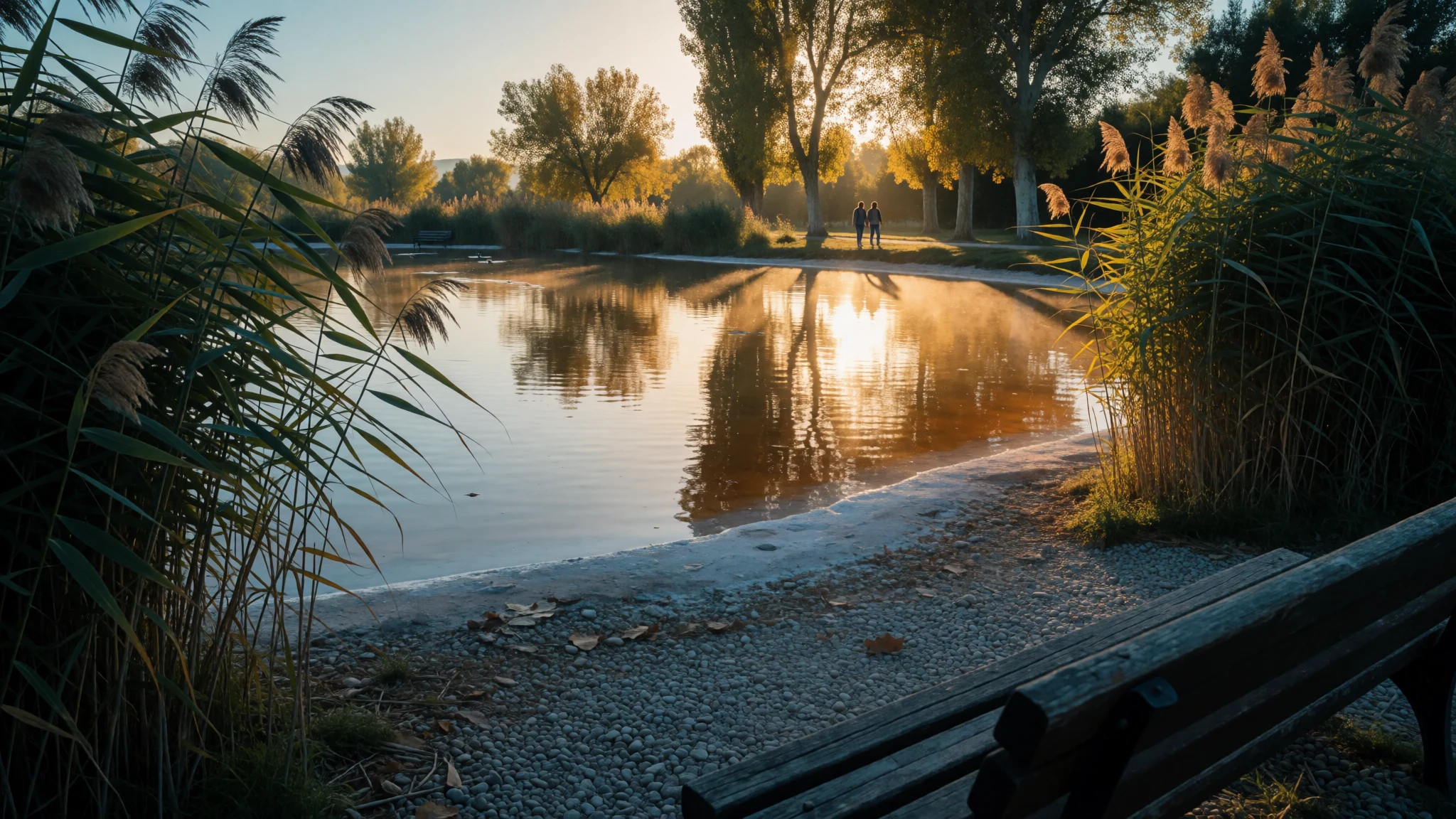
Tuzla is a lived-in salt city in north-east Bosnia, with lakeside walks, Ottoman and Austro-Hungarian layers, and a sober memorial in its old centre.
The place
Tuzla sits in north-eastern Bosnia and Herzegovina, on a flat east–west plain about 245 m above sea level, beneath the Majevica hills and beside the small Jala river. Residential districts climb the slopes of Ilinčica, Kicelj and Gradina to the north and south, so the centre feels like a shallow bowl with houses along its rim. About 111,000 people live here, and the place works as a regional capital rather than a showpiece: two universities keep the cafés busy with students, hospitals draw patients from the surrounding area, and the industrial base explains the plain, workaday look of some districts. Visitors expect little and are often pleasantly surprised.
Salt is the thread through everything. The name comes from the Turkish word for salt, brine under the ground shaped the settlement and paid for its growth, and the same brine now feeds the Pannonica lakes in the city park, where hundreds of thousands of people come each year to swim, stroll and sit by the water. Tuzla is also known across Bosnia as a mixed city. Bosniaks, Serbs, Croats and a small Jewish community live side by side, and that mix survived the Bosnian War and has been kept since. Expect a genuine town rather than a stage set: winters are cold, summers can be hot, and tourists are few, which makes for easy conversations and unhurried afternoons.
Its story
Tuzla has been lived in for around six thousand years, and digs show a Neolithic settlement on the site. Before Rome arrived, the Illyrian Breuci held the area, and the Romans knew the place as Salines, a name that points straight at the salt springs. A Byzantine emperor, Constantine Porphyrogenitus, wrote about a fort here in the year 950. In the Middle Ages the town was called Soli, simply 'salts' in the local language, and it sat within the Bosnian kingdom.
That kingdom fell to the Ottomans in 1467, and the area passed through the hands of a local noble family before the Ottomans took firm control in the following decades. The modern city traces its start to 1510, when it became a garrison town. Its Turkish name, meaning 'place of salt', dates from this period. Ottoman rule lasted nearly 400 years, with Tuzla administered as part of the Sanjak of Zvornik, and it left mosques, a street plan in the old centre and a taste for coffee and grilled meat.
In 1878 Austria-Hungary occupied Bosnia, bringing theatres, schools, railways and new public buildings. After the empire dissolved, Tuzla became part of the first Yugoslavia, and later of the socialist federation. In 1995, during the Bosnian War, shelling of the central square killed 72 young people, an event the city still marks with a memorial.
What to see
- Kapija memorial and Trg Slobode — Old town, central square
Tuzla's old-town square holds the Kapija, a gate-shaped memorial to the 72 young people killed by artillery fire in 1995. A poem is carved into it; ask a local to translate it. Names and flowers are often fresh. Visit quietly, then walk to the nearby park where the victims are buried.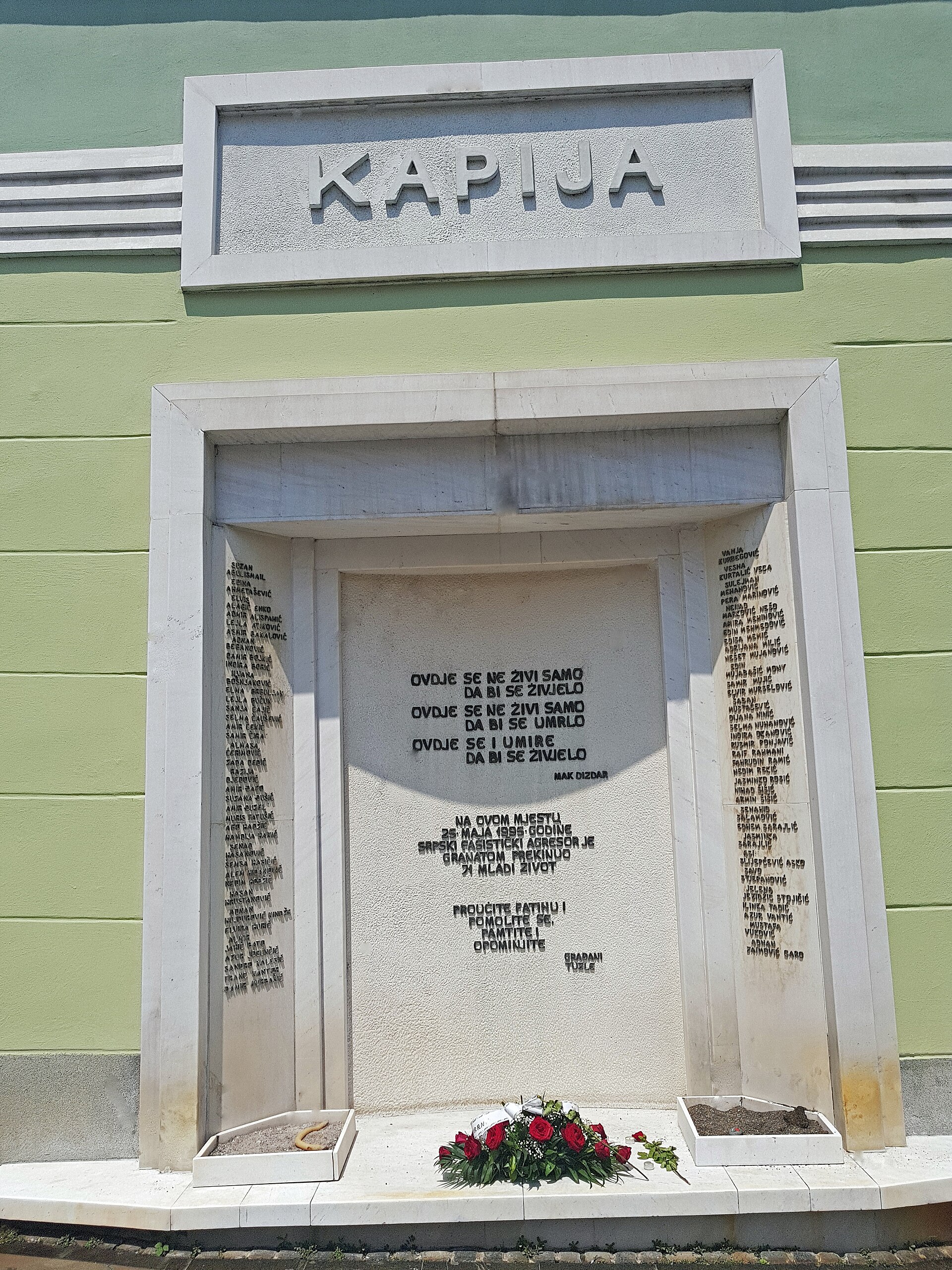
- Pannonica Lakes — Central park
Three salt-water lakes in the city park, fed from local brine wells. They have beaches, bars and a play area, and on summer weekends the shore is full of families. In winter the scene is calmer and frosty, good for a long walk. Salt gives the water a buoyant, slightly sticky feel.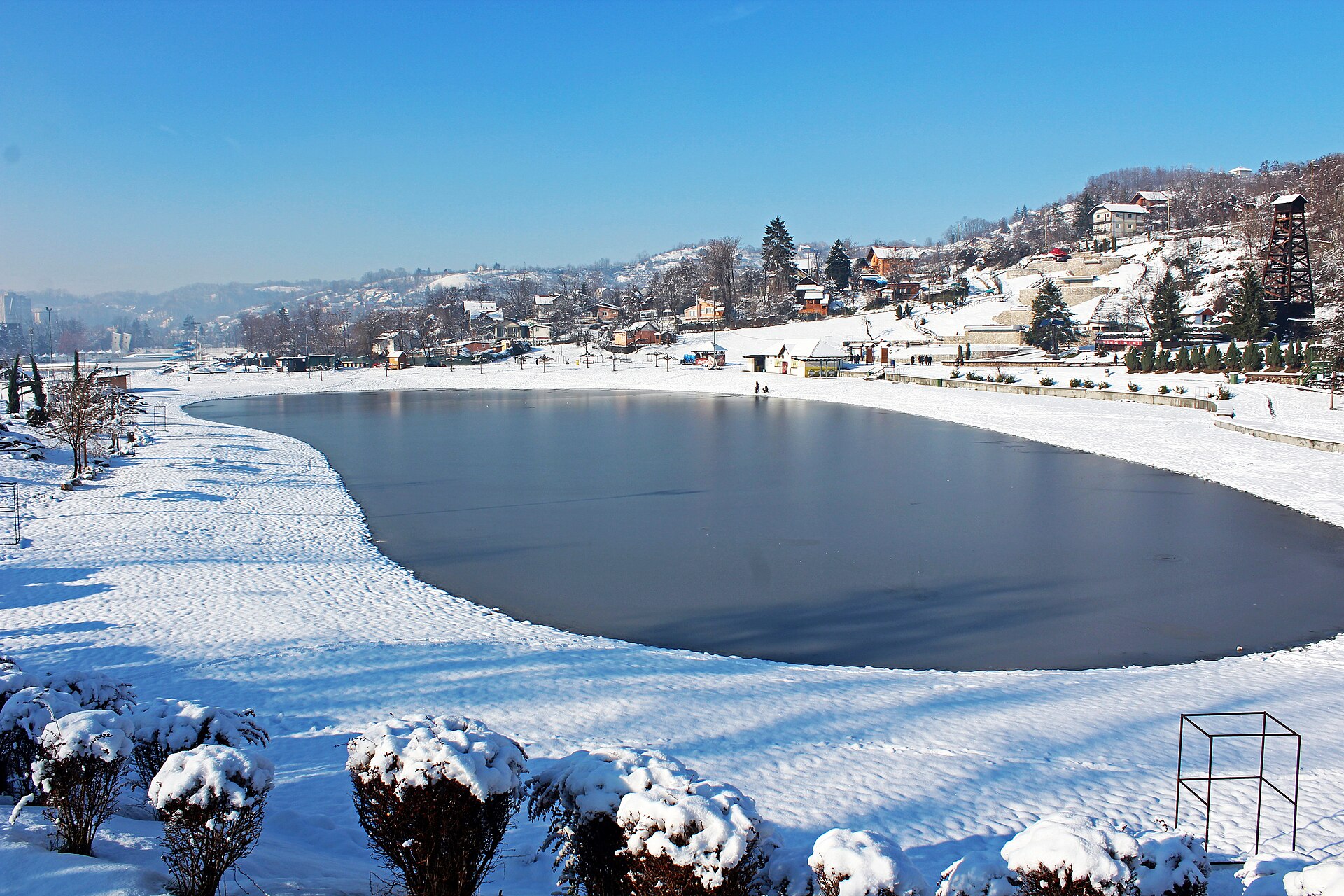
- Museum of Eastern Bosnia — City centre
The regional museum gathers archaeological, ethnographic, historical and art pieces from across north-eastern Bosnia, so it works as a useful primer on the long story of the area before wandering the streets. Check the city website for opening arrangements, as they can change with the season. - Solni Trg (Salt Square) — Old town, near the centre
An open-air museum opened in 2004 that explains how salt was taken from the ground and why it mattered to Tuzla. It is a short, informal visit, best paired with the lakes, and it makes the city's name feel concrete rather than just a piece of etymology. - Behram-beg Mosque — City centre
An Ottoman-era mosque in the heart of the city, and the clearest reminder of Tuzla's long Ottoman chapter. The exterior is simple and graceful, and its courtyard is a calm pause between the noisier streets. Visitors are welcome outside prayer times; dress modestly and remove shoes before going in.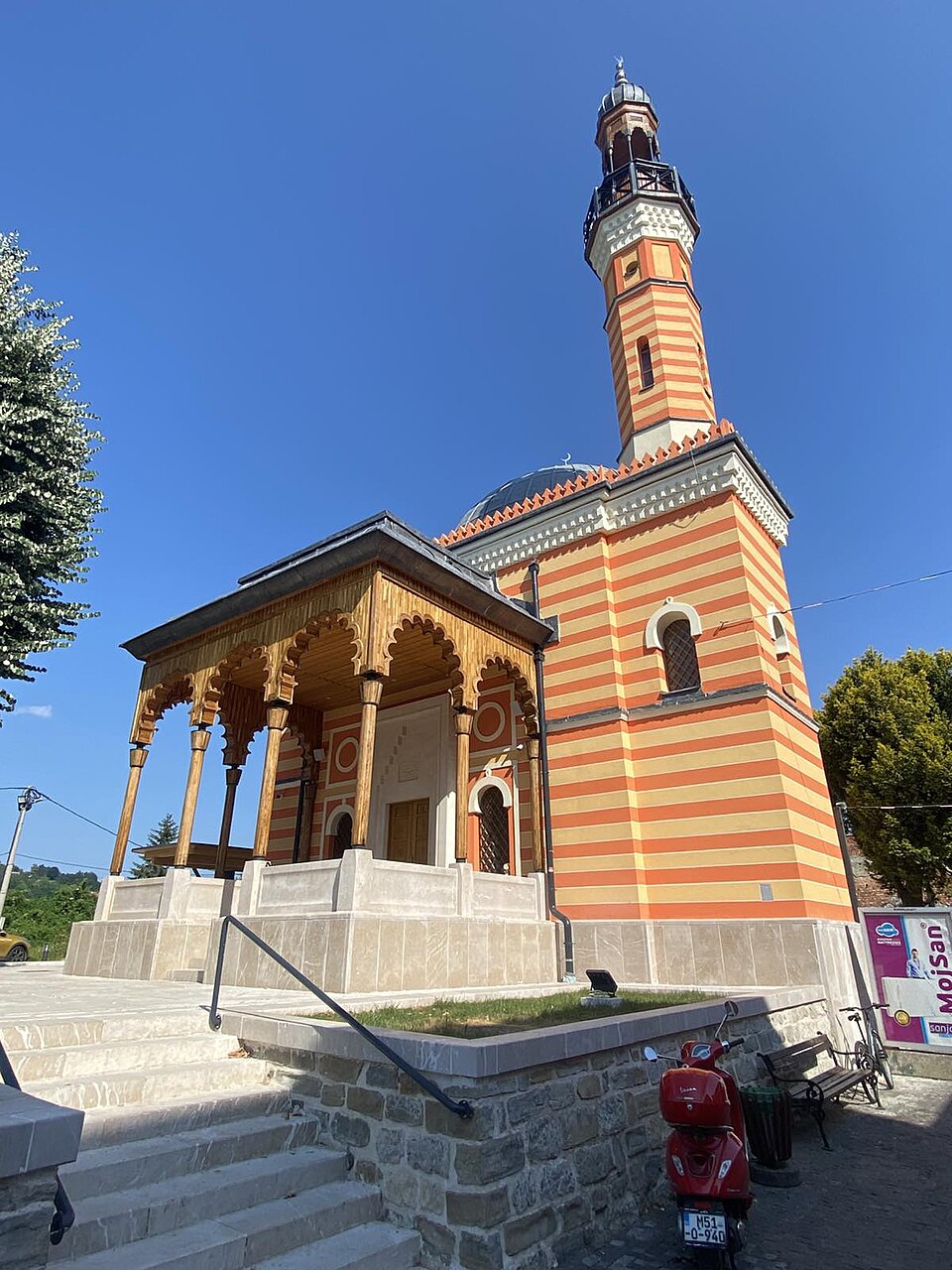
Culture
Tuzla has a quietly literary and theatrical reputation. Meša Selimović, one of the Balkans' most influential novelists, came from here, and the city hosts a book festival each July where the Meša Selimović prize is awarded for a novel in the languages of Bosnia and Herzegovina, Croatia, Serbia and Montenegro. The Tuzla National Theatre was founded in 1898, during Austro-Hungarian rule, and has run continuously since 1944. Galleries add to the picture: the Portrait Gallery shows local and international artists, and another is devoted to the Tuzla painter Ismet Mujezinović.
Religious life reflects the city's mixed character. Mosques are numerous, an Orthodox church stands in town and came through the war untouched, and the Franciscan monastery of St Peter and Paul serves an active Catholic community. Church bells and the call to prayer share the same air, and neighbours of different faiths tend to treat that as ordinary.
The war is never far from conversation, though people rarely volunteer it to strangers. Listen more than you ask, avoid taking sides on politics, and accept coffee when it is offered, since refusing can seem cold.
At the Kapija memorial and the nearby graves, keep your voice low and skip the smiling photographs, and cover shoulders and knees and take off your shoes if you step inside a mosque.
What to wear
Tuzla's traditional dress belongs to the wider Bosnian village and Ottoman-influenced town costume, and it is now mostly seen at folklore festivals, weddings and cultural events. Women's outfits include dimije, baggy trousers gathered at the ankle, worn with embroidered waistcoats and headscarves; men's included šalvare, loose trousers, a wool or cotton shirt and a jelek, a short embroidered waistcoat, sometimes with a red fez. Cotton, wool and linen were the usual fabrics, with embroidery and woven bands for decoration.
Everyday clothing in Tuzla is simple and European: jeans, jackets, trainers, and smart-casual outfits in cafés and on the main streets in the evening. Students dress like students anywhere, and office wear is neat rather than flashy. Some women cover their hair and some do not; both are normal, and nobody comments.
For visitors, the climate decides most things. Summers are warm and can turn hot, so light cotton and a hat help, while winters are cold with frost on many nights, calling for a proper coat, gloves and shoes with grip. Spring and autumn bring showers, so a light waterproof is sensible. For mosques, carry a scarf for women and wear long trousers or a long skirt and covered shoulders for everyone. Comfortable flat shoes suit the paved centre and the lake paths.
What to eat
- Ćevapi — Any ćevabdžinica in the city centre
Small grilled minced-meat sausages served in flatbread with raw onion, often with kajmak, a soft dairy spread. Locals say the Tuzla version differs from the Sarajevo one, so it is worth asking which style a place serves. - Burek and other pita — Neighbourhood bakeries and buregdžinicas
Layered filo pies filled with minced meat. The cheese version is sirnica, spinach and cheese is zeljanica, and potato is krompiruša. Traditionally eaten at breakfast with plain yoghurt, and filling enough to carry you through a morning of walking. - Begova čorba — Traditional Bosnian restaurants in the centre
A creamy chicken and vegetable soup that goes back to the Ottoman table, thickened and finished with lemon and sometimes okra. It is comforting on a cold day and appears on many traditional menus. - Bosnian coffee with sweets — Cafés and bars in the old town
Coffee is brewed in a small copper džezva and poured into tiny cups, served with a sugar cube and often a piece of baklava or tufahija, a poached apple stuffed with walnuts. The ritual is slow and meant for talking. - Salt-town grills and local meat dishes — Family restaurants and fast-food eateries around the centre
Beyond ćevapi, menus lean on grilled meat, stuffed peppers and sarma, cabbage rolls, served with bread and salad. Portions are generous, and international cuisine is thin on the ground, so Bosnian cooking is the main choice.
Plan it
Best time. May–June and September for mild, comfortable days and lake walks; July and August are warm to hot and best for the Pannonica beaches; winters are cold with frequent frosts, so December to February suits only those happy with the chill. Spring and summer also bring most of the thunderstorms.
How long. 2–3
Getting there. Tuzla has its own small airport, and Sarajevo airport is the usual alternative, followed by a bus to Tuzla. Direct buses also run from Mostar and Osijek, and the main bus station is the arrival point. The last leg into the centre is a short taxi or walk.
Budget. low
Tips
- Ask at the counter or check with the bus operator, as the printed timetable at the main bus station has been unreliable
- Carry some cash for cafés, bakeries and small shops, though cards work in larger places
- Visit the lakes early or late on summer weekends, when families crowd the shore
- Bring layers and a proper coat for winter, as the plain holds cold air
- Check the official city website, https://grad.tuzla.ba/, for museum and event details
Etiquette
- Keep quiet and avoid casual photography at the Kapija memorial and the graves nearby
- Cover shoulders and knees and remove shoes before entering a mosque
- Accept an offered coffee, and avoid opening conversations about the war
Nearby
Sources
- Wikidata Q174684 (CC0)
- Wikipedia: Tuzla (rev 1381022641) (CC BY-SA 4.0)
- Wikivoyage: Tuzla (rev 5426957) (CC BY-SA 4.0)
- Photo: View of Tuzla (Boabo) (CC BY 3.0)
- Photo: Kapija place (Deanza7) (Public domain)
- Photo: Monument to King Tvrtko I (Sebleouf) (CC BY-SA 4.0)
- Photo: Behram-begova džamija (Emin Tarahija) (CC0 1.0)
- Photo: Pannonian Lakes in winter (KalyEV.) (CC BY-SA 4.0)
- Photo: Trg Slobode (Apokar) (CC BY-SA 4.0)
- Photo: Čajniče 1943 (unknown author) (Public domain)
- Photo: Kapija 2018 (KalyEV.) (CC BY-SA 4.0)


