Thespiae
Thespiae, Greece
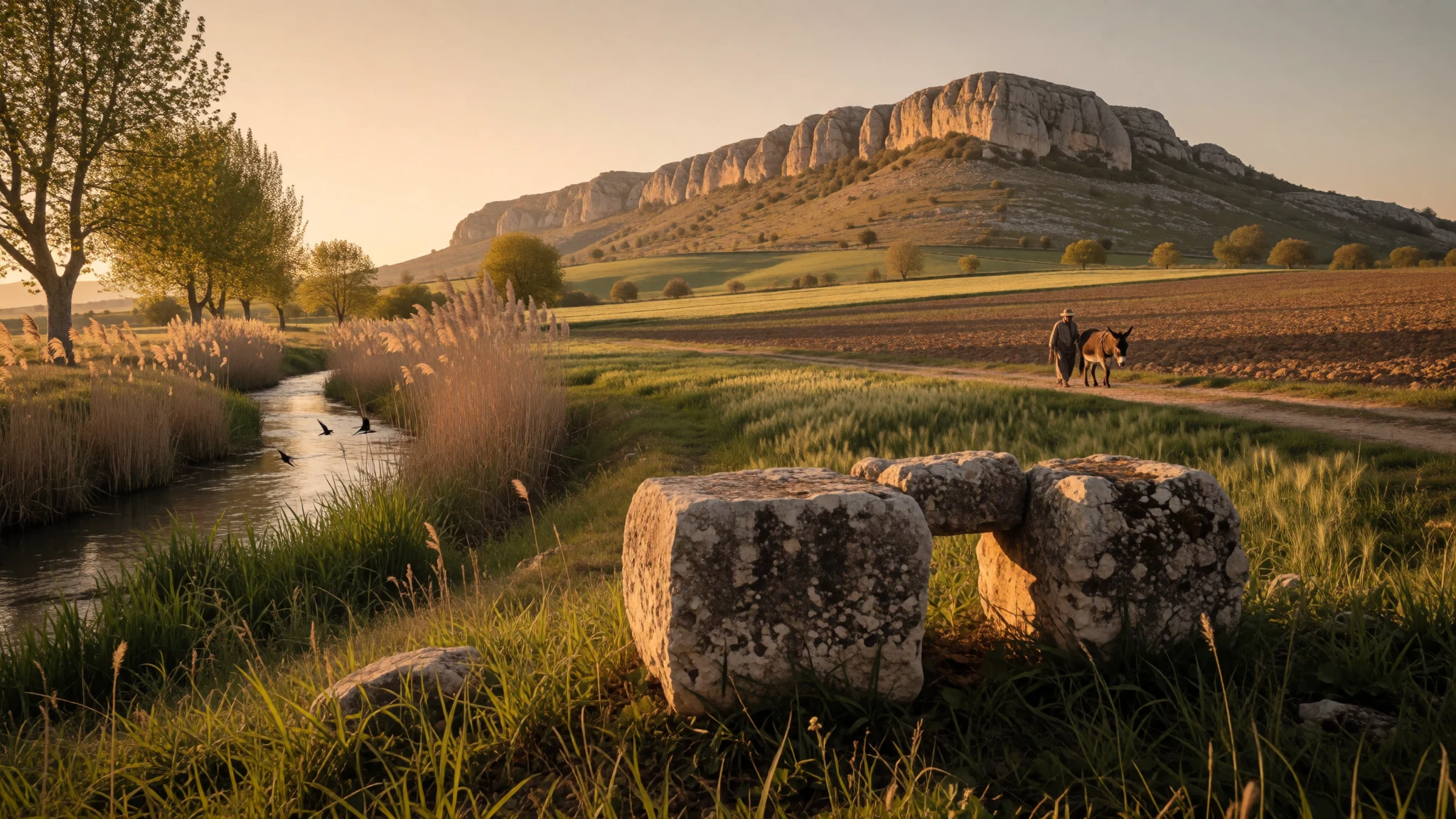
Thespiae is a quiet Boeotian site below Mount Helicon, home of the Muses and Eros and of the 700 soldiers who stood at Thermopylae.
The place
Thespiae was an ancient Greek city in Boeotia, the farming region north-west of Athens, and today it is an archaeological site rather than a town. It lay at the foot of Mount Helicon, close to the right bank of a stream the ancients called the Thespius and Greeks now call the Kanavari. Anyone arriving with hopes of standing temples should adjust them: this is a quiet, rural place, and its interest lies in what the city did more than in what is left on show. Its reputation rests on three things. The first is courage, since Thespian soldiers stayed at Thermopylae beside the Spartans while other Greeks withdrew. The second is devotion, because the city honoured the Muses, the goddesses of song and learning, and Eros, the god of desire, with festivals and competitions. The third is myth, for stories set Heracles, Narcissus, a man-eating dragon and the Lion of Cithaeron in this landscape. Thespiae belonged to the Boeotian League, a federation of neighbouring states led by Thebes, yet it often pulled its own way and rivalled its larger neighbour. It lasted into Roman times. The visit works best as one stop in a loop through central Greece, pairing a short look at the site and its surroundings with Thebes, Thermopylae and the mountain monasteries. The ground is open country, exposed to sun in summer and green and muddy after winter rain. Facilities are minimal, so food and water are best arranged before arriving.
Its story
Thespiae entered history as part of the Boeotian story, in which a people said to have been driven out of Thessaly after the Trojan War gradually settled the plain; other traditions make them Mycenaean in origin. Thespiae was taken up in a later stage of that settlement. In its early centuries land and wealth sat with a handful of noble families, and few could afford the armour a hoplite, a heavy infantryman, needed. Short of fighters, the city leaned on Thebes for protection. Over time it grew bolder, destroying the neighbouring settlement of Ascra and later settling Eutresis, steps that loosened its dependence on its powerful partner. It also joined the Boeotian League, perhaps as a shield against raids from Thessaly, and after the Persian Wars it sent two generals to the league instead of one, probably reflecting the districts it controlled. Its defining moment came in 480 BCE. When Persia invaded, only Thespiae and Thebes among the Boeotian cities sent men to Thermopylae, and Thespiae's contingent of 700 hoplites stayed with the Spartans on the final day, fighting so that others could retreat. Later generations raised a monument to them. Thespiae stayed loyal to the Greek cause at a time when most of its neighbours did not, kept up its rivalry with Thebes, and survived into the Roman Empire, by then better known for its sanctuaries and sculpture than for its soldiers.
What to see
- The site of ancient Thespiae — Open farmland below Mount Helicon
The site of ancient Thespiae lies in open farmland beneath Mount Helicon. Little is staged for visitors, so it is a place for reading the landscape: the mountain behind, the Kanavari stream alongside, and the plain the city once governed. Access can vary, so check locally and with the Ministry of Culture's site listings before going. - Thermopylae — Coastal pass, Phthiotis
Thermopylae is a narrow coastal passage to the north, where Thespiae's 700 hoplites made their stand beside the Spartans in 480 BCE. Expect a roadside memorial and open ground rather than ruins. It gives the Thespian story a place to stand in, and it is easy to combine with a drive along the main road. - Archaeological museum, Thebes — Thebes, Boeotia
The archaeological museum in Thebes is the natural companion to Thespiae, since the two cities were allies and rivals within one regional culture. Look for Boeotian pottery, including the black-glazed drinking cups that also turn up in museums abroad. Opening arrangements change, so check the official Ministry of Culture site before travelling. - Ossios Loukas Monastery — Hills near Distomo and Itea, Phocis
Ossios Loukas is a historic monastery in the hills of central Greece, near Itea. After a morning among the thin remains of an ancient city, it offers a calm and still-living counterpart. Shoulders and knees must be covered, and visiting times are set by the community, so check ahead. - Gorgopotamos Bridge — Near Lamia, Phthiotis
Gorgopotamos Bridge is a railway bridge over the Gorgopotamos river near Lamia, the target of a Second World War sabotage raid known as Operation Harling. It suits travellers who want modern history alongside the ancient kind. The drive from Thespiae is long, so it pairs sensibly with Thermopylae on the same day.
Culture
Thespiae's ancient culture centred on the Muses and Eros. Festivals and competitions in their honour drew poets, musicians and athletes to the foot of Mount Helicon, a mountain the Greeks associated with poetry and song. Sculptors such as Praxiteles and Lysippos honoured Eros in their work, and the city's name travelled well beyond Boeotia because of it. The myths set around the place are vivid: Heracles and the Lion of Cithaeron, a dragon that swallowed people whole, and Narcissus, the youth who fell in love with his own reflection. The living culture today is that of rural Boeotia: farming villages, Orthodox churches, saints' day festivals, kafeneia where a small cup of Greek coffee can last an hour, and a deep, unshowy attachment to local history. The soldiers of Thermopylae remain a point of pride across central Greece, and memorials to them are treated with real seriousness. Visitors who expect marble temples will find something different here, because the experience is more about imagination than spectacle. Reading a few lines of Greek myth under the mountain and then walking the ground is the usual way in. Greeks in small places are generally hospitable and curious about anyone who shows interest in their history, and a greeting in Greek is warmly received. At memorials, churches and monasteries around Thespiae, keep your voice low, cover your shoulders and knees, and never climb on or lean against ancient stones.
What to wear
Thespiae's ancient dress was the same as that of most Greek cities: the chiton, a tunic of linen or wool pinned at the shoulders, with the himation, a rectangular wool cloak, draped over it, and the peplos, a heavier wool garment, for women. Colour came from plant and mineral dyes, and fine linen marked wealth. Regional Greek costume, with embroidered wool, linen and heavy woven aprons or sashes, survives mainly at festivals, in dance groups and on national holidays. Day to day, people in Boeotia dress as in the rest of provincial Greece: jeans, shirts, light jackets, linen in summer, and practical work clothes in the fields. Older women in villages often wear dark, modest clothing. A visitor needs mainly to dress for the weather and the terrain. In summer that means a sun hat, sunglasses, light long sleeves and trousers against strong sun and dry grass, and plenty of sun cream. In winter and early spring, bring layers and a waterproof, as the ground gets muddy. Sturdy closed shoes with a good grip are better than sandals on uneven, rocky ground. For monasteries and churches, carry something that covers shoulders and knees; shorts, bare shoulders and short skirts will not be welcome inside.
What to eat
- Kokoretsi — Village tavernas and grill houses across central Greece, especially at festivals and Easter
Kokoretsi is a rich skewer of lamb offal wrapped in intestine and slowly grilled over charcoal. It is traditional at Easter and festive meals. Order it in a grill house where it is turning on the spit, and expect a strong, smoky flavour. - Arnaki psito — Family-run tavernas on the roads around Thebes and Livadeia
Arnaki psito is roast lamb, cooked slowly with lemon, oregano and olive oil until it falls from the bone. It is a weekend and holiday dish, so ask in local tavernas what is on that day and share a large portion. - Mezedes with local sausages — Kafeneia and ouzeri in Boeotian towns and villages
Mezedes are small plates shared over a drink, often with local sausages, cured meats, olives and bread. A group can build a meal from five or six of them. Ask what the kitchen makes locally rather than picking from the usual list. - Katiki and tsalafouti — Dairy counters and weekly street markets in towns such as Thebes
Katiki and tsalafouti are soft, tangy fresh cheeses made from local milk, spread on bread or served as part of a mezedes spread. Both are mild and creamy. Look for them at market stalls and small dairies, where they are sold fresh. - Feta with horta — Village tavernas and home-style eateries
Feta is the salty white cheese eaten with almost everything in Greece, while horta are boiled wild greens dressed with olive oil and lemon. Together they make a simple, inexpensive plate, and a useful vegetarian option in meat-heavy country.
Plan it
Best time. April–May and October–November, when the weather is mild and the countryside is green or golden. July and August are very hot with little shade at open sites, and winter can be wet and cold, especially near the mountains.
How long. 1–2
Getting there. Fly to Athens International Airport, then take a hire car or an intercity bus towards Thebes or Livadeia; the last leg to the site is by car or taxi along local roads. Check the KTEL bus operators' timetables before relying on public transport.
Budget. low
Tips
- Hire a car if possible, as the site, Thebes and Thermopylae are spread out and local buses are infrequent
- Go early in summer, before the heat builds, and carry water and sun protection because there is little shade
- Check the Ministry of Culture's official site for current opening arrangements before visiting any museum or archaeological site
- Carry some cash for village cafés and small tavernas, which do not always take cards
- Eat before arriving, since there are few facilities at the site itself
Etiquette
- Cover shoulders and knees when entering churches and monasteries
- Do not climb on or remove anything from ancient stones
- Keep voices low at war memorials
Nearby
Sources
- Wikidata Q1141295 (CC0)
- Wikipedia: Thespiae (rev 1383536235) (CC BY-SA 4.0)
- Wikivoyage: Boeotia (rev 5305355) (CC BY-SA 4.0)
- Photo: Boeotian kantharos, Louvre MNC670 (Public domain)
- Photo: Venus of Arles (CC BY-SA 2.5)

