Saratov
Saratov, Russia
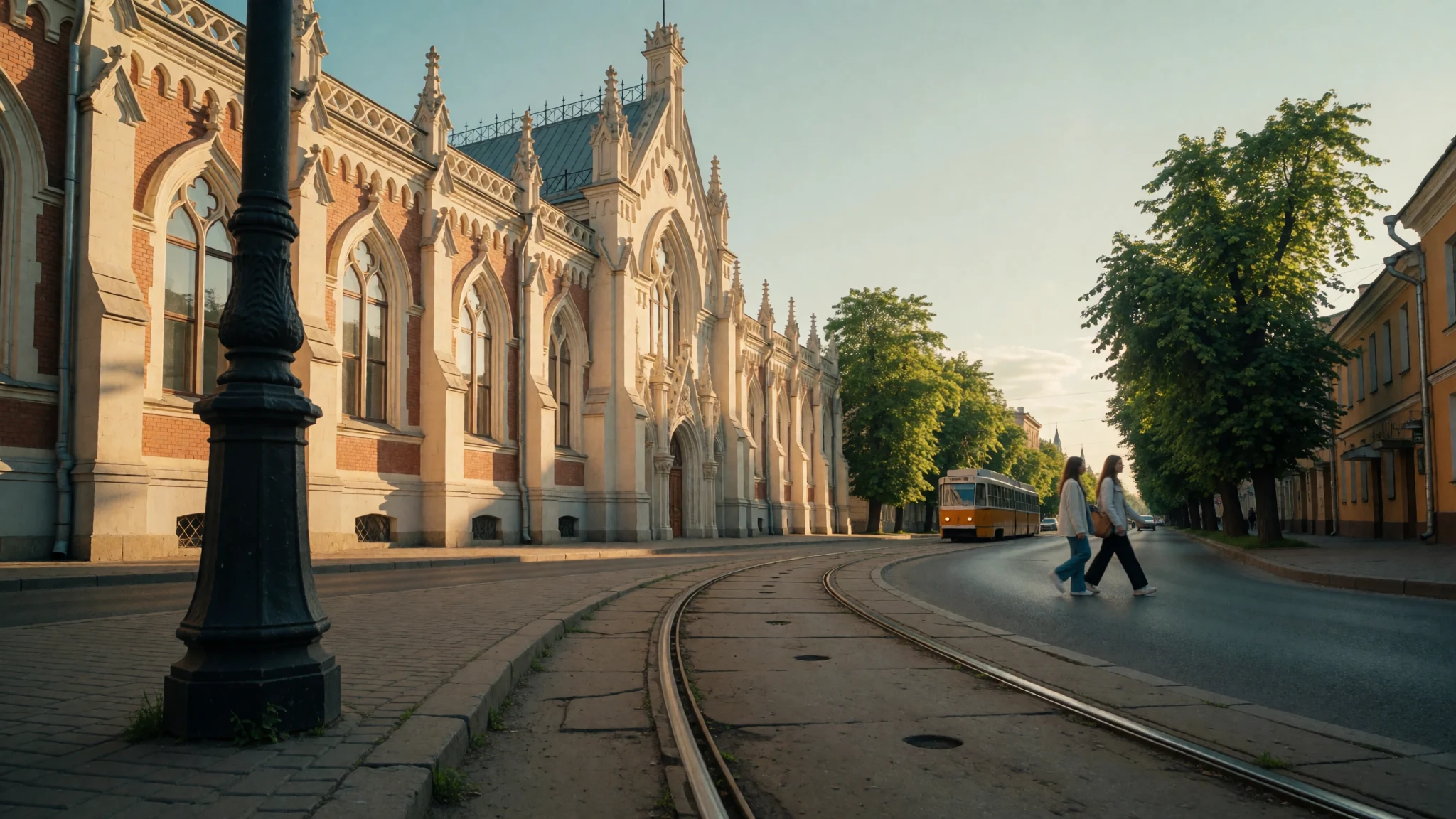
Saratov is a working Volga port with a grand conservatory, a covered market and river views, and almost no tourist crowds.
The place
Saratov is a Volga river port and the capital of its oblast, home to about 840,000 people and standing at roughly 50 metres above sea level. The city rises from the river's right bank into a grid of tree-lined streets, and a long road bridge links it with Engels on the opposite shore. The centre is compact enough to cover on foot. A pedestrian boulevard, Prospekt Stolypina, runs up to Kirov Square, and most of the sights worth a stop lie within a short tram or marshrutka ride of it. The skyline mixes merchant-era mansions, a neo-Gothic conservatory, Soviet apartment blocks and the occasional onion-domed church. Saratov is also a university town. The state university, the technical university, a drama theatre, the conservatory and the Radishchev Art Museum give it a steady student and arts crowd, which shows in the cafés and the evening concerts. The climate is moderately continental: summers are warm and sunny, the air is fairly dry, and winters are properly cold. Saratov is not a headline destination and foreign visitors are few, so a traveller here is more a curiosity than part of a queue. Distances in this part of Russia are large. Moscow is an overnight train away, and the city works best as a pause on a Volga journey, whether by rail or on a summer river cruise, or as a base for exploring the surrounding oblast.
Its story
Saratov's story begins before Saratov itself. A Golden Horde city called Uvek stood near the present site from the middle of the thirteenth century until Tamerlane destroyed it in the late fourteenth. The Russian town came later. Its exact founding date is unknown, but the usual estimate is about 1590, when Tsar Feodor I was securing the south-eastern frontier with a chain of Volga outposts. Saratov began as a fortress, and a weakly defended one. Cossack and Kalmyk raiders took it several times, and Cossack rebels seized it again in the eighteenth century. Town status came early in that century. Later the settlement, administered first from Kazan and then from Astrakhan, became the seat of a viceroyalty and then a governorate in its own right. The river made it prosperous. Grain, flour and shipping turned a frontier post into a merchant city, large and wealthy enough by the early twentieth century to support its own conservatory. It was also a place of many peoples. Poles and Germans jointly built a Catholic church, and the Catholic diocese based here covered dozens of Polish-German and Armenian parishes. Volga Germans settled in large numbers and shaped the city's trade and streets, until they were expelled in the years around the Second World War. Their absence is as much a part of the city's story as its grain barges.
What to see
- Conservatory — Central Saratov, Kirov Avenue
Saratov's conservatory is the building locals point to first. Its neo-Gothic façade began life as a music school and was reworked before opening as a conservatory in the early twentieth century. Admire it from the corner of Kirov Avenue, then check its concert listings, since performances are the best reason to go inside.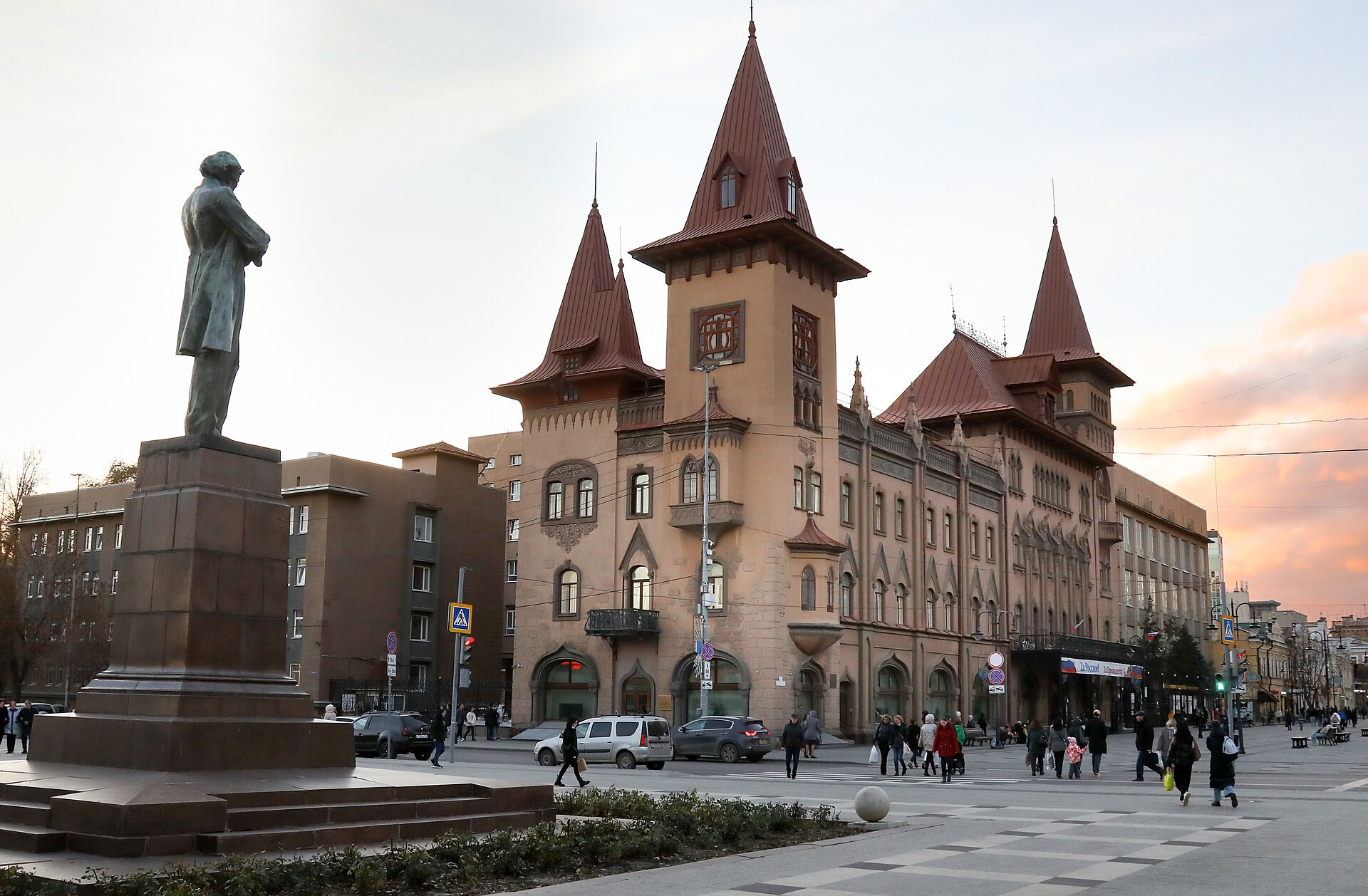
- Kirov Square and Prospekt Stolypina — City centre
Kirov Square is the city's main transport hub, where trams and marshrutkas gather at the top of the pedestrian boulevard. Look for the giant Lenin mosaic on a wall opposite the old office building. The boulevard below is the easiest place to watch daily life, with buskers, benches and cafés. - Covered Market — Central Saratov
Saratov's covered market is a large hall from the pre-revolutionary period, still trading. Stalls sell fruit, vegetables, meat, nuts and sweets. Go in the morning for the best choice, bring cash for small purchases, and treat it as the quickest way into everyday local taste.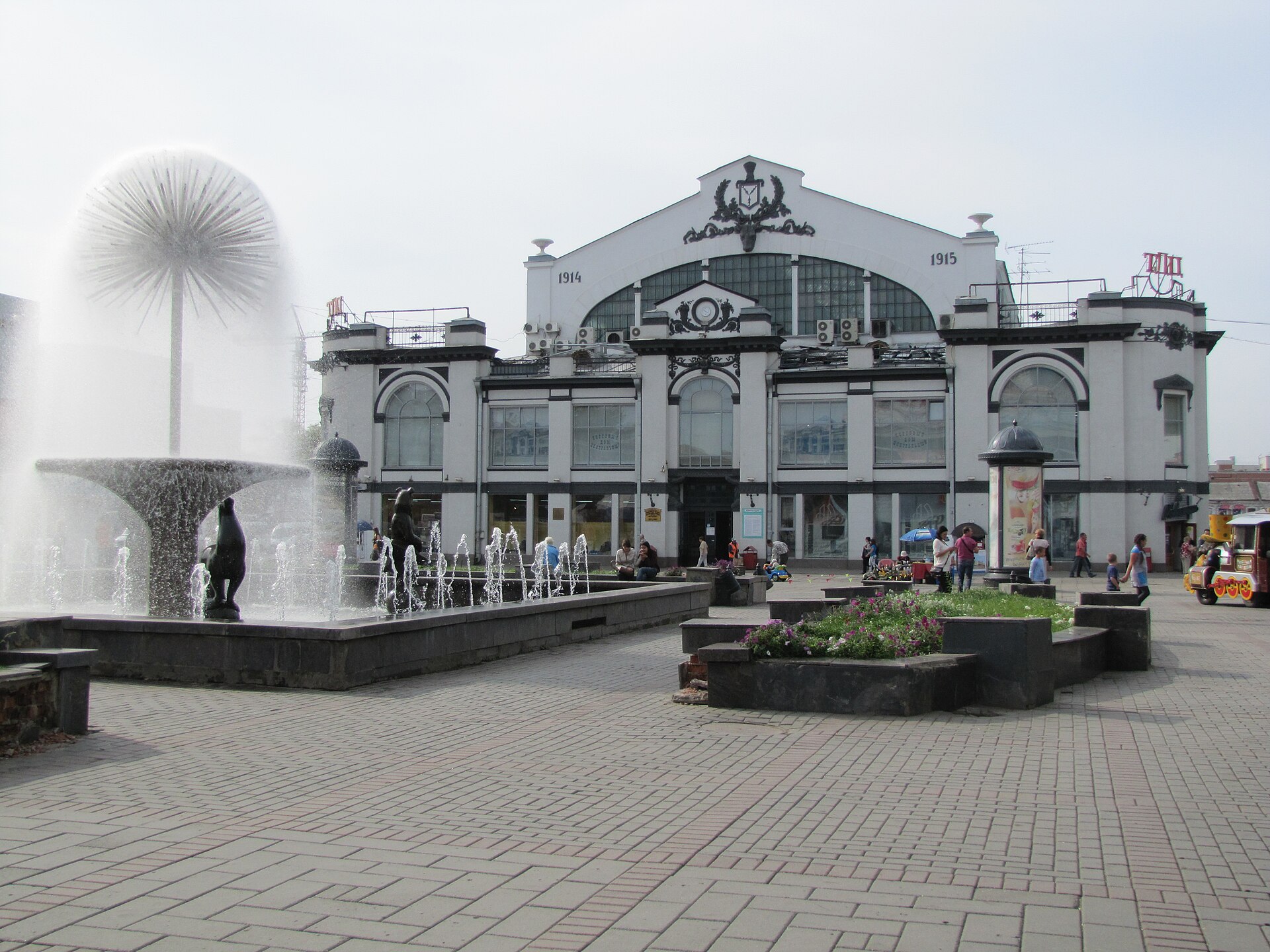
- Victory Park — Hilltop above the city
Victory Park sits on high ground above Saratov and holds military hardware, Second World War memorials and open views over the city and the Volga. The crane memorial, Zhuravli, gives the best outlook. It is a calm place for a late afternoon walk, especially in clear summer light. - Circus — City centre
Saratov's circus building dates to the nineteenth century and is among the older ones in Russia. A statue of the three Nikitin brothers, who founded the circus in the Volga region, stands to the left of the entrance. Check the official listings for performances, as the programme changes through the year. - Limonarium — Northern part of the city
The Limonarium is a greenhouse full of unusual plants, including giant citrus fruits. It is a good refuge on a cold winter day or in the heat of high summer, and works well as a short, quiet stop away from the central streets.
Culture
Saratov carries its culture lightly but seriously. Music is the clearest thread: the conservatory, built in a neo-Gothic style and opened in the early twentieth century, was among the first institutions of its kind in Russia, and it reflects how much the Volga merchants invested in the arts. Theatre, the circus, the art museum named after Radishchev and a large student population keep a steady programme going. The city's mixed past is visible too. Russian Orthodox churches stand beside the Catholic heritage of its Polish and German settlers, and Armenian parishes once formed part of the same diocese. Everyday manners are those of provincial Russia: people can seem reserved at first, then become generous hosts once a conversation starts, and a few words of Russian are received warmly. Tea, conversation and long meals matter more than speed. Public transport is shared and a little crowded, with marshrutkas that stop on request, and it pays to have small change ready. Evenings on the central boulevard are social, with families and students strolling until late in summer. Religious holidays are observed, and churches are busy on those days. When entering an Orthodox church, cover your shoulders and knees, women should cover their hair, and ask before photographing people or services.
What to wear
Saratov's traditional dress follows the wider Russian pattern. Women wore the sarafan, a sleeveless long dress of linen or wool, over an embroidered blouse, with a headdress such as a kokoshnik at festivals. Men wore belted linen or cotton shirts, and winter meant sheepskin and felted valenki boots. Wool shawls from the Orenburg region were prized in this part of Russia for their warmth. Today these garments appear mostly on stage and at folk festivals, and in the occasional wedding or village celebration. On the street, Saratov dresses much like other Russian cities: neat, practical and a little more dressed up than a visitor might expect, with smart trousers, jackets and good shoes even for casual evenings. Winters are properly cold, so locals wear heavy coats, hats and boots from late autumn. Summers are warm and sunny, with light dresses and shirts common. A visitor should pack for the season: layers, a warm hat and waterproof boots in winter, and light cotton, sun protection and comfortable walking shoes in summer. The pavements are uneven in places, so sturdy soles help. For Orthodox churches, carry a scarf for covering hair, and wear something that covers shoulders and knees. Smart casual clothes are welcome at the theatre and the conservatory.
What to eat
- Borshch — Cafés along Prospekt Kirova
Saratov serves borshch as everyone in Russia does, a beetroot soup often finished with sour cream and dark bread. Order it in a local café on Prospekt Kirova, where simple Russian cooking is the staple, or sit down with a bowl at a central canteen. - Solyanka — Cafés in the central streets
Solyanka is a thick, tangy soup of meat or fish with pickles, olives and lemon. It suits cold weather and a long afternoon. Look for it on the menus of ordinary Russian cafés in the city centre. - Blini — Russian cafés near Prospekt Kirova
Blini are thin pancakes eaten with sour cream, jam, honey or savoury fillings. They make a light breakfast or an afternoon snack. Most Russian-cuisine cafés in the centre serve them, and they are easy to order even without much Russian. - Volga river fish — The covered market and riverside eateries
As a river port, Saratov has long eaten Volga fish, fried, baked or in soup. Ask what is fresh that day and let the staff recommend. Sellers at the covered market often have smoked and salted fish too. - Market nuts and sweets — Stalls in the covered market
The covered market sells nuts, dried fruit and candies by weight, and they make good portable snacks for a train journey. Tasting a little is common, so ask politely, then buy what you like.
Plan it
Best time. May to June and September, when the weather is warm, sunny and fairly dry. July and August can be hot, and winter is cold with snow. River cruises on the Volga run from early May until the end of September.
How long. 2–3
Getting there. The usual route is the overnight train from Moscow's Pavletsky Station, leaving in the afternoon or evening and arriving in the morning; trains also run from Samara in the north and from Volgograd and Astrakhan in the south. Buses exist but are less comfortable over long distances. Check the city website, http://www.saratovmer.ru/, and the airport and rail operators for current services.
Budget. low
Tips
- Book long-distance trains early, especially in summer
- Carry some cash for markets, small cafés and marshrutkas
- Visit the covered market in the morning for the best choice
- Check concert and circus listings before you arrive
- Pack for the season: winters are properly cold and summers warm and sunny
Etiquette
- Cover shoulders and knees, and women should cover their hair, when entering an Orthodox church
- Ask before photographing people, especially at services
- Greet shop and market staff politely before ordering
Nearby
Sources
- Wikidata Q5332 (CC0)
- Wikipedia: Saratov (CC BY-SA 4.0)
- Wikivoyage: Saratov (CC BY-SA 4.0)
- Photo: Saratov (Alexxx1979) (CC BY-SA 4.0)
- Photo: Bender House in Saratov (Vyacheslav Bukharov) (CC BY-SA 4.0)
- Photo: Conservatory (Masha.Kondrasheva) (CC BY-SA 4.0)
- Photo: Church of Intercession (Alx0yago) (CC BY-SA 4.0)
- Photo: Covered market (Darya-Darya) (CC BY 3.0)
- Photo: Schmidt steam mill (Anastasia Galyamicheva) (CC BY-SA 4.0)
- Photo: Saratov bridge over the Volga (Olesya Boeva) (CC BY 3.0)
- Photo: Plan of Saratov, 1903 (Public domain)


