Porto Santo
Porto Santo, Portugal
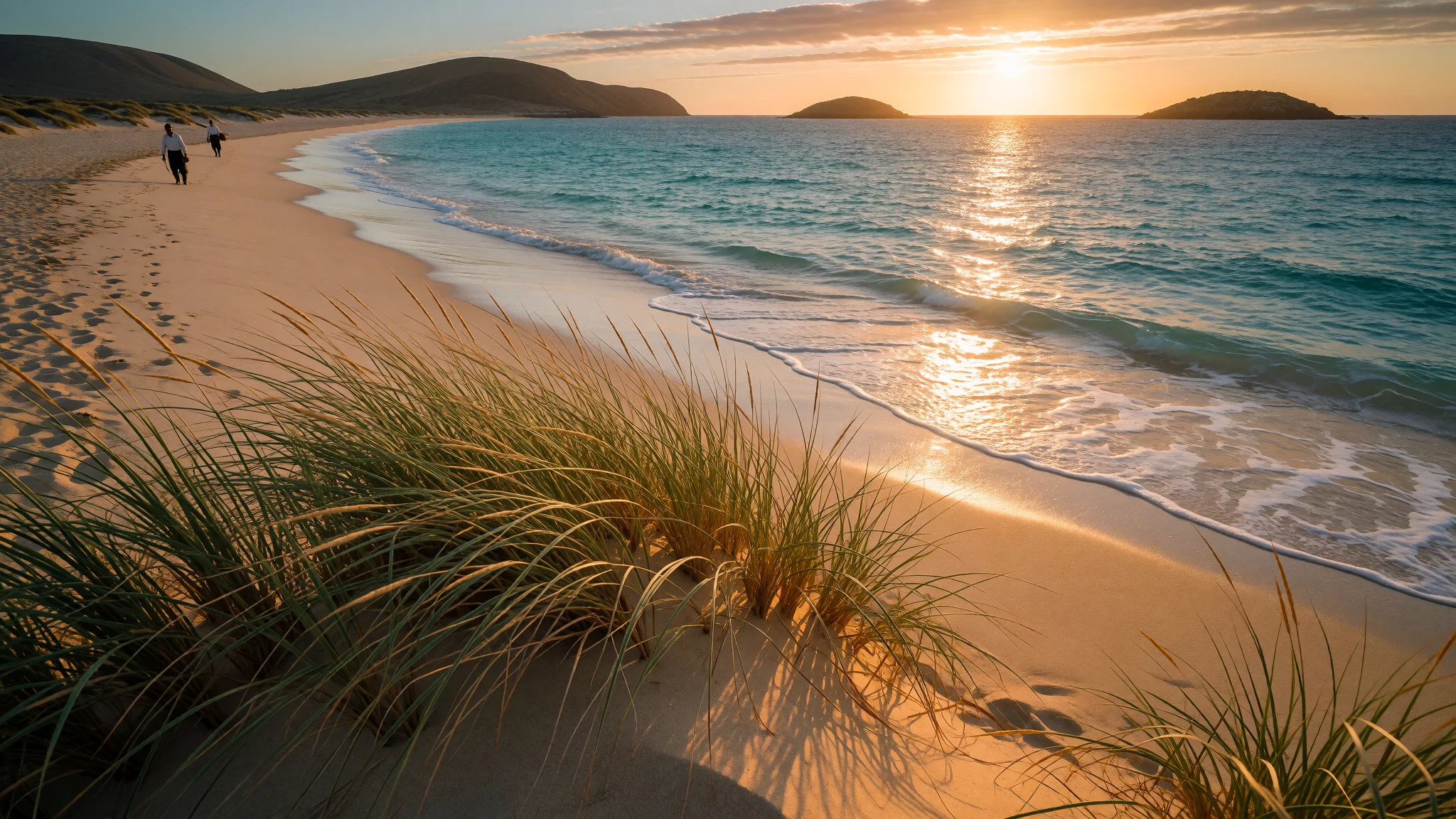
Porto Santo offers a long pale beach, quiet hills and a calm island pace, a short hop from Madeira across the Atlantic.
The place
Porto Santo is the northernmost and easternmost island of the Madeira archipelago, a Portuguese municipality that covers the whole island and has just over five thousand residents. It lies 43 km north-east of Madeira itself, out in the North Atlantic, and measures only about 42.59 square kilometres, so a single day of driving can take in most of it. The island divides into two quite different halves. The south-west is a low coastal plain, broken only by small rounded hills, and it carries a nine-kilometre ribbon of pale sand that gives Porto Santo a real advantage over its larger neighbour. The north-east is rugged, a cluster of peaks and cliffs that includes Pico do Castelo, Pico da Juliana, Pico da Gandaia and Pico do Facho, the last reaching 517 metres. Vila Baleira is the main town and the base for nearly everything: the seafront, the old church, the town hall, and most of the eateries. Tourism is the island's main industry, built on hotels put up in the twentieth century and on the beaches and mild climate. The airport handles flights from Lisbon and Porto, plus charters from several European countries. Expect a quiet, slow island rather than a lively one. Summer brings the crowds and the sunbathing, while the hills suit walkers in the cooler months. Funchal and the green mountains of Madeira are a short flight away, which makes Porto Santo a good partner for a longer trip rather than a replacement for it.
Its story
Porto Santo enters the written record in 1418, although mapmakers knew of the Madeira islands well before that. Charts from the fourteenth century place islands roughly where they are, and a Castilian monk's travel book from the same era lists names that include Puerto Santo, the Spanish form of the present name. Portugal's formal claim probably had a strategic edge, since Spain was pressing its own interests in the Canary Islands and Lisbon did not want to be shut out of the Atlantic. The claiming voyage involved João Gonçalves Zarco and Tristão Vaz Teixeira, captains serving Prince Henry, whom King John I had sent to find new land west of Africa. They were on the volta do mar, the wide westward swing that sailing ships used to get home, when a storm blew them off course. They found a sheltered bay on Porto Santo and rode out the weather there. To sailors who believed they had been spared from drowning, the place felt like a gift from heaven, and the name Holy Harbour followed. In the centuries afterwards the island became a small stopping place on Atlantic routes, and it later gave its name to a story about Christopher Columbus, whose house in Vila Baleira is now a museum. The island's quiet streets today give little hint of that seafaring past, but the harbour story still explains the name on every signpost.
What to see
- Columbus's house, Vila Baleira — Vila Baleira
Christopher Columbus's house in Vila Baleira is now a small museum about the Portuguese voyages of discovery and the navigator's stay on the island. Maps, navigation instruments, portraits and other artworks fill the rooms. It is a short, absorbing stop, and a sensible choice for a hot afternoon when the beach glare is too much. - Matriz Church — Vila Baleira
The Matriz Church stands in the heart of Vila Baleira and dates from 1430, though French buccaneers pillaged it in 1556. Inside, paintings by Martin Conrad and Max Romer draw passing visitors. It is modest in scale and a visit takes minutes, but it gives the town centre a cool pause and a sense of age.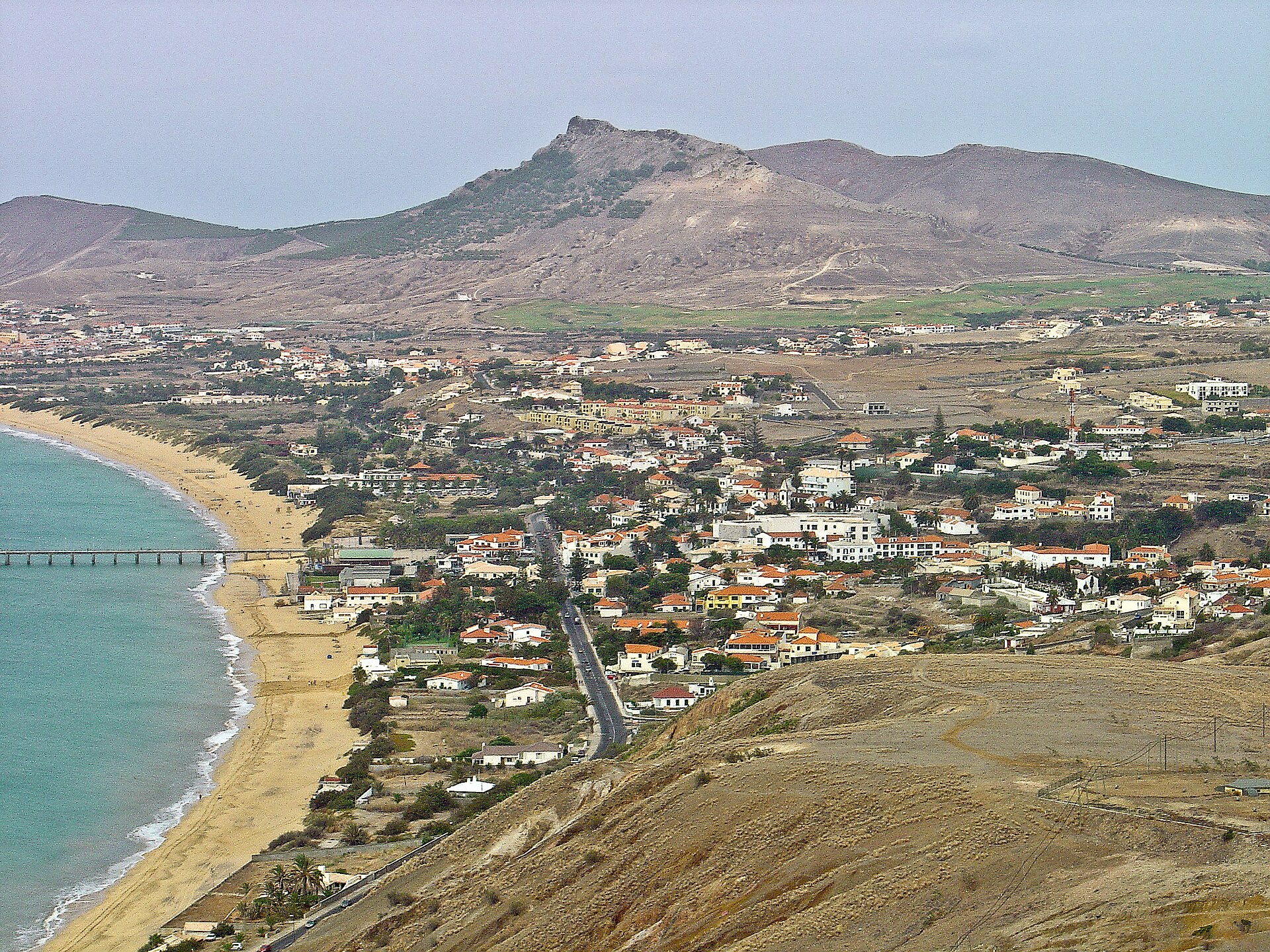
- Pico do Castelo viewpoint — North-east hills
Pico do Castelo, listed at 437 metres, is a low summit by mountain standards, but the drop to the sea gives it a wide outlook over Vila Baleira, the long beach and the small islands offshore. Go early or late for cooler air, as exposed ridges can be windy. - The nine-kilometre beach — South-west coast
The beach runs for nine kilometres along the south-west coast. Locals credit its sand with easing rheumatism and speeding recovery from broken bones, though that is tradition rather than medical advice. Mostly it is a long, easy place to swim and walk. In high summer the stretch nearest Vila Baleira fills first, and a short walk finds space. - Paços do Concelho — Vila Baleira
The Paços do Concelho, the town hall, was built in the sixteenth century in the middle of Vila Baleira. Over the years it served as both a jail and a palace, an unusual pairing. It is best seen as part of a short stroll between the church and the Columbus museum, which stand close by.
Culture
Porto Santo's culture is that of a small Portuguese island community that has lived from the sea, the land and, more recently, its visitors. With about five thousand residents, it is a place where people tend to know one another, and the pace of life follows the seasons: busy and sociable in summer, much quieter in winter. Catholic tradition runs through the calendar, and the main feast of the island is that of Nossa Senhora da Graça, which brings processions and gatherings to the town. Dates can change, so the municipality's official site is the best place to check. Madeiran habits show in the local speech, the music and the cooking, though islanders are quick to point out that Porto Santo has its own identity, flatter, drier and more sandy than its larger neighbour. Pride in the seafaring past is visible in the Columbus house and in the way the Holy Harbour story is told. Visitors are mostly Portuguese families and holidaymakers from northern Europe, so English is widely understood in hotels and restaurants, but a few words of Portuguese are always appreciated. Outside summer, shops and eateries may keep shorter hours, so it helps to plan around that. In the Matriz Church and at feast-day processions, dress modestly, keep your voice low and ask before photographing anyone who is praying.
What to wear
Porto Santo dresses for sun, sand and wind, and its traditional clothing now appears mostly at festivals. Traditional dress follows the wider Madeiran pattern: women in a bright striped skirt, an embroidered white blouse and a small cap, men in a white shirt, dark trousers and a cap, usually in wool, cotton or linen. These outfits turn up at folklore performances and feast days rather than in daily life. Everyday wear is relaxed and practical. Residents favour light cotton and linen, sandals or trainers, and a windproof layer for evenings and the exposed hills. Smarter clothes come out for church and family occasions, but nothing is formal, and the dress code in restaurants is casual. A visitor should pack for the beach and the town separately. Swimwear belongs on the sand, and a shirt or cover-up is expected in Vila Baleira, particularly in shops, cafés and the church, where covered shoulders and knees are respectful. A wide-brimmed hat, sunglasses and strong sun protection matter, since shade on the beach is scarce. For the peaks and cliff paths, wear closed shoes with a good grip, because the ground is dry, stony and can be slippery. A light jacket is useful in the evening and for crossing to Madeira, where the weather can be cooler and wetter.
What to eat
- Espetada — Grill restaurants in and around Vila Baleira
Beef cubes threaded on a skewer, seasoned with garlic and salt, then grilled over a wood fire and often served hanging from a hook. It is a sociable, hearty dish for sharing, and a standard of the Madeiran table. - Lapas grelhadas — Seafront eateries in Vila Baleira
Limpets grilled in their shells and served sizzling with garlic butter and a squeeze of lemon. The flavour is salty and rich, and they are eaten straight from the shell with a fork, often as a starter before fish. - Bolo do caco — Bakeries and cafés in Vila Baleira
A round, flat bread cooked on a hot stone, split open and filled with garlic butter. It is soft inside and lightly toasted outside, and it appears alongside espetada or as a snack with a drink. - Grilled fresh fish — Harbour and seafront restaurants
The day's catch, simply grilled and served with boiled potatoes, salad and olive oil. Ask which fish is freshest rather than choosing from the menu, and expect the kitchen to be proud of the answer. - Poncha — Small bars and cafés around Vila Baleira
A strong island drink of sugar-cane spirit, honey and citrus juice, stirred with a wooden tool until frothy. It is sweeter than it tastes, so drink slowly, especially in the heat of the afternoon.
Plan it
Best time. June to September for swimming and the warmest beach days, though this is also the busiest period. May and October are quieter and still pleasantly mild, which is the temperate climate the island's tourism depends on. Winter suits walking and golf, with a chance of wind and rain.
How long. 2–3
Getting there. Porto Santo Airport (PXO) has daily flights to Madeira Airport (about 15 minutes) and connections from Lisbon and Porto (roughly one and a half hours), plus seasonal charters from other European countries. The last leg is a short road transfer to Vila Baleira by taxi or hire car. Sea crossings from Madeira are possible; check current operators locally.
Budget. mid
Tips
- Book flights and rooms early for July and August, when the island is at its busiest
- Carry sun protection and water, as there is little shade on the beach or the hills
- Take a taxi or hire car to reach the north-east peaks; the walking distances are longer than they look
- Check the official site, https://www.cm-portosanto.pt/, for feast dates and opening times outside summer
- Carry a little cash for small cafés, though cards are accepted in most places
Etiquette
- Cover up when leaving the beach for the town or the church
- Keep your voice low in the Matriz Church and during processions
- Ask before photographing people, especially at religious events
Nearby
Sources
- Wikidata Q27320 (CC0)
- Wikipedia: Porto Santo Island (rev 1364362275) (CC BY-SA 4.0)
- Wikivoyage: Porto Santo (rev 4288834) (CC BY-SA 4.0)
- View of Madeira, ISS Expedition 41 (Earth Science and Remote Sensing Unit, Johnson Space Center) (Public domain)
- Vila Baleira, Ilha de Porto Santo (Vitor Oliveira) (CC BY-SA 2.0)
- 9400 Pedras Pretas, Portugal (1) (Jorge Daniel Guimarães) (CC BY 3.0)
- 9400 Pedras Pretas, Portugal (10) (Jorge Daniel Guimarães) (CC BY 3.0)
- 9400 Pedras Pretas, Portugal (11) (Jorge Daniel Guimarães) (CC BY 3.0)
- 9400 Pedras Pretas, Portugal (12) (Jorge Daniel Guimarães) (CC BY 3.0)
- 9400 Pedras Pretas, Portugal (13) (Jorge Daniel Guimarães) (CC BY 3.0)
- 9400 Pedras Pretas, Portugal (16) (Jorge Daniel Guimarães) (CC BY 3.0)


