Perperikon
Perperikon, Bulgaria
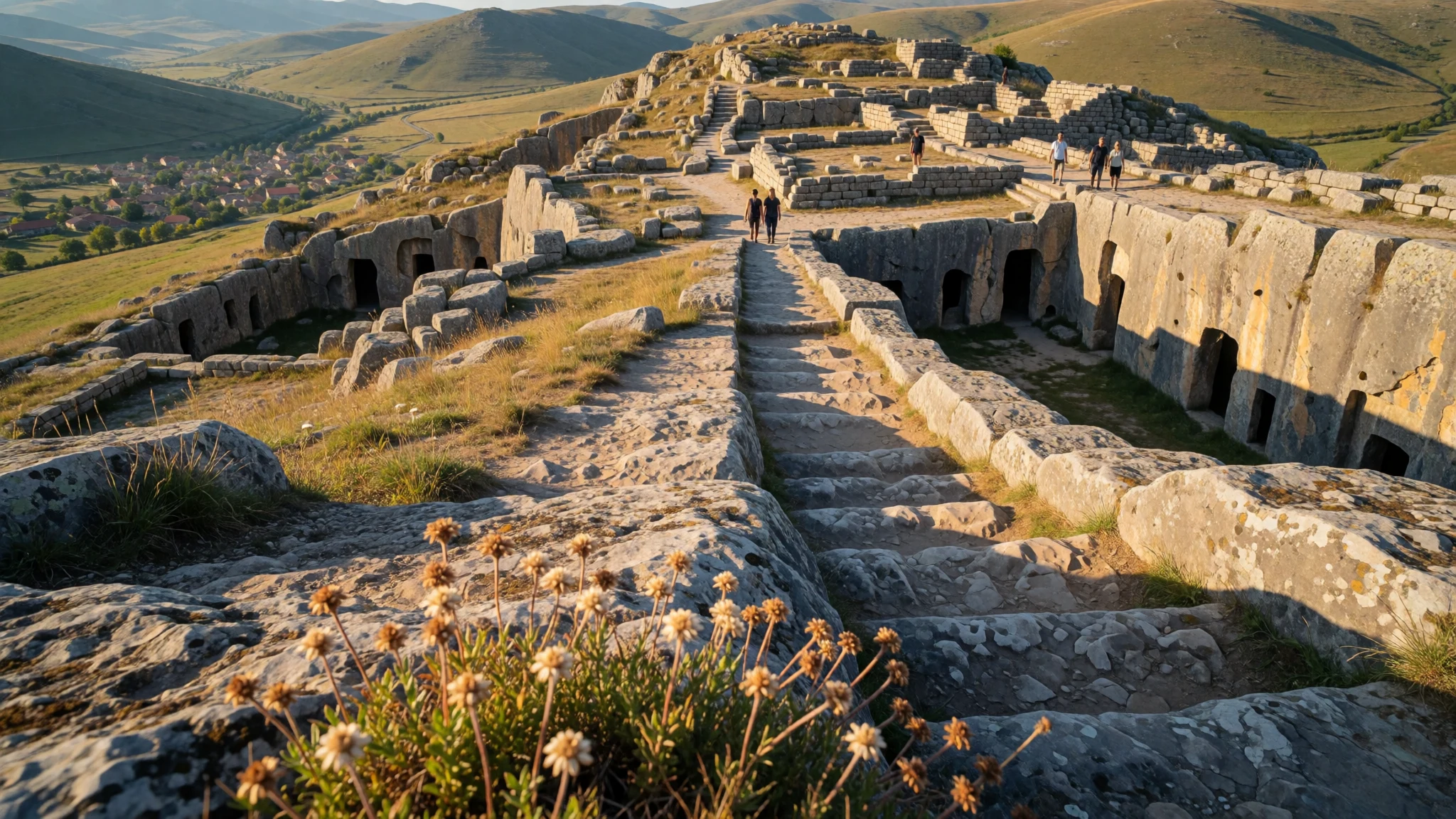
Perperikon offers a rare journey through ancient megaliths, Roman palaces, and medieval fortresses carved directly into the rocky summits of the Rhodope Mountains.
The place
Perperikon sits perched high above the landscape in the Eastern Rhodope Mountains of Bulgaria, functioning as a sprawling archaeological wonder carved directly into massive stone outcrops. The surrounding region is defined by rolling hills, winding rivers, and small settlements such as the village of Gorna krepost nestled quietly at the foot of the hill. Visitors wandering through the site encounter a vast complex where nature and human engineering blur together. Stone steps, massive walls, and deep cisterns have been hewn out of the live rock over thousands of years, creating a dramatic labyrinth of ruins that open up to sweeping views across the valley.
The geography of this part of Bulgaria bridges major historic trade routes connecting Europe with the Middle East, drawing diverse peoples who left their mark across the landscape. Walking through Perperikon feels akin to stepping back through successive layers of history, from prehistoric sacred sanctuaries to robust medieval fortifications. The weathered stones retain the pale warmth of the southern sun, and the quiet atmosphere of the hills is broken only by the wind whistling through the ancient courtyards and the distant rush of nearby waterways.
Exploring the complex requires navigating uneven rocky terrain, ancient pathways, and exposed stone structures that demand steady footwear and a sturdy pace. The expansive scale of the site reveals itself gradually as visitors climb higher toward the upper plateau, where the most significant sanctuaries and royal quarters once stood. The stark beauty of the stone architecture against the open sky makes this southeastern European ridge a remarkable destination for those drawn to ancient landscapes and deep historical roots.
Its story
Perperikon carries a deep historical narrative that stretches across millennia, beginning with human activity around the dawn of human settlement eras. Early communities utilized the imposing rocky hill for shelter and ritual gatherings, leaving behind pottery shards and rudimentary artifacts. By the Bronze Age, distinct architectural marks began to appear on the stone surface, followed during the Early Iron Age by the creation of an impressive round altar hewn directly out of the bedrock. Scholars associate this phase with ancient sanctuaries dedicated to sacred rites, potentially housing the legendary Temple of Dionysus.
As political structures shifted in antiquity, Perperikon grew in stature and influence. Historical records note that Medokos declared himself king of Thrace here following earlier political transitions. Subsequent centuries brought Roman administration, transforming the settlement into a grand urban center complete with multi-storey palaces, temples, and defensive walls that encircled the entire hill. The architecture underwent continuous destruction and rebuilding as empires rose and fell across the Balkans.
During the medieval period, the complex functioned as a formidable fortress defending the frontier against shifting regional powers. After centuries of abandonment and quiet decay, modern archaeological excavations initiated at the turn of the twenty-first century began peeling back the accumulated earth and debris. These careful digs uncovered the monumental proportions of the ancient citadel, bringing international attention to the vast megalithic ensemble and paving the way for contemporary preservation efforts.
What to see
- The Acropolis and Rock Altar — Upper summit plateau
At the very highest point of Perperikon lies the magnificent sacred core of the ancient site. Here, an enormous circular altar is meticulously carved directly into the living stone, surrounded by remnants of ancient shrines and open-air ritual spaces that gaze out over the sweeping Rhodope landscape below. - The Roman Palace Complex — Central terrace levels
Sprawling across the lower terraces, the grand residential and administrative quarters reflect classical imperial ambitions. Visitors can trace the foundations of multi-level buildings, spacious courtyards, and thick stone walls that once accommodated the regional elite and governing authorities of the empire. - Medieval Fortress Walls — Outer perimeter
Robust defensive fortifications encircle the archaeological site, constructed during the medieval era to protect the strategic stronghold. Massive stone blocks fitted tightly together demonstrate the defensive engineering employed by Bulgarian rulers to safeguard the hill against regional conflicts and sieges. - Rock-Cut Streets and Cisterns — Throughout the archaeological park
A complex network of pathways, staircases, and deep water reservoirs are carved deeply into the stone throughout Perperikon. These ingenious infrastructure elements illustrate how ancient inhabitants managed water collection and urban circulation across the dry, elevated hilltop environment. - The Visitor Centre — Base of the archaeological site
Positioned to introduce guests to the sprawling complex, this modern facility provides context on the extensive excavations led by archaeologists. Exhibition displays help visitors visualize how the ruined stone terraces functioned during successive historical epochs before exploring the hill.
Culture
Perperikon and the surrounding Rhodope region reflect a welcoming, warm cultural environment where residents are often eager to engage with visitors and share local stories. In smaller villages near the archaeological site, rural hospitality runs deep, and travellers frequently encounter friendly greetings or spontaneous invitations to share a meal or coffee. Engaging in polite conversation is appreciated, though daily interactions in shops or local businesses tend to be straightforward and practical rather than chatty. When passing locals or working stalls in the hills, offering a pleasant greeting sets a respectful tone for any exchange. Visitors should note that cultural pride is strong, and cultural identity is deeply cherished across the country. When conversing with locals around Perperikon, always refrain from referring to the Bulgarian alphabet as the Russian alphabet.
What to wear
Traditional clothing in the Perperikon region and wider Bulgarian countryside features intricate embroidery, heavy woollen aprons, and woven textiles historically crafted for warmth and durability during rural life. While traditional garments are now largely preserved for folk festivals, national holidays, and ethnographic displays, modern residents in nearby towns dress in contemporary European styles suitable for daily work and travel. Visitors exploring the archaeological ruins of Perperikon should prioritize practical comfort above all else. Sturdy walking shoes or hiking boots are essential for navigating the steep, uneven stone steps and rocky trails that cover the hillside. Lightweight layers, a sun hat, and reliable sunglasses are recommended during warmer months, as the open hilltop offers very little shade from the bright southern sun.
What to eat
- Shopska Salad — Any traditional local restaurant or tavern
A refreshing staple of local dining featuring crisp cucumbers, ripe tomatoes, onions, and bell peppers, generously topped with grated white brined cheese and fresh parsley, found at any traditional eatery. - Mixed Grill — Traditional roadside taverns and grills
A hearty selection of spiced meats including grilled pork kebapche and kyuftete, served sizzling hot alongside french fries and ljutenica relish in village mehanas. - Tarator — Local cafés and traditional dining spots
A cooling traditional cold soup made from strained yoghurt, finely diced cucumbers, garlic, dill, and crushed walnuts, particularly popular during warm summer days. - Banitsa — Village bakeries and morning markets
Flaky layered pastry filled with crumbled white cheese and eggs, baked until golden and enjoyed warm as a comforting breakfast or mid-morning snack from local bakeries. - Kavarma — Traditional Rhodope restaurants
A slow-cooked stew of pork or chicken combined with leeks, mushrooms, peppers, and savory herbs, traditionally simmered and served in an individual earthenware pot.
Plan it
Best time. May to June and September to October offer pleasant mild weather ideal for exploring the open hilltop ruins without the intense summer heat.
How long. 2–3
Getting there. Fly into Sofia or regional airports, then travel by road toward Kardzhali and onward to the archaeological site near Gorna krepost.
Budget. mid
Tips
- Wear sturdy footwear with good grip for climbing uneven ancient stone steps
- Arrive early in the morning to beat the midday sun and tourist crowds
- Bring plenty of drinking water, as shade on the hilltop is scarce
- Carry cash for small village shops and entrance fees where card machines may not work
Etiquette
- Greet locals in rural areas with a polite local greeting
- Respect archaeological preservation boundaries by not climbing on fragile restored walls
Nearby
Sources
- Wikidata Q1943549 (CC0)
- Wikipedia (CC-BY-SA 4.0)
- Wikivoyage (CC-BY-SA 4.0)