Palikir
Palikir, Federated States of Micronesia
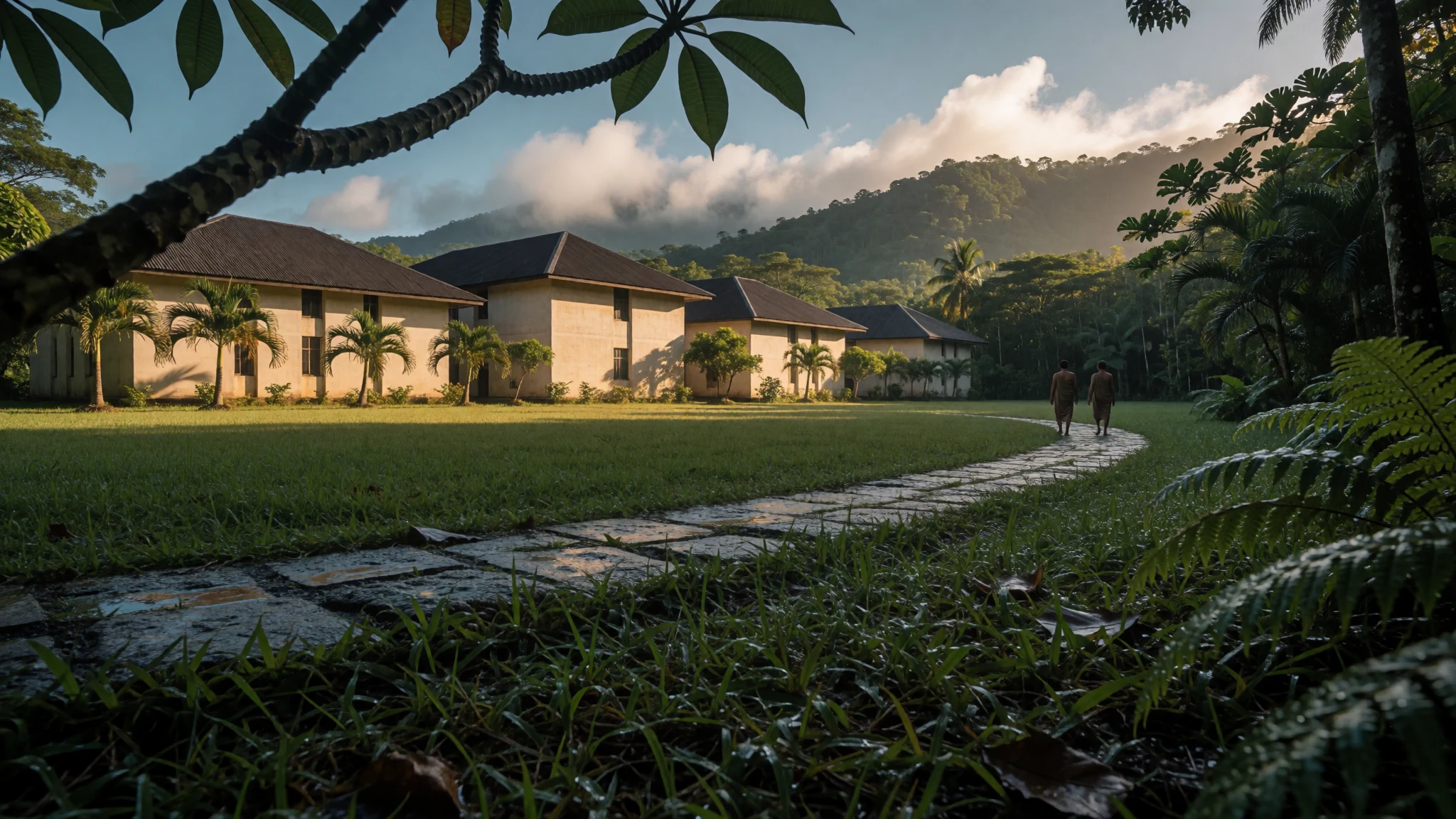
Palikir is a small, rain-soaked purpose-built capital on Pohnpei, where government lawns meet rainforest, waterfalls and the ruins of an island city.
The place
Palikir is the capital of the Federated States of Micronesia, set about 80 m above sea level on the northwest side of Pohnpei, a high volcanic island ringed by a coral reef. Roughly 6,200 people live here. It is less a city in the usual sense than a government campus with a village around it: ministries, a scattering of houses and the president's residence, all tucked into forest. Kolonia, the island's main town and the capital of Pohnpei state, lies about 8 km to the northeast, and that is where most shops, eateries and everyday errands happen. Inland the land climbs steeply. Mount Nanlaud, about 9 km to the southeast, reaches 782 m and is the highest point in the country. The island is roughly circular and about 97 km around, so a full loop by road is an easy day. The climate is tropical rainforest, with temperatures hovering near 27 °C all year and about 5,202 mm of rain annually. There is no dry season to wait for; sun, cloud and downpour take turns within the same hour, and the green of the hillsides is the result. Pohnpei has no natural beaches. A belt of mangrove swamp surrounds it instead, and sea access is patchy. Palikir itself is quiet and orderly, and works best as a base for seeing the island and its government, not as a sightseeing city in its own right.
Its story
Palikir was a tiny village of little consequence for most of its history, and the story of the place is really the story of Pohnpei. In early times the island was run by tribal chiefs. European ships reached it in the fifteenth century, but nobody settled until Spain established a presence in 1886. Germany bought the Caroline Islands from Spain in 1898, after the Spanish–American War. Japan took control during the First World War, and in the Second World War its forces built an airfield near Kolonia and dug in on the island's high ground. Afterwards the United States administered the territory until the Federated States of Micronesia became independent in 1979. The new government wanted a purpose-built administrative centre rather than crowding into Kolonia, and the Palikir area was chosen. American aid paid for the offices, some housing and the president's residence, and the site was declared the capital in 1989. It is therefore a young capital, barely a generation old, built on what had been farmland and forest. Even now the settlement is small and village-like, with the federal administration of the whole country running from a few low buildings. The older layers of Pohnpei's past lie elsewhere on the island, in the ruins at Nan Madol, the Spanish wall in Kolonia and the Japanese guns on Sokehs Ridge.
What to see
- The government campus — Palikir
The campus holds the Congress and Supreme Court buildings, plain modern blocks on open lawns with forest rising behind. It is a working site, so the pleasure lies in walking its edges, watching weather roll in and seeing how a purpose-built capital sits in rainforest. Ask locally what is open to visitors.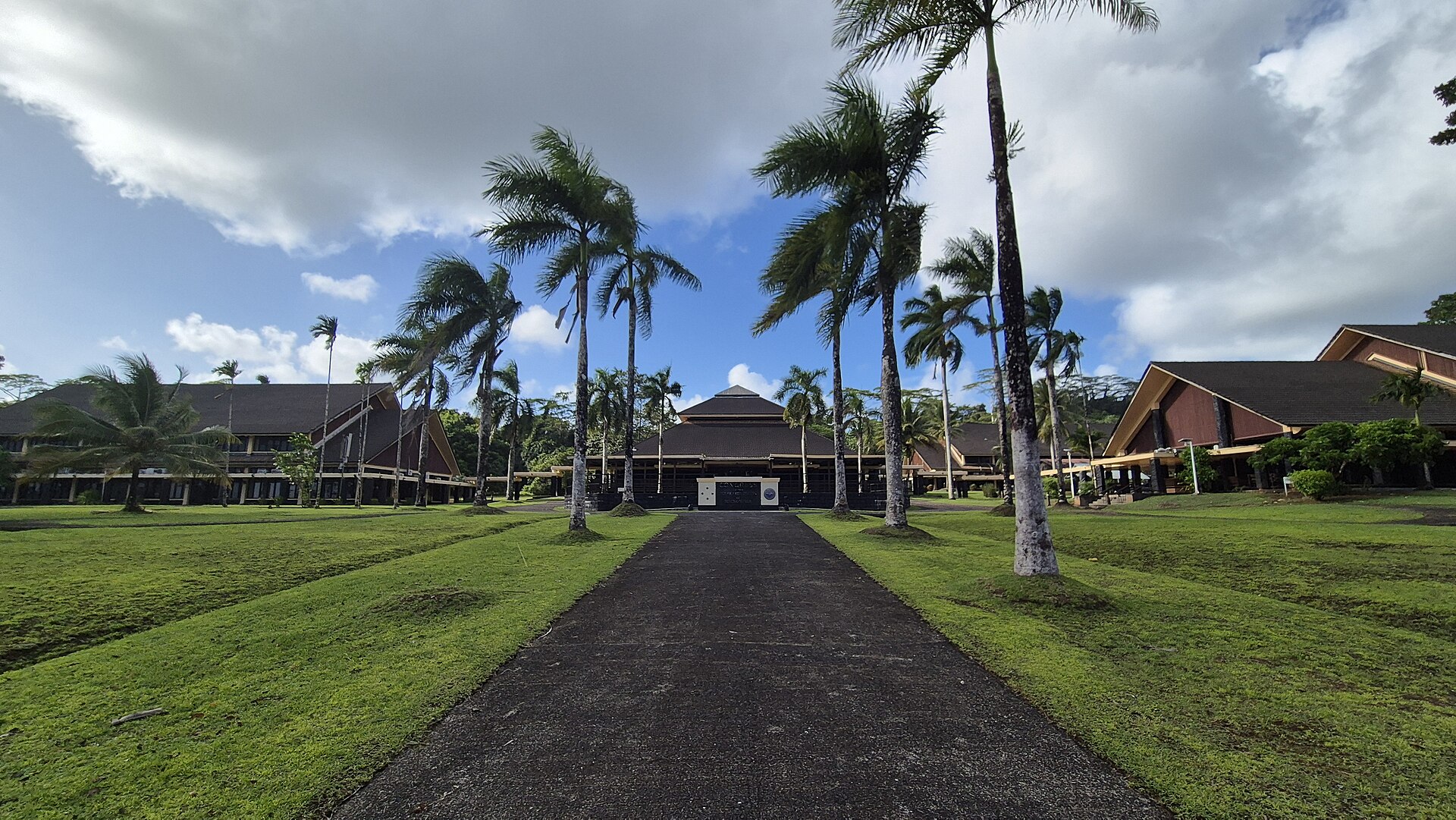
- Kepirohi Waterfall — Eastern Pohnpei
Kepirohi Waterfall falls into a pool where visitors swim, on the far side of the island from Palikir. Locals sometimes offer a back massage under the falling water. With so much rain feeding the interior, the flow is rarely thin. Rocks are slippery, so wear shoes with grip. - Sokehs Ridge — Near Kolonia
Sokehs Ridge is a massive rock outcrop close to Kolonia, with a trail to the top. The reward is a wide view over the island, plus Japanese guns left from the Second World War. Allow half a day, start early before cloud builds, and expect mud. - Nan Madol — Eastern Pohnpei
Nan Madol is a ruined royal city built on artificial islands in the lagoon, about a thousand years old. Low stone walls and canals spread through mangroves. It is a long excursion from Palikir; arrange access and a local guide through your accommodation, and bring insect repellent. - Reefs, mangroves and Nett Point — Coast and lagoon
Mangroves ring Pohnpei, so sea access is limited; Nett Point offers public entry to the water. Diving and snorkelling are mostly along the reefs, and the best spots need a boat. The simple cabins at Nahlap, in Kitti, suit a day on the reef.
Culture
Palikir is a government town, but the culture around it is Pohnpeian, and that is worth understanding before arriving. The island kept its chiefly traditions through Spanish, German, Japanese and American rule, and traditional titles and village obligations still sit alongside the elected state and federal governments. Family, land and respect for rank matter, and the pace of life follows the weather more than the clock. Churches are central to community life, and Sunday is quiet. The island's best-known ceremonial drink is sakau, prepared and shared in a formal setting; it is something to be invited to, not something to ask for as a tourist. Visitors often find Micronesians reserved at first and warm once introduced, so a greeting and a little patience go a long way. The country is a federation of four states, and Pohnpei is the most developed of them, though development here means a handful of eateries, a small airport and a single main town. Petty theft from parked vehicles is the main nuisance, in an otherwise very safe place. Take it slowly, accept that plans bend around rain, and treat the capital's quiet streets as someone's home district. Ask permission before photographing people or stepping onto private land, and dress modestly in villages and churches.
What to wear
Palikir wears its clothes for heat and rain, and the habits come from a mix of island tradition and church-influenced modesty. Traditionally, Pohnpeians wore wrapped lengths of cloth and skirts made from plant fibre, and flower garlands for the head and neck, which still appear at ceremonies, celebrations and welcomes. Hibiscus and other local plants supply fibre and decoration. Today the ordinary picture is simpler. In the capital, office workers wear short-sleeved shirts or blouses, trousers or knee-length skirts, and many women wear loose, long dresses or wrap skirts in bright printed cotton. Men often wear a wrapped cloth or shorts away from the office. Flip-flops and sandals are normal, and umbrellas are everywhere. A visitor should dress for a warm, damp climate near 27 °C all year, with modest cuts out of respect for local norms: shoulders and knees covered in villages, churches and government buildings. Choose lightweight fabrics that dry fast, as cotton stays wet for days. A thin rain jacket matters more than a sun hat, though both are useful. Footwear needs grip for muddy trails, waterfall rocks and mangrove paths, so bring light trail shoes or sandals with straps, and keep a spare dry pair for travelling.
What to eat
- Japanese-style set lunch — Family-run eateries in Kolonia
A legacy of the Japanese period, the set lunch brings fish, tuna sashimi, rice, salad and a bowl of soup on one tray. It is filling and good value. Look for it at the longer-established eateries in Kolonia, usually served at midday. - Sashimi and sushi from a revolving tray — Riverside eateries near Kolonia
Some riverside eateries serve lunch from a rotating central tray, where diners pick sashimi, cucumber rolls, fried chicken or seafood pasta. Tuna is the safe, fresh choice here. Go at lunchtime when the choice is widest and the turnover quick. - Breadfruit and banana chips — Local eateries and roadside stalls
Breadfruit is the island's starchy staple, roasted, boiled or fried, and thin crisps of breadfruit and banana often arrive free as a first nibble. Eat them while waiting for the main course, and ask what else is in season. - Chinese stir-fries — Near the shipping port, Kolonia
Cooks from China run several kitchens on the island, and their dishes lean on fresh vegetables, a welcome change after days of fish and rice. Portions are generous, so share. The eatery by the shipping port is a popular choice. - Island fish and American-style plates — Marina-side restaurants in Kolonia
Some restaurants mix local seafood with American standards such as burgers and salads. Order the fish of the day if offered, and expect a relaxed pace. Dinner out is a treat on Pohnpei, as there are only about ten restaurants.
Plan it
Best time. Any month works. Temperatures sit near 27 °C all year and rain falls every month, with no dry season, so choose by flight days and pack for showers. February to April is a loose suggestion rather than a promise of drier weather.
How long. 2–3
Getting there. United Airlines runs the island-hopper through Micronesia, east to west on Tuesday, Thursday and Saturday and west to east on Monday, Wednesday and Friday; Nauru Airlines has a once-weekly service linking Brisbane, Nauru and other Pacific islands. Check the airlines' official sites for current schedules. From the airport near Kolonia, Palikir is about 8 km by road, so take a taxi or arrange a pick-up with your accommodation.
Budget. mid
Tips
- Arrive at the airport at least an hour before boarding; bags are searched by hand
- Pack a light rain jacket and a dry bag, as showers come daily
- Do not leave valuables on show in parked vehicles
- Bring your own snorkel gear, as hire is limited and the best reef spots need a boat
- Hire a guide or driver for Nan Madol and the waterfalls; ask your accommodation
Etiquette
- Dress modestly in villages, churches and government buildings
- Ask before photographing people or entering private land
- Treat invitations to ceremonies as an honour and follow your host's lead
Nearby
Sources
- Wikidata Q42751 (CC0)
- Wikipedia: Palikir (rev 1373593286) (CC BY-SA 4.0)
- Wikivoyage: Palikir (rev 5417172) (CC BY-SA 4.0)
- Photo: Palikir Government Buildings (MaxMonaco) (CC BY-SA 4.0)
- Photo: Palikir 2025-Presidential (Zykasaa) (CC BY-SA 4.0)
- Photo: Lithuanian and Micronesian flags in Palikir (Zykasaa) (CC BY-SA 4.0)
- Photo: Palikir (cropped) (Gargoylepni) (Public domain)
- Photo: Palikir 2025-1 (Zykasaa) (CC BY-SA 4.0)
- Photo: Palikir 2025-Conference 2 (Zykasaa) (CC BY-SA 4.0)
- Photo: Palikir 2025-Conference Centre (Zykasaa) (CC BY-SA 4.0)
- Photo: Palikir 2025-Congress (Zykasaa) (CC BY-SA 4.0)


