Nyíregyháza
Nyíregyháza, Hungary
Nyíregyháza is a relaxed north-eastern Hungarian county capital, good for village-life museums, Greek Catholic heritage and a slow, unhurried Plain-country stop.
The place
Nyíregyháza is the county capital of Szabolcs-Szatmár-Bereg, in the far north-east of Hungary, and a city with county rights, home to about 114,000 people. It sits flat and low, around 116 metres above sea level, in the middle of the Nyírség, a sandy farming region whose name comes from the birch trees associated with it. This is not a city of dramatic skylines. The centre is a tidy run of squares, pedestrian streets and public buildings, with the town hall, county hall and co-cathedral all within a short stroll of one another. Beyond the centre lie suburbs, orchards and fields, and to the north the wooded, lakeside district of Sóstó, where the zoo and the open-air museum draw most of the day trippers. Several main roads and railway lines meet here, which makes the city a natural gateway towards Ukraine, Romania and the Transylvanian side of the old kingdom, and a sensible base for exploring the eastern plains. The climate is humid continental: summers are warm, winters are cold enough for frost and occasional snow, and spring and autumn are mild and changeable. Nyíregyháza is a working city rather than a museum piece, with students, shoppers and office workers filling the main street and cafés putting tables out on the pavements in summer. It rewards a day or two of unhurried wandering rather than a checklist.
Its story
Nyíregyháza first turns up in writing in 1209, under the short name Nyír, the word for birch, borrowed from the sandy region around it. A record from 1326 mentions a church, and that is the origin of the second half of the name, since egyház means church. For a long time it was a modest farming settlement, home to only a few hundred people by the later Middle Ages. Then the Ottoman occupation of Hungary emptied it, and it stayed deserted until resettlement began in the decades before the middle of the seventeenth century. The real turning point came after the Rákóczi war of independence, when new settlers arrived, most of them Slovaks from around Békéscsaba. Growth was quick enough that by 1786 the town had won a licence for regular markets, and it was already the largest community in the county, with several thousand residents. Early in the nineteenth century it was prosperous enough to free itself from its landowning lords, the Dessewffy and Károlyi families. More recently, the fall of communism brought foreign-owned factories, and a later recession cut several thousand jobs, a reminder that the city's fortunes still follow the wider economy. That long story of emptying and refilling is one reason the centre feels more planned and recent than ancient, with wide streets and civic buildings rather than a medieval tangle.
What to see
- Kossuth Square and the town hall — City centre
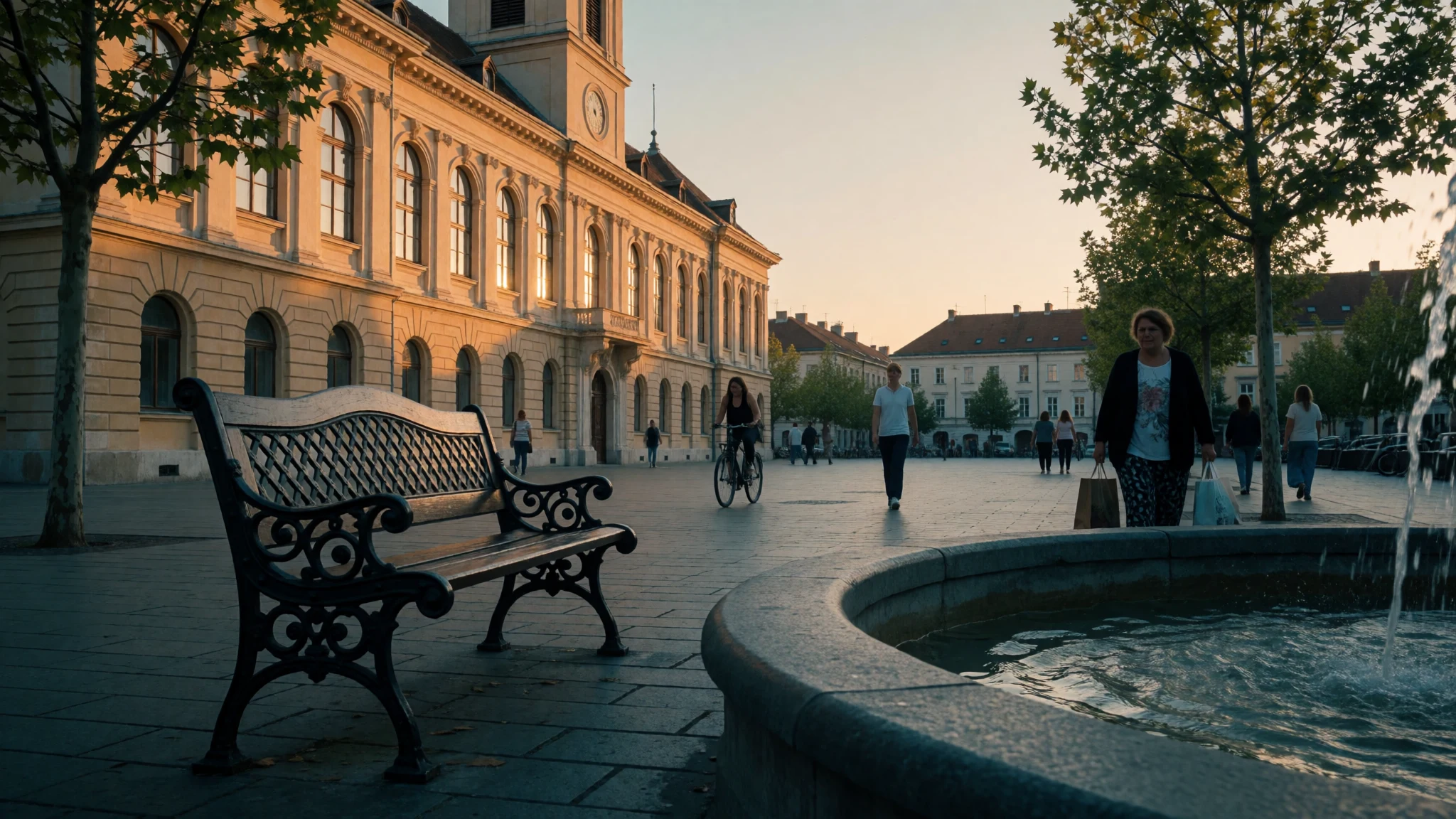
Kossuth Square is the civic heart of Nyíregyháza, a broad pedestrian space framed by the town hall and other public buildings. It is the easiest place to start, with benches, fountains and cafés close by. Come in the morning for quiet, or early evening when locals gather.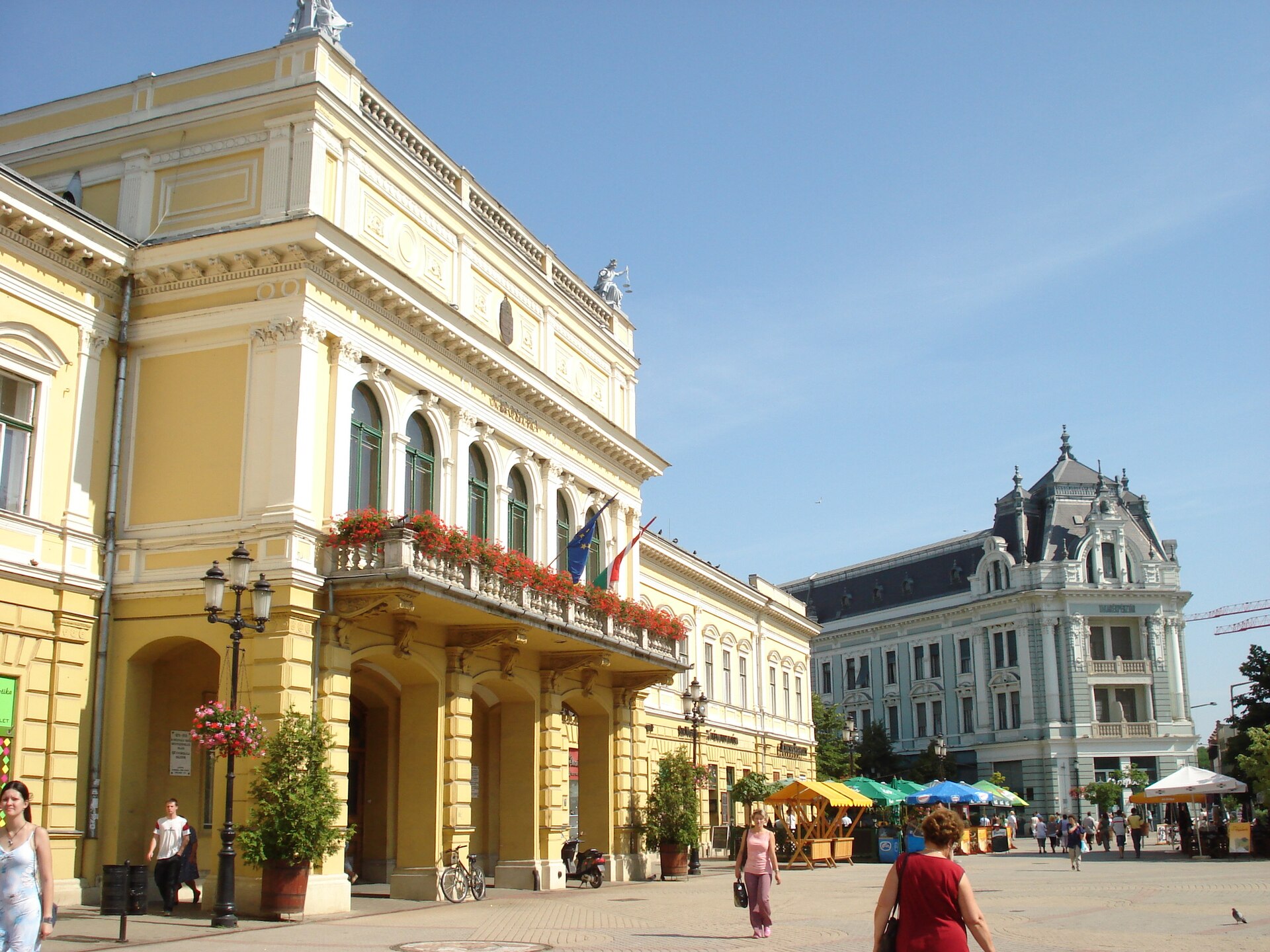
- Open Air Museum of Sóstó — Sóstó, north of the centre
The open-air museum collects rural buildings and household objects from the region as it was around a century ago. Thatched houses, farmyards and workshops show how people on the plain lived and worked. Festivals and events are held through the year, so check the official site for dates. - Jósa András Museum — City centre
This is the city's main museum, with permanent exhibitions and changing displays. The collections include material on the painter Gyula Benczúr and the writer Gyula Krúdy, both tied to the area. It is a good rainy-day stop and gives useful local context before heading out to villages. - Greek Catholic Art Collection — City centre
A small collection of art from the Hungarian Greek Catholic church, with objects reaching back to the sixteenth century. Icons and liturgical pieces show the Eastern traditions that shaped this part of Hungary. It pairs well with a look at the nearby co-cathedral, if opening times allow. - Kállay Collection — City centre
This collection gathers items that belonged to Miklós Kállay, a former prime minister of Hungary. It is a compact, specialist visit, more for readers of twentieth-century history than casual sightseers. Pair it with the nearby museum and the central squares for an easy half-day on foot.
Culture
Nyíregyháza is a mixed-faith city in a country where Catholicism has two distinct faces. Roman Catholics belong to the Diocese of Debrecen-Nyíregyháza, which the city shares with its larger neighbour, and the church runs schools and a college here. The Greek Catholic community, which follows Eastern rites while accepting the authority of Rome, is just as visible. Nyíregyháza is the seat of the Diocese of Hajdúdorog, the only Hungarian Greek Catholic bishopric, and a local collection preserves church art from as far back as the sixteenth century. Icons, services and a different musical tradition make the two churches feel separate even when their buildings stand close together. Beyond religion, local pride runs to literature and painting. The writer Gyula Krúdy and the painter Gyula Benczúr are both claimed by the city, and the main museum gives each a permanent display. Village customs from the surrounding plain survive in festivals, especially at the Sóstó open-air museum, where seasonal events recreate rural working life. Everyday manners are courteous and fairly formal: people greet shopkeepers on entering, shake hands at a first meeting and use formal address with older strangers. In a church here, keep your voice low, cover bare shoulders and do not photograph a service or the worshippers without asking first.
What to wear
Nyíregyháza's traditional dress belongs to the wider Hungarian folk wardrobe of the Great Plain rather than to one local costume. Women's festive outfits combine full pleated skirts, white linen or cotton blouses with embroidered sleeves, and bright aprons and headscarves, while men wore linen shirts, wide trousers, waistcoats and, in cold weather, heavy sheepskin or felted wool coats. Embroidery, lacework and woven hemp and linen were household crafts, and the costumes now appear mainly at folk festivals, weddings, church feasts and school performances. The open-air museum is a good place to see them displayed. Day to day, people in Nyíregyháza dress much as in any central European city: jeans, trainers, simple jackets and smart-casual office wear, with a little more formality for church, theatre and family occasions. Winters call for coats, hats and scarves, while summer is warm enough for shorts and sandals. Visitors should pack layers, since spring and autumn can swing between warm afternoons and chilly mornings, and a light rain jacket is useful in any season. Comfortable shoes matter, as the centre is best explored on foot and the paths around Sóstó can be sandy, or muddy after rain. For churches, carry a shawl or a long-sleeved top and avoid very short shorts or sleeveless tops. A sun hat helps at the zoo in summer.
What to eat
- Chicken gyros in a bun — Snack bars and street stalls around the centre
Nyíregyháza's local take on gyros puts chicken inside a large soft hot-dog-style bun rather than a pita. It is a filling street meal, eaten standing or on a bench, and easy to find across the city. - Fried freshwater fish — Fish eateries and lakeside spots near Sóstó
Small river and lake fish, usually fried whole and eaten with bread, suit the plain's waterways. Expect a simple plate, often with salad or chips, and a cold drink. It is best enjoyed outdoors in warm weather. - Gulyás — Traditional Hungarian restaurants and lunch eateries in the centre
Hungarian goulash here is a paprika-red soup or stew of beef, potatoes and vegetables, served with bread. Portions are generous, so it works well as a main course on a cool day. Ask for fresh chilli on the side if you want more heat. - Lángos — Market stalls and fairground-style kiosks
A flat disc of deep-fried yeast dough, usually topped with sour cream and grated cheese, sometimes garlic. It is salty, heavy and very satisfying after a morning of walking, and best eaten hot, straight from the stall. - Apple pastries — Bakeries and cafés on the pedestrian streets
The Szabolcs area is known for orchards, so apple features in strudel, pies and drinks. A slice of almás pite with coffee makes a good afternoon break, and local bakers often sell it by the piece.
Plan it
Best time. May–June and September–October, when days are mild to warm and the city is pleasant for walking. July and August are warm and best for the lakeside; winters are cold, with frost and some snow.
How long. 1–2
Getting there. Fly to Budapest, then take a direct InterCity train to Nyíregyháza, which is quicker and cleaner than the slower stopping services. By road, the M3 motorway links Budapest directly. In town, city buses and taxis (Bolt and Szabolcs Taxi both have apps) cover the last leg from the station.
Budget. low
Tips
- Choose an InterCity rather than a stopping train from Budapest to save time
- Check the official site (https://www.nyiregyhaza.hu/) for museum and event opening times before visiting
- Carry some cash for markets and small snack bars, though cards work in most restaurants
- Pair Sóstó's zoo and open-air museum into one relaxed day
- Use Nyíregyháza as a base for a day trip to Debrecen by InterCity
Etiquette
- Greet shop and restaurant staff when you enter and say thanks when you leave
- Dress modestly and keep quiet inside churches
- Ask before photographing people, especially at festivals and services
Nearby
Sources
- Wikidata Q171223 (CC0)
- Wikipedia: Nyíregyháza (rev 1381509765) (CC BY-SA 4.0)
- Wikivoyage: Nyíregyháza (rev 5412949) (CC BY-SA 4.0)
- Photo: Main square, Nyiregyhaza, Hungary (Public domain)
- Photo: Nyíregyháza montázs (CC BY-SA 4.0)
- Photo: County Hall, Nyíregyháza (CC BY-SA 4.0)
- Photo: Váci Mihály Municipal Cultural Centre, Nyíregyháza (CC BY-SA 4.0)
- Photo: Nyíregyháza main street (Public domain)
- Photo: Train station in Nyíregyháza (Public domain)
- Photo: Nyíregyháza line 23 bus (CC BY-SA 4.0)
- Photo: Nyíregyháza county government building (Public domain)


