Mykines
Mykines, Faroe Islands
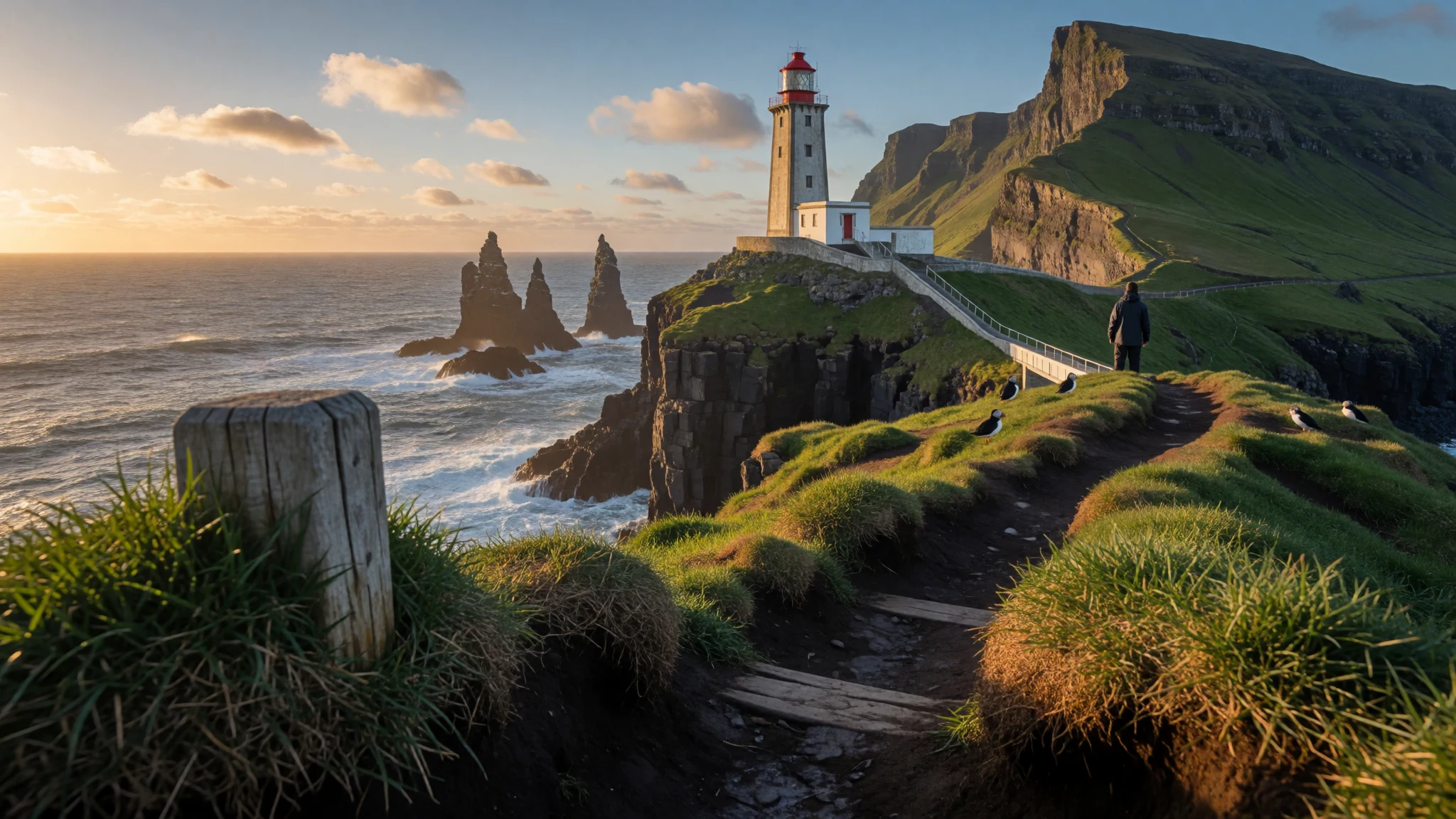
Mykines is a remote Faroese island of puffin colonies, basalt cliffs and one tiny village, reached by a short but weather-dependent crossing.
The place
Mykines is the westernmost of the main Faroese islands, a green, steep-sided lump of rock in the Atlantic. Its longitude would put it an hour behind, yet it keeps Greenwich Mean Time like the rest of the archipelago. The only settlement shares the island's name and has a population of 16, so in summer the visitors easily outnumber the residents. The village sits on the sheltered eastern side, a huddle of small houses and a little church, with the land rising behind it to ridges that drop away in cliffs on the far side. To the west lies the islet of Mykineshólmur, about a kilometre long, reached by a short footbridge across the narrow strait of Holmgjógv. Sea stacks crowd its western tip, where a lighthouse stands. On the north side of the main island, the valley of Korkadalur holds tall basalt columns known as the Stone-wood. Almost everything here is about birds and weather. Puffins nest in the turf above the cliffs through the summer, and the best colonies can only be reached on foot, over open grass with no shelter. Mist can arrive within minutes, ferries are sometimes cancelled, and the place feels properly remote even though the crossing from Vágar is short. For many people it is a day trip. For those who stay overnight, it is the evening light and the quiet once the last boat has gone.
Its story
The name Mykines may predate the Norse settlers. One reading links it to an old Irish phrase meaning pig island, possibly a nod to whales, which Irish speakers called sea sows. Pollen records suggest that oats and barley were grown here around the seventh century, which hints at monks or hermits arriving before the Vikings, though nobody can say who they were. The rock beneath the island is part of the oldest section of the Faroes, built from repeated lava flows. Softer ash layers between the basalt have been worn away by wind and sea, leaving ledges where birds nest in huge numbers. Life was hard and sometimes cruel. Around 1595 a sudden storm caught fishing boats from across the islands, and the working men of Mykines were lost, an estimated twenty to thirty of them. In 1667 a Dutch ship, the Walcheren, broke up on the shore, and the islanders salvaged what they could. The twentieth century tied Mykines to the wider world. In 1909 the lighthouse was built on Mykineshólmur together with the first bridge across Holmgjógv. In 1928 radio beacons and a telephone connection arrived. British forces finished a radar station in the spring of 1942, a reminder of the war in the North Atlantic. A second bridge followed in 1953, and in 1970 an airliner heading for Vágar crashed in bad weather on the island.
What to see
- Mykineshólmur and the footbridge — West of the village
Mykineshólmur is the islet at the island's western end, about a kilometre long, reached by a short footbridge over Holmgjógv. The strait shows thick layers of lava stacked one on another. Beyond the bridge the ground climbs towards sea stacks and a lighthouse, with puffins nesting in the turf along the way.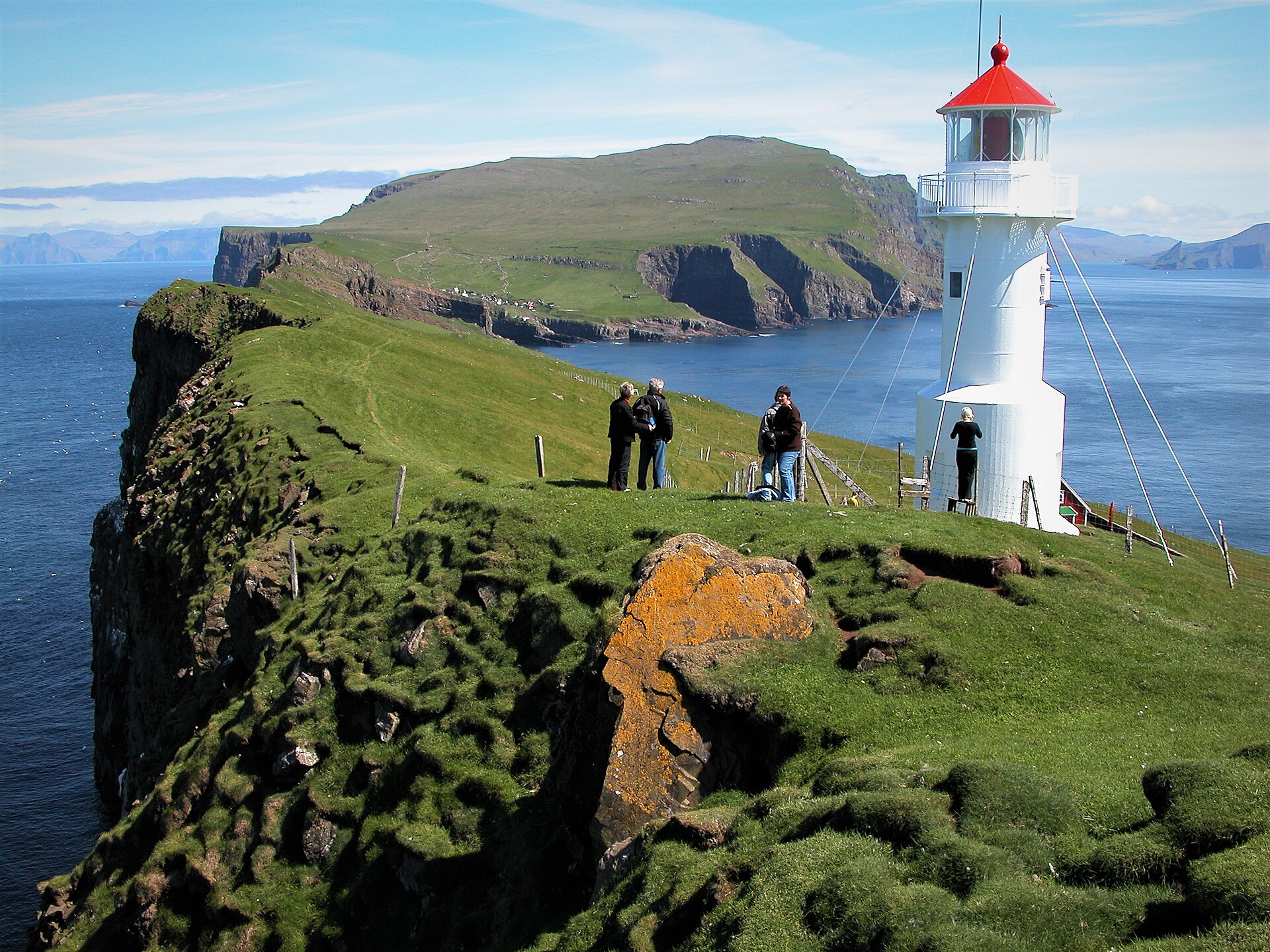
- Mykines village and church — Eastern side of the island
The village of Mykines is the island's only settlement, a cluster of small houses on the sheltered eastern side. Its Lutheran church, Mykinesar kirkja, dates from 1862 and has since been restored. It is small and plain, and worth a quiet look before or after the hike, when the village is at its most peaceful.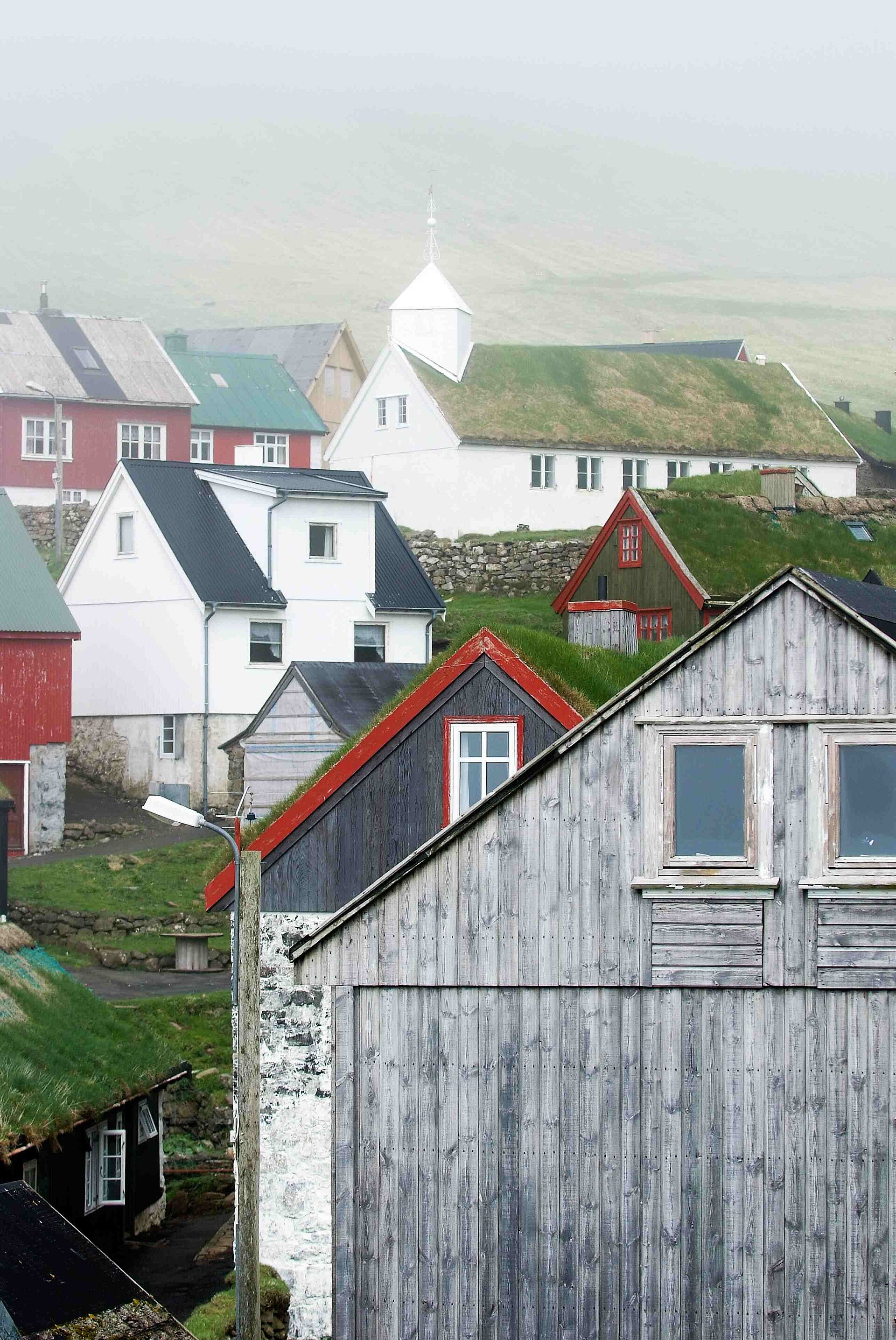
- The puffin colonies — Clifftops and slopes beyond the village
Puffins are the reason most people come. The colonies sit on grassy slopes and clifftops, and reaching them means a walk over open, often boggy ground. Visitors who are not Faroese must go with a guided tour, booked in advance through the official hiking site. Tours run only within set daytime hours. Bring waterproofs even on bright mornings.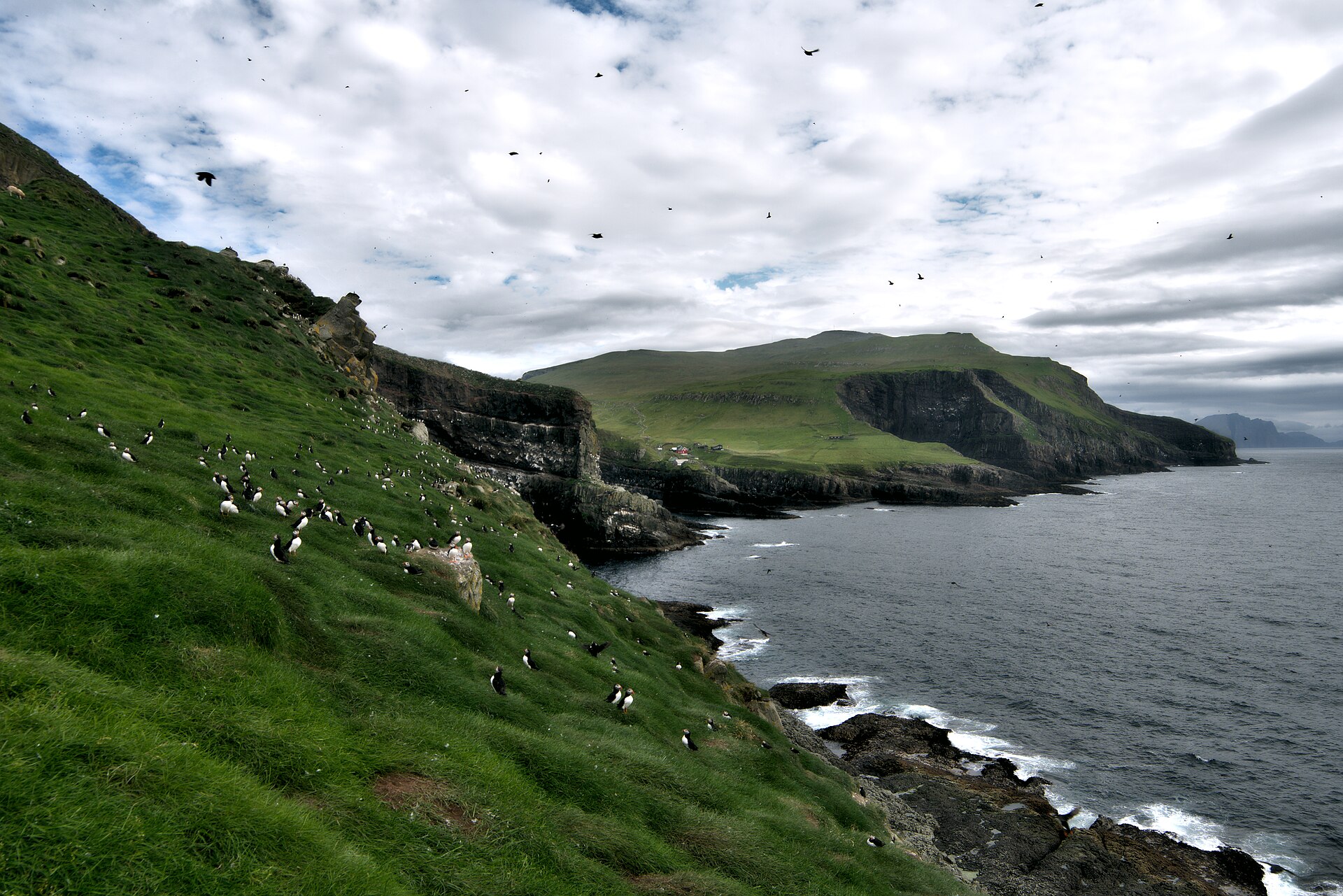
- Mykines Lighthouse — Western tip of Mykineshólmur
The lighthouse stands at the far western end of Mykineshólmur, with the keeper's cottage nearby. Apart from the village, it is the only other built feature on the island. It has been listed as closed until further notice, so check current access before planning the walk. The cliffs and sea stacks around it are the real draw.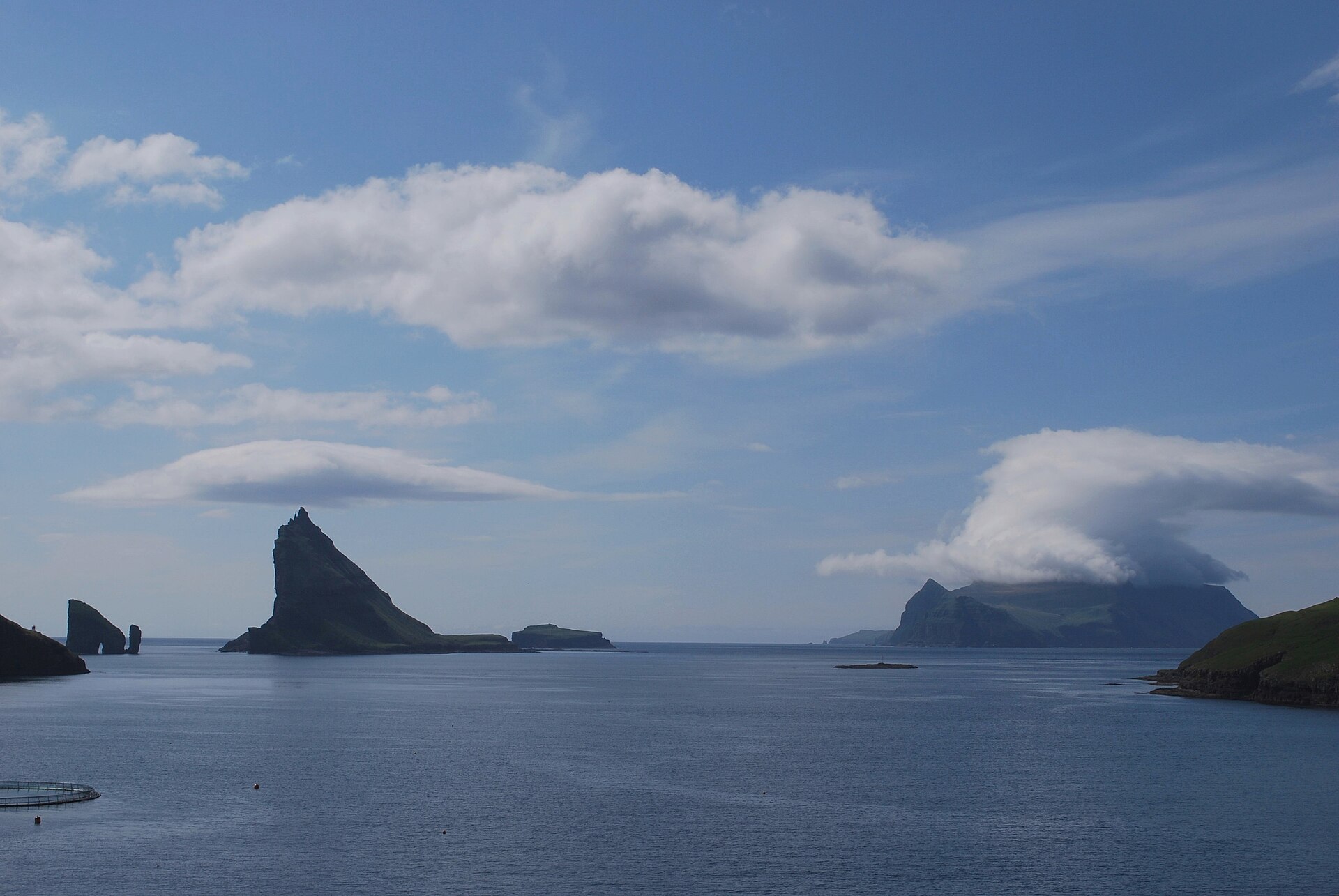
- Korkadalur and the Stone-wood — North side of the island
Korkadalur is a valley on the island's north side where basalt forms tall columns, known as the Stone-wood. It is a useful reminder that the whole island is the remnant of lava flows. The ground here is exposed, so go with your guide, watch the sky, and expect cloud to drop quickly.
Culture
Mykines has a community small enough that everyone knows everyone, and much of daily life follows the seasons. In summer the village fills with walkers, the two small eateries open, and boats arrive on a regular rhythm. In winter the place is far quieter, with sailings thin and most visitors gone. Faroese is the first language, and the Lutheran church is the focal point of village life, as it is across the islands. Houses here include old turf-roofed black houses, and a few quad bikes serve for carrying loads between the harbour and the village. The island's relationship with seabirds goes back centuries, and the birds still shape how people think about the land. Visitors who are not Faroese may not wander the hills freely. The hike to the colonies is run as a guided tour, partly to protect the nesting ground from trampling, and partly because the cliff edges are unforgiving. That rule is a form of courtesy as much as safety, and it is taken seriously by locals. Weather decides everything, including whether the boat sails, so patience is part of the experience. If the crossing is cancelled, the sensible response is to rebook calmly and be flexible. Keep to the marked path, hold a respectful distance from nesting puffins, and follow your guide's instructions rather than stepping onto the turf for a closer picture.
What to wear
Mykines belongs to the Faroese tradition of wool, and the traditional national dress is made from it. Women's costume uses fine wool in dark tones with a bright shawl and silver clasps, and men's pairs a knitted jumper or waistcoat with breeches and a woollen cap. These outfits are mainly worn for weddings, church festivals and national celebrations in summer, not for everyday life. Day to day, people on Mykines dress for wind, rain and rough ground. That means waterproof jackets, rubber boots, sturdy trousers and thick knitwear, often a Faroese-patterned wool jumper that is as practical as it is handsome. Because the village is tiny and working life is outdoors, nobody dresses up. For a visitor, practicality comes first. Wear layers you can add to or shed quickly, with a windproof, waterproof outer shell and trousers that dry fast. Walking boots with good grip are essential on wet grass and uneven slopes, and a hat and gloves are worth packing even in summer. Sunglasses help when the cloud lifts. If you plan to visit the church, tidy, modest clothing is courteous, although nobody expects formal dress. A small daypack with a spare layer and a flask is the sensible way to carry everything.
What to eat
- Fish soup — Village café in the old building, summer season
A warm bowl of fish soup is the classic order after a wet walk, and the village café in the old building serves it. Expect honest, filling cooking rather than anything elaborate, and good value as fuel before the ferry back. - Lamb and mutton — Village cafés at dinner, or with your hosts
Lamb and mutton are traditional Faroese meats, often boiled or dried, and sheep are central to island farming. Ask at a village café or your lodging whether lamb is on the dinner menu, as meals tend to depend on the day's supplies. - Wind-dried fish — Home meals and guesthouse suppers
Fish preserved by drying in the sea wind is part of the Faroese larder. It has a strong, savoury taste and a chewy texture, and may appear as part of a home supper or shared meal, so it is worth asking your hosts. - Coffee and cake — The small café beside the campsite
A small café near the campsite serves light snacks, hot drinks and something sweet through the day, with proper meals at dinner. After a damp morning on the hill, it is a very good place to warm up.
Plan it
Best time. May to August, when puffins are on the cliffs, the boats run most often and the village eateries are open. Outside summer sailings are fewer and cafés close, and the weather is wetter and more changeable.
How long. 1–2
Getting there. Fly to Vágar Airport in the Faroe Islands, then travel to Sørvágur for the short ferry crossing to Mykines village. A helicopter service also runs from Vágar on some days. Check the official ferry and helicopter sites for current times, fares and booking windows.
Budget. mid
Tips
- Book the ferry ahead in summer, and check the operator's site on the morning in case of cancellations
- Reserve your guided puffin hike through the official hiking site before you arrive
- Visit Mykines early in a longer Faroe trip so a cancelled sailing can be rebooked
- Bring waterproofs, a warm layer, boots and snacks, since food on the island is limited
- Allow a buffer on your return journey if you have a flight to catch
Etiquette
- Stay on the marked path and keep well away from nesting puffins
- Follow your guide's instructions, particularly near cliff edges
- Take all litter back with you and leave the village quiet in the evening
Nearby
Sources
- Wikidata Q213372 (CC0)
- Wikipedia: Mykines (rev 1378109010) (CC BY-SA 4.0)
- Wikivoyage: Mykines (rev 5411939) (CC BY-SA 4.0)
- Erik Christensen, Mykines and Mykineshólmur (CC BY-SA 4.0)
- Erik Christensen, Drangarnir, Tindhólmur and Mykines (CC BY-SA 1.0)
- Arne List, Mykines village (CC BY-SA 1.0)
- Joxean Koret, A colony of puffins in Mykines (CC BY-SA 2.0)
- Arne List, ATV in Mykines (CC BY 3.0)
- Arne List, Black house in Mykines (CC BY 3.0)
- Jonas Søby Pedersen, Bygden Mykines set fra Rógvukollur (CC BY 4.0)
- Erik Christensen, Bøur, Vágar (CC BY 3.0)


