Mantineia
Mantineia, Greece
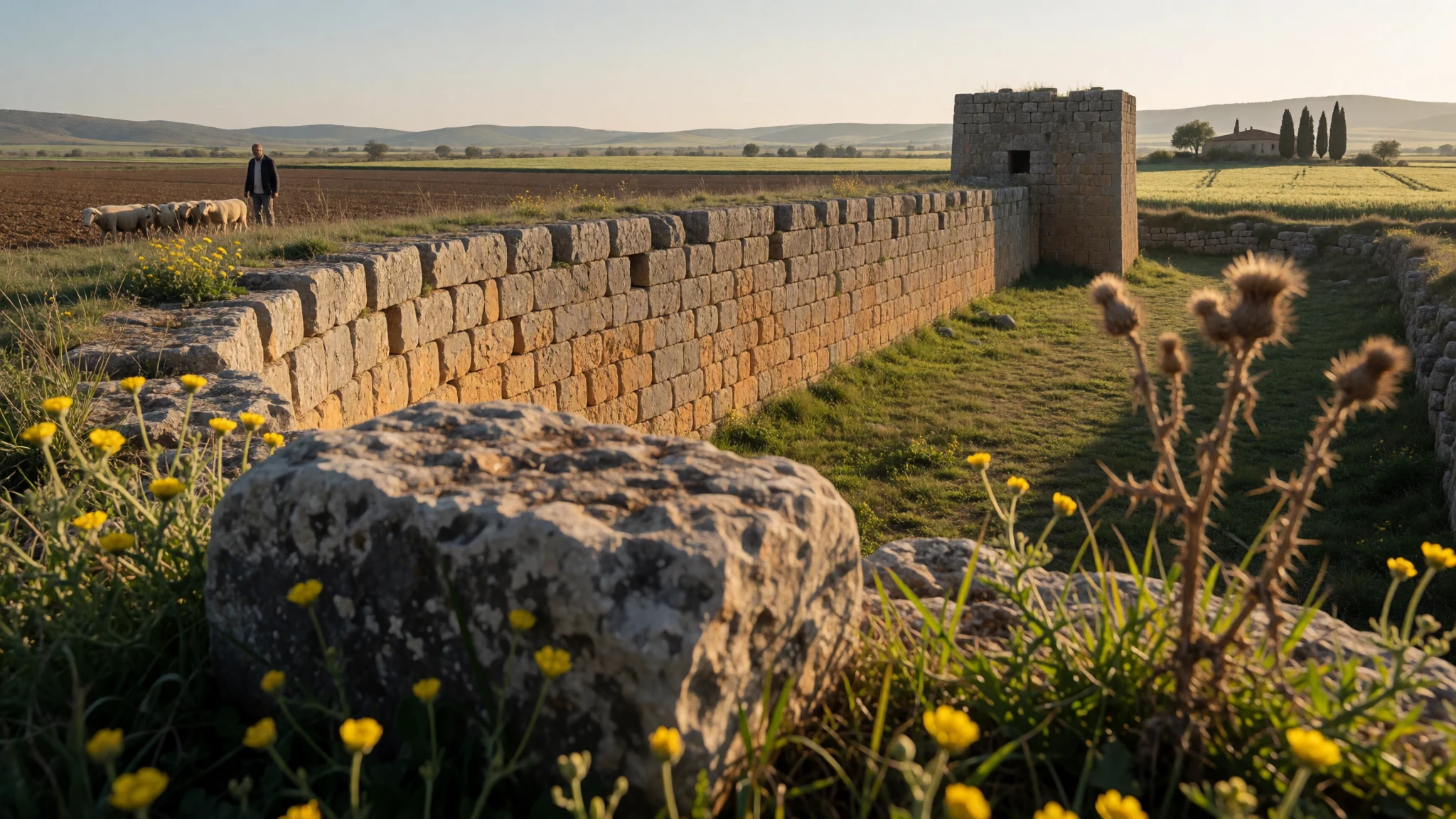
Mantineia is a quiet Arcadian plain where a vanished Greek city, its walls and its theatre still lie among the fields.
The place
Mantineia lies on a high, flat plain in the northeastern corner of Arcadia, in the central Peloponnese, about 600 m above sea level. The ancient city is now an archaeological site rather than a town. What survives is a ring of wall, the outlines of public buildings and a theatre set into the old market area, all scattered across farmland. The nearest proper town is Tripoli, the regional centre, and since the 2011 local government reform the surrounding area has been a municipal unit within Tripoli's municipality. That unit counted 1,693 residents in 2021, spread over small farming villages, with Nestani as its former seat. The setting is quiet. Services at the site are thin, and the usual soundtrack is wind, sheep bells and the occasional tractor. The altitude keeps the air cooler than on the coast, but the plain is open and there is little shade among the ruins. The landscape also explains the history: level ground ringed by hills made a natural arena for armies and good land for growing crops. Today the plain is better known for a pale white wine made from the moschofilero grape, which carries the Mantineia name on its label. Think of the site as a half-day stop on an Arcadian road trip, easily paired with Tripoli, rather than a destination that needs several days.
Its story
Mantineia was formed around 500 BC, when a cluster of neighbouring villages agreed to live as one city. Poseidon was its patron god, and the travel writer Pausanias later described its many temples. Tradition also says that Diotima, the teacher whom Socrates credited with shaping his ideas, served as a priestess here. The city's position made it a repeated battleground. In 418 BC, Sparta and Athens, each with allies, fought on the plain, and the Athenian side collapsed after its commander Laches fell. Within a few decades Sparta used the peace settlement of 387 BC as an excuse to split the city back into villages, and in 385 BC it was taken and dismantled. It was rebuilt after Spartan power cracked, this time with an almost oval wall that reused parts of the old one. A second battle in 362 BC saw Thebes win the field but lose its general Epaminondas, and Theban dominance faded with him. In 223 BC the Macedonian king Antigonus III Doson sacked the city and handed it to the Achaeans, who renamed it Antigonia. The Roman emperor Hadrian restored the old name when he visited in 130 AD and built a temple to Antinous. Pausanias saw the ruins himself a few years before 166 AD and wrote them up in his eighth book.
What to see
- The ancient theatre — Ancient site, Mantineia
Mantineia's theatre was cut into the slope beside the old agora, so the civic centre and the entertainment space sat together. The curve of the seating is easy to read, even where the stone is worn or overgrown. It is the best place to sit and picture a city assembling. Spring grass can hide uneven ground.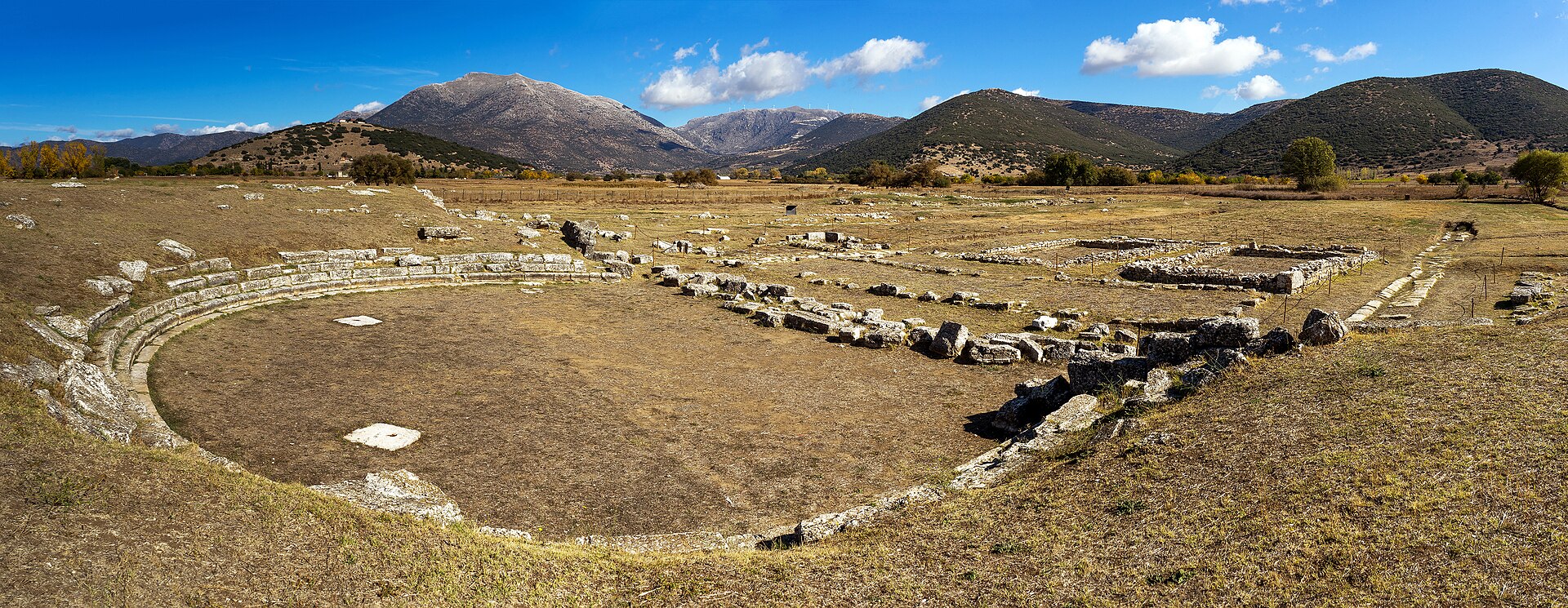
- The city walls — Perimeter of the ancient city
The oval circuit of fortification is the most striking thing on the plain. Lower courses of stone survive for long stretches, and the remains of towers show where defenders once stood. Walking a section of the line gives a feel for how large the rebuilt city was. Wear sturdy shoes, as paths are rough.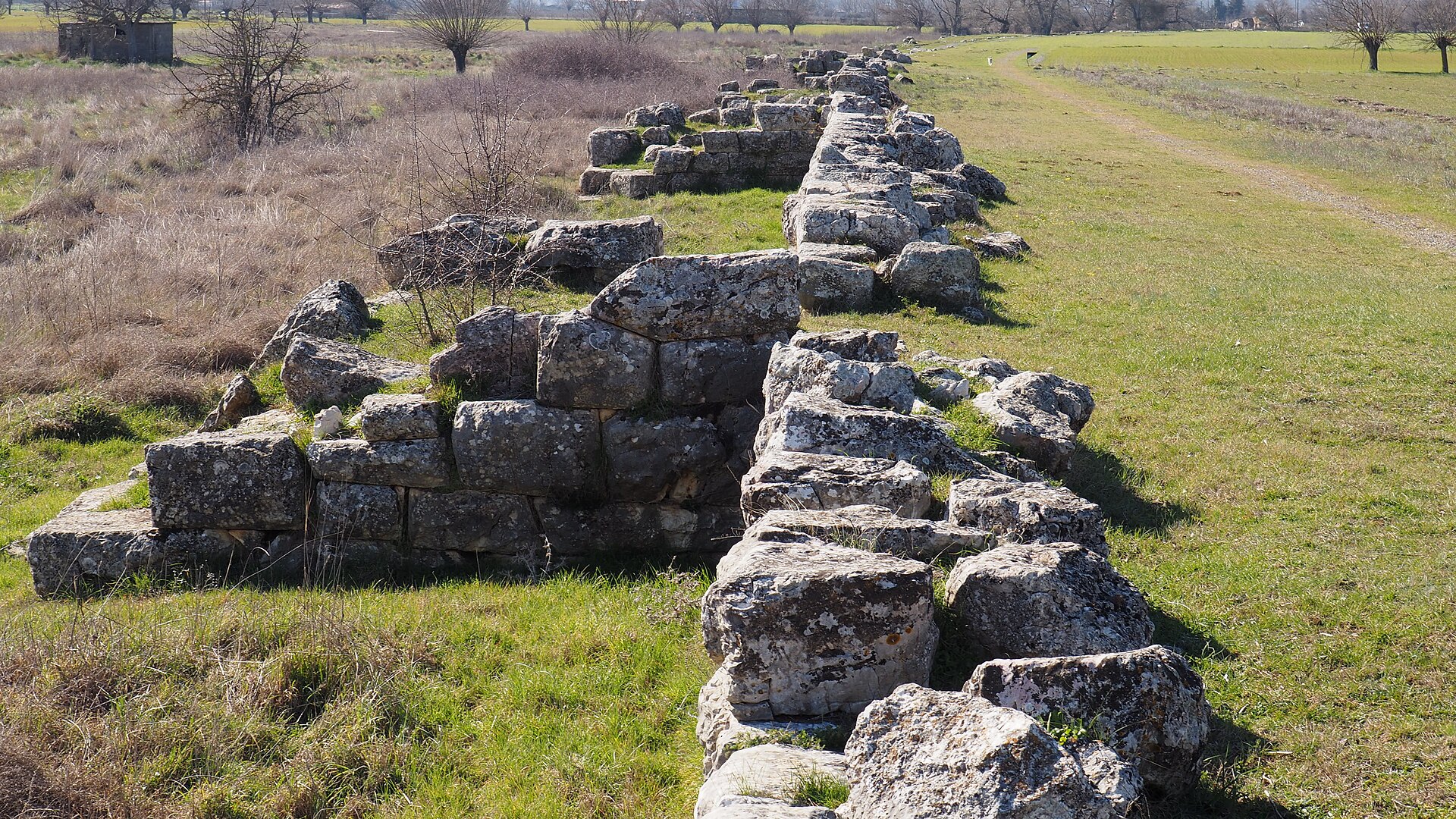
- The agora — Centre of the ancient city
The old market and meeting place lay at the heart of the city, and its foundations are still traceable among the fields. Nineteenth-century French and British surveyors drew plans of it, which are worth looking up beforehand because the ground is low and plain. Reading the layout helps more than any single standing stone.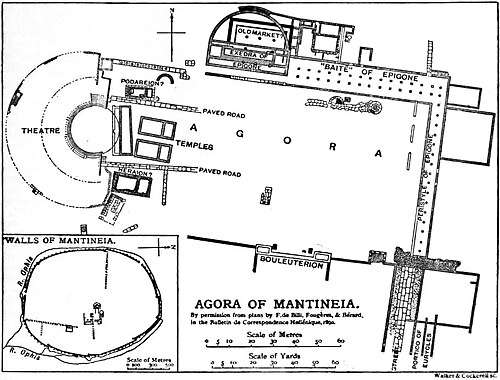
- The battlefield plain — The plain around the site
Two major clashes took place on the open ground around Mantineia, and the plain itself is the memorial. Stand at the edge of the site and look across the farmland to the surrounding hills to understand why armies met here. Late afternoon light is gentlest, and old travellers' engravings show the view has changed little.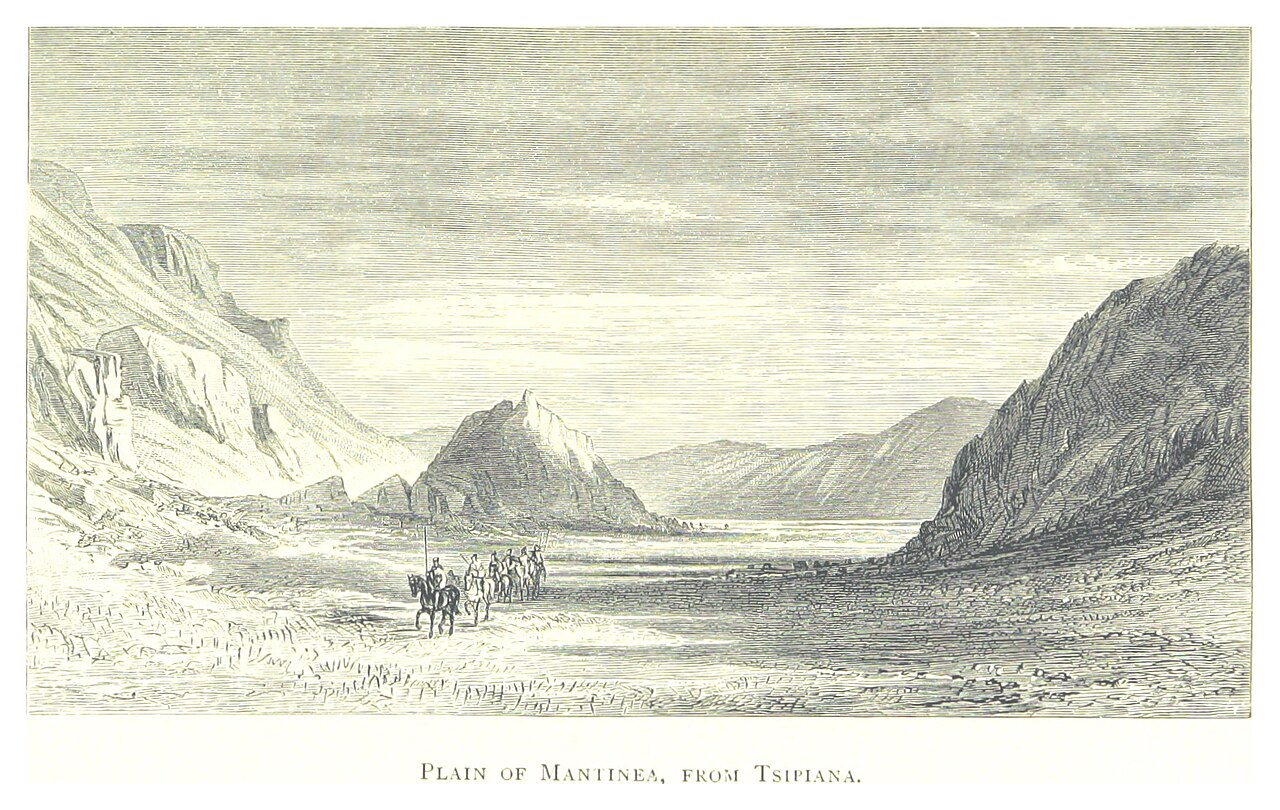
- The Muses relief in Athens — National Archaeological Museum, Athens
A marble base carved with the Muses was found at Mantineia and is now in the National Archaeological Museum in Athens, attributed to the school of Praxiteles. It makes a useful companion to the site: the carving shows the quality of work the city could commission. It is a separate trip, not part of the visit to the plain.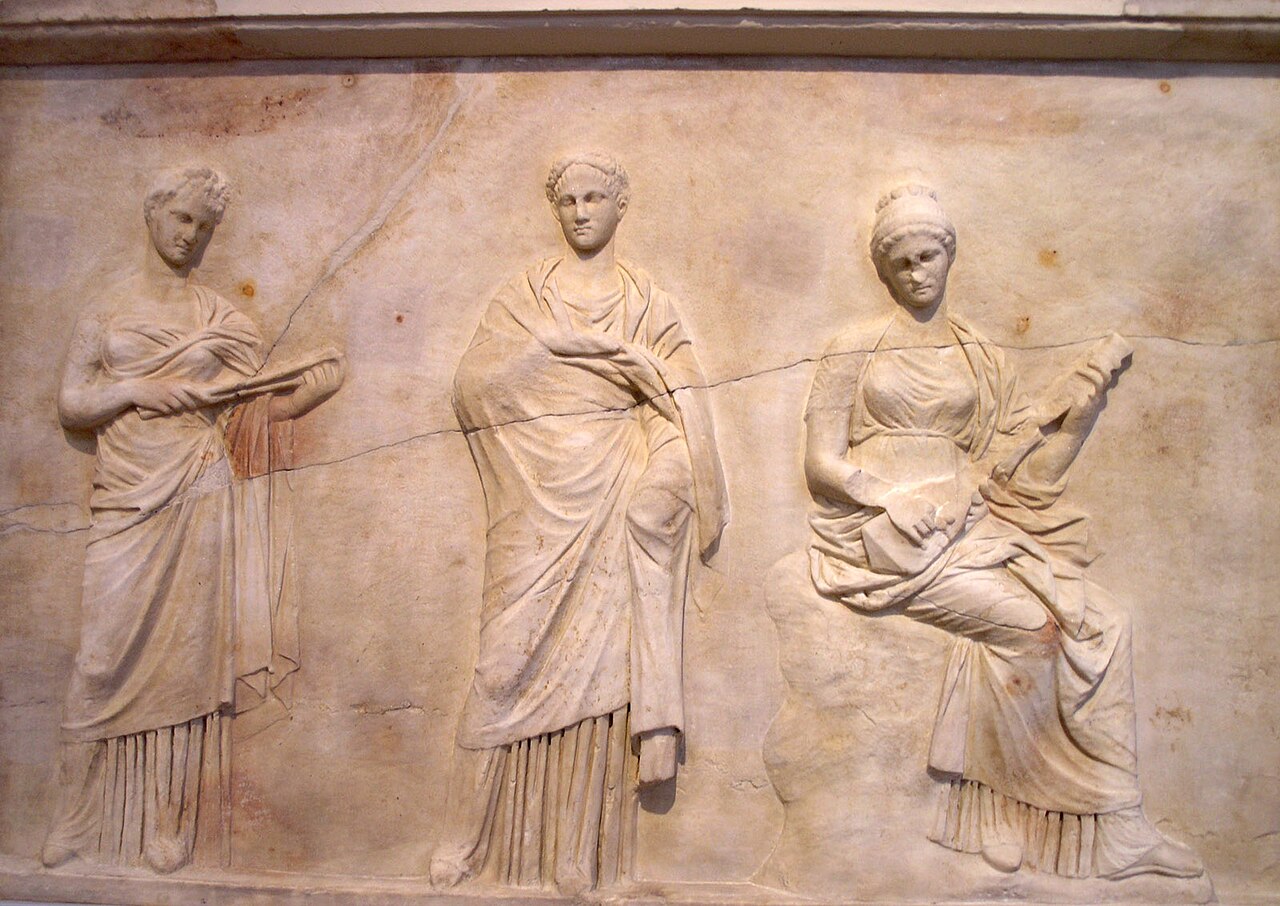
Culture
Mantineia carries its classical past lightly. The people who live around the plain are farmers and villagers, and daily life revolves around fields, orchards and vineyards rather than the ruins. The ancient city worshipped Poseidon as its patron, and local tradition links the priestess Diotima to a sanctuary nearby, but the living religion today is Greek Orthodox. Village churches mark saints' days with services, shared meals and music, and Easter is the high point of the year. Social life centres on the kafeneio, the traditional coffee house, where men and women of all ages linger over small cups of Greek coffee, cards or backgammon. Hospitality is real: a visitor who stops to ask a question may be offered coffee, a spoon sweet or a glass of the local white wine. Wine is a matter of regional pride, and the Mantineia name on a bottle is a protected designation. Arcadia as a whole is a place of mountain villages and slow rhythms, and the pace takes adjusting to. Shops may close in the afternoon, and meals start late in the evening. Learn a few Greek greetings, such as kalimera for good morning and efharisto for thank you, because they are warmly received. At the ruins, leave every stone and potsherd exactly where it lies and keep off the tops of the ancient walls.
What to wear
Around Mantineia, traditional dress belongs to the wider Peloponnese and mainland Greece rather than to one village. Women's festive costume was built from layers of wool, linen and cotton, with embroidered aprons, woven sashes and headscarves or coins on the headdress. Men's ceremonial dress includes the pleated fustanella kilt, white shirt, waistcoat and tasselled shoes, now mostly seen at national holidays, school parades and folk-dance festivals. Hand weaving and embroidery survive in some households and craft groups, but few people wear these clothes day to day. What people wear now is ordinary and practical: jeans, shirts, work jackets and sturdy boots in the fields, with neat casual clothes for church and the town. Older women in villages often still favour dark colours. For a visitor the main considerations are sun, terrain and churches. In summer the plain is hot and open, so a wide-brimmed hat, sunglasses, sunscreen and light long sleeves help. In spring and autumn bring a light jacket, as the elevation keeps mornings and evenings cool. Closed shoes or trainers with grip are better than sandals on stony wall lines and uneven grass. If you step inside a village church, cover shoulders and knees, and carry a scarf or light shirt for the purpose. Beachwear is out of place everywhere here.
What to eat
- Moschofilero wine — Tavernas and wineries on the plain
The pale, aromatic white wine from the moschofilero grape is the local calling card, with a protected designation carrying the Mantineia name. It is crisp and floral, a good match for grilled food. Look for it on any taverna list in the area or ask at a local winery. - Hortopita — Village bakeries and family-run eateries
A pie of wild or cultivated greens wrapped in thin pastry, sometimes with feta or herbs. It is a staple of mountain Greek cooking, eaten warm as a snack or light meal. Village bakeries and home-style eateries are the best bets, particularly in spring when the greens are fresh. - Loukaniko — Butchers and grill houses, Tripoli area
Pork sausage seasoned with orange peel, herbs and wine or spices, common across the Peloponnese. It is usually grilled or fried and served with bread and a squeeze of lemon. Butchers and traditional grill houses in Tripoli and the plain's villages sell and serve their own versions. - Grilled lamb or goat — Grill houses (psistaria) in Tripoli and nearby villages
Spit-roasted or charcoal-grilled meat is the centrepiece of festival tables in Arcadia, especially at Easter and on saints' days. In everyday eateries it appears as chops or portions with potatoes and lemon. A psistaria, a grill house, is the type of place to look for. - Mountain honey and herbal tea — Roadside stands and village shops
Honey from thyme and wild flowers, along with dried mountain tea, is sold in small shops and roadside stands in the Arcadian uplands. The tea is drunk hot and mild, the honey spooned over yoghurt. Both travel well and make an easy edible souvenir of the plain.
Plan it
Best time. April–May and September–October. The plain sits at about 600 m, so spring and early autumn are mild and the fields are green or golden. July and August are hot and shadeless on the ruins, and winter can be cold and wet.
How long. 1
Getting there. Fly to Athens International Airport, then take an intercity bus or hire a car to Tripoli, the main town of Arcadia. The last leg to the site is a short drive from Tripoli by car or taxi; public transport out to the plain is limited, so check current timetables locally.
Budget. low
Tips
- Hire a car in Athens or Tripoli, as the site is hard to reach otherwise
- Bring water, a hat and sun protection, since shade is scarce on the plain
- Check the official Greek Ministry of Culture site for current opening arrangements before travelling
- Carry some cash for village cafés and small shops
- Combine the visit with Tripoli and other Arcadian sites to make a fuller day
Etiquette
- Leave stones and pottery fragments where they lie, and keep off the walls
- Cover shoulders and knees when entering a village church
- Ask before photographing people, especially older villagers
Nearby
Sources
- Wikidata Q1160195 (CC0)
- Wikipedia: Mantinea (rev 1375864602) (CC BY-SA 4.0)
- Wikivoyage: Arcadia (Greece) (rev 5302256) (CC BY-SA 4.0)
- Photo 01-nama-3-muses.jpg (CC BY 3.0)
- Photo 02-.jpg (CC BY-SA 4.0)
- Photo 03-le-mus-e-des-instruments-de-musique-populaire-grecque-ath-ne.jpg (CC BY 2.5)
- Photo 04-farrer-1882-p209-plains-of-mantinea-from-tsipiana.jpg (Public domain)
- Photo 05-eb1911-agora-of-mantineia.jpg (Public domain)
- Photo 06-fortifications-of-ancient-mantineia.jpg (CC BY-SA 4.0)
- Photo 07-mandinia-ko-ci.jpg (CC BY 4.0)
- Photo 08-mantin-e-blouet-guillaume-abel-1831.jpg (Public domain)


