La Graciosa
La Graciosa, Spain
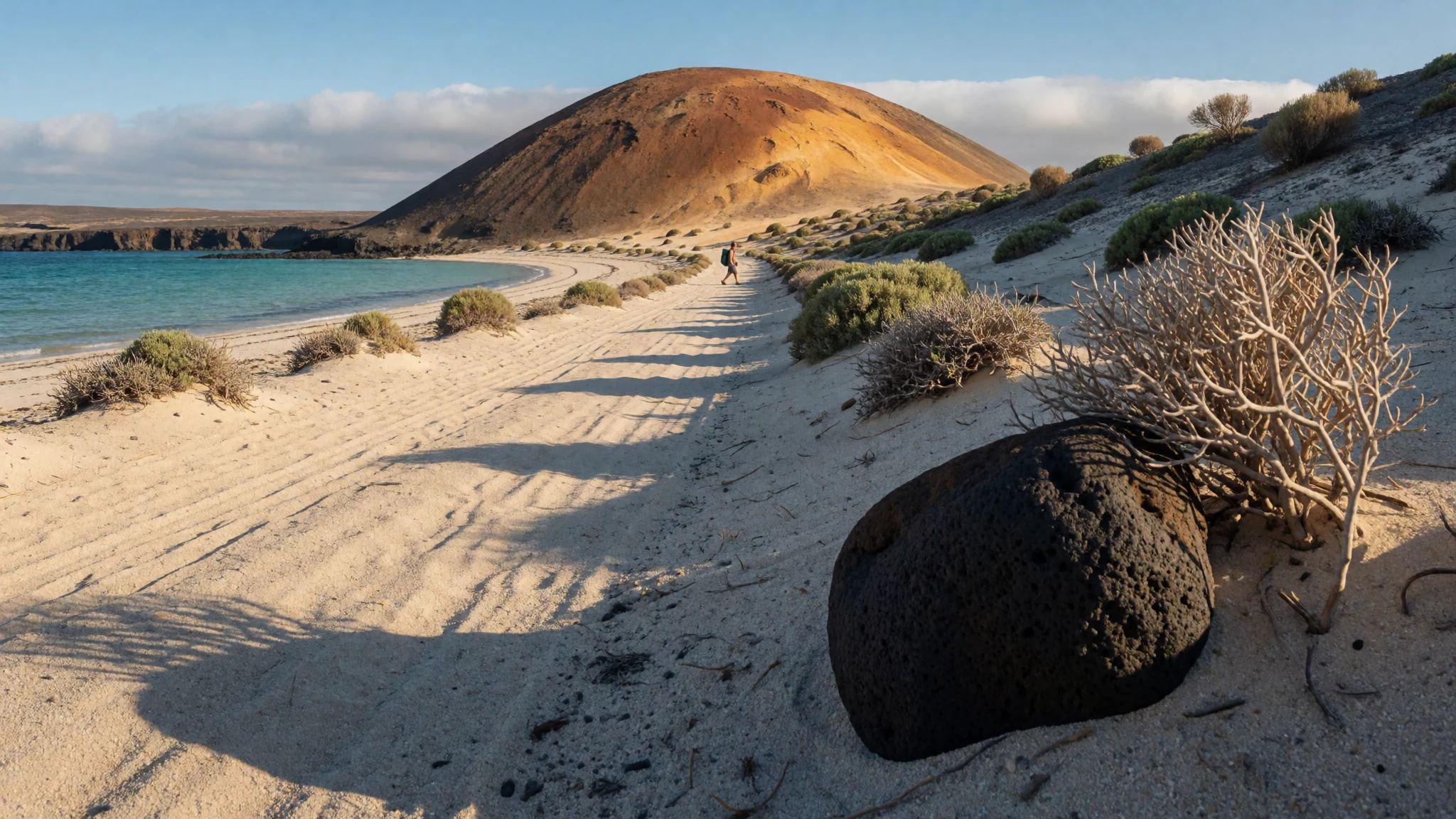
La Graciosa is a car-free island of sand streets off Lanzarote, where a short ferry buys quiet beaches, volcanic hills and fresh fish.
The place
La Graciosa is a small volcanic island in the Canary Islands, lying across the narrow Strait of El Río from the north end of Lanzarote. About 734 people live here, almost all in Caleta del Sebo, the fishing village on the south-east side; the only other settlement, Casas de Pedro Barba, is mostly a summer retreat. Everything else is protected land inside the Chinijo Archipelago Natural Park and is managed by the Spanish state. The island is low and dry, with a few bare volcanic cones, the highest reaching 266 metres, and long pale beaches along its coasts. Streets are packed sand rather than tarmac, and private cars are not allowed, so people walk, cycle or ride in the occasional licensed vehicle. The village has what a small community needs: a school, a clinic, a pharmacy, a bank, a post office, supermarkets and a handful of bar-restaurants around the square and harbour. Fishing and tourism pay the bills. Because goods, and even the drinking water, are shipped or piped in from Lanzarote, everyday shopping costs more than on the bigger islands. In 2018 the Spanish Senate declared La Graciosa the eighth Canary Island, though the change was largely symbolic and the island still answers administratively to the municipality of Teguise on Lanzarote. Day-trippers arrive on the morning ferries and thin out by evening, which is when the village feels most like itself. The wind is constant, shade is scarce, and the skyline across the strait is the dark cliffs of Lanzarote.
Its story
La Graciosa began as lava. About sixteen million years ago a plume of hot rock beneath the Atlantic pushed a chain of volcanic islands above the waves, and the Canaries have been growing, merging and wearing down ever since. La Graciosa, its neighbours Montaña Clara and Alegranza, and a couple of rocky stacks make up the Chinijo Archipelago, the small northern outliers of Lanzarote. For most of its human history the island was a place of hard living. With so little rain, people depended on the sea, on salt, and on drought-tolerant crops such as aloe, and the small museum in the village records that trade alongside the marine life of the surrounding reserve. Caleta del Sebo grew up around the landing place used by fishing boats. Its church, finished in the twentieth century, has an altar shaped like a boat, a fair summary of what the community lived on. Legal status long lagged behind reality: for years the island counted officially as an islet, and only in 2018 did the Spanish Senate name it the eighth Canary Island. That change brought few practical effects, and daily life still runs on ferry timetables, desalinated water and the weather. Today the protected-park status keeps building and traffic in check, which is why the sand streets and the unhurried scale of the place have survived.
What to see
- Caleta del Sebo harbour — Caleta del Sebo
The harbour at Caleta del Sebo is where the ferry lands and where the rhythm of the island shows. Colourful fishing boats unload their catch for the village restaurants, with the black cliffs of Lanzarote filling the view across the strait. Come early or stay late, when the day-trippers have gone, and the quayside turns calm.
- Iglesia de Nuestra Señora del Carmen — Caleta del Sebo
The church of Nuestra Señora del Carmen in Caleta del Sebo is modest from outside, but its altar has been built in the shape of a fishing boat and decorated with scenes from the lives of fisherfolk. It later became the parish church. Go in quietly, and check locally for service times, since it is a working church. - Montaña Amarilla and Bahía Francesa — South-west coast
Montaña Amarilla is a rust-yellow volcanic cone on the island's south-west side, reached on foot or by bicycle along sandy tracks from the village. Its colour glows in low evening light, and the nearby Bahía Francesa offers pale sand for a swim. Carry water and sun protection, because there is no shade and no shop out here.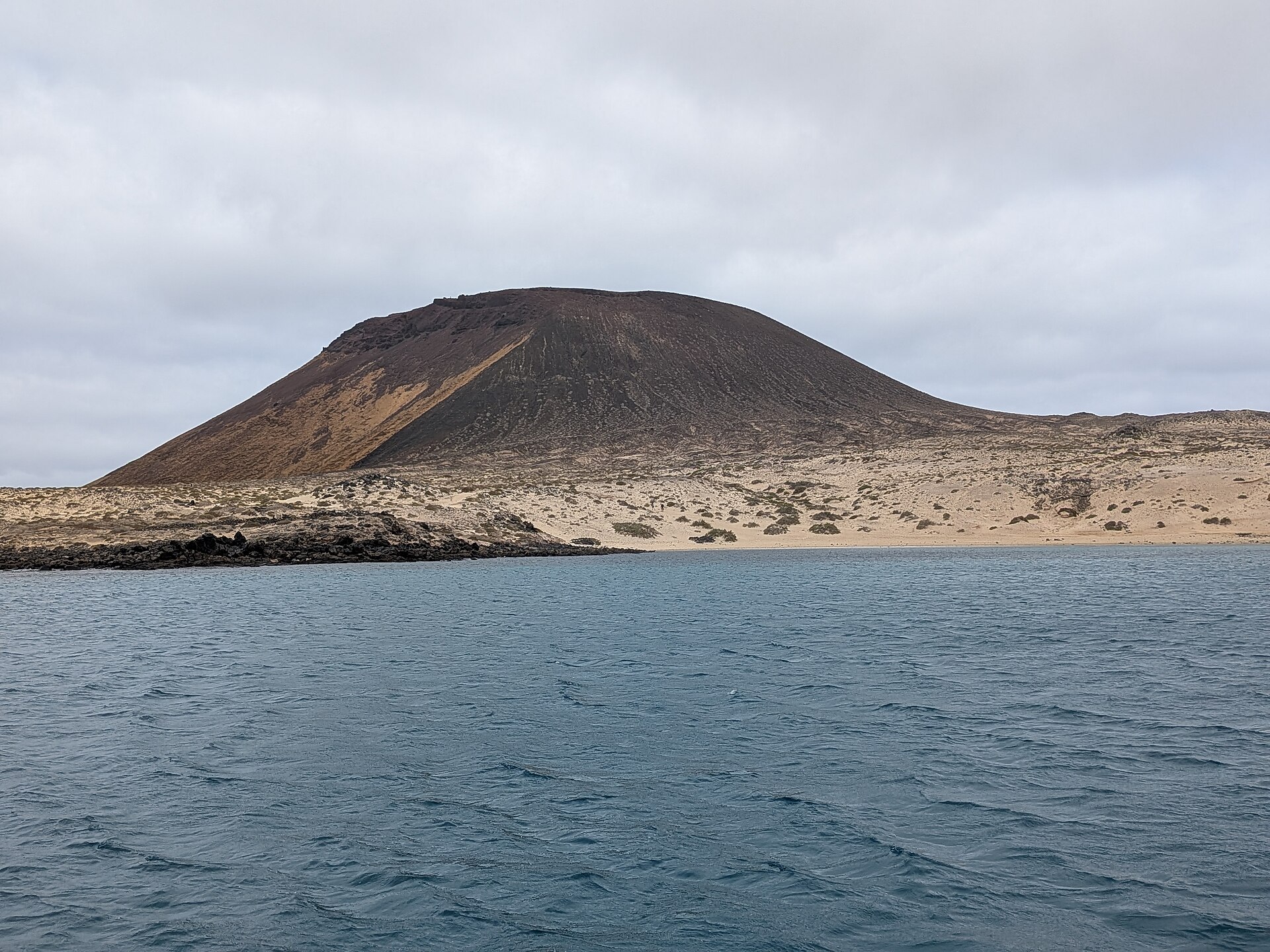
- Chinijo Museum — Caleta del Sebo
The Chinijo Museum is a tiny exhibition on the geography and history of the archipelago, covering how aloe and salt were produced and what lives in the surrounding marine reserve. It has been listed as temporarily closed, so ask in the village or look online before planning around it. If open, it makes a quick, useful introduction. - Diving the marine reserve — Caleta del Sebo
Diving around La Graciosa is arranged through a dive centre in Caleta del Sebo, which runs excursions as far as Alegranza, rents kit and teaches beginners. The waters belong to a marine reserve, so sea life is the draw. Book ahead in the busy summer months and expect trips to depend on Atlantic swell and wind. - Montaña Clara and Alegranza — North of the island
Montaña Clara and Alegranza are uninhabited islands north of La Graciosa, with rocky stacks beyond them. They are best seen from a boat excursion, which leaves from Órzola and may collect passengers at Caleta del Sebo, or from the island's northern shore on a clear day. The reward is the view of volcanic outlines rising straight from the sea.
Culture
La Graciosa has the culture of a small Canarian fishing community, where the sea sets the routine and nearly everyone knows everyone. Spanish is the everyday language, spoken with the soft Canarian accent, and family ties to Lanzarote run deep. The church of Nuestra Señora del Carmen shows the island's outlook: Our Lady of Carmen is widely honoured in Spain as protector of seafarers, and the boat-shaped altar makes the link plain. Village festivals are likely to revolve around the saint and the harbour, so it is worth asking locally about dates. Daily life is unhurried. Shops and restaurants may close in the afternoon, meals start late by British or Indian standards, and a grill can be slow because food is cooked to order. Residents are used to day visitors but live with limited resources. Drinking water comes from a desalination plant on Lanzarote and travels under the strait by pipe, waste has to be shipped off, and the protected landscape depends on people keeping to existing tracks. Cyclists share the sand lanes with walkers and the odd service vehicle, and a friendly greeting when passing is normal. Evenings centre on the square and harbour, where families gather outdoors once the heat and wind ease. Visitors who stay overnight find the village far quieter than the day-trip crowd suggests. Etiquette: keep to the marked sand tracks, carry your rubbish back to the village, and use tap water sparingly, since every drop is piped under the sea from Lanzarote.
What to wear
La Graciosa has no dress of its own; the traditional costume is the wider Canarian one, seen at festivals and folk events across the archipelago. Women's versions typically combine a full gathered skirt, an apron, a white blouse and a shawl, topped with a straw hat, in wool, linen and cotton. Men wear a white shirt, waistcoat and dark trousers, again with a straw hat. These outfits come out for romerías, saint's-day celebrations and folk performances rather than everyday life. Day to day, islanders dress for sun, salt and wind: shorts and T-shirts, sandals or canvas shoes, wide-brimmed hats, and waterproof jackets and boots for people working on boats. Visitors should pack for exposure. Choose light long-sleeved cotton or linen layers, a hat that will not blow away, strong sunscreen and sunglasses. Sturdy sandals or trainers help on soft sand and volcanic gravel, and bare feet get uncomfortably hot on summer afternoons. A windproof layer is useful on the ferry and in the evening, even in warm months. Swimwear is normal on the beaches, but cover up with a shirt or wrap when walking through the village or entering the church, where modest dress is expected. Bring a small bag for water and snacks if you plan to cycle to the far beaches.
What to eat
- Caldo de pescado — Harbourside restaurants, Caleta del Sebo
A light fish soup made with sea bream and grouper, served hot. A version thickened with sweetcorn is called caldo de millo. Look for it on the menus of the harbourside restaurants in Caleta del Sebo, where the fish arrives from boats moored nearby. - Sancocho — Traditional eateries in Caleta del Sebo
A Canarian stew built on salted fish and potatoes, eaten with bread made from gofio, toasted flour, and lifted by a spoonful of mojo sauce. Order it at a traditional eatery in the village; portions are filling, so it suits a long lunch. - Lapas and clacas — Grill restaurants near the harbour
Limpets (lapas) and a small shellfish known as clacas are grilled and finished with green mojo, a garlicky herb sauce. They are a plate to share with bread, usually found at grill restaurants near the harbour. - Grilled fresh fish — Grills around the harbour and square
Whatever the boats landed that morning is typically grilled whole and served with wrinkled potatoes and mojo. At a grill in Caleta del Sebo expect to wait, since cooking is done to order; treat it as a slow lunch rather than a quick stop. - Tapas and cold beer — Café-bars around the square and harbour
Small plates of fresh tapas, toast with toppings and a cold beer make an easy light meal at the café-bars around the square and harbour. They suit the hour after a hot ride or walk, before dinner or a ferry back.
Plan it
Best time. April–May and October–November, when the climate is mild and the island is quieter; summer brings the most visitors, strong sun and little shade, and the wind is a factor in any season.
How long. 1–2
Getting there. Fly to Lanzarote's airport near Arrecife, then travel to Órzola at the island's north tip; foot-passenger ferries to Caleta del Sebo run roughly hourly and take about 30 minutes. Check the ferry operators' sites for timetables, fares and the last return crossing.
Budget. mid
Tips
- Check the last ferry back to Órzola before heading to the far beaches, as you must return the same way
- Carry water, sun protection and a hat; there is almost no shade away from the village
- Order bottled water with meals and use tap water sparingly, since it is piped from Lanzarote
- Hire a bicycle in Caleta del Sebo to reach Montaña Amarilla and the western beaches over sand tracks
- Book accommodation early for summer, as the campsite at Playa del Salado has closed
Etiquette
- Stay on existing tracks, as the island sits within a protected natural park
- Take all rubbish back to the village bins
- Dress modestly when entering the church
Nearby
Sources
- Wikidata Q849958 (CC0)
- Wikipedia: Graciosa, Canary Islands (rev 1370158864) (CC BY-SA 4.0)
- Wikivoyage: Graciosa (Canary Islands) (rev 5402975) (CC BY-SA 4.0)
- Photo: La Graciosa – Montaña Clara – Alegranza (H. Zell) (CC BY 3.0)
- Photo: La Graciosa (MiljenkoSuljic) (CC BY-SA 4.0)
- Photo: La Graciosa (2017) (Filip Rojík) (CC BY-SA 4.0)
- Photo: Chinijo Archipelago from Lanzarote (MiljenkoSuljic) (CC BY-SA 4.0)
- Photo: Montaña Amarilla (Robertpba) (CC0 1.0)
- Photo: Salinas del Río, el Río i la Graciosa (Enric) (CC BY-SA 4.0)
- Photo: Salinas del Río, el Río i la Caleta del Sebo (Enric) (CC BY-SA 4.0)
- Photo: El Río i les muntanyes de la Graciosa (Enric) (CC BY-SA 4.0)


