Kryvyi Rih
Kryvyi Rih, Ukraine
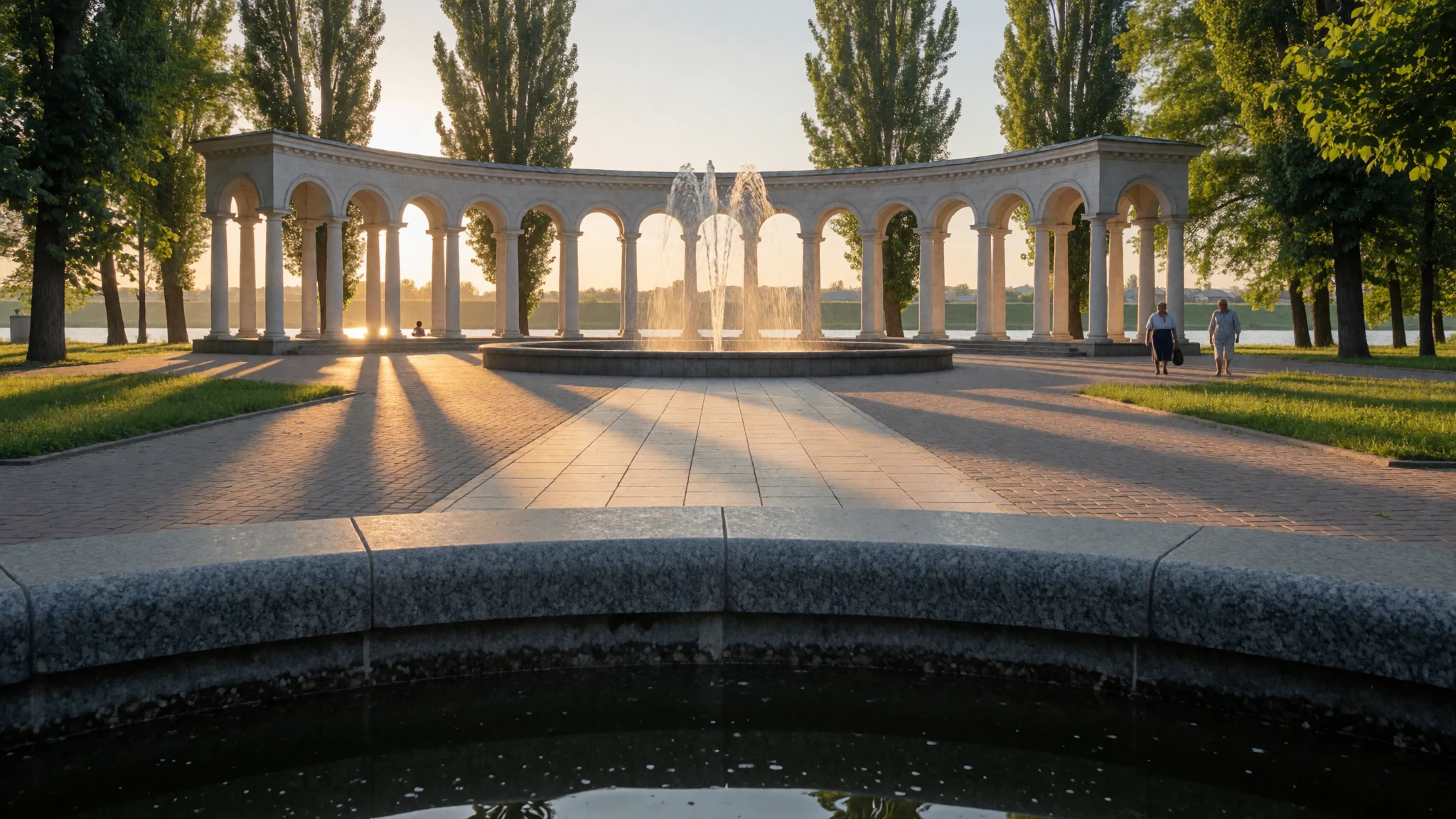
Kryvyi Rih is a long, working iron-ore city on the Ukrainian steppe, with riverside parks, a botanical garden and honest industrial character.
The place
Kryvyi Rih sits on the steppe of central Ukraine, in Dnipropetrovsk Oblast, about 84 m above sea level. A little over six hundred thousand people live here, spread along a long, thin ribbon of land that follows the iron-ore belt beneath it. Wikidata classes it as a linear city, and that shape explains almost everything about getting around. Instead of one compact centre there are several districts strung out along the river valleys, each with its own shops, squares and transport stops. The Saksahan and Inhulets rivers meet here, and the greenest, most pleasant parts of town hug their banks: embankment parks, boat pavilions and rocky outcrops above the water. Away from the water the landscape is industrial. Mines, spoil heaps, coking plants and steelworks are part of the skyline, and they are the reason the city exists. Tourism is modest. There is no old walled core and no famous headline monument; the appeal is a working Ukrainian city with Soviet-era civic architecture, leafy riverside promenades and a strong local theatre habit. Residents are proud of the rivers and of the botanical gardens on the outskirts. Most outsiders who come have a personal connection, an interest in industrial heritage, or are passing through on the way to Dnipro. The city's tourism site, touristkr.com.ua, is the place to check for current information. Distances between sights are long, so it pays to choose one district a day and see it properly rather than crossing the whole city repeatedly.
Its story
Kryvyi Rih began as a Cossack winter camp and became an official staging post in 1775, the founding year in the city's facts. Before that the land belonged to the Zaporozhian Cossacks, whose host listed the place among its seasonal settlements. When a war with the Ottomans ended, Russian officials set up a relay station on the roads to nearby garrisons, modelled on the post stations of the Mongol era. In the same year Catherine the Great ordered the Cossack Sich dissolved, and its lands were annexed and handed to the gentry. For decades Kryvyi Rih remained a village, gaining its first stone houses and a few water mills. Everything changed when the ore beneath the steppe was recognised. A geologist named Alexander Pol is credited with identifying the Kryvbas iron basin, and in the 1880s Belgian, French and British money arrived, along with a railway to carry ore to Dnipro. The settlement received city status in 1919. Under Soviet planning the huge Kryvorizhstal works opened in 1934, drawing workers from across the union and fixing the long, stretched-out shape the city still has. Growth continued after the Second World War, then stalled in the 1990s as unemployment rose and many residents left. The sale of the steelworks into private hands in 2005 brought fresh investment, some of which paid for parks and urban regeneration.
What to see
- Heroiv Park — Central district
Heroiv Park is a central green space where Ukrainian and Soviet-era memorials stand within a few minutes' walk of each other. A flower clock and a Chernobyl memorial sit among the statuary, which makes it a quick, free lesson in how the city remembers its past. A good first hour in town. - Fedor Mershavtsev Park — Saksahan riverbank, west of the centre
Fedor Mershavtsev Park, laid out in Stalinist Empire style, has a central fountain, a white colonnade and a boat pavilion on the Saksahan. Boat rides pass beneath Lovers Bridge, a gentle way to see the river. Running arrangements vary, so ask locally or check the tourism website first.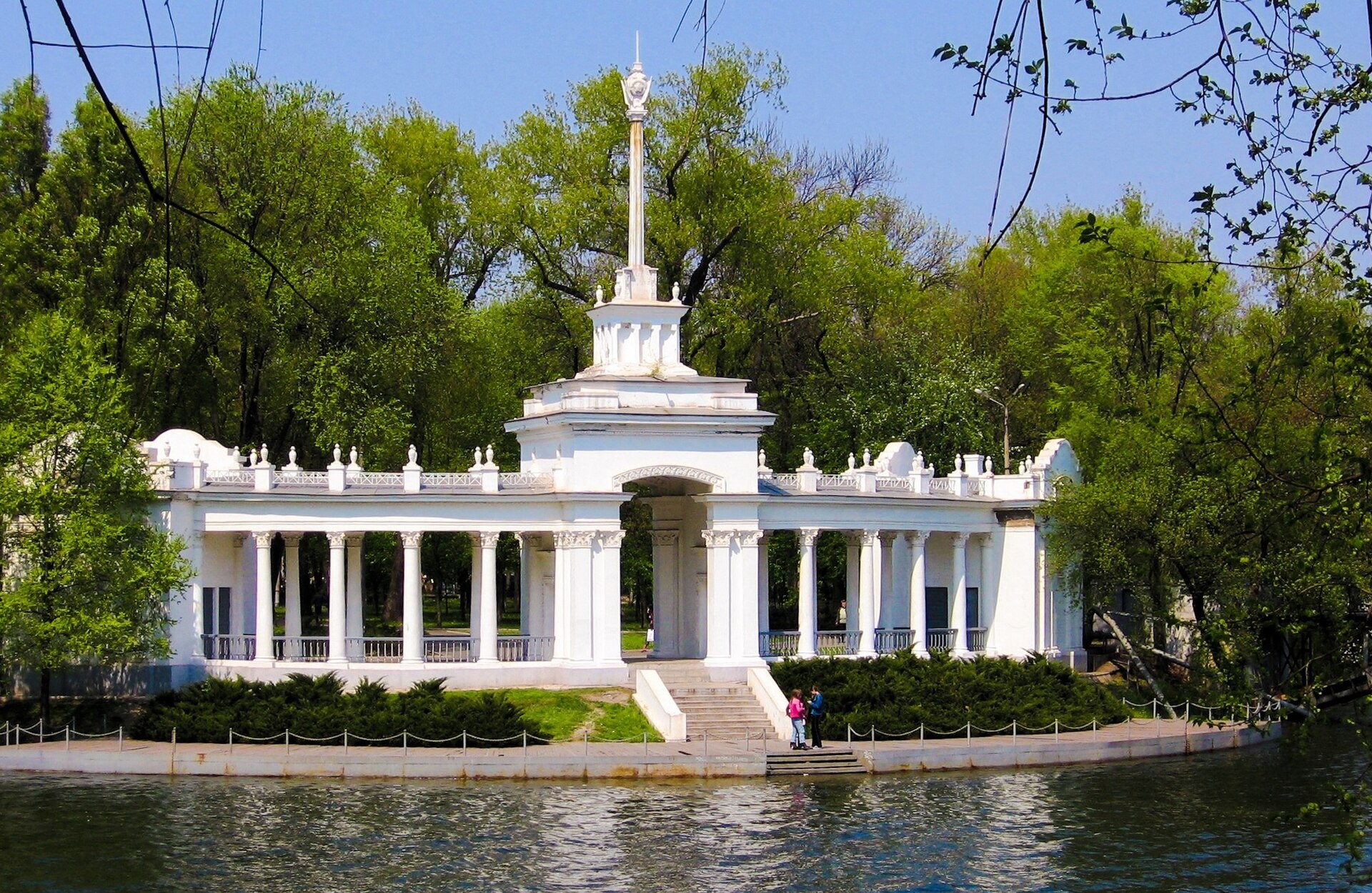
- Haharina Park — Saksahan riverbank, west of the centre
Haharina Park is another riverside green space, with a sundial and a children's park named for Yuri Gagarin. It suits a slow stroll after the larger Mershavtsev Park close by. Half an hour is plenty, and the embankment path makes an easy way to continue on foot. - White Stones Waterfall — Inhulets valley, western edge
White Stones Waterfall is a viewpoint over a cascade and dam on the Inhulets, with a tall railway bridge crossing the valley. The approach is not obvious, so get directions from a local or a map app before setting out, and wear shoes that cope with rough, uneven ground.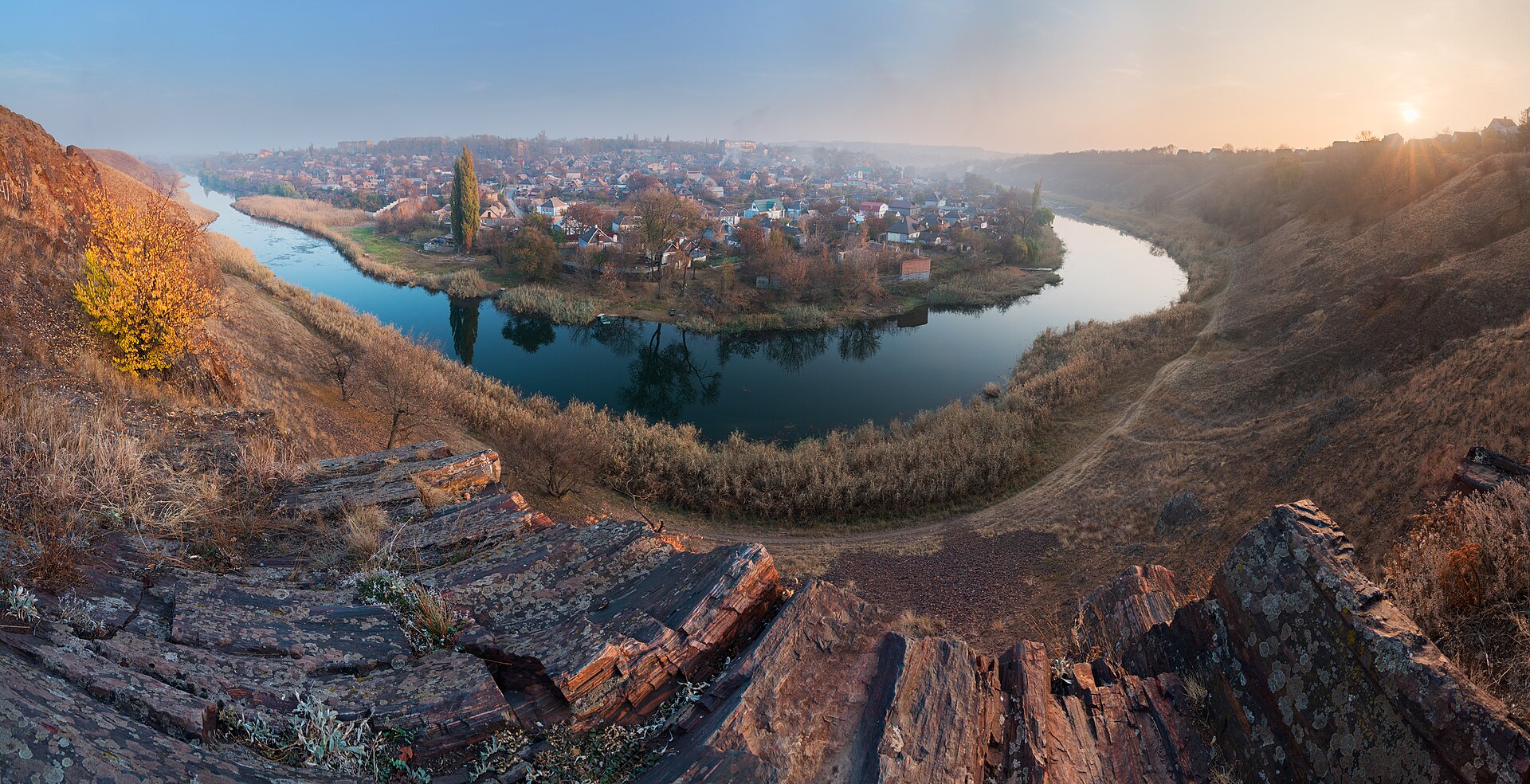
- Kryvyi Rih Botanical Gardens — Outskirts, north-east of the city
Kryvyi Rih Botanical Gardens lie outside the built-up area, to the north-east, and are what the city is best known for among tourists. Allow half a day including the journey out and back, and check the official tourism website for current opening arrangements before going.
Culture
Kryvyi Rih has a lively performing-arts habit for an industrial city. Theatre, circus and dance all have a home here, along with a doll theatre and a movement theatre. Its first theatre, the Coliseum, opened in the early twentieth century, and the Kryvbas Theatre later merged with the Shevchenko company, so stage traditions run deep. The city is also the birthplace of Eugenie Gershoy, who emigrated to the United States as a child and became a sculptor and watercolourist; her work is held by several major American museums. The Jewish community once played a large part in local life, and a synagogue building survives as a reminder. Day to day, culture here is shaped by work. Shift patterns, steel and mining families, and Soviet-era housing blocks give the place a plain-speaking character that locals wear lightly. Public memory is visible in the parks, where Soviet war memorials, eternal flames and newer Ukrainian monuments stand close together, and people have strong feelings about all of them. Language is also a sensitive subject. Both Ukrainian and Russian have long been heard in the city, but since the full-scale invasion many residents have deliberately moved to Ukrainian. Greet people with a simple Ukrainian "Dobryi den" rather than assuming Russian is welcome, and do not photograph industrial plants, bridges or military sites, as taking pictures there can lead to questioning by the authorities.
What to wear
Kryvyi Rih shares the dress traditions of central Ukraine, where the embroidered shirt, the vyshyvanka, is the best-known garment. Traditional shirts are cut from linen, hemp or cotton and stitched at the collar, cuffs and chest in geometric or floral patterns, often in red and black thread. Women historically wore them with wrapped or woven wool skirts and bright sashes, and men with wide woven belts. Today the vyshyvanka comes out for weddings, christenings, school ceremonies and festivals, and in May many people wear one to work on the national day devoted to it. Everyday dress in the city is practical and fairly smart: dark jackets, jeans, trainers or sturdy shoes, and plenty of sportswear. Young people follow European street trends, and offices and theatres lean smart casual. Visitors should dress for the weather and the terrain. Summers on the steppe are hot and dusty, so light cotton and a hat help, while winters are cold and need a warm coat, gloves and insulated, non-slip boots. Comfortable walking shoes matter because distances are long and riverside paths can be rough. At Orthodox churches, cover shoulders and knees, and women may want a scarf for the head. Avoid camouflage or military-style clothing, which can attract unwanted attention in wartime conditions.
What to eat
- Borshch — Canteen-style eateries and neighbourhood cafés
Borshch is the beetroot soup at the centre of Ukrainian cooking, usually with cabbage, potato and meat, finished with sour cream and garlic bread rolls. Every household has its own version. Look for it at canteen-style eateries and ordinary neighbourhood cafés. - Varenyky — Cafés and supermarket cooked-food counters
Varenyky are boiled dumplings stuffed with potato, cabbage, cheese or cherries, served with sour cream or fried onions. They suit a cold day and are easy to order by pointing. Find them on café menus and at the cooked-food counters of larger shops. - Deruny — Family-style restaurants and covered markets
Deruny are crisp potato pancakes, often eaten with sour cream or alongside meat. They make a filling, plain lunch and appear on most traditional menus. Look for them in family-style restaurants and at stalls in the covered markets. - Holubtsi — Canteens and supermarket ready-meal counters
Holubtsi are cabbage rolls filled with rice and minced meat, simmered in a tomato sauce. They are home cooking at its most comforting, and a common lunchtime dish. Try them in canteens and at the ready-meal counters of the bigger supermarkets. - Salo with rye bread — Meat stalls in the city markets
Salo is cured pork fat, sliced thin and eaten on dark rye bread with garlic or mustard, often alongside a drink. It is an acquired taste for some visitors. Buy it from the meat stalls of a market, where sellers will usually offer a taste.
Plan it
Best time. May–June and September, when the steppe is green and temperatures are comfortable for walking by the rivers. July and August can be hot and dusty, while winters are cold and grey.
How long. 2
Getting there. Ukraine's airspace is closed to civil aviation because of the war, so there is no usable airport. Arrive by train or road from elsewhere in Ukraine. Most long-distance trains serve the main railway station, but the city has several stations along its length, so check which one your ticket uses. Check current government travel advice before planning any trip.
Budget. low
Tips
- Check your government's travel advice and install a local air-raid alert app before and during any visit
- Pick one district per day: the city is very long and crossing it takes time
- Drink bottled water rather than tap water
- Carry some cash as well as a card for markets and small cafés
- Use a taxi booked through a local after dark and agree the fare first, especially if travelling alone
Etiquette
- Greet in Ukrainian and do not assume Russian is welcome
- Do not photograph industrial sites, bridges or military personnel
- Cover shoulders and knees when entering an Orthodox church
Nearby
Sources
- Wikidata Q157137 (CC0)
- Wikipedia: Kryvyi Rih (rev 1382921261) (CC BY-SA 4.0)
- Wikivoyage: Kryvyi Rih (rev 5407653) (CC BY-SA 4.0)
- Photo: Kryvyi Rih Old Town, Igor Kvochka (CC BY-SA 4.0)
- Photo: Kryvyi Rih Old Town (cropped), Igor Kvochka (CC BY-SA 4.0)
- Photo: Kryvyi Rih main railway station, Александр Водолазский (CC BY 4.0)
- Photo: Coke oven battery №6, ArcelorMittal Kryvyi Rih (CC BY-SA 4.0)
- Photo: Central Post Office, Kryvyi Rih, WDKeeper (CC BY-SA 4.0)
- Photo: Boat station at the confluence of the Inhulets and Saksahan, Dogvillan (CC BY 3.0)
- Photo: View of Inhulets River from Rocks of MODR, Ryzhkov Sergey (CC BY-SA 4.0)
- Photo: Synagogue of Kryvyi Rih (Public domain)


