Kos
Kos, Greece
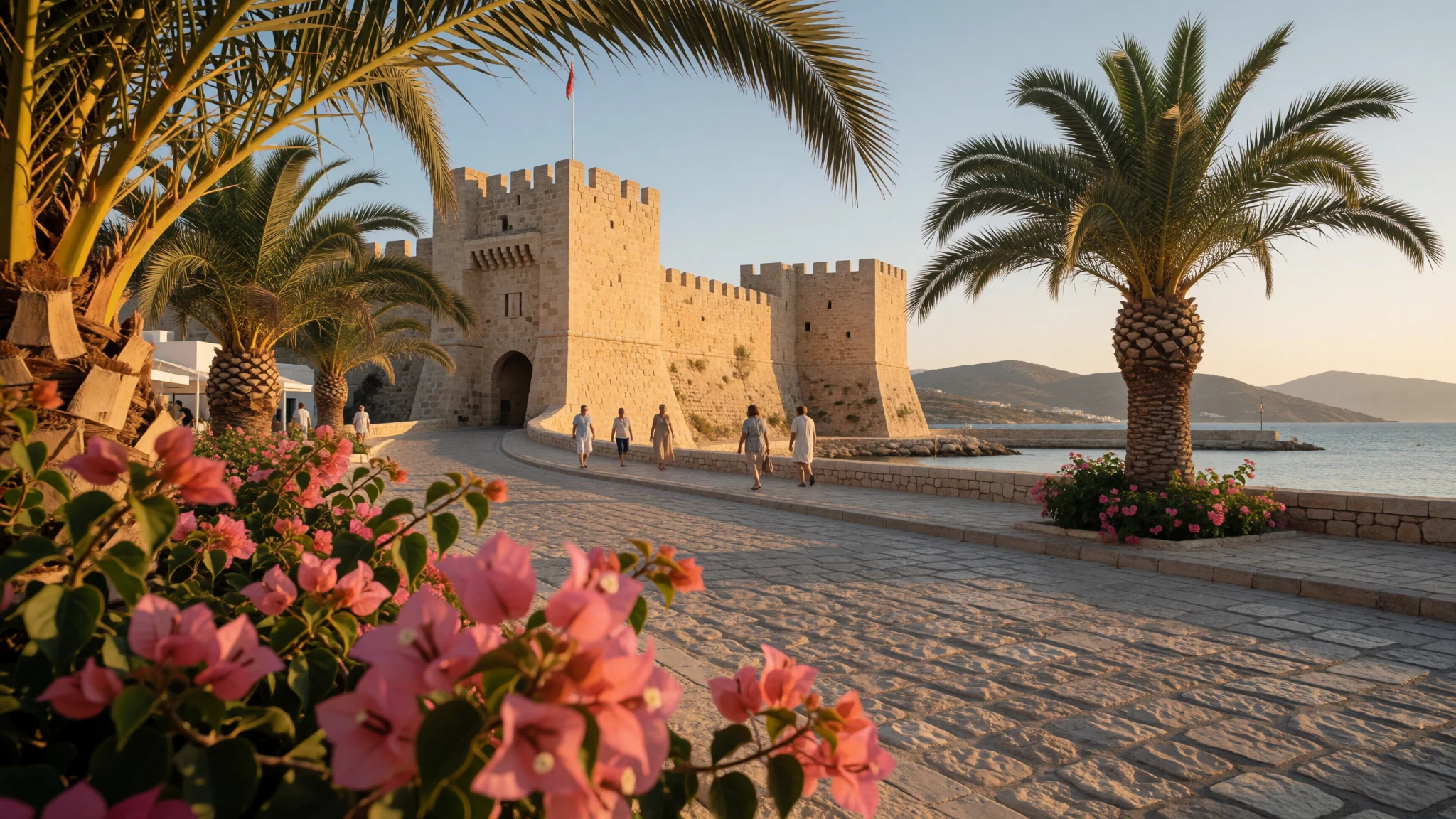
A Dodecanese island balancing sun-soaked beaches with an equally rich archaeological heart in its capital.
The place
Kos sits in the southeastern Aegean Sea as part of the Dodecanese chain, positioned between Kalymnos to the north and Nisyros to the south. The island measures 42 by 11 kilometres and carries a resident population of roughly 33,000, making it the second busiest settlement in that island group after Rhodes. The topography is defined by a central ridge reaching 846 metres, which creates a distinct separation between the windward northern shore and the sheltered southern coast. The main town, simply named Kos, acts as the administrative and tourist hub, featuring a compact medieval core that has expanded into a modern resort area with a long promenade. Beyond the capital, the coastline is dotted with villages such as Mastihari in the northwest, Kefalos in the southeasterly corner, and the quieter settlements of Zia and Tigaki. The weather follows a Mediterranean pattern, meaning the island endures hot, dry summers and mild, wetter winters. Coastal areas are ideal for swimming from late spring through early autumn, while the interior hills offer a slightly breezier escape from the midday heat. For those preferring to move by land, the island is compact enough to circle by rental car or bus, with the main routes connecting the west and east ends passing close to several ancient site clusters. The overall atmosphere is distinctly Greek island, though with a modern hospitality industry that has expanded significantly in recent years, bringing a mix of quiet village tavernas and larger hotel complexes to the same coastline.
Its story
The history of Kos is deeply entangled with the medical legacy of Hippocrates, the Ancient Greek physician whose birth the island claims. For centuries, the town was a significant academic centre, particularly regarding the study and practice of medicine. A pivotal moment in the island's governance was its integration into the Dorian Hexapolis, a league of six cities that included nearby Lindos and Kamiros. This period saw the construction of the Asclepieion, a sanctuary dedicated to Asclepius, the god of healing, where patients were treated through a combination of ritual and early therapeutic procedures. The town also features notable Roman engineering, including a large amphitheatre and a stadium, remnants of a cosmopolitan port that hosted ships from across the eastern Mediterranean. Later centuries brought rule by the Knights of St. John, who established the prominent Castle of Neratzia to guard the harbour against Ottoman forces and pirates. In 1947, the island was formally returned to Greece after a complex period of Italian administration and global conflict, leading to a demographic shift that solidified the current cultural landscape. Today, the physical remains of these successive eras—Mycenaean, Roman, Crusader, and Ottoman—offer a dense layer of history concentrated within a short walking distance of the old town centre, allowing visitors to trace the commercial and religious currents that shaped the eastern Aegean.
What to see
- Castle of Neratzia — Kos town port
This 14th-century fortress dominates the harbour entrance and serves as the visual gateway to Kos town. Constructed by the medieval order of the Knights Hospitaller, it has served as a military garrison and a lighthouse over the centuries. Today, the structure offers a panoramic platform for viewing the harbour, the old town, and the surrounding coastline. It is a bustling spot in the tourist season, but the approach along the palm-lined avenue provides a pleasant transition from the main road to the historic centre. - Asklepieion — North side of Kos
Located on a hillside on the island's north side, the Asclepieion is a sanctuary dedicated to worship and healing. The site features a temple, an underground chamber used for dreams or 'incubation', and ruins where medical treatments were supposedly performed. It is a large archaeological zone that requires some walking on grassy paths. This is the most significant historical site on the island, directly linked to the legacy of Hippocrates and the practice of early therapy. - Kos Hippocrates' Tree — Kos town
A large Plane tree in the old town is traditionally believed to be where Hippocrates taught his students. While the original tree from the fifth century BC is long gone, the current tree is a very old replacement that has been preserved as a physical connection to the famous physician. It stands on a paved square, making it an easily accessible point of interest for those exploring the historic quarter of the city. - Roman Odeon — Kos town, near the Gymnasion
This ancient cinema and lecture hall provides insight into the island's past as a major urban centre. The structure was built to host public performances and speeches, and it features a well-preserved seating area and a stage. Its construction was part of a broader effort to create public spaces for civic life in the Roman period, reflecting the wealth and popularity of the port at that time. - Archaeological Museum — Kos town, near the Agora
The municipal museum houses collections of artefacts excavated across the island. It includes statues, pottery, and mosaics that document the various civilisations that occupied the area. Many of the items found at the Roman Odeon and other nearby sites are displayed here, providing the historical context for the ruins explored in the town. The building itself is a notable example of inter-war architecture. - Mastihari — Northwest coast
This seaside settlement in the northwest is one of the most popular for sunbatheing and swimming. It features a long sandy beach that faces north and west, offering a different seaview from the main town. The atmosphere here is more relaxed and catered towards families, with various tavernas and small shops along the strip. It is a good option for those who prefer a slightly quieter environment to the central port area.
Culture
The people of Kos have a predominantly Orthodox Christian identity, a heritage that is visible in the numerous churches and chapels dotting the island. Historically, the island was home to a significant Turkish-Muslim community, and a small mosque still stands in the old town, maintained as a place of worship. The local economy is deeply tied to tourism, but agriculture remains a major source of livelihood. The island is famous for the cultivation of 'Cos lettuce', a variety of romaine that originated here, as well as the production of almonds, figs, and olives. These agricultural products give the local diet a specific character. The social rhythm slows down during the late afternoon, particularly after the mid-day meal. Interaction with locals is generally warm, though very direct and straightforward. To show respect and integrate smoothly into the daily life of the island, visitors should avoid loud disturbances at late hours and be mindful of the quietude in smaller villages, which can feel overwhelmingly different from the busy coastal resorts.
What to wear
Traditional dress in the Dodecanese often features the 'fustanella', a pleated tunic worn by men, and the 'tsaroucho' for women, though these are now largely reserved for festive or ceremonial occasions rather than daily wear. The local population typically dresses in casual, comfortable clothing suited to a hot climate, with light cotton and linen being the primary materials. For visitors, practicality is the main consideration; the heat can be intense, particularly in July and August, so breathable fabrics and sun-protective wear are standard. Comfortable walking shoes are essential, as many of the historical sites involve uneven stone paths or dusty trails. If visiting religious sites, modesty is expected; covering the shoulders and knees is a simple and respectful practice. Hairspray styles that are prominent on the Greek mainland are less common on the islands, where a more laid-back, sun-bleached aesthetic is the norm. The local swimwear scene is essentially unremarkable, though the popularity of the beach means many visitors will be seen in standard swimwear on the sand.
What to eat
- Astyropita — Local bakeries and traditional tavernas
A traditional Greek flatbread, typically filled with various combinations of cheese, tomatoes, and onions. It is a staple of the region and can be found fresh from local bakeries or as a meal component in taverna kitchens. The bread is often baked in a wood-fired oven during the day, providing a warm, crusty base for a variety of local ingredients that are in season. - Seftalia — Seafront tavernas in Kos town
A meat dish made from minced meat, often beef or lamb, wrapped in grape leaves and grilled over charcoal. It is a classic taverna meal that brings out the flavours of the local livestock. The dish is often served with a side of rice and a simple tomato salad. It is a representation of the grill culture that is central to island dining experiences. - Tyropita — Confectioneries and morning cafes
A savory pastry made of phyllo dough and a filling of feta cheese and other ingredients. It is a common snack, available for breakfast in the morning or as a mid-day treat from a local pastry shop. The cheese used is typically locally produced, giving the dish a distinct tanginess that is characteristic of Aegean cuisine. - Xipouta — Village restaurants in Mastihari and Zia
A type of pita bread filled with meat, tomatoes, and other vegetables, cooked in a clay pot over a charcoal grill. It is a hearty and satisfying meal that reflects the tradition of slow-cooking in a specific, communal style. The 'xipouta' is often eaten communally, as the pot is brought to the table and shared among the diners at the restaurant. - Island Dips — Open-air cafes in the old town
A selection of homemade dips such as tzatziki, tarama, and melitzanosalata, typically served with warm bread. These are essential for starting a meal at a taverna and are made with the island's famous produce. The hummus is also often available, given the island's close proximity to the Turkish coast, reflecting the cross-cultural culinary influences present in the Dodecanese.
Plan it
Best time. May through June for a mix of good swimming weather and slightly fewer crowds, or September and early October when the island retains its warmth but the heat begins to break. July and August are very popular and can be extremely busy.
How long. 3–5
Getting there. Fly into Kos International Airport (KGS), which is a short taxi or bus ride from the main town. The island is also well-served by ferries from Piraeus, Rhodes, Leros, and Patmos. For day-trippers, several catamarans operate across to Bodrum on the Turkish coast.
Budget. mid
Tips
- Rent a car early in the season to ensure an easy bookable model.
- Visit the north beach areas for clearer water, and the south for more shade and a lagoon-like environment.
- Book the Catamaran crossing to Bodrum in advance during high season.
- Take water when hiking up to the Asclepieion.
Etiquette
- Remove shoes if required when entering smaller, private chapels.
- Speak softly in the quieter inner villages.
- Use the public bins and do not leave glass on the beach.
Nearby
Sources
- Wikidata Q187027 (CC0)
- Wikipedia (rev 1375842151) (CC BY-SA 4.0)
- Wikivoyage (rev 5407561) (CC BY-SA 4.0)
- Photo Kos Castle (CC BY-SA 3.0 de)
- Photo Kos view (CC BY-SA 3.0 de)
- Photo Eurasia mosaic (CC BY 3.0)
- Photo Gymnasion (Public domain)
- Photo Odeon (CC BY 3.0)
- Photo Asklepieion (CC BY 3.0)


