Isabela Island
Isabela Island, Ecuador
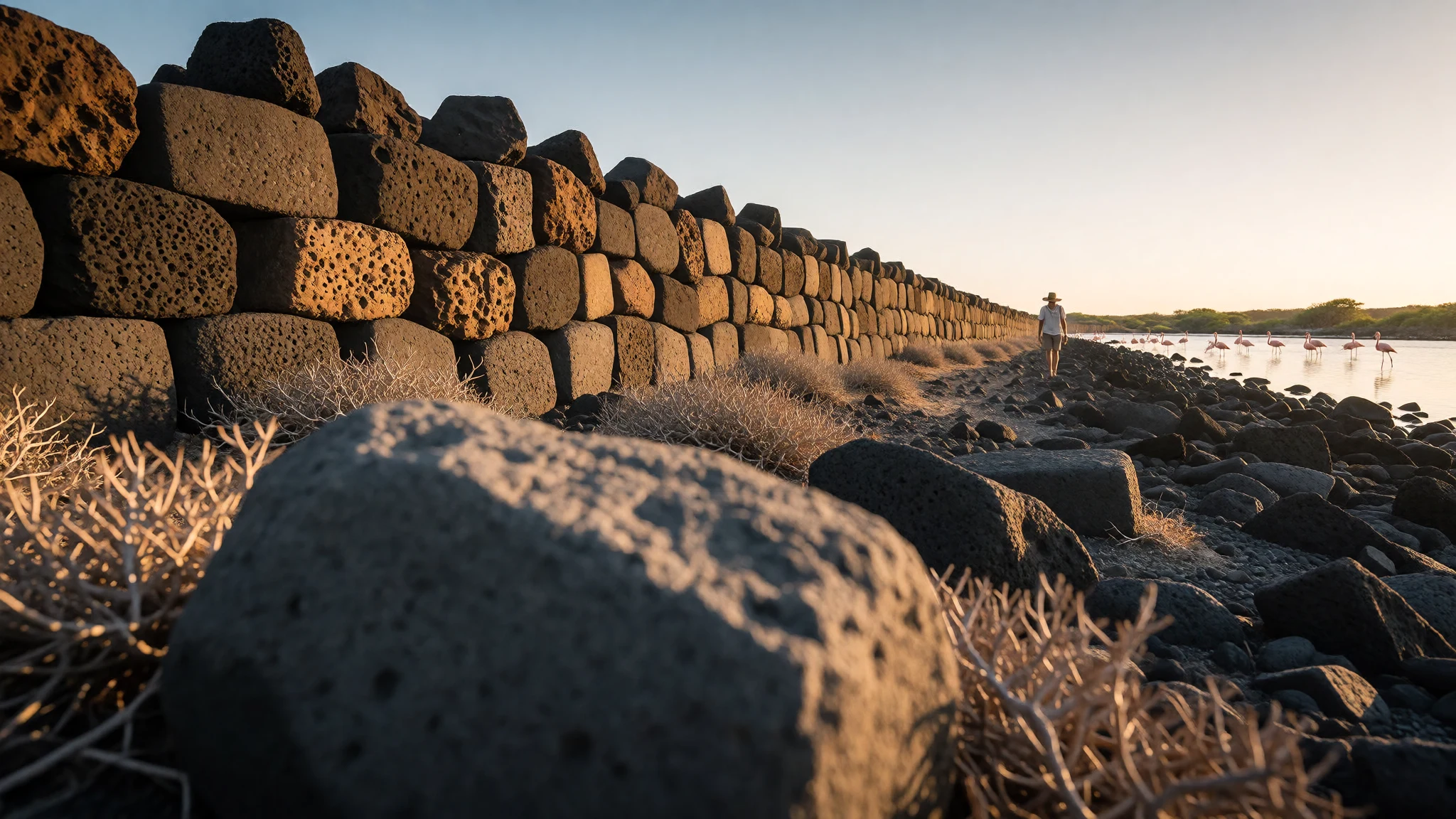
Isabela Island is a chain of volcanoes on the equator, where flamingos, penguins and giant tortoises live beside a sleepy sand-street town.
The place
Isabela Island is the largest of the Galápagos, and it feels more like a small country than a single island. The equator runs across it, and six volcanoes, joined by old lava flows, make up its long, seahorse-shaped body. The highest point, on Wolf Volcano, stands 1,700 m above the sea. Its area is greater than all the other islands in the group added together, yet about 3,000 people live here, nearly all of them in Puerto Villamil, a low-rise town of sandy streets on the southern tip. Beyond the town there is very little road. Most of the land belongs to the national park: black lava fields, dry scrub, damp green slopes on the volcanoes, mangrove edges and shores where marine iguanas lie piled on warm rock. Visitors tend to experience Isabela in one of two ways. Those who stay in Puerto Villamil make day trips on foot, by road and by small boat to the nearby volcano, lagoons and snorkelling spots. Those on longer cruises reach the remote western coast, where most of the island's visitor sites lie, far from Santa Cruz; only the longer, costlier boat tours go that far. The pace is slow, the nightlife is quiet and the sea crossing from Santa Cruz can be rough. The sun is strong all year, shade is scarce on the lava, and the water is cooler than many first-time visitors expect.
Its story
Isabela Island has a short human history and a long geological one. For centuries the only visitors were whalers, buccaneers and naval crews, who valued the giant tortoises because the animals could be stacked alive in a ship's hold and eaten months later. Permanent settlement came late: Puerto Villamil and Santo Tomás were founded in 1893, and by 1905 about 200 people lived on the island. They worked with what was to hand, digging sulphur around steaming vents, burning coral into lime, and killing tortoises for meat and oil. Later the island held a penal colony, and prisoners were set to build a long wall of lava blocks in the hills. It is now called the Wall of Tears and stands beside a popular walking trail. Underneath all of this sits the volcanic story. Six volcanoes rose from the sea floor and merged into one landmass, and several are still active, which is why some of the tortoises at the island's breeding centre carry scars from lava. In recent decades the local economy has turned from extraction towards protection and tourism, with fishing and small-scale farming continuing alongside. Young tortoises raised at the breeding centre are released into the wild, a quiet reversal of the long period when they were taken off the island by the shipload.
What to see
- Giant Tortoise Breeding Centre — Edge of Puerto Villamil
The Giant Tortoise Breeding Centre, a short walk from Puerto Villamil, raises young tortoises from Isabela's volcanoes until they are big enough for release. Pens hold hatchlings of different ages, and some adults show scars from lava. Flamingos wade in the lagoons along the boardwalk that leads there, so allow time for slow strolling and photographs. - Sierra Negra Volcano — Highlands above Puerto Villamil
Sierra Negra is one of the island's six volcanoes, and its wide caldera is the main day trip from town. Walkers go with a guide, usually starting early. On clear days the rim views across black lava are far-reaching; cloud often hides them, and wildlife is sparse. It pairs well with the sulphur-mine fumaroles nearby. - Los Túneles — Coast south-west of Puerto Villamil
Los Túneles is a maze of eroded lava arches, canals and small bridges off the southern coast, reached by small boat from Puerto Villamil. Cactus grows on the rock, blue-footed boobies nest on top, and turtles, rays and fish pass underneath in clear water. Snorkelling suits confident swimmers; ask the operator about sea conditions. - Wall of Tears trail — West of Puerto Villamil
The Wall of Tears trail takes about 2.5 to 3 hours return from town, passing lagoons, beaches crowded with marine iguanas and viewpoints before ending at the heavy lava-stone wall built by prisoners. Go early, carry water, and wear closed shoes because the path crosses sharp, uneven rock. - Las Tintoreras — Islet just off Puerto Villamil
Las Tintoreras is a small islet and lava channel just off Puerto Villamil, where white-tip sharks rest in a narrow lagoon. They are watched from the trail, as swimming in the lagoon is not allowed. The walk also passes marine iguanas and sea lions, sometimes penguins, with snorkelling nearby. - Concha de Perla — Waterfront, Puerto Villamil
Concha de Perla is a sheltered natural pool beside the town's waterfront, popular for easy snorkelling. Sea lions often share the water, and fish drift among the rocks and mangrove roots. It is calm enough for beginners, though tide and swell change, so check conditions locally before getting in and keep a respectful distance from the animals.
Culture
Isabela Island's community is small, and daily life runs on a few shared rhythms. Most residents are Spanish-speaking Ecuadorians, many with family ties to the mainland, and their work revolves around fishing, farming, guiding, boat crews and guesthouses. The town is quiet by day, with some shops shutting in the heat, and lively in the late afternoon when people gather on the beach and the main square for volleyball, football and conversation. Evenings are sedate: a couple of beach bars, then an early night before the morning boats. Conservation is part of local identity rather than a slogan. The national park shapes where people can walk, what they can build and how tours operate, and many residents are trained guides who know the wildlife well. Guides are required at most park sites, and rules on trails, group sizes and landing areas are enforced. Greetings matter: a 'buenos días' to shopkeepers and boat crews goes a long way, and patience with slow service reads as politeness. Supplies arrive by boat, so shortages happen, and holidays can slow things further. Visitors who treat the island as a community, not only a reserve, tend to get the warmest welcome. Keep to marked trails and stay at the distance your guide sets from tortoises, iguanas and sea lions, never touching or feeding them.
What to wear
Isabela Island has no costume of its own, because the community is young and drawn mostly from mainland Ecuador. Traditional clothing there belongs to other regions: the woollen ponchos, wrapped skirts and embroidered blouses of the Andean highlands, and the fine toquilla-straw hat known abroad as the Panama hat, woven on the coast. These appear at fiestas, school parades and souvenir stalls, not in daily life on the island. What people actually wear now is practical: shorts, T-shirts and football shirts, sandals or flip-flops, fishing caps, and quick-dry shirts on guides and boat crews. Evenings are casual, with cotton trousers or a light dress for restaurants. Visitors should dress for sun, sea and rough rock. Pack a long-sleeved sun shirt, a wide-brimmed hat with a chin strap, sunglasses and reef-safe sun cream, plus closed shoes with a grippy sole, since lava is sharp and uneven. Water shoes help at rocky entries, and a wetsuit, which can usually be rented locally, makes snorkelling comfortable in the cooler months. A light rain jacket suits the misty season, and a fleece helps on the early boat crossing. Swimwear belongs on the beach: put on a shirt and shorts or a wrap before walking into town or a restaurant.
What to eat
- Almuerzo set lunch — Small eateries around the main square, Puerto Villamil
The almuerzo is the island's everyday lunch: a bowl of soup, then rice, beans and a piece of meat or fish, often with salad and a juice. It is filling, simple and the cheapest regular meal in town, found at small family-run eateries. - Encebollado — Cafés and eateries near the waterfront, mornings
Encebollado is a tuna soup with yuca, pickled red onion and lime, served hot with chifles or bread. It is a mainland coastal staple, eaten here at breakfast or late morning, and it suits mornings after early boat trips. - Ceviche — Beachfront restaurants in Puerto Villamil
Ceviche in Ecuador means fish or prawns cured in lime juice with onion, tomato and coriander, served with popcorn or plantain chips. On Isabela it is made from the local catch, and the best versions are eaten fresh at lunch. - Bolón de verde — Bakeries and breakfast cafés near the square
A bolón is a dumpling of mashed green plantain, filled with cheese or pork crackling and fried until crisp outside. It is a classic Ecuadorian breakfast, usually served with coffee, and a good fuel before a long volcano walk. - Grilled fresh fish with patacones — Small restaurants on the sandy streets towards the beach
Fish of the day is grilled whole or as a fillet and served with patacones, which are twice-fried green plantain slices, plus rice and salad. Evenings in the town's small restaurants are the best time, when the fishing boats have been in.
Plan it
Best time. December–May is warmer and sunnier, with calmer sea and warmer water for snorkelling, though showers are common and the heat can be strong at midday. June–November is cooler, with grey misty skies and cooler water, when a wetsuit helps. Wildlife is good all year.
How long. 3–4
Getting there. Fly from mainland Ecuador (Quito or Guayaquil) to Baltra or San Cristóbal, then take a boat to Puerto Ayora on Santa Cruz. From there a public speedboat runs to Puerto Villamil on Isabela, twice a day, taking about 2 hours. Small inter-island aircraft also fly to Isabela; check current operators.
Budget. mid
Tips
- Buy the Santa Cruz–Isabela boat ticket at least a day ahead, and arrive early because bags are searched for agricultural items
- Take seasickness precautions for the crossing; the seats at the back are less bumpy
- Carry cash for small eateries and guesthouses, as card use is patchy and ATMs can run empty
- Book volcano, tunnels and snorkelling trips through a licensed local operator, and start walks early before the heat
- Bring refillable water bottles and strong sun protection; shade is scarce on the lava
Etiquette
- Go with a licensed guide where the park requires one, and stay on marked trails
- Keep your distance from wildlife and never touch, feed or chase animals
- Take all rubbish back with you and avoid bringing seeds, soil or fresh food onto the island
Nearby
Sources
- Wikidata Q83639 (CC0)
- Wikipedia: Isabela Island (Galápagos), rev 1380687292 (CC BY-SA 4.0)
- Wikivoyage: Isabela (Ecuador), rev 5405453 (CC BY-SA 4.0)
- Photo 01: Elizabeth Bay birds (putneymark) (CC BY-SA 2.0)
- Photo 02: Volcanic Rocks in Elizabeth Bay (MasterfulNerd) (CC BY-SA 4.0)
- Photo 03: Darwin Lake near Tagus Cove (MasterfulNerd) (CC BY-SA 4.0)
- Photo 04: Galápagos Hawk on Isabela Island (MasterfulNerd) (CC BY-SA 4.0)
- Photo 05: Galapagos Mockingbird (Judy Gallagher) (CC BY 2.5)
- Photo 06: Apollo Soyuz Test Project, Isla Isabel (NASA) (Public domain)
- Photo 07: Apollo Soyuz Test Project, Isla Isabel (NASA) (Public domain)
- Photo 08: Boats near Isabela Island (Adavyd) (CC BY-SA 4.0)


