Hassan II Mosque
Hassan II Mosque, Morocco
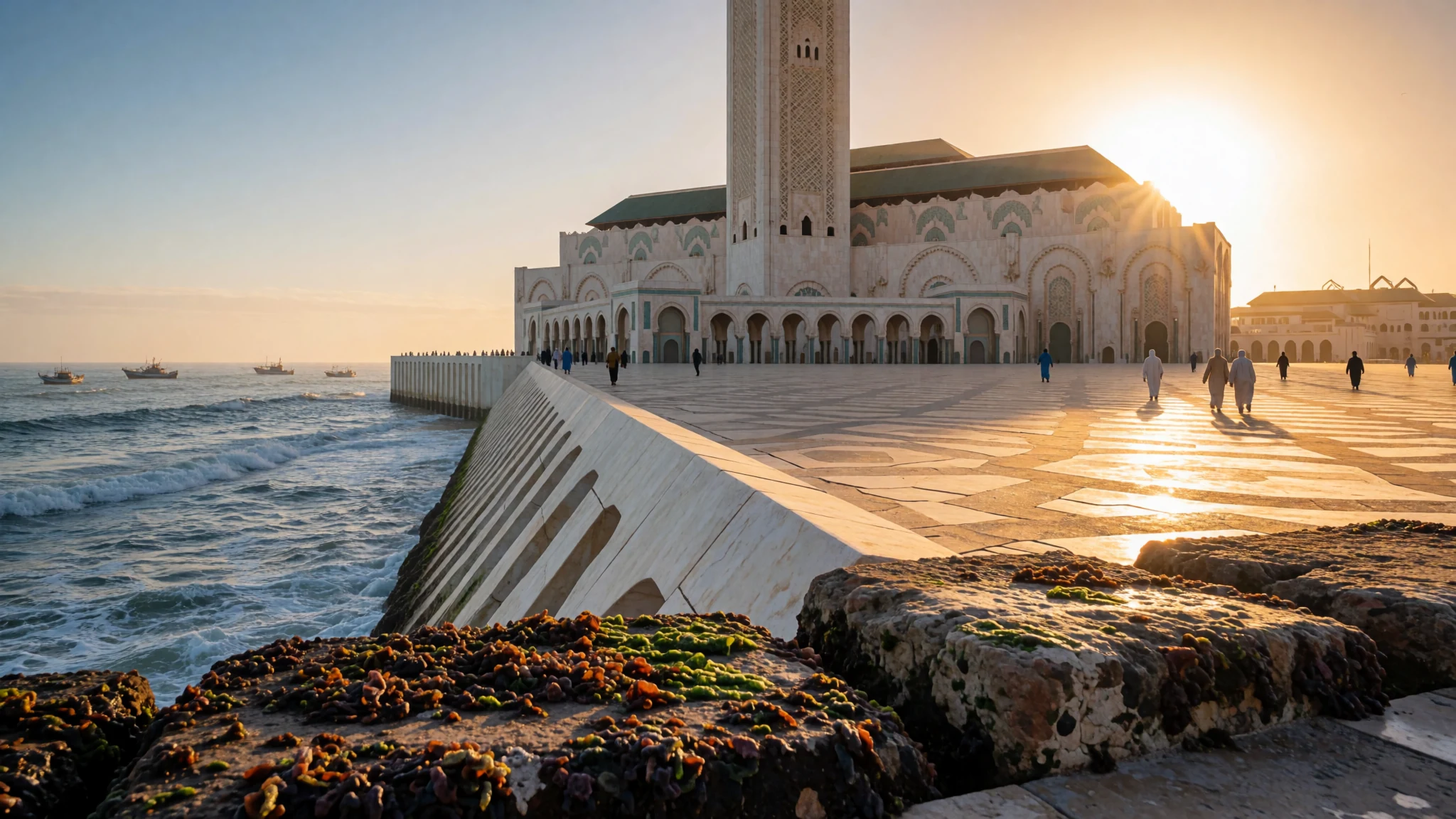
Casablanca's Atlantic-edge landmark, a large marble mosque built partly over the sea, is worth a morning on any Morocco trip.
The place
The Hassan II Mosque stands on a headland in Casablanca, where the old harbour meets the El Hank lighthouse on the Atlantic side of the city. The complex covers about 9 hectares and combines the prayer hall with a madrasa, hammams, a museum of Moroccan history, conference rooms and a large library. Gardens and fountains fill the spaces between the buildings. Much of the mosque sits on a platform that reaches out over the water, and it is approached from land along a wide boulevard on its southern side.
The prayer hall is finished in marble, and its roof can be opened. The minaret rises 210 metres, and at night a laser on its top sends a beam towards Mecca. Inside, carved woodwork, plasterwork and zellige tilework cover much of the surface, and the craftsmanship is the main reason the building repays a slow visit. The hall can take 25,000 worshippers, and the outside grounds hold many more during big prayers.
The seafront setting is unusual for a mosque of this size. Two breakwaters protect the foundations from waves that can reach 10 metres, and the sea breeze keeps the air fresh. The gardens are well tended, and families often gather on the lawns for picnics, which gives the place a relaxed feel. Casablanca is a busy port and commercial city, so the mosque's calm contrasts with the traffic on the boulevard. The complex is busiest around Friday midday prayers.
Its story
The mosque grew out of a royal question about how to honour the dead. When King Mohammed V died in 1961, King Hassan II asked the country's best artisans to propose a mausoleum that would express the devotion the late king inspired. The mausoleum was eventually sited in Rabat, but the ambition to build something monumental stayed with Hassan II. In 1980, on his birthday, he spoke of wanting Casablanca to have a building its people could be proud of, set on the water so that worshippers could pray on firm ground while looking out over the sea.
Michel Pinseau, a Frenchman who had spent time living in Morocco and understood its traditional crafts, was given the job of designing the mosque. The engineering fell to Bouygues, a construction group. Work began in July 1986. The schedule aimed for completion in time for the king's 60th birthday in 1989, but the building ran late, and it was formally opened in August 1993, close to the anniversary of the Prophet's birth.
Paying for it was the controversy. Morocco is a lower-middle-income country, and the construction cost was estimated at about 585 million euros. Much of the money came from ordinary people: around twelve million donors gave, each receiving a receipt and certificate, and the smallest gift was 5 dirhams. Businesses and foreign governments contributed as well, and Western lenders provided construction loans, which Morocco repaid. The scale reflects a wish to rival the great mosques of the Islamic world, even though the government lacked the funds to match that wish on its own.
What to see
- Main entrance and forecourt — Bd. Sidi Mohammed Ben Abdallah, southern façade
Approach the mosque from the wide boulevard on its southern side and the scale becomes clear before you reach the steps. The main entrance door is a large carved piece, and the forecourt can hold a great many people on festival days. Give yourself time here: photographs of the façade work best in the softer light of early morning or late afternoon, when the marble does not glare.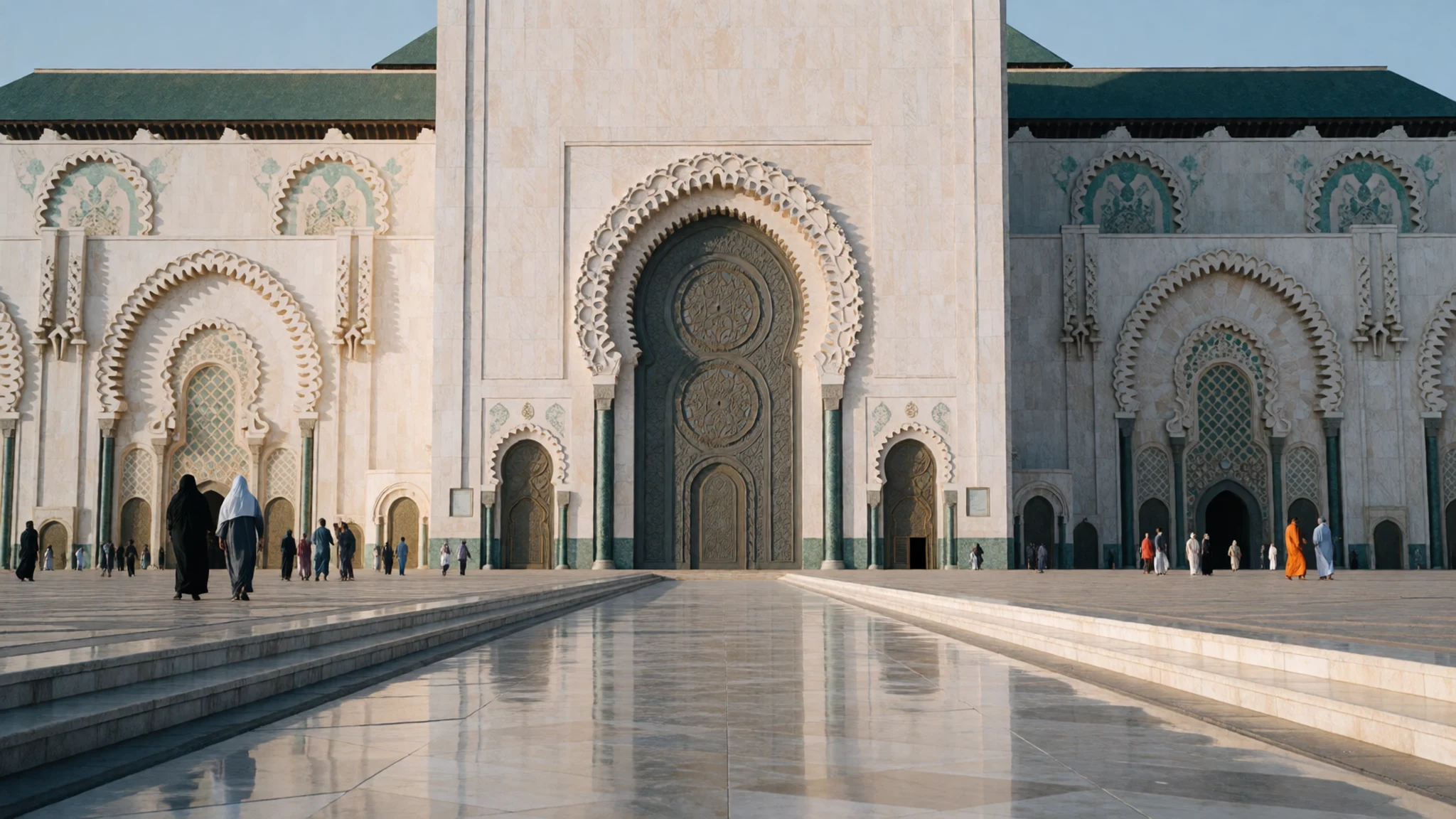
- Seafront platform over the Atlantic — Seafront platform, on the Atlantic side
The prayer hall reaches out over the Atlantic, so on a calm day the waves slap against the stone below the platform. Two breakwaters shield the foundations from swells that can rise up to 10 metres. Early light turns the water pale and sharpens the mosque's outline. Mornings are quieter, the breeze is fresh, and the air is cleaner than in the city centre.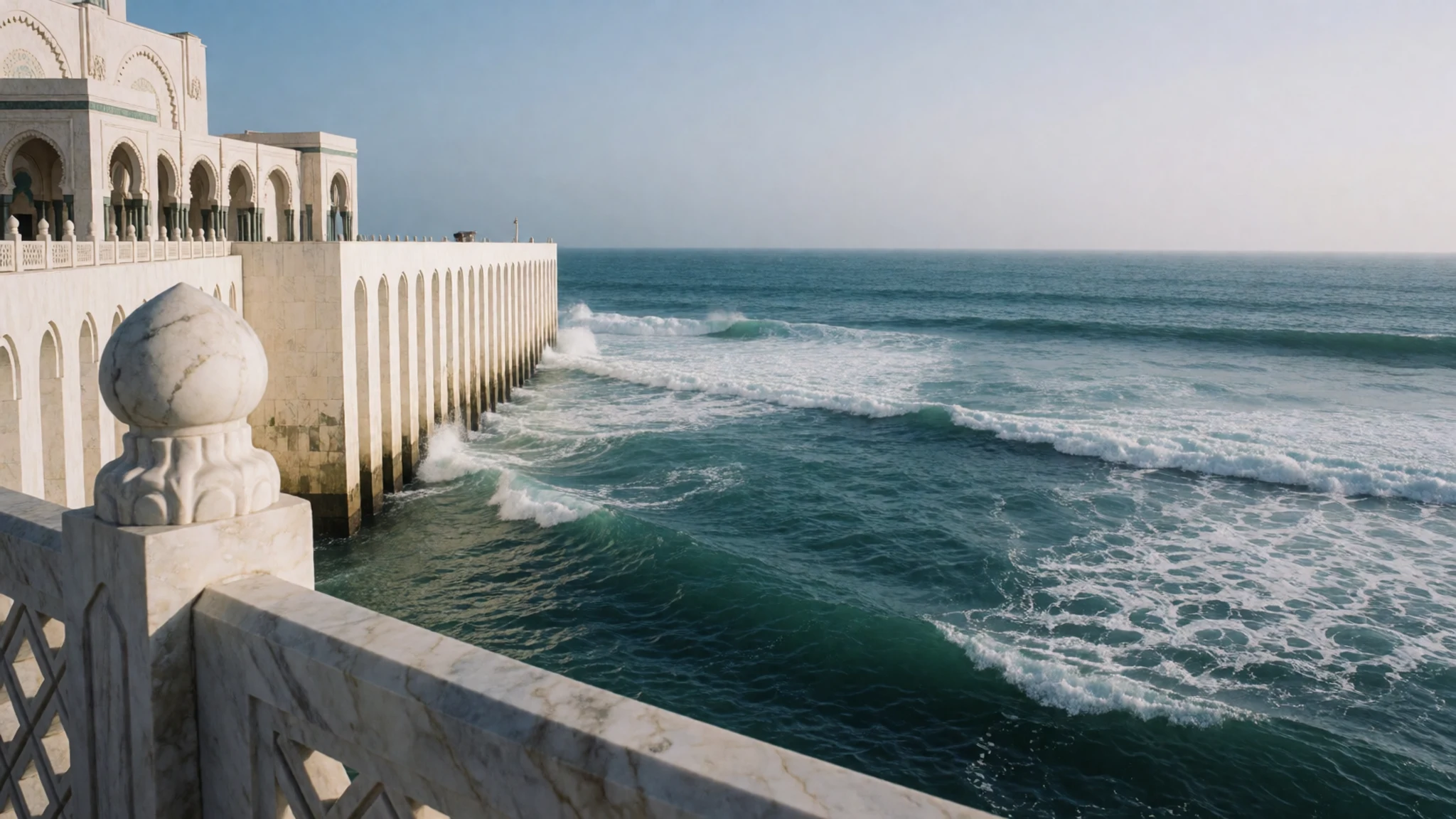
- Prayer hall interior — Prayer hall, ground level
The prayer hall is the heart of the building and the part most visitors want to see. Shoes come off before you step inside. Plasterwork and painted decoration run across the ceilings and columns, and the marble in the floor and walls shows a range of tones. The hall can take around 25,000 worshippers, so even busy sessions feel spacious. Check the official site for visiting arrangements, as they change.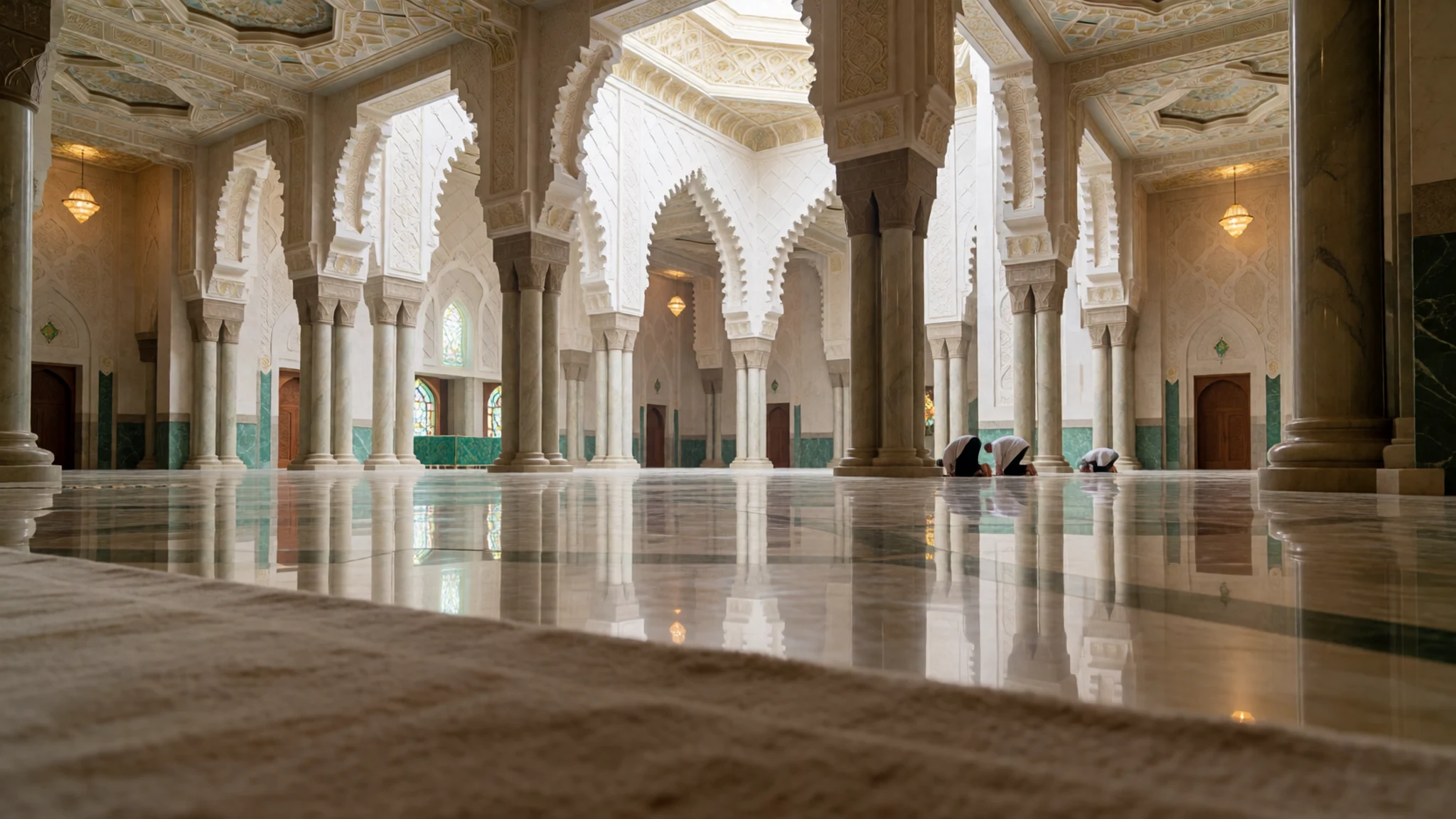
- Carved woodwork — Carved ceilings and panels in the prayer hall
Look closely at the geometric patterns, which repeat across carved wood, plaster and tile. The building drew craftsmen from across the kingdom, and it is the cumulative detail, rather than any single panel, that makes the strongest impression. Stay on the walkways and avoid blocking doorways near the prayer areas.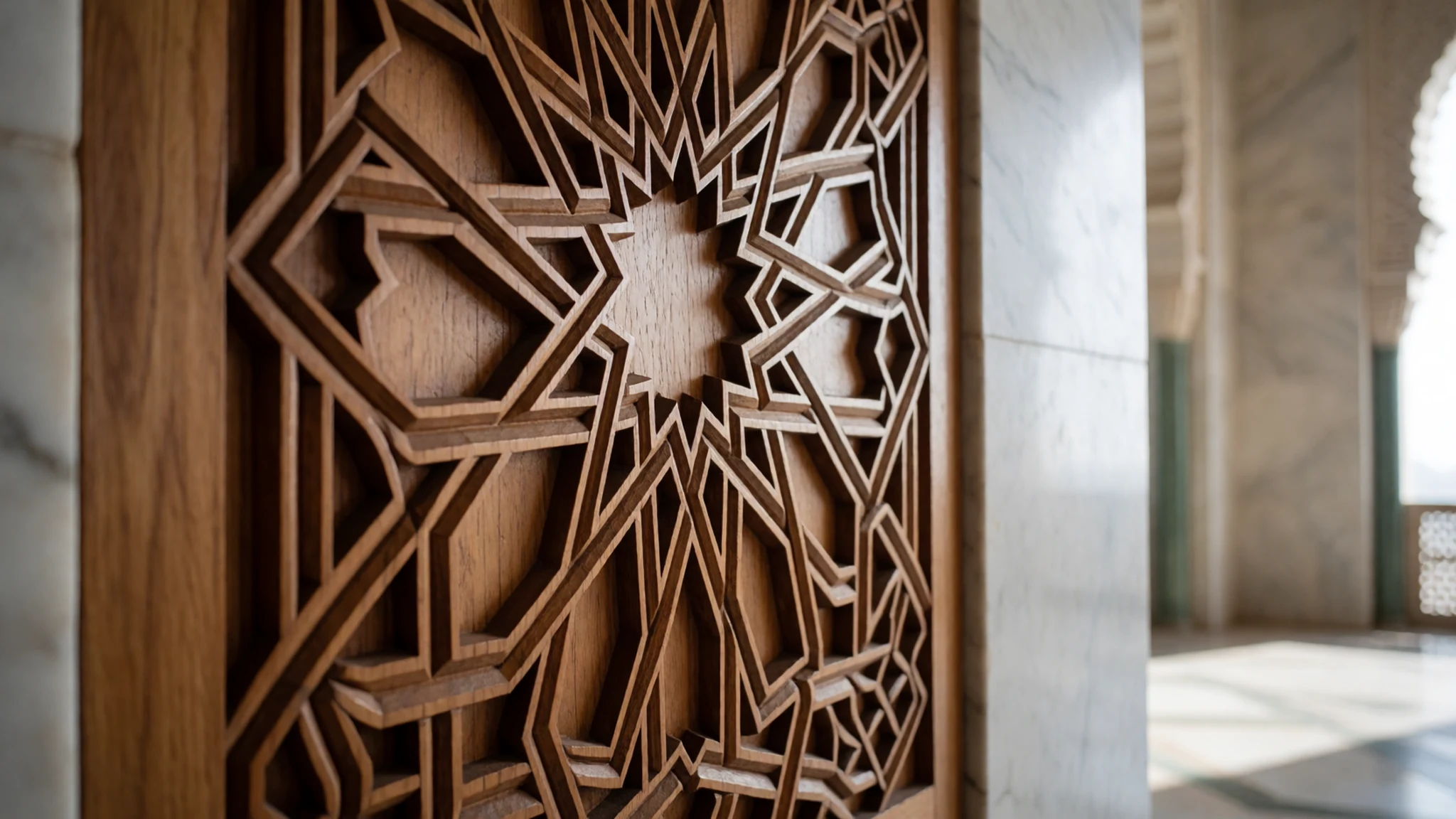
- Zellige tilework and the courtyards — Courtyards and gardens around the prayer hall
Zellige, the mosaic of hand-cut glazed tiles, is one of the crafts the builders brought together in this mosque. Its geometric panels show the fine work that Moroccan tilemakers are known for. Forty-one fountains sit in the courtyards, and the gardens around them are popular with families for picnics. Check which courtyards are open before you plan your route.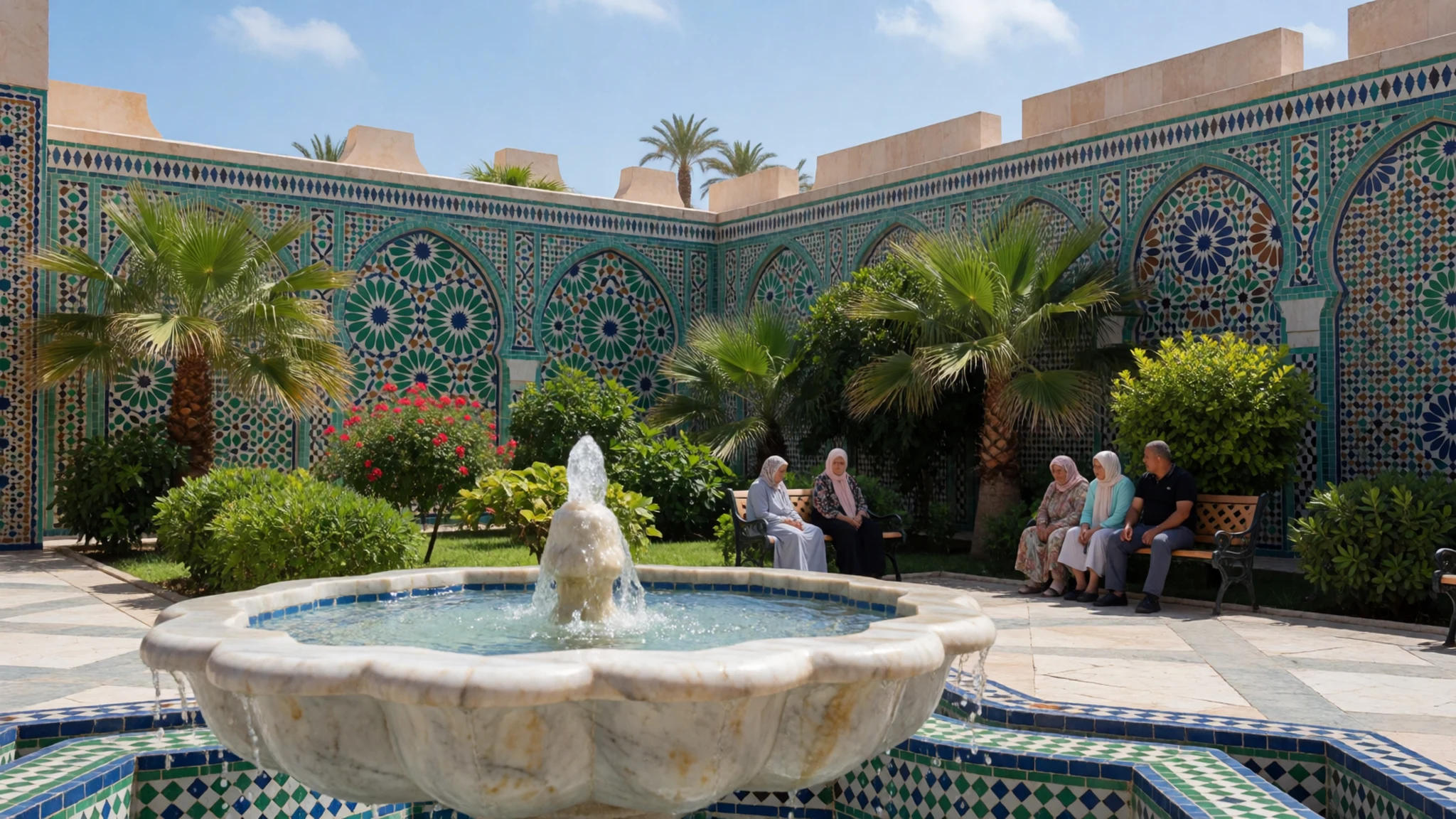
Culture
Hassan II Mosque is a working place of worship before it is a monument, so the visit follows the rhythm of prayer. Modest dress is expected: covered shoulders and knees suit both men and women, and a scarf for the hair is useful for women. Footwear comes off at the threshold, so shoes that slip on and off easily are the practical choice. Groups of worshippers gather in the hall and forecourt for the daily prayers, and voices should drop in those areas. Photography of the building is common, but people at prayer should not be photographed without asking. Casablanca is a busy commercial city, so the quiet of the prayer hall can feel like a change of pace from the boulevard outside. Eating and drinking are best kept outside the mosque grounds, since the gardens are used by families for picnics and the complex is first and foremost a place of prayer. Friday midday prayers draw the largest congregations, and the forecourt can be crowded then. Keep to the walkways and do not step onto the prayer carpets with shoes on, even when the hall looks empty.
What to wear
In Casablanca, traditional dress is the djellaba, a long, loose robe with a hood that men and women have worn across the country. Finer versions are made of wool or cotton, with careful stitching at the neck and cuffs. Women's formal kaftans are often silk or brocade with embroidery at the sleeves and hem. The babouche, a backless leather slipper, is the usual footwear to go with it. In the city itself, most people wear Western-style clothes: jeans, shirts, blazers and office dress. Many women wear headscarves, and many men wear plain trousers and shirts. Everyday fashion is practical and urban.
For a visit to the mosque, wear clothes that cover shoulders and knees, whatever the weather. Casablanca can be warm in summer and mild in winter, and the sea breeze at the shore makes a light layer useful. Choose loose trousers or a long skirt, with a shirt that has sleeves. Carry a light scarf that you can drape over your hair, which is useful in the prayer areas. Pick shoes that slip off easily, since you will remove them at the threshold, and bring a pair of socks.
What to eat
- Harira — Local cafés in the medina quarter and family-run eateries
A thick soup of tomato, lentils, chickpeas and herbs, often with a little lamb or chicken, traditionally eaten to break the fast during Ramadan. Most cafés serve it at dusk in the city, and it is also a cheap, filling starter at any family-run eatery.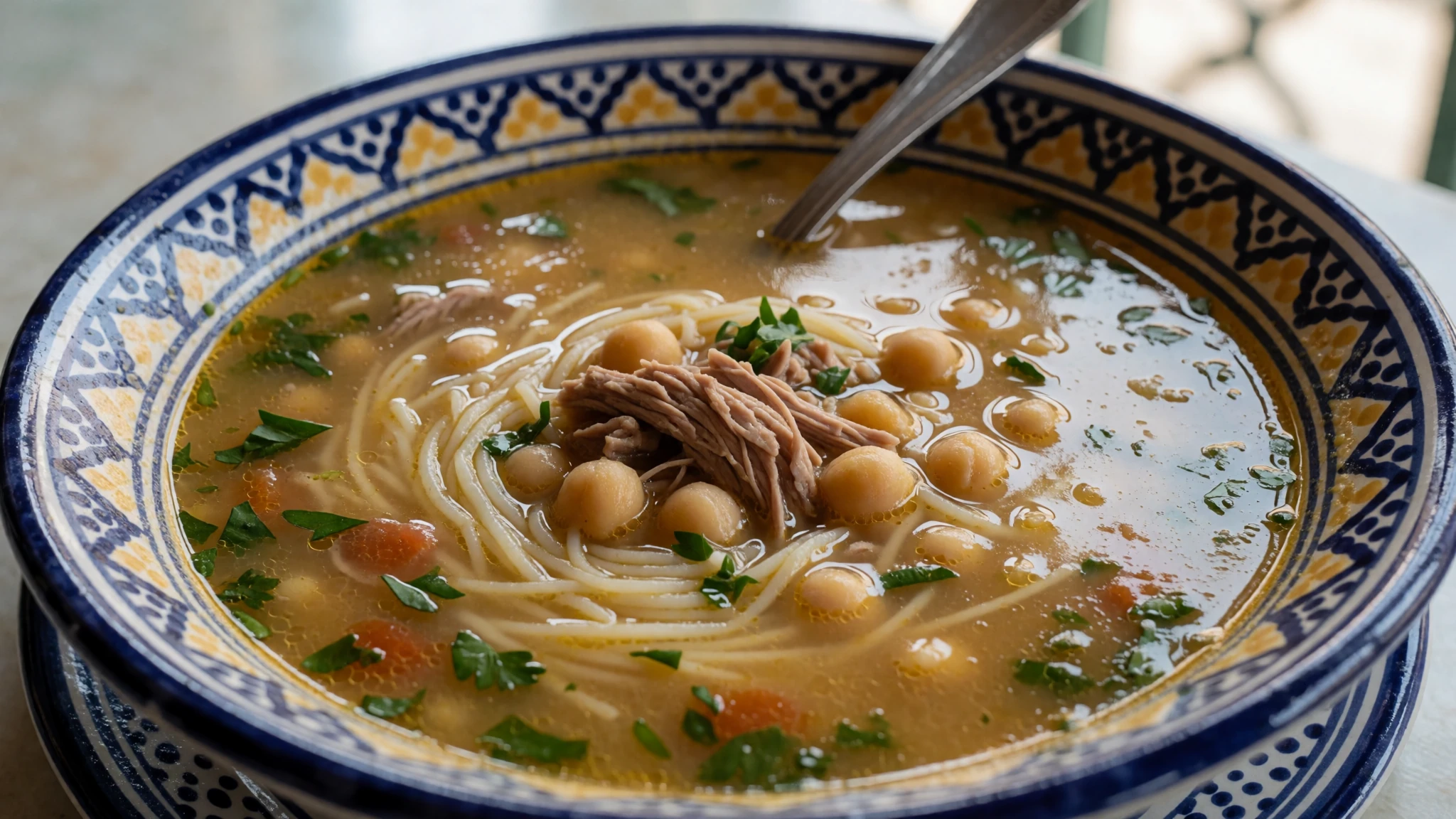
- Grilled sardines — Grill stalls and small eateries by the old harbour
Sardines grilled over charcoal and served with lemon, cumin and bread. Fresh fish is landed at the port, so the freshest plates come from small grills along the harbour front. Eat them with your hands and a squeeze of lemon, and keep the bread for the juices.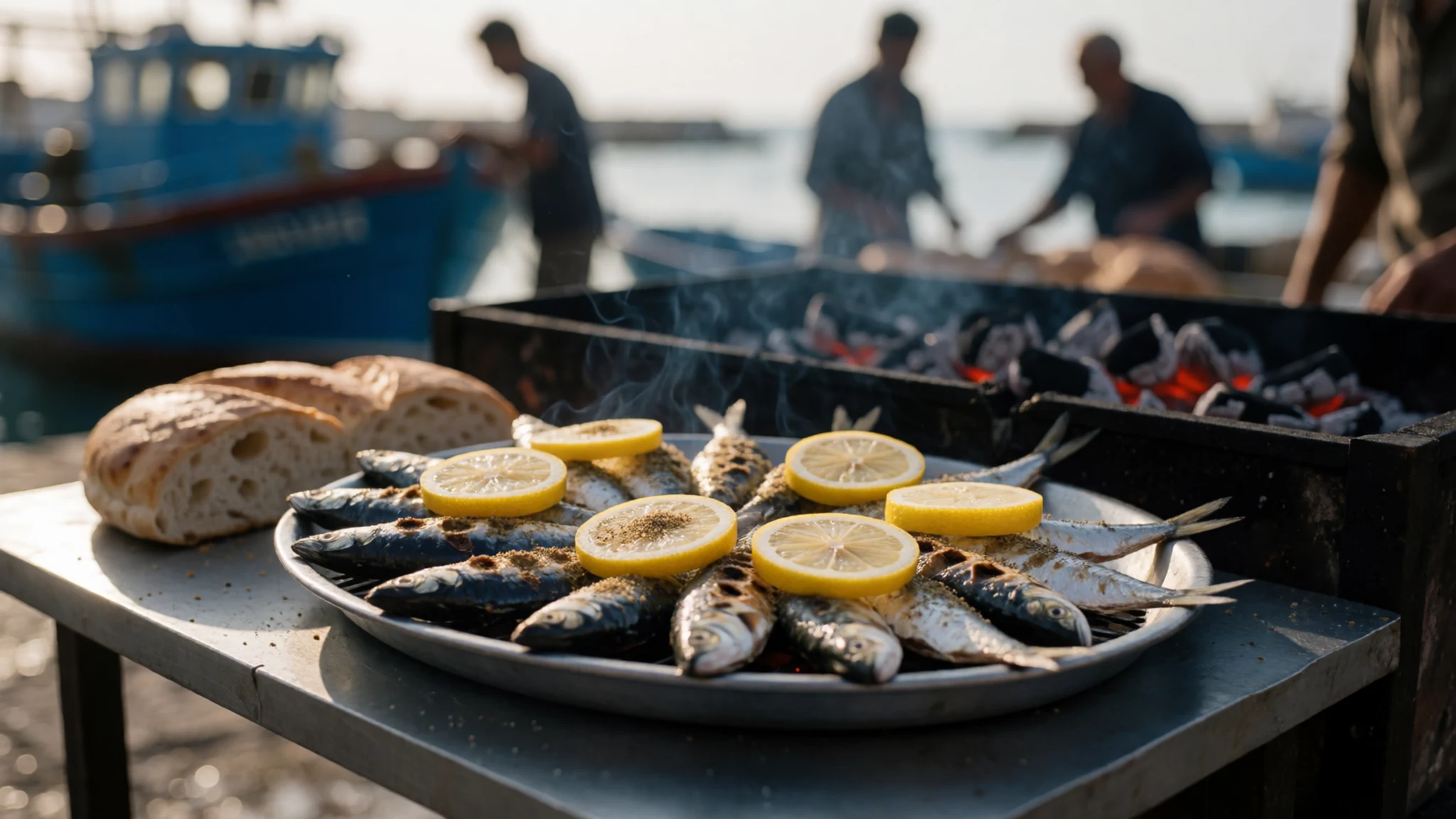
- Pastilla — Traditional pastry shops and family-run eateries in the city centre
Layers of thin pastry filled with spiced chicken or pigeon, dusted with cinnamon and sugar. It is a celebration dish, usually made for weddings and holidays, so order it when a café has a fresh batch. The sweet and savoury balance surprises first-time visitors. - Mint tea — Any café along the seafront or in the medina
Green tea brewed with fresh mint and a generous spoonful of sugar, poured from height to make a foam. Teamakers are everywhere, and it is offered as a welcome in homes and shops. Drink it slowly, as it is served hot and sweet. - Chebakia — Pâtisseries near the central boulevard
Sesame and honey pastries, fried and shaped into flowers, traditionally eaten during Ramadan with harira. They keep well, so they make an easy thing to take away. Pastry shops sell them by weight across the city.
Plan it
Best time. Winter (December to February) brings the mildest temperatures, with daytime highs around 25 to 27 C, but it is also the wettest stretch of the year, and sea breezes keep the coast fresh. Summer is warmer and winter is wetter.
How long. 1–2
Getting there. Fly into Mohammed V International Airport, then take a taxi or the train into Casa-Port station. From there the mosque is a walk of roughly twenty minutes along the seafront boulevard, or a short taxi ride.
Budget. mid
Tips
- Go early in the morning, when the forecourt is quieter and the light on the water is good
- Check visiting arrangements on the official site before you travel, as times change
- Carry some cash in dirhams for taxis, snacks and small purchases
- Plan around Friday midday prayers, when the grounds are at their busiest
- Bring water and a hat for the open forecourt, especially in summer
Etiquette
- Remove your shoes before entering the prayer hall
- Dress with covered shoulders and knees, and carry a scarf
- Ask before photographing people at prayer
Nearby
Sources
- Wikidata Q41346 (CC0)
- Wikipedia: Hassan II Mosque (rev 1382499358) (CC BY-SA 4.0)
- Levée de soleil sur la mosquée Hassan à Casablanca (Milamber's portfolio) (CC BY 2.5)
- View of Casablanca from rooftop bar (Sgroey) (CC BY 4.0)
- Hassan II mosque in construction (Associated Press/Michael Goldsmith) (Public domain)
- Wooden mosaic, Hassan II Mosque (xiquinhosilva) (CC BY 2.5)
- Zellige mosaic detail, Hassan II Mosque (Dortiti) (CC BY-SA 4.0)
- DSC_0213, Morocco 2005 (John Pannell) (CC BY 2.5)
- Main entrance door at the Hassan II Mosque (Tinuzzo) (CC BY 4.0)
- Inside the Masjid (Signaling dogs) (CC BY-SA 4.0)
- Wikivoyage (CC BY-SA 4.0)


