Great Living Chola Temples
Great Living Chola Temples, India
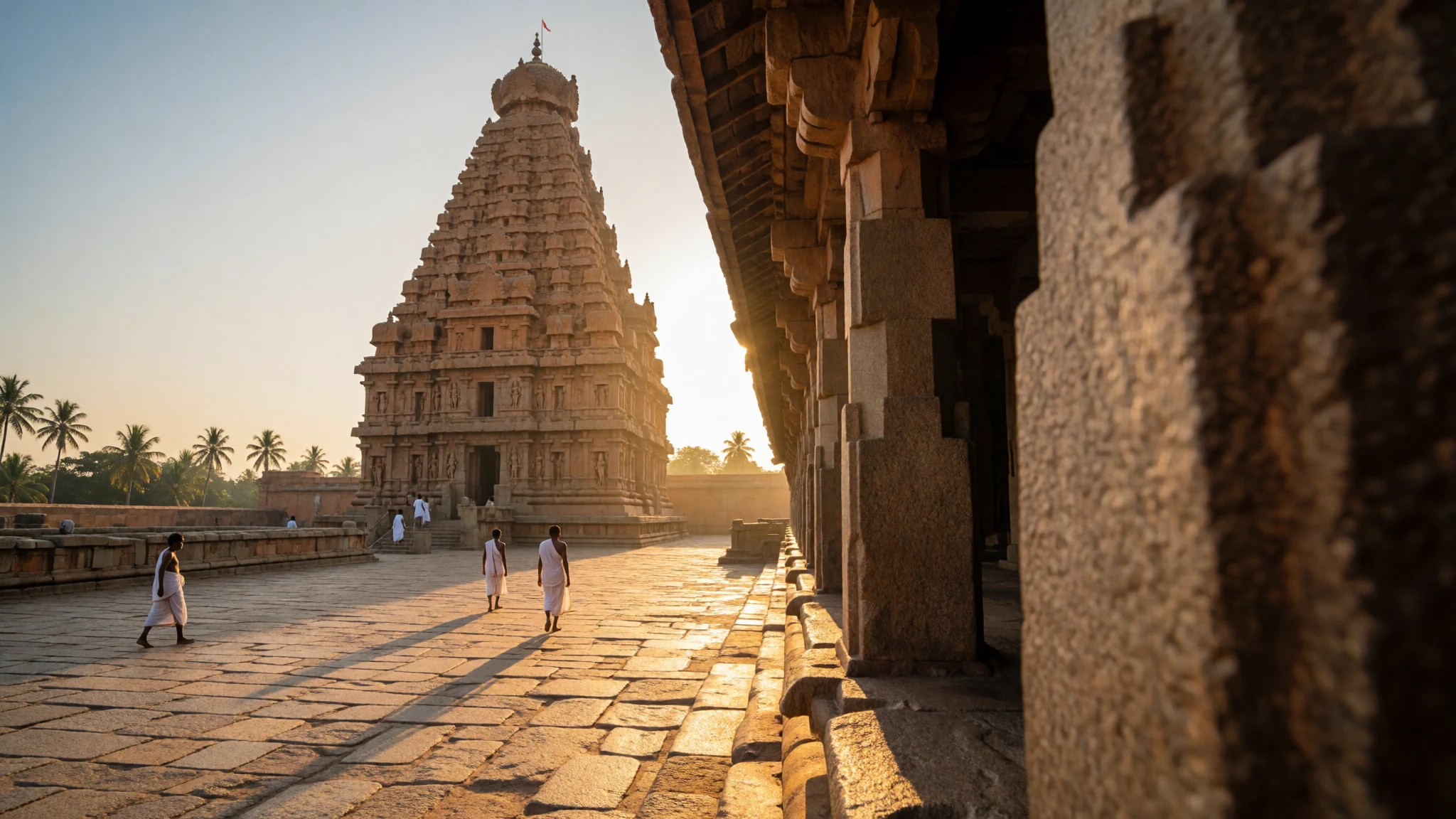
Great Living Chola Temples is a UNESCO grouping of three major Shaivite sites where Chola-era stone carving and temple planning still feel alive.
The place
The Great Living Chola Temples is a UNESCO World Heritage Site in Tamil Nadu, India, covering three Hindu temples from the Chola dynasty era. The set connects the dots between Thanjavur, Gangaikonda Cholapuram and Darasuram through a shared Dravidian temple language—towering gopurams, deep stone reliefs, and temple courtyards shaped for ritual life as much as for architecture.
In practice, the visit reads like a slow walk through different “snapshots” of the same tradition. At Thanjavur, the Brihadisvara Temple anchors the story of Chola power and Shaivism with its commanding presence and dense programme of sculpted detail. In Gangaikonda Cholapuram, the Brihadisvara Temple continues the theme with a slightly different emphasis in massing and how the grounds are composed. Darasuram’s Airavatesvara Temple rounds out the trio with its refined ornament and a calmer feel as you move through the inner and outer spaces.
Season matters. South India can be very humid when the rain builds, and sun exposure is real on open temple grounds. The temples are also religious working places, so prayer rhythms shape your experience more than queues or ticket lines. Festivals can bring crowds, drums and extra movement around processional areas; on quieter days, the stonework becomes the main event—close enough to notice the storytelling carved into columns and walls.
Its story
The Great Living Chola Temples is best understood as a dynasty-era toolkit made in stone. Over the span of the 10th to 12th centuries, Chola rulers leaned on temple building not just to honour Shiva, but to project stability, learning and labour—centuries of craftsmanship packed into a few sites.
At Thanjavur’s Brihadisvara Temple, the atmosphere is dominated by scale and stone density, as if the temple complex was designed to be read slowly from multiple angles. Move through the courts and the design starts to feel rhythmic: thresholds, corridors, and open spaces that guide movement during worship. The same pattern repeats across the UNESCO grouping, but each temple has its own character—different proportions, different emphases in ornament, and a slightly different “tempo” as the grounds open and narrow again.
Gangaikonda Cholapuram’s Brihadisvara Temple and Darasuram’s Airavatesvara Temple keep the thread going, showing how the tradition adapted while staying recognisably Chola. The result is a living heritage: even when visitors come for photography and architectural study, the temples remain part of everyday religious life in Tamil Nadu.
If architecture is what usually draws people in, Tamil culture is what keeps them there—language, festivals, and the daily cadence of devotion surrounding these carved monuments.
What to see
- Brihadisvara Temple, Thanjavur
Brihadisvara Temple at Thanjavur is the anchor site in the UNESCO grouping, with a strong sense of centre stage and surrounding courts. Expect to spend time looking at how pathways and openings shape movement, then zoom in on the carved details that give the stonework its “handmade” feeling. - Brihadisvara Temple, Gangaikonda Cholapuram
The Gangaikonda Cholapuram Brihadisvara Temple connects the Chola story across the region, with a distinct layout and a different balance between mass and ornament. Walk the edges of the complex slowly; the angles from courtyards to thresholds give a more architectural view than a straight-on approach. - Airavatesvara Temple, Darasuram
Airavatesvara Temple at Darasuram is known for its elegant stone detailing within the Dravidian temple style. The experience here often feels calmer: you can linger in the spaces where carvings cluster, and notice how decorative work supports the overall geometry rather than fighting it. - Festivals as part of the visit
Festival moments across Tamil Nadu: Aadi Perukku brings water celebrations, while Deepavali, Karthigai Deepam, Krishna Jayanti and Navaratri add lights, gatherings and special worship that spill beyond the main festival days into temple areas.
Culture
The Great Living Chola Temples sits inside Tamil Nadu’s long cultural rhythm, where religion, language and identity run deep. You’ll often hear Tamil in everyday life, and it’s tied to how people describe their region’s history. It also helps explain why local identity matters in modern politics: Dravidianism has shaped how many Tamils talk about belonging.
On the ground at these temples, the practical focus is worship etiquette. The temples are active religious spaces, so your body language matters more than what you’re wearing. Speaking gently, keeping voices down in inner areas, and letting worship flow uninterrupted makes the visit feel respectful and smoother.
Names and addresses can be different from what visitors expect. Tamil names often follow patterns like given name + father’s name + an optional place name, plus an optional caste title. When meeting someone, using the given name is a safer default than trying to interpret abbreviations.
You may also notice a wider social context around language politics and regional identities; it’s best to avoid commentary unless invited into it.
Visitor etiquette: dress modestly and keep noise low in temple areas, following any instructions from temple staff.
What to wear
For the Great Living Chola Temples, dress is mainly about modesty and practicality in an active religious setting. Traditional Tamil clothing you might see includes the sari for women—often in cotton or silk with contrasting borders—plus dress variations like the mundu/lungi for men. On festival days, richer colours and more formal textiles may appear, but everyday clothing in Tamil Nadu is usually comfortable and breathable.
What visitors typically wear now is a mix: light cotton shirts or kurtas, long loose trousers or jeans, and breathable footwear. In temple zones, you’ll need to be ready for footwear rules, so choose slip-on sandals or shoes that are easy to remove.
What to wear yourself: a light layer for mornings and evenings, clothing that covers shoulders and knees, and socks or footwear you can take off quickly. If you’re coming in the hotter months, fabrics that handle humidity help, but avoid anything too tight or overly revealing—temple courtyards can feel crowded and people will be moving in and out of inner spaces.
A hat and sunglasses help for outdoor walking, and a small scarf can double as sun protection and shoulder coverage when you enter more formal areas. Keep your bag compact so you can comply with any entry checks without stress.
What to eat
- Idli — Breakfast stalls and tiffin counters in Tamil Nadu towns
Idli is a popular tiffin item made from steamed rice-and-lentil batter. In Tamil Nadu it commonly appears for breakfast, alongside chutneys and sambar, in places that serve quick morning meals rather than full sit-down lunches. - Dosa (including masala dosa) — Any neighbourhood breakfast eatery or market-side counter
Dosa is a crisp pancake-style dish made from a batter of rice and black gram. Many shops offer plain dosa and variations such as masala dosa, where spiced potato filling goes inside for a hearty tiffin. - Vada — Snack stands and tiffin hubs in Tamil Nadu cities
Vada is a deep-fried lentil doughnut, commonly eaten as a snack or part of a tiffin set. Expect it with chutney or alongside other breakfast items in places that focus on quick, affordable South Indian meals. - Pongal — Breakfast menus across Tamil Nadu (especially morning counters)
Pongal is rice cooked together with lentils and seasoned with ghee and spices. It’s a comforting breakfast option, especially when the weather feels warm and you want something filling and aromatic. - Sambar and rasam with rice ‘meals’ — Local ‘meals’ restaurants near main roads and temple precincts
A typical lunch-style meal in Tamil Nadu centres on rice with sambar and rasam plus multiple spicy sides. It’s the kind of plate you’ll find in local thalis or meals-focused restaurants in temple-adjacent areas.
Plan it
Best time. March–April for comfortable temple walking, and late October–November for clearer weather; June can be rainy, and August tends to be hot and humid.
How long. 3–4
Getting there. Fly into one of Tamil Nadu’s airports (Chennai, Coimbatore, Madurai, Tiruchirappalli or Thoothukudi), then use trains or road connections to reach the Thanjavur–Gangaikonda Cholapuram–Darasuram circuit; for the last leg, expect local roads and short transfers between sites.
Budget. mid
Tips
- Start temple visits early to beat the heat and get calmer courtyard moments
- Plan the three sites as a circuit so travel time stays manageable
- If travelling intercity by bus, reserve in advance because many services fill up
- Carry cash for smaller temple areas and casual food stops
- Bring water and a light layer for sun and shade shifts around open courtyards
Etiquette
- Remove shoes where required and follow any slipper guidance at temple thresholds
- Keep your voice low in inner worship areas and move calmly through crowds
- Be ready to wait quietly if a ceremonial moment blocks entrances
Nearby
Sources
- Wikidata Q695229 (CC0)
- Wikipedia — Great Living Chola Temples (CC BY-SA 4.0)
- Wikivoyage — Tamil Nadu (CC BY-SA 4.0)
- Photo photos/01-darasuram-airavatesvara-temple-dravidian-architecture-india.jpg (CC BY 4.0)
- Photo photos/02-a-collage-of-great-living-chola-temples-unesco-heritage-site.jpg (CC BY-SA 4.0)
- Photo photos/03-brihadisvara-temple-thanjavur-peruvudaiyar-kovil-ttkcvrvb122.jpg (CC BY-SA 4.0)
- Photo photos/04-gangaikonda-cholapuram-tamil-nadu.jpg (CC BY 3.0)
- Photo photos/05-airavatesvara-temple-dharasuram-kumbakonam-ttkcvrvb122k23iph.jpg (CC BY-SA 4.0)
- Photo photos/06-thanjavur-brihadishwara-temple-7013915633.jpg (CC BY 2.5)
- Photo photos/07-brihadisvara-temple-thanjavur-tamil-nadu-india-2016-086.jpg (CC BY-SA 4.0)
- Photo photos/08-thanjavur-brihadeeswarar-temple.jpg (CC BY-SA 4.0)


