Dahshur
Dahshur, Egypt
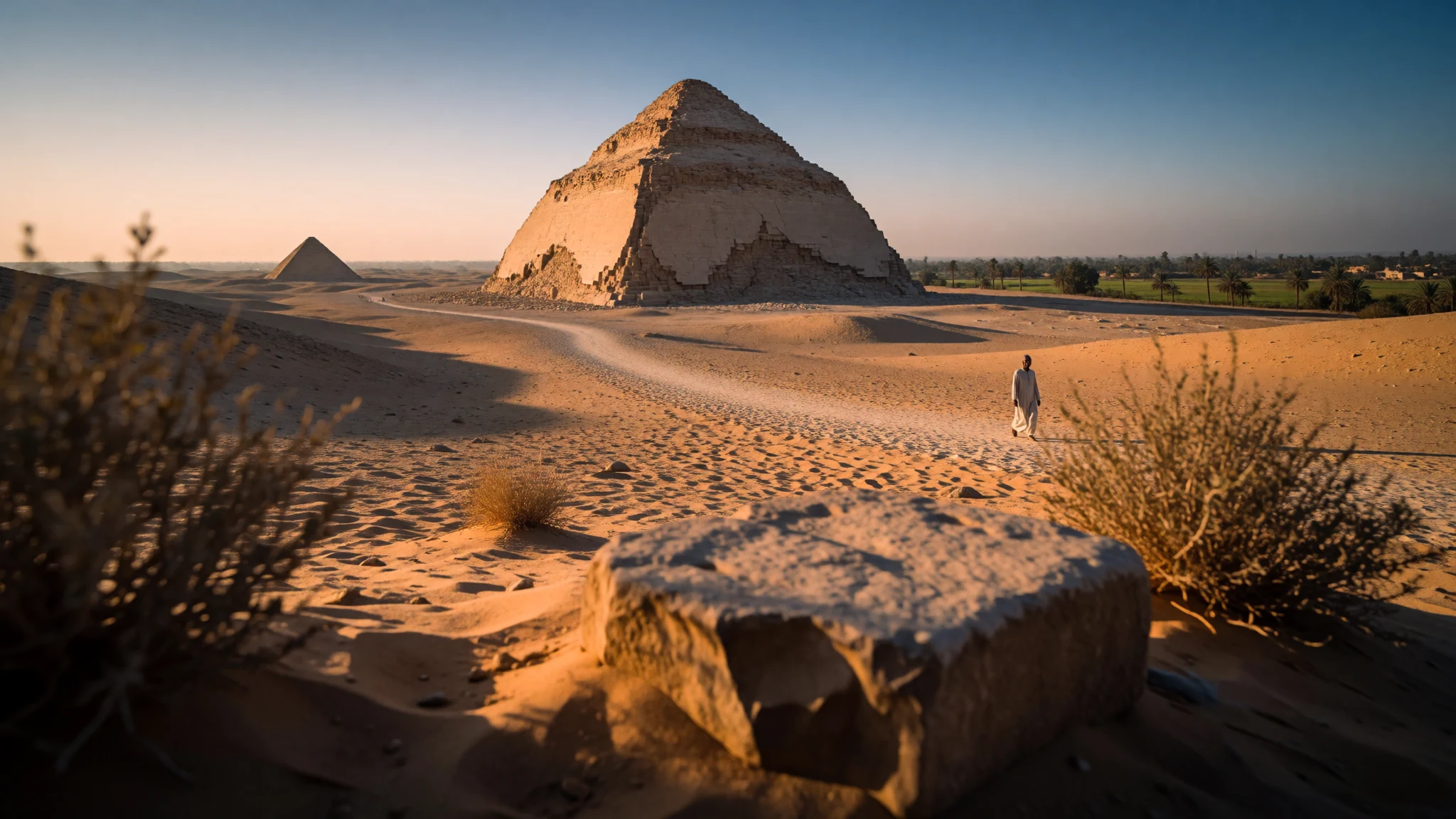
Dahshur offers big, ancient pyramids across open desert with far fewer people than Giza, and a rare chance to see how pyramid design evolved.
The place
Dahshur sits on the desert plateau west of the Nile, at the point where the green farmland of the valley stops and the sand begins. It is a necropolis and archaeological site, inscribed by UNESCO, and one of the pyramid fields that once served the ancient capital, Memphis, along with Giza, Saqqara and Abusir. The name is shared with a nearby village, Manshiyyat Dahshur (Arabic: دهشور), whose fields and palms run almost to the edge of the desert.
What draws visitors is scale without the scrum. The main monuments are the Bent Pyramid and the Red Pyramid, both built for King Sneferu. They stand well apart across open ground, so a visit feels like crossing a landscape rather than queueing at a monument. Visitor numbers are much lower than at Giza, the sales pressure is lighter, and the horizon is mostly sand, sky and the occasional camel with a tourist policeman on top.
The flip side is honesty about effort. There is almost no shade, little in the way of services, and distances that look short on a map and feel long in the sun. Tuk-tuks cannot enter the site, so the walking between monuments is real.
The area was a closed military zone for years and only opened to ordinary visitors in recent times. Egypt's antiquities authorities now encourage people to come here, partly to ease the pressure on the Giza pyramids. For anyone who has already done Giza, or wants the pyramids without the crowds, Dahshur is the better half-day.
Its story
Dahshur's story belongs largely to one king, Sneferu, who founded the Fourth Dynasty and was the father of Khufu, the builder of the Great Pyramid at Giza. Wikidata dates the site to 2589 BCE. Sneferu's reign was a long experiment in how to build a royal tomb that would stand for ever, and Dahshur holds two of the results.
The Bent Pyramid came first. Its builders started with a steep angle, then changed to a gentler one partway up, most likely because the structure was showing signs of strain. The sudden kink gives the monument its name and makes it one of the few pyramids that records its own design problem in stone.
The Red Pyramid applied the lesson. It was built at the gentler angle from the start, giving a true, smooth-sided pyramid, and it takes its name from the reddish tint of its weathered limestone once the finer outer casing was stripped away. Sneferu also completed a pyramid at Meidum for his predecessor Huni, so in sheer volume of stone the father outdid his famous son.
Centuries later, kings of the Middle Kingdom's Twelfth Dynasty returned to Dahshur and built their own pyramids, on a much smaller scale and often with mud brick rather than blocks of limestone. Most are now rubble or eroded mounds. Together the site reads like a timeline of trial, success and decline.
What to see
- Red Pyramid — Northern Dahshur
The Red Pyramid is a true pyramid with smooth sides, and the reddish glow of its weathered limestone gives it its name. Visitors can climb down a long, steep passage into the interior chambers. It is hot, stuffy and narrow, but the vaulted rooms inside are worth the stoop.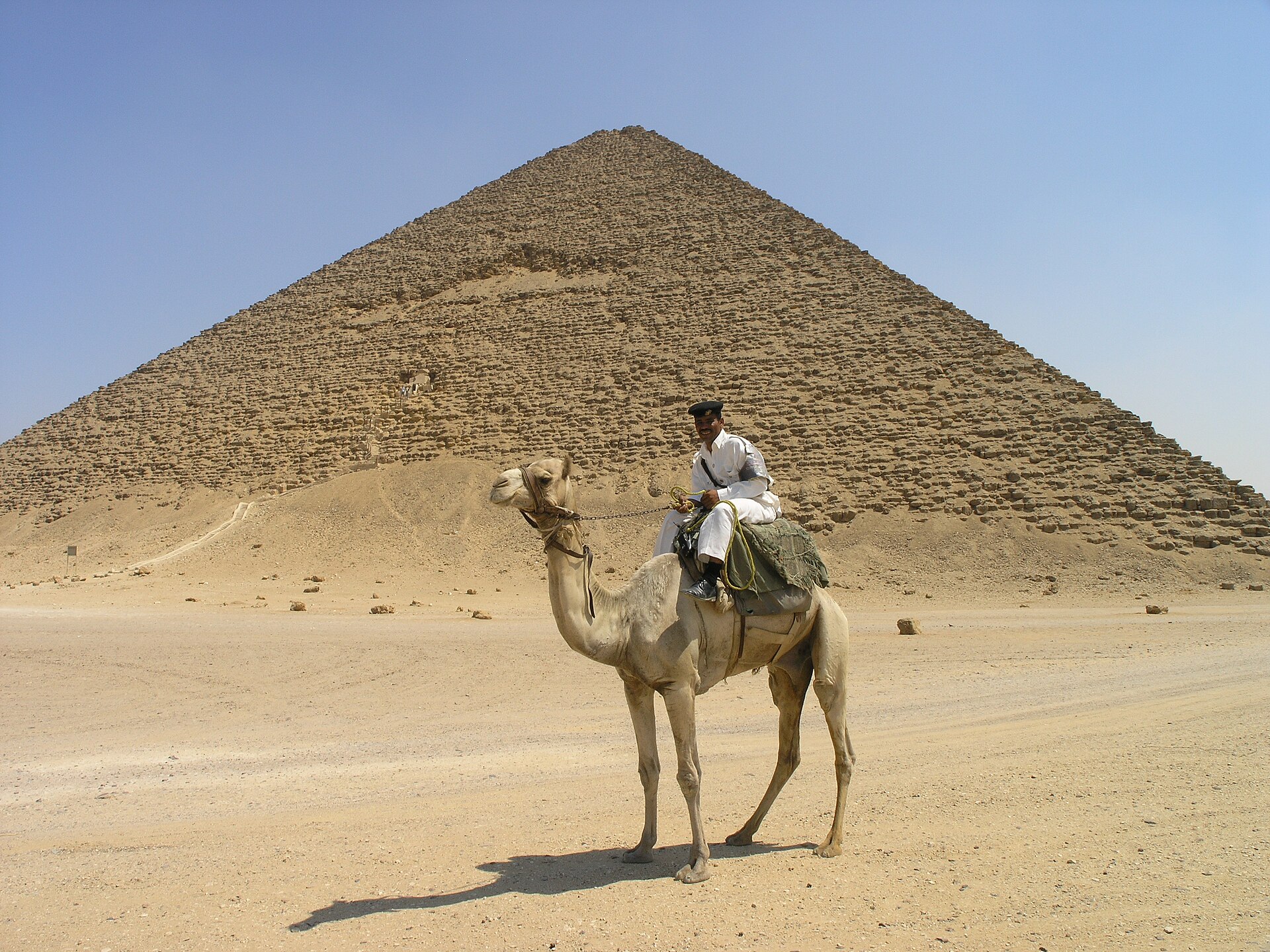
- Bent Pyramid of Sneferu — Southern part of the necropolis
The Bent Pyramid changes slope abruptly about halfway up, which is the quickest lesson in ancient engineering anywhere in Egypt. Much of its outer casing survives, so it looks more finished than most pyramids. Seen from a distance beside the Red Pyramid, the two make a striking pair.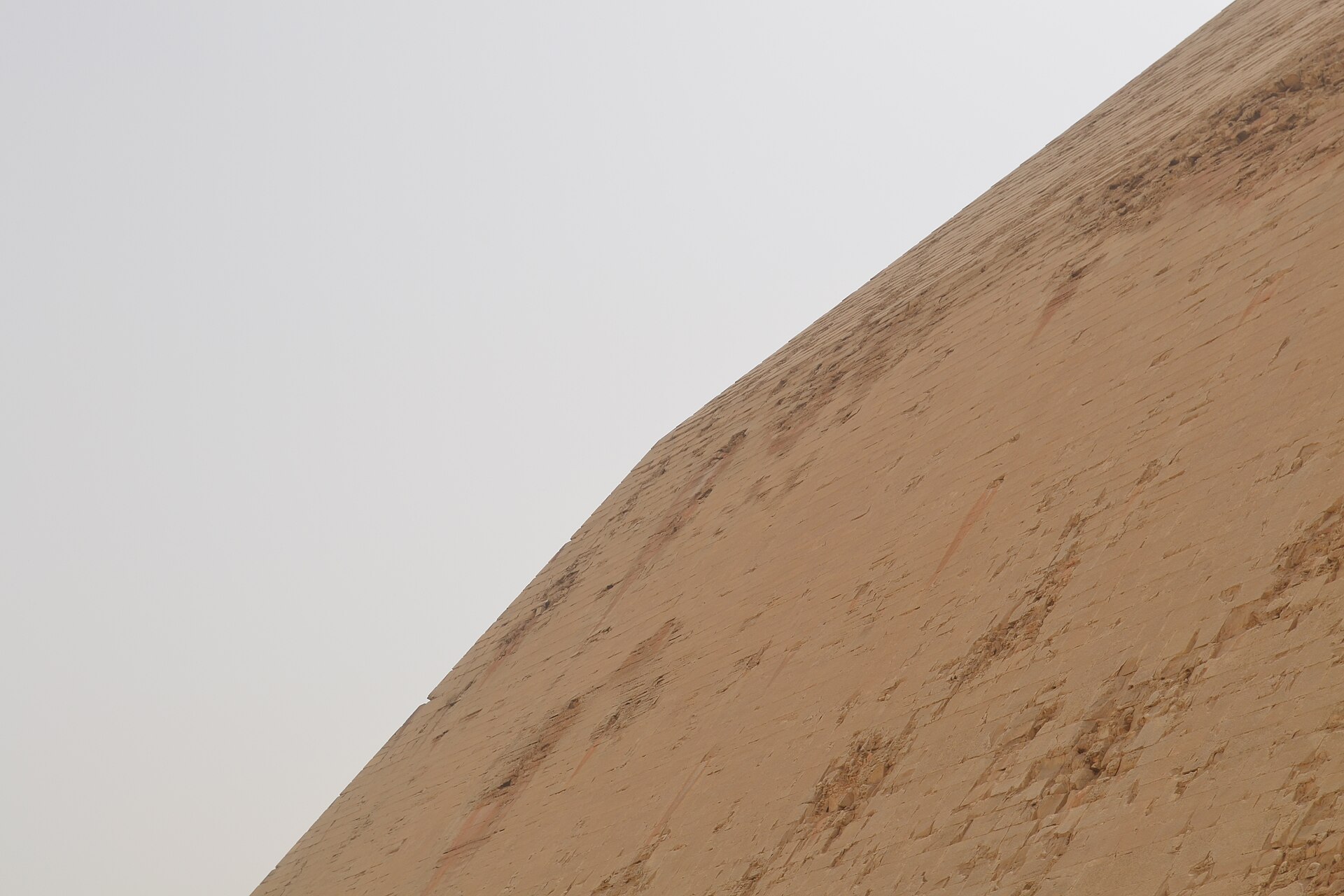
- Black Pyramid of Amenemhat III — Eastern edge of the site
From a distance the Black Pyramid looks like a dark, ragged hill. Up close it is made of millions of mud bricks, and the outer layers have largely collapsed, leaving the inner core exposed. It is a useful reminder of how fragile these monuments become without their stone casing.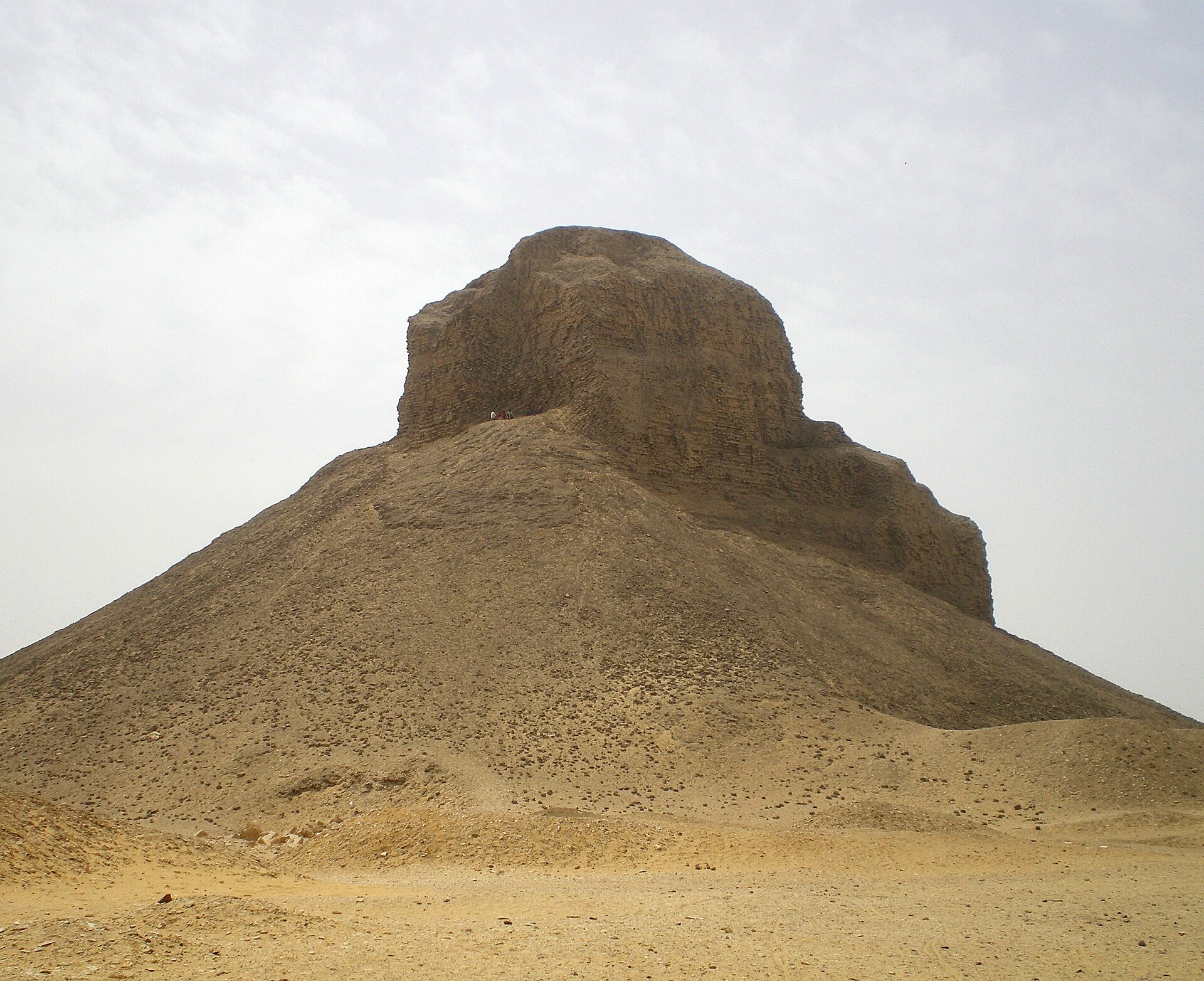
- The Forgotten Temple — Between the Bent and Black Pyramids
Very little remains of the Forgotten Temple beyond a couple of stelae stumps in the sand. It is worth the stop mainly as a waypoint on the walking route between the main pyramids, and as a quiet spot where the scale of the desert becomes obvious. - Tombs of the royal women — Centre of the necropolis
At the centre of the necropolis, the tombs of royal women from the Middle Kingdom are laid out in rows. They are modest ruins rather than grand monuments, but they show that Dahshur was a working royal cemetery with queens and princesses buried near their kings.
Culture
Dahshur is first of all a cemetery, and the pyramids were built as part of a belief system in which the king's body and name had to be preserved so that he could continue after death. The stone, the long internal passages and the placement on the west bank, the side of the setting sun, all follow from that idea. The pyramid was never meant to be visited by the public, only maintained by priests.
Today the living culture around the site is that of rural Egypt. The village of Manshiyyat Dahshur is a farming community where many families work the fields at the edge of the desert, and some local men run camel and horse rides, guide visitors informally or sell drinks and souvenirs. Conversation is usually friendly and unhurried, and tea is often offered as part of it.
The site is also tied up with modern Egyptian pride in archaeology. Excavation and conservation work continue here, and the authorities see Dahshur as a way to spread visitors beyond Giza. Rules at the monuments are enforced by tourist police, who are generally relaxed but do expect visitors to follow marked routes and stay out of restricted areas.
The local rhythm is shaped by the heat. Mornings are busiest, the middle of the day is quiet, and a pause in the shade is considered sensible rather than lazy.
Agree the price of any camel, horse or guide before you start, and ask before photographing local people or their animals.
What to wear
Traditional dress in the villages around Dahshur is the galabeya, a loose ankle-length robe usually made of cotton, worn by men in plain colours or stripes and often topped with a scarf or small cap against the sun. Women in rural families wear long dresses or galabeyas of cotton or lightweight synthetic blends, with a headscarf, and darker or patterned cloth for everyday work. Heavier wool is kept for cold winter mornings.
What people wear now is a mix. In the village, older men tend to stay with the galabeya, while younger men often wear shirts and trousers. Women combine long skirts or dresses with colourful headscarves, and in nearby Cairo styles are more varied, from western-style office wear to full-length abayas. Tourist police and site staff wear uniforms in sand and white tones.
Visitors should dress for the desert first and for local modesty second. Light, loose cotton or linen that covers shoulders and knees works well for both heat and respect. A wide-brimmed hat, sunglasses and a scarf for dust are more useful than they look. Footwear matters more than anything else: closed, sturdy shoes or trainers with good grip, because the ground is sandy and stony and the routes between pyramids are long. Sandals quickly fill with sand. In winter, a light jacket helps on cool mornings.
What to eat
- Koshari — Simple koshari eateries in Cairo and Badrashin
Koshari is a hearty mix of rice, lentils, pasta and chickpeas topped with spiced tomato sauce and crisp fried onions. It is cheap, filling and vegetarian, and widely served at simple eateries in Cairo and the larger towns along the road to the site. - Ful medames — Morning stalls and small cafés in villages and towns
Ful medames is a slow-cooked dish of mashed fava beans with oil, lemon and cumin, eaten with bread. It is a traditional Egyptian breakfast and a good fuel before a day of walking in the desert sun. - Ta'amiyya — Street stalls and sandwich counters near markets
Ta'amiyya is the Egyptian version of falafel, made from fava beans rather than chickpeas and with a green, herby centre. It is usually eaten in a roll of bread with salad and tahini, and is easy to find as a quick snack. - Aish baladi — Village bakeries around Manshiyyat Dahshur
Aish baladi is a flat, round wholemeal bread baked in village ovens and eaten with almost every meal. Fresh from the oven it is soft and slightly chewy, and it is the best companion to beans, cheese and grilled meat. - Grilled kofta and kebab — Grill restaurants in Cairo and on the main roads towards Saqqara
Spiced minced meat or chunks of lamb and chicken, grilled over charcoal and served with bread, salad and rice, are the standard sit-down meal after sightseeing. Quality varies, so a busy place with a visible grill is a good sign.
Plan it
Best time. October–November and March–April, when days are warm rather than fierce. Dahshur has a hot desert climate, and summer afternoons on the shadeless plateau are punishing. Winter mornings can be cool but pleasant.
How long. 1
Getting there. Fly into Cairo, then reach Dahshur by hired taxi, usually combined with Saqqara and Memphis, or on a guided coach tour from Cairo or Giza. By public transport, take a local train towards Fayum and get off at Al Mazghona, or take the metro to Helwan, then a tuk-tuk to the site gate. Tuk-tuks cannot enter, so the last leg is a long walk with no shade.
Budget. mid
Tips
- Start early to beat the heat and the tour groups
- Carry plenty of water, since there is little shade or shopping on site
- Bring cash for entrance fees, drinks and any camel ride, and check the official antiquities authority site for current tickets
- Combine Dahshur with Saqqara and Memphis in a single day using a hired driver
- Agree prices for taxis or tuk-tuks before setting off
Etiquette
- Dress modestly in light, loose clothing covering shoulders and knees
- Follow marked routes and stay out of restricted areas
- Ask before photographing local people and their animals
Nearby
Sources
- Wikidata Q685414 (CC0)
- Wikipedia: Dahshur (CC BY-SA 4.0)
- Wikivoyage: Dahshur (CC BY-SA 4.0)
- Dahshur - Red Pyramid - Tourist policemen on camel (Daniel Mayer) (CC BY-SA 2.5)
- Bent Pyramid (I love Naples).jpg (Kristina) (CC BY 2.5)
- Black Pyramid of Amenemhat III (Tekisch) (CC BY 3.0)
- Francis Frith, The Pyramids of Dahshoor, From the East (Public domain)
- Potato cultivation 1 (Yousef Naser Mohamed Mohamed) (CC BY-SA 4.0)
- Dashoor (1879) TIMEA (Grahame, George; Evans, Miss) (CC BY-SA 2.5)
- 11-degree angle change of the Bent Pyramid at Dahshur (Darer101) (CC BY-SA 4.0)
- Bend Pyramid and Red Pyramid of Dahshur (Banja-Frans Mulder) (CC BY 3.0)


