Cephalonia
Cephalonia, Greece
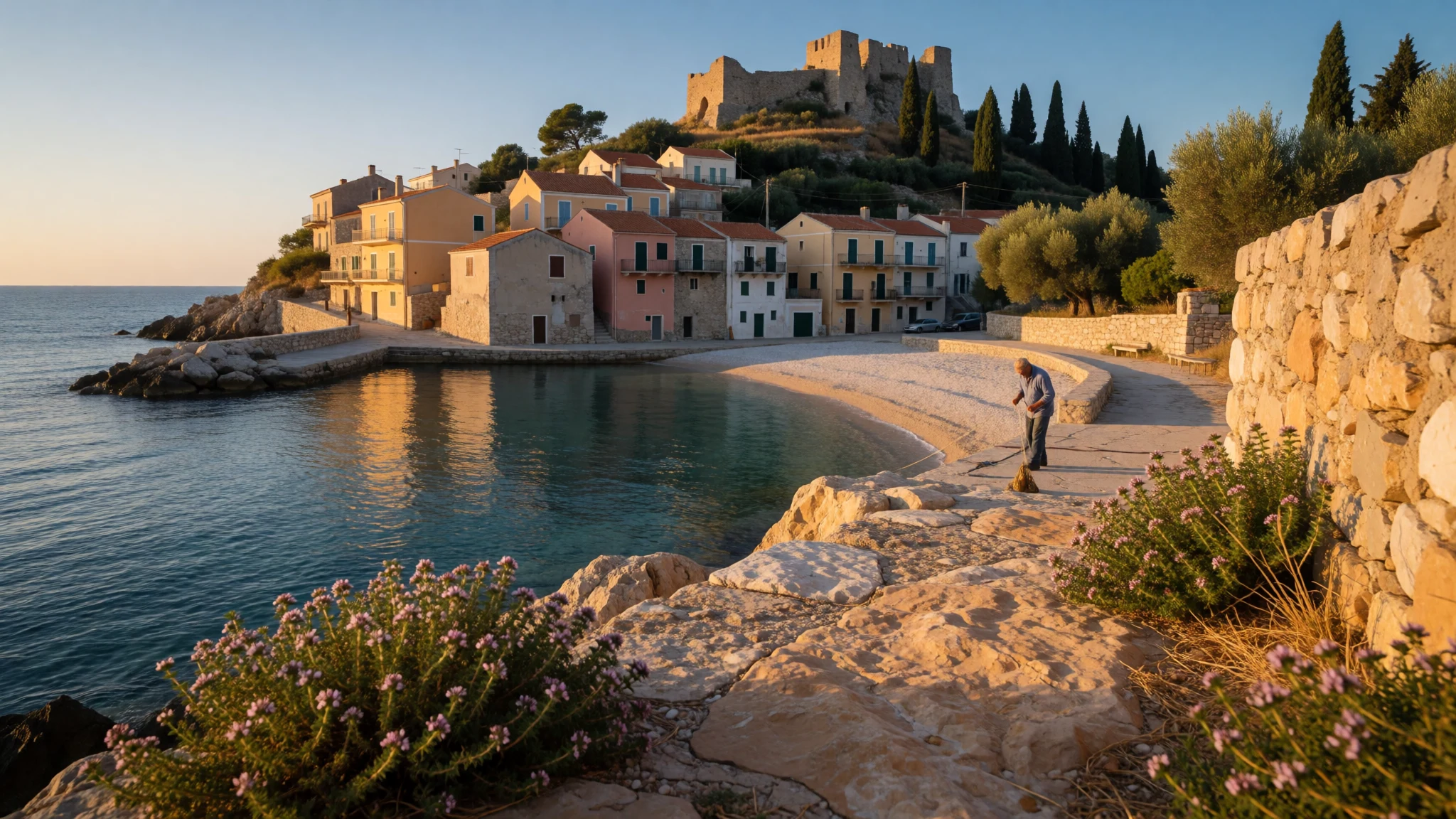
Cephalonia is a big, mountainous Ionian island of quiet villages, caves and coves, rebuilt after 1953 and best explored slowly by car.
The place
Cephalonia is the largest of the Ionian Islands, off the west coast of Greece, and it forms a regional unit of its own. Greek spellings include Kefalonia (Κεφαλονιά), and older books use Kefallinia or Kephallenia. About 36,000 people live here. Argostoli, the capital, holds roughly a third of them, while Lixouri, on the Paliki peninsula across the bay, is the other main town. Between them they account for almost two-thirds of residents, so most of the island is villages, olive terraces and coves linked by winding roads. Mountains fill the interior, and the island's elevation is listed at 1,620 metres, which means the sea is never far below and cooler air is a short drive upward. The natural landmarks are specific: Melissani Lake, the Drogarati caves and the Koutavos Lagoon beside Argostoli. Two smaller islands, Petalas and Asteris, are uninhabited. Cephalonia sits inside an earthquake zone, and small tremors happen many times a year, mostly unnoticed. The 1953 earthquake destroyed nearly every settlement; Fiskardo in the north came through untouched, which is why it looks older than the towns around it. Distances on the map understate the time needed, because mountain roads are slow. A small airport near Argostoli and ferry links to Italy and the Greek mainland make arrival easy, but crossing the island takes patience, and a car is close to essential.
Its story
Cephalonia's name is tied to a myth. Cephalus, a hero with Athenian connections, helped Amphitryon of Mycenae in a war against the Taphians and Teleboans, and was rewarded with the island of Same. It was then called Cephallenia after him. A second story concerns Odysseus. Some writers have suggested Cephalonia, rather than the small island now called Ithaca, as his Homeric home. Robert Bittlestone's book Odysseus Unbound argues that Paliki, today a peninsula, may have been a separate island in the late Bronze Age, and that Homer's Ithaca could be that piece of land. A research project examined the idea for three years from the summer of 2007. The theory remains debated, but it gives walkers on Paliki something to think about. The island also appears in the cult of the goddess Britomartis, said to have been honoured here as Laphria. In recorded antiquity, from at least the 6th century BC, four independent city-states shared the land: Pale, Cranii, Same and Pronnoi. They correspond roughly to modern Lixouri, Argostoli, Sami and the north. Each minted its own coins and built temples and fortifications in town and countryside. Later centuries brought Venetian influence, still visible in church decoration. The most recent break came in 1953, when the earthquake ended many old villages and sent families to rebuild elsewhere.
What to see
- Assos — North-west coast
Assos sits on a narrow peninsula on the island's west side, with pastel houses around a small harbour and a ruined fortress on the headland above. It suits a slow half-day: a swim, a walk up to the castle path, a late lunch. Parking is limited, so arrive early.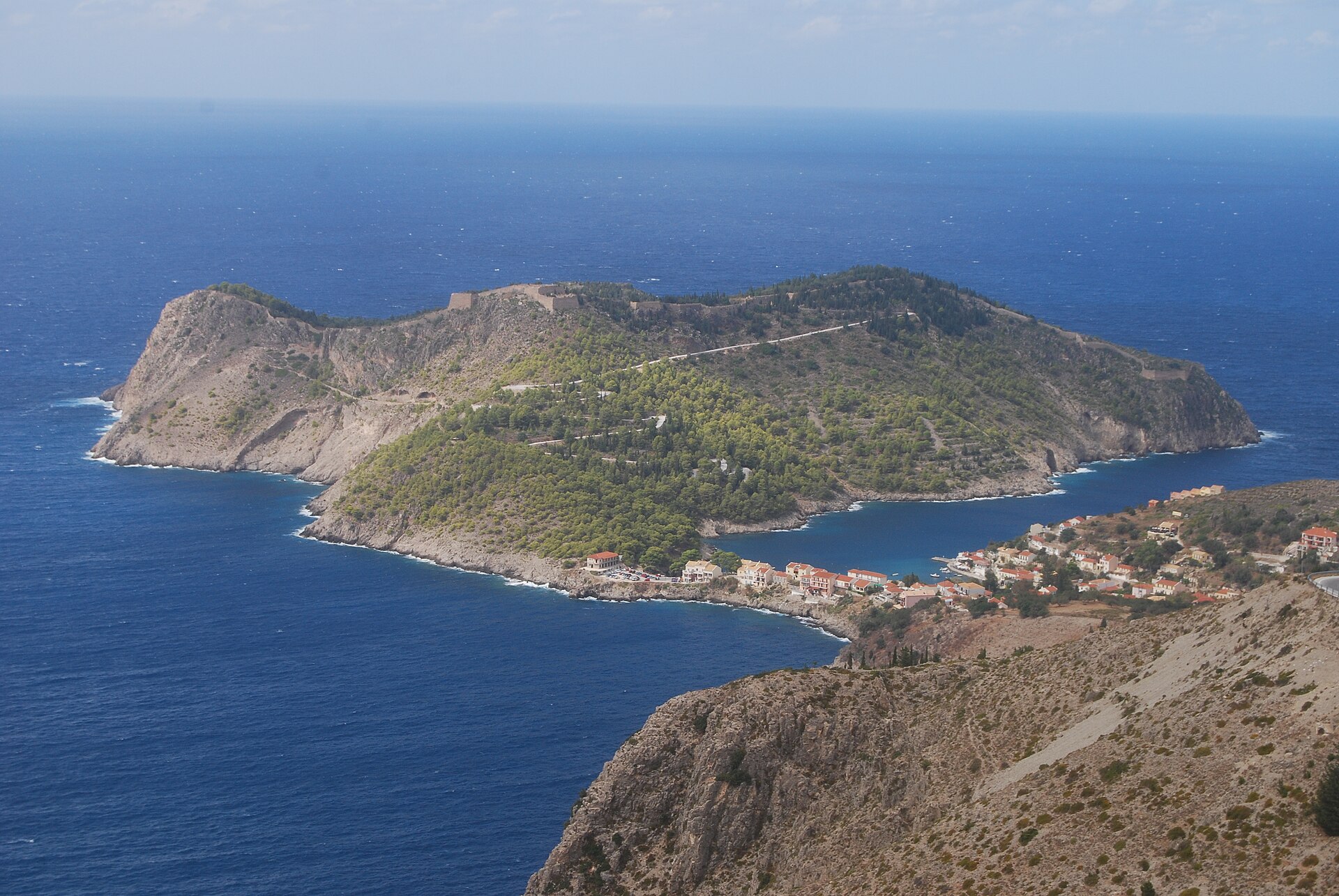
- Fiskardo — Northern tip
Fiskardo is the northern harbour village that escaped the 1953 earthquake, so its waterfront keeps an older look than most of the island. Yachts fill the bay in summer and the evening promenade gets busy. Come in shoulder season for a quieter wander and a swim from nearby coves. - Castle of Agios Georgios — Peratata, south of Argostoli
The hilltop castle near Peratata gives wide views across the southern interior and out to sea. It served as a fortified centre of the island for a long time, and walking its walls helps explain how Cephalonia was governed. Wear shoes with grip, because the stones are uneven and exposed to sun.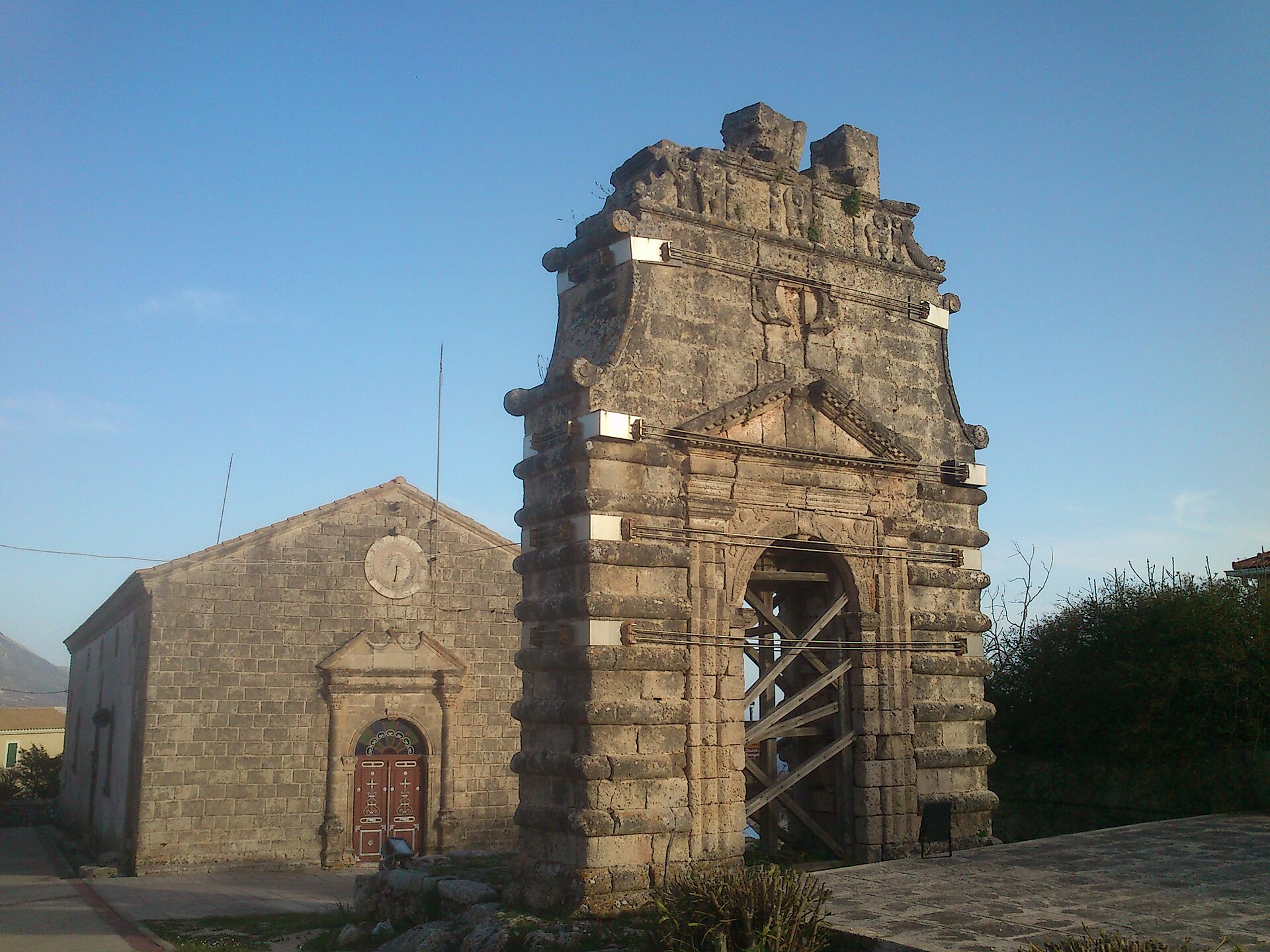
- Palaia Vlachata — Inland, check local directions
Palaia Vlachata is a ghost village abandoned after the 1953 earthquake. Roofless stone houses stand among scrub, and nobody is there to guide you or explain. It is a sobering stop that shows what the quake did to everyday life. Walls can be unstable, so keep to open paths and do not climb. - Monastery of Agios Gerasimos — Omala valley
This monastery lies on a small plain between Argostoli and Michata, surrounded by mountains and approached by an avenue of trees. It honours Saint Gerasimus, the island's patron saint, whose relics are kept in the old church. Pilgrims come throughout the year, so expect a working religious site, not a museum.
Culture
Cephalonia's cultural life is tied to its churches and monasteries. Saint Gerasimus of Kefalonia, the patron saint, is honoured at a large monastery on the road between Argostoli and Michata, where his relics are venerated in the old church. Another big monastery, Haghia Panagia, stands at Markopoulo in the south-east. The monastery of Sissia was destroyed in 1953 and its ruins remain. Even so, many churches across the island survived the earthquakes, and some date back to the Renaissance. Their ornaments show Venetian mannerism, a reminder of the centuries when the Ionian Islands looked west to Venice rather than east to Constantinople. The islands also share a musical tradition known as the Ionian School, which grew from the same Venetian and Italian influences. The island's history of earthquakes shapes local attitudes: people are matter-of-fact about tremors and proud of rebuilding. Towns have a lively café life in the evening, with families out late, especially in summer. Saints' days and church feasts fill the calendar, and village celebrations often include music, food and dancing that visitors are generally welcomed into if they are respectful. Cover your shoulders and knees before entering any church or monastery, and ask before photographing inside or near the relics of Saint Gerasimus.
What to wear
Cephalonia's traditional dress belongs mainly to festivals now. Island costume of the Ionian type used wool, linen and some silk, with embroidered bodices, aprons and headscarves for women and waistcoats, sashes and wide trousers or breeches for men, though details varied by village. These outfits appear at church feasts, folk dance performances and school parades, and some families keep heirloom pieces. In daily life, people dress like the rest of Greece and southern Europe: light cotton and linen in summer, jeans and jumpers in winter, and sturdy shoes in the villages. Older residents, particularly women in rural areas, may still wear dark clothing and a headscarf to church. Visitors should plan around the sun and the terrain. In summer wear breathable cotton, a brimmed hat and sunscreen, and carry water. Bring shoes with grip for rocky coves, castle paths and uneven village lanes, because flimsy flip-flops struggle there. Carry a light layer for evenings and mountain roads, which can be cooler and windier than the coast. For monasteries and churches pack a shawl or scarf and a long skirt or trousers, since shorts and sleeveless tops are not accepted. Swimwear belongs on the beach and boat; put a shirt or wrap on for walking through villages and into restaurants.
What to eat
- Kefalonian meat pie — Restaurants in Argostoli and village tavernas
A hearty farmhouse pie of meat in a thick pastry case, usually served as a main course. It is rustic rather than refined, and quality varies, so ask locals. Argostoli restaurants are a reasonable place to try it. - Fresh grilled fish — Harbour tavernas at Fiskardo and the Argostoli waterfront
Fish grilled simply with olive oil and lemon is the standard order at harbour tavernas. Choose what is on the day's catch rather than a fixed menu, and ask how it is sold before you order. - Robola wine — Village wine cellars in the hills above Argostoli
Robola is a white wine associated with the island's upland vineyards, dry and crisp with a mineral edge. It pairs well with fish and salads. Tastings are possible at wineries, so check opening arrangements first. - Greek salad with local feta — Any village taverna or café-restaurant
Tomatoes, cucumber, olives and a slab of feta under olive oil and oregano make a cooling lunch in summer heat. Island olive oil is worth tasting on its own with bread. - Almond sweets and honey — Confectioners and bakeries around Argostoli and Lixouri
Bakeries and small confectioners sell almond-based sweets, honey cakes and spoon sweets made from local fruit. They travel well and suit a gift bag home. Ask for a taste if shops allow it.
Plan it
Best time. May–June and September–October, when days are warm, the sea is swimmable and crowds are thinner than in high summer. July and August are hot and busy, especially at Fiskardo and Assos. Winter is mild but wetter, and many seasonal places close.
How long. 4–6
Getting there. Fly to Kefalonia airport near Argostoli and Lassi, a small island airport that gets crowded on Tuesdays and Sundays. Ferries run from Italy, from Patras and Killini on the Greek mainland, and from Pessada to Zakynthos. Hire a car on arrival.
Budget. mid
Tips
- Hire a car: buses are limited and the best coves and villages are spread out
- Allow extra time for mountain roads, and check before taking unpaved tracks, as some need four-wheel drive
- Expect airport queues on Tuesdays and Sundays, the main travel days
- Carry some cash for small villages, and check the official site (http://www.kefalonia.gr) for local information
- Watch for uneven pavements in dimly lit streets at night
Etiquette
- Cover shoulders and knees at churches and monasteries
- Ask before photographing people, services or relics
- Take rubbish with you from coves and walking paths
Nearby
Sources
- Wikidata Q178488 (CC0)
- Wikipedia: Cephalonia (rev 1385020473) (CC BY-SA 4.0)
- Wikivoyage: Kefalonia (rev 5406911) (CC BY-SA 4.0)
- Photo: Asos, Kefalonia, Greece (Matt Sims) (CC BY 2.5)
- Photo: Locator map for Kefalonia municipality (Pitichinaccio) (CC BY 3.0)
- Photo: Melissani-exc (ChristosV) (CC BY 3.0)
- Photo: Church at Kastro, Kefalonia (Saintfevrier) (CC BY 3.0)
- Photo: Mills at the bay of Argostoli (Illustrated London News) (Public domain)
- Photo: Lixouri 1910 (Public domain)
- Photo: Royal Air Force Operations in Malta, Gibraltar and the Mediterranean, 1940-1945 (Public domain)
- Photo: House destroyed in the earthquake 1953, Assos (ChristosV) (CC BY 3.0)


