Canossa Castle
Canossa Castle, Italy
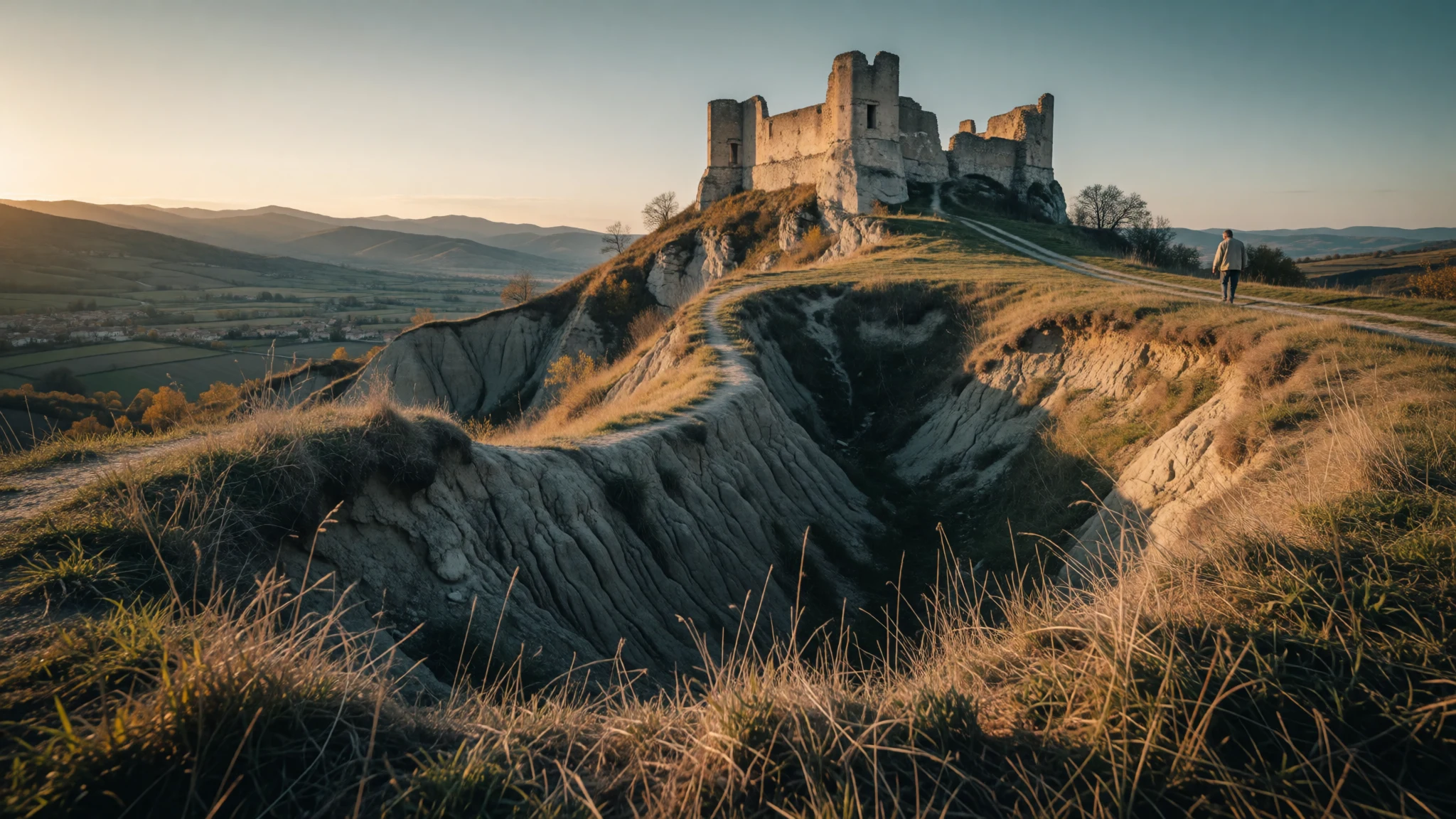
Canossa Castle is a windswept hilltop ruin in the Emilian hills where an emperor and a pope settled one of medieval Europe's great quarrels.
The place
Canossa Castle sits on a rocky hilltop in the Apennine foothills of the province of Reggio Emilia, in northern Italy. What survives is a ruin, a scatter of walls and foundations on a pale summit, with eroded clay slopes known locally as calanchi falling away on several sides. The surrounding country is quiet farmland and woodland dotted with small villages, and it feels a long way from the busy plain below, even though the motorway and fast trains of the Po valley are close by. The province runs from the River Po in the north, across broad lowland, and up into the mountains, with Parma to the west and Modena to the east. Pig farming is important here, and the sausages and cured pork of the region follow from it. Canossa is known across Europe for a single event: the meeting in 1077 between Emperor Henry IV and Pope Gregory VII, which gave the language the phrase 'the Road to Canossa'. The site is classed as both a castle and a castle ruin, and the second description is the honest one. Visitors come for the setting and the history rather than for intact rooms. The hill gives long views over the badlands, and in winter snow turns the clay slopes white and the ruin stark. It makes an easy half-day from Reggio Emilia, or a pleasant stop on a longer drive through the hills. Opening arrangements change, so the official site, http://www.castellodicanossa.it/, is the place to check before setting out.
Its story
The story of Canossa Castle begins around 940, when the hill was fortified by Adalbert Atto, a count whose father came from a Lombard noble line. The summit held his residence, a church dedicated to Sant'Apollonio and a small community of Benedictine monks, all behind a triple ring of walls, with barracks and servants' quarters tucked between the outer two. It earned a reputation as a formidable fortress, and it sheltered Adelaide of Italy when Berengar II besieged it for years without success. The famous episode came in 1077, during the Investiture Controversy, the long contest over whether kings or popes had the right to appoint bishops. Henry IV came to the hill to seek reconciliation with Gregory VII, who was on friendly terms with the castle's owner, Matilda. She later arranged for her lands to pass to the Church at her death in 1115, but her heirs refused to accept it. The centuries that followed were less dramatic. Troops from Reggio destroyed the castle and its church in 1255. Ownership then moved between the Canossa family, the city of Reggio and the House of Este, who held it for most of the time until 1796, when local rebels drove out its last holders. The poet Ludovico Ariosto was appointed castellan in 1502 and lived here for a short spell. In 1878 the Italian State bought the ruin and declared it a national monument.
What to see
- The summit ruins — Canossa hilltop
The walls and foundations on top of the hill are the heart of a visit. Stand among them and the old layout becomes easier to picture: a residence, a church and a monastic community inside concentric defences. The stone is pale and weathered, and the sense of height and exposure matters as much as any single wall.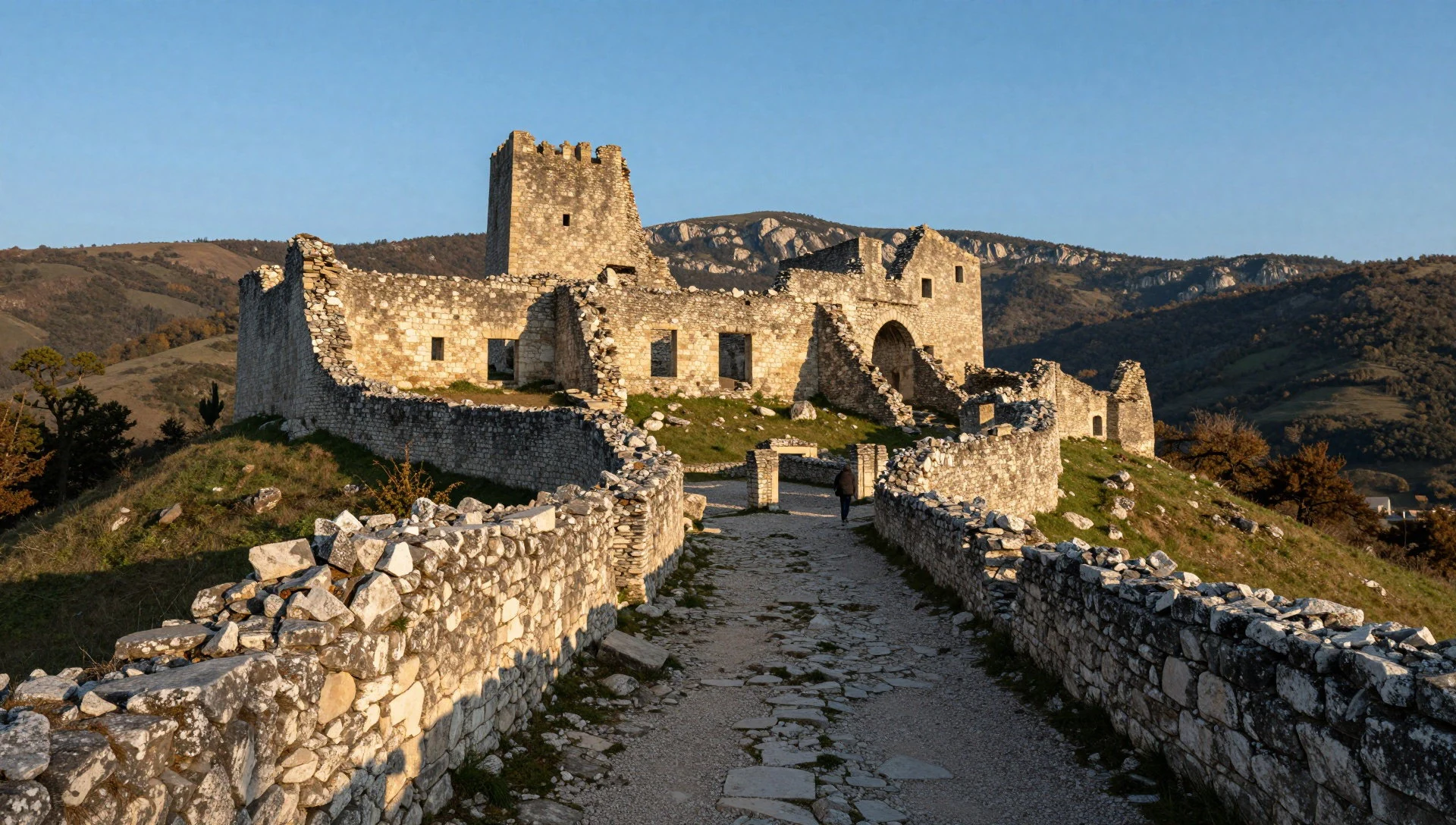
- The calanchi badlands — Slopes around the castle
Eroded clay slopes drop away below the castle in ridges and gullies, grey in dry weather and sharply patterned after rain. Photographs from the opposite side show the ruin perched above them, and this is the best way to grasp why the hill was chosen for a stronghold. Snow in winter changes the scene completely.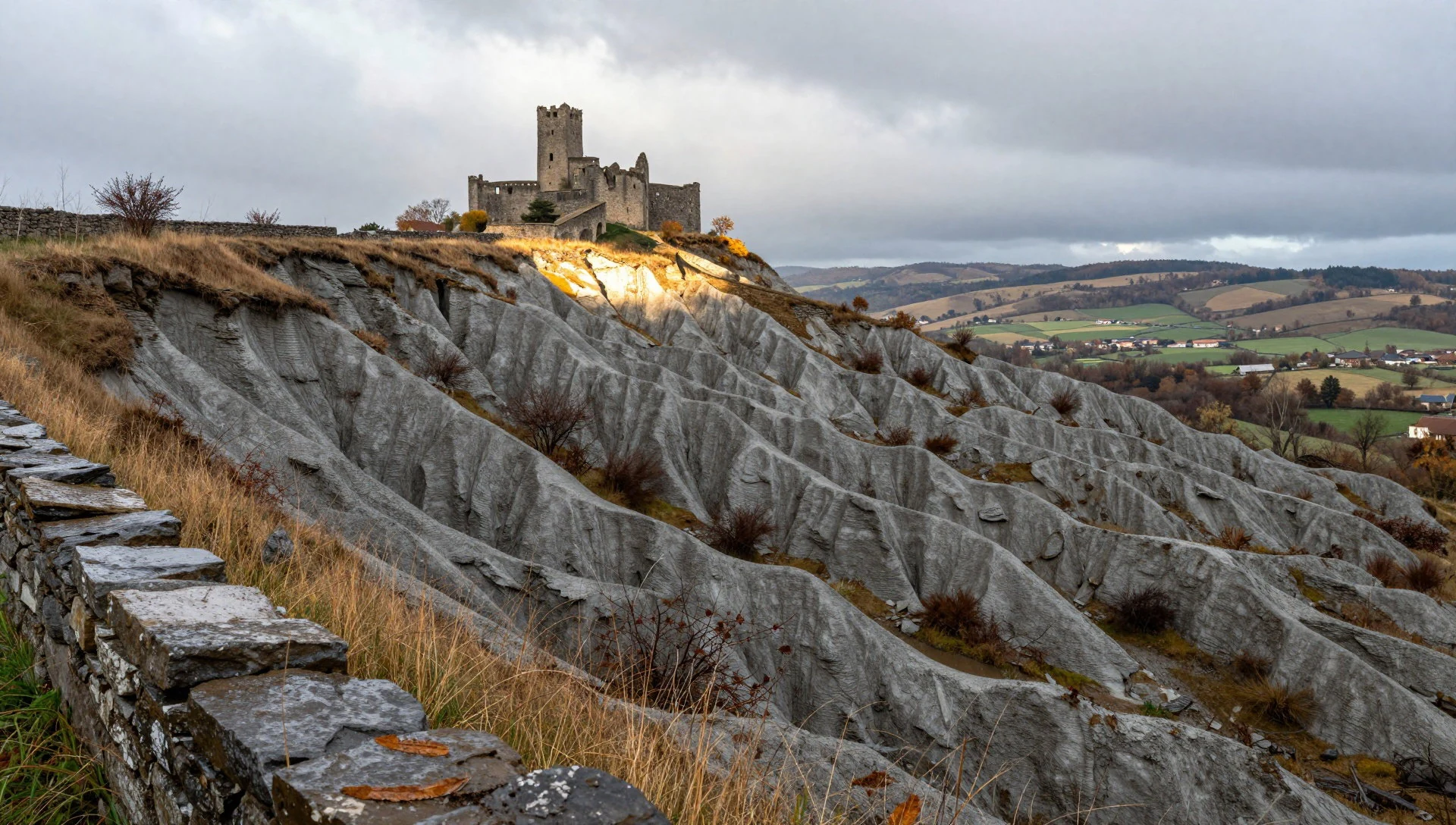
- The monastic quarters — Within the castle complex
Part of the site marks where monks lived in the time of Countess Matilda. These smaller, quieter stones are easy to walk past, but they are a reminder that the castle was also a religious house, with a church and a Benedictine community living alongside the soldiers and servants.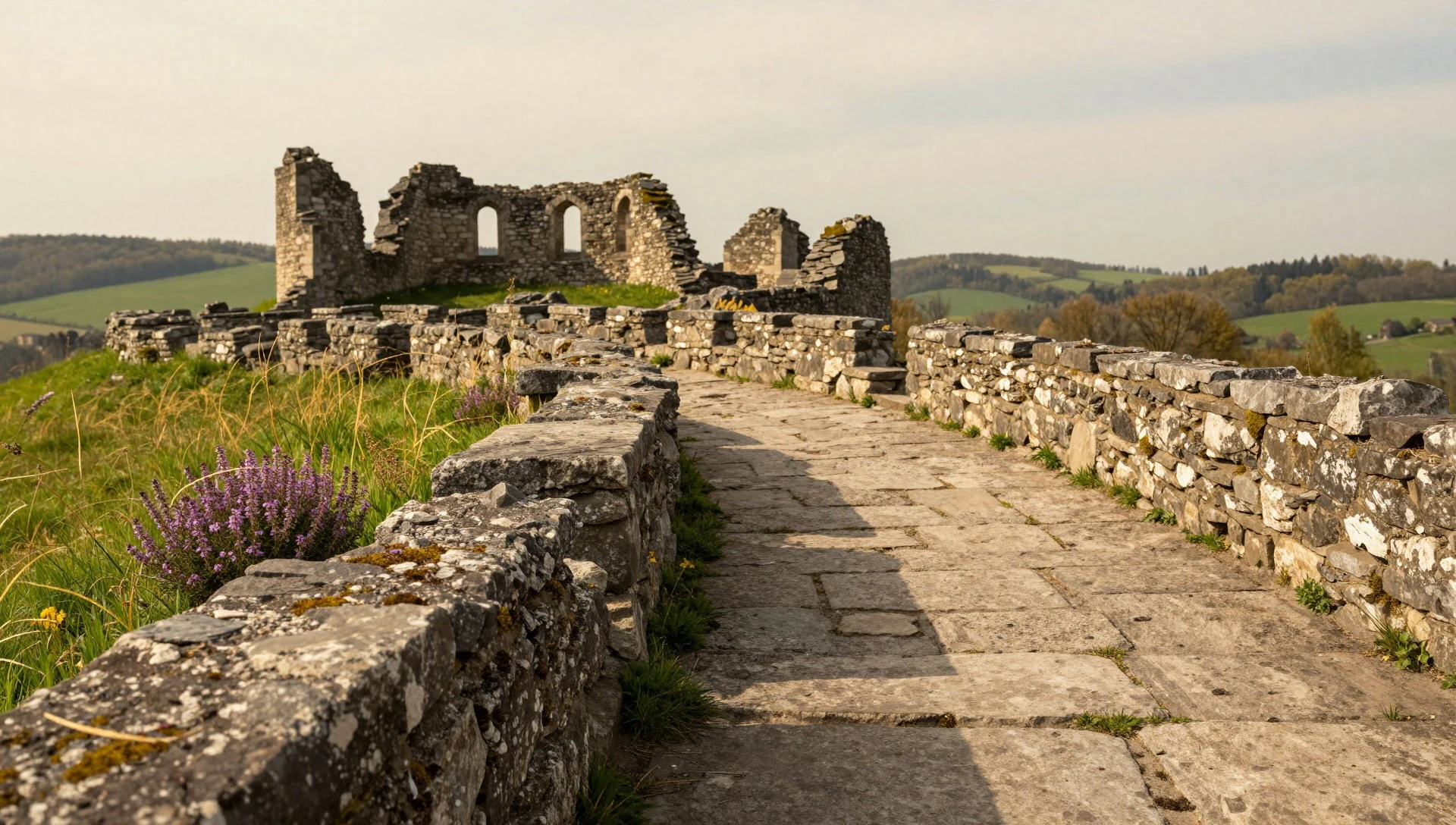
- Castello di Rossena — Reggio Emilia hills
Another castle of the Reggio hills, Rossena stands on a rocky outcrop in the same landscape of ridges and clay. It helps to see it as part of a wider network of hill fortresses, and it makes a natural second stop for anyone with a car and an afternoon to spare.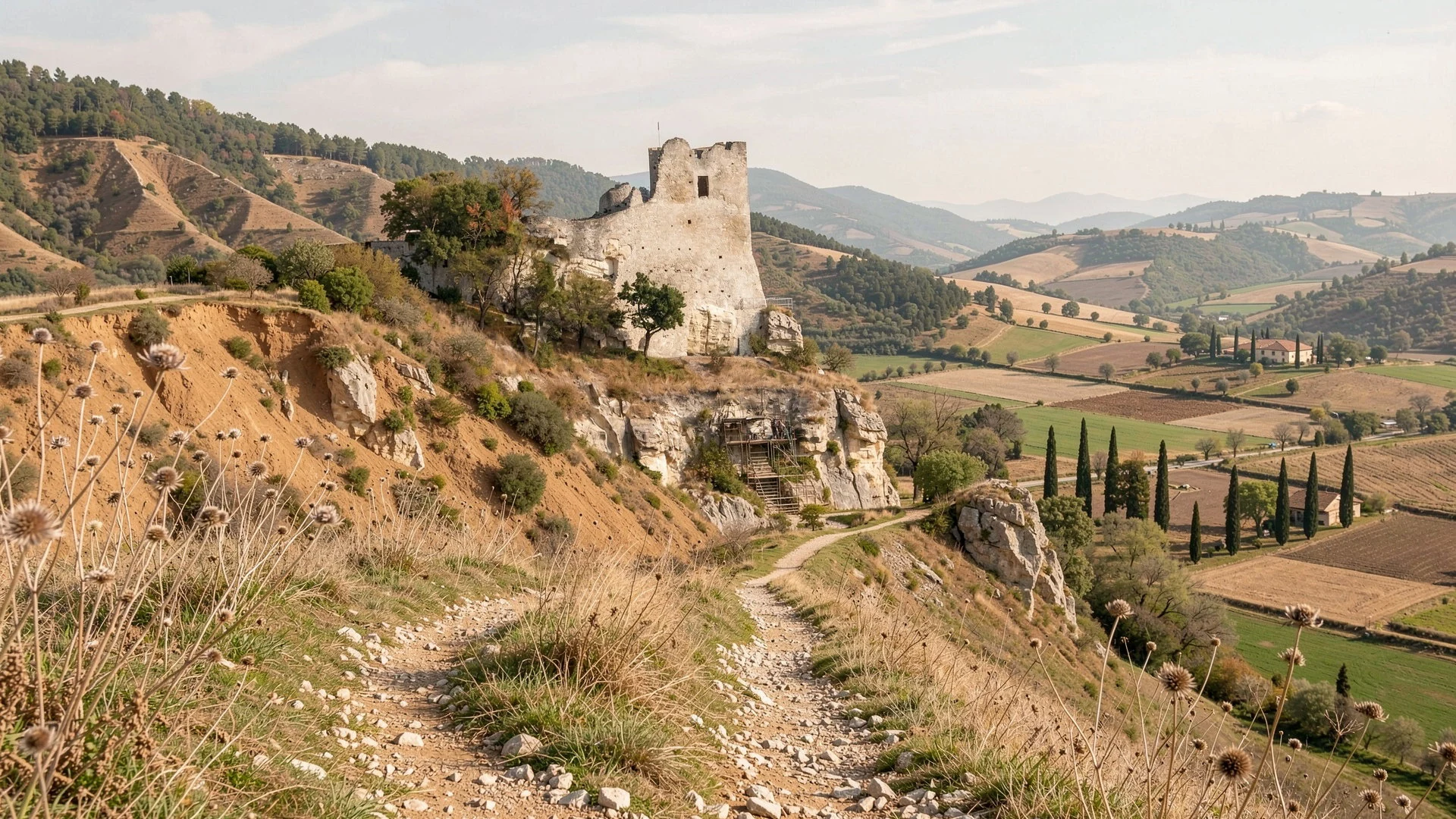
- Reggio Emilia old centre — Reggio Emilia city
The provincial capital has the largest cluster of sights in the area: the cathedral, the basilicas of San Prospero and the Virgin of Ghiara, and the cloisters of the monastery of San Pietro. It is also where the fast trains arrive, so it works as a base for Canossa.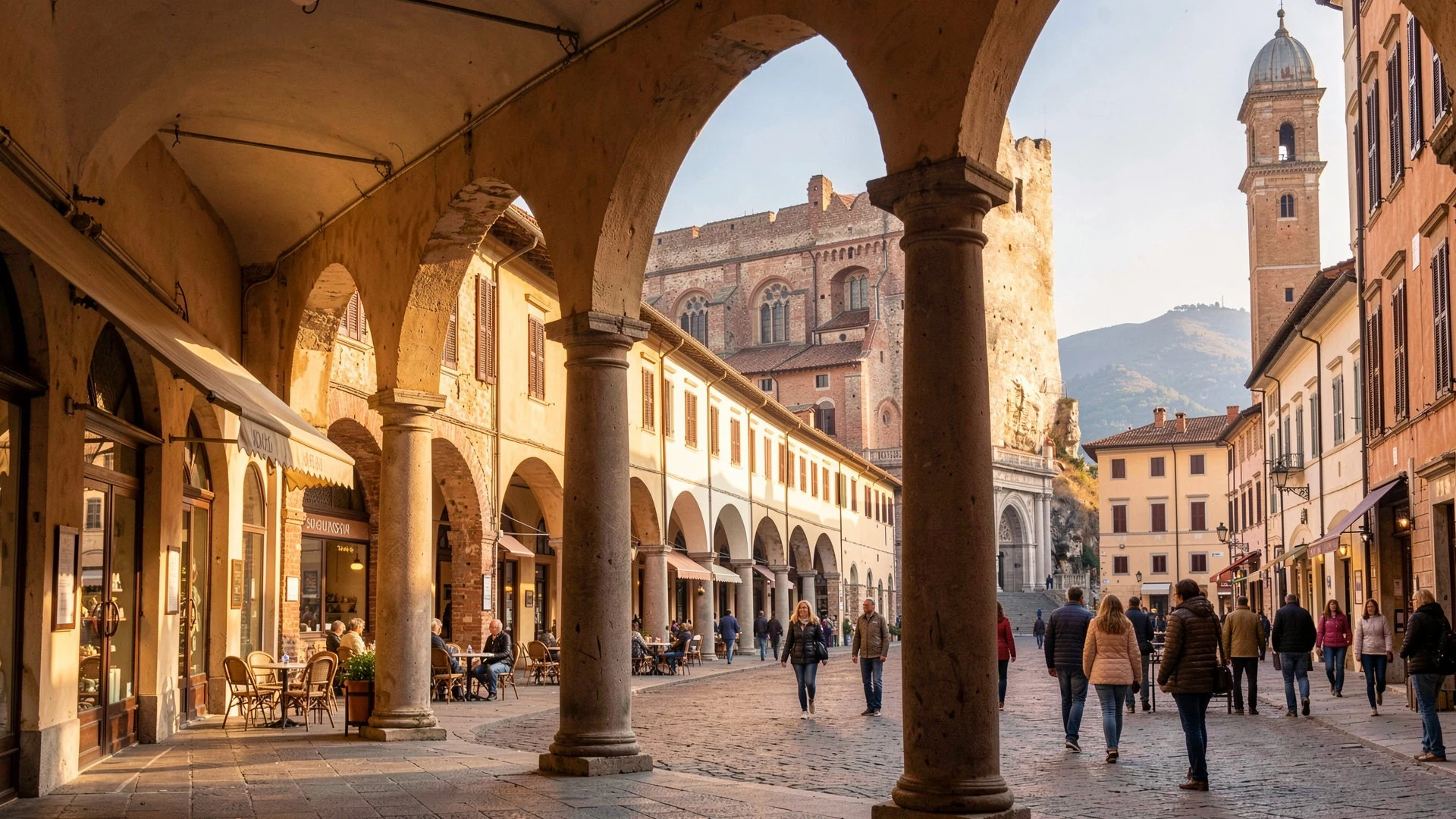
Culture
Canossa Castle carries a meaning in European culture far larger than its ruined walls. 'The Road to Canossa' became shorthand for a powerful figure forced to back down, after Emperor Henry IV came to the hill in 1077 to settle matters with Pope Gregory VII. Locally the memory is warmer towards Matilda, the countess who owned the castle and was friendly with the pope, and who remains the figure most associated with the place. The people of the province call themselves Reggiani, and they take pride in a short list of things: the Tricolore, which was created in Reggio, a food culture built on pork and cheese, and a rural calm that sets the hills apart from the nearby cities. Meals are unhurried and centred on family and local produce, and a visit to a farm or a small producer is often how outsiders meet that culture. Faith is visible in the village churches and the basilicas of Reggio, and many local festivals follow the church calendar. Conversation is friendly but a little reserved at first, and a greeting in Italian is always appreciated. Please keep to the marked paths on the ruin, since the old walls and the clay slopes around them are fragile, and do not climb on the stonework.
What to wear
Around Canossa Castle there is no single costume that people still wear day to day. The historic dress of the Emilian countryside was practical: wool and linen for work and cold winters, with plainer cloth for everyday and finer fabric kept for church and feast days. Today that past appears mostly in festivals and re-enactments, where medieval-style gowns, tunics and cloaks recall the age of Countess Matilda. What people actually wear now is ordinary northern Italian dress: neat, understated and a little more formal than in many countries. Jeans or chinos with a good jacket are normal in Reggio, while in the hill villages practical outdoor clothing and sturdy shoes are common, especially among farmers and walkers. Visitors should dress for the terrain and the weather first. The hilltop is open and exposed, so layers, a windproof jacket and a hat for summer sun are sensible, and weather in the hills can turn cold quickly. Shoes need good grip, because the paths are uneven and the clay slopes become slippery after rain. Flat soles and closed toes are better than sandals. For churches in Reggio and the villages, covered shoulders and knees are expected, so a light scarf or shirt in the daypack is useful.
What to eat
- Aceto Balsamico Tradizionale — Small producers and delicatessens around Reggio Emilia
Reggio and Modena are the only sources of the protected balsamic vinegar. The label must say 'Tradizionale'; otherwise it is a cheaper imitation. It is dark, syrupy and used by the drop on cheese, meat or even fruit.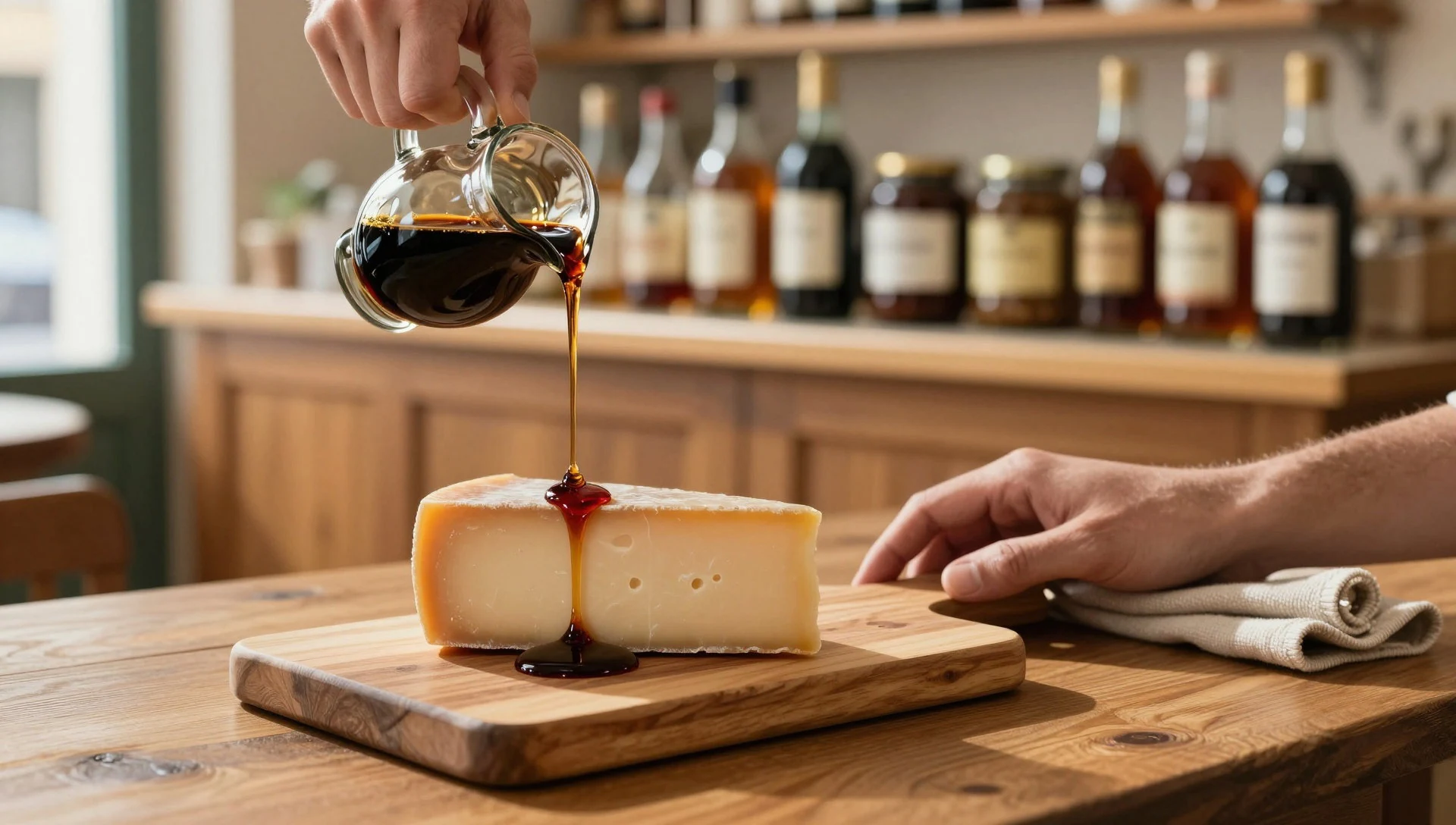
- Salumi and sausages — Delicatessens and trattorie in Reggio and the hill villages
Pig farming is central to the province, so cured pork and sausages are everywhere. Expect sliced cold cuts on a board, eaten with bread and local pickles, and a simple plate is often the best introduction to the region's cooking.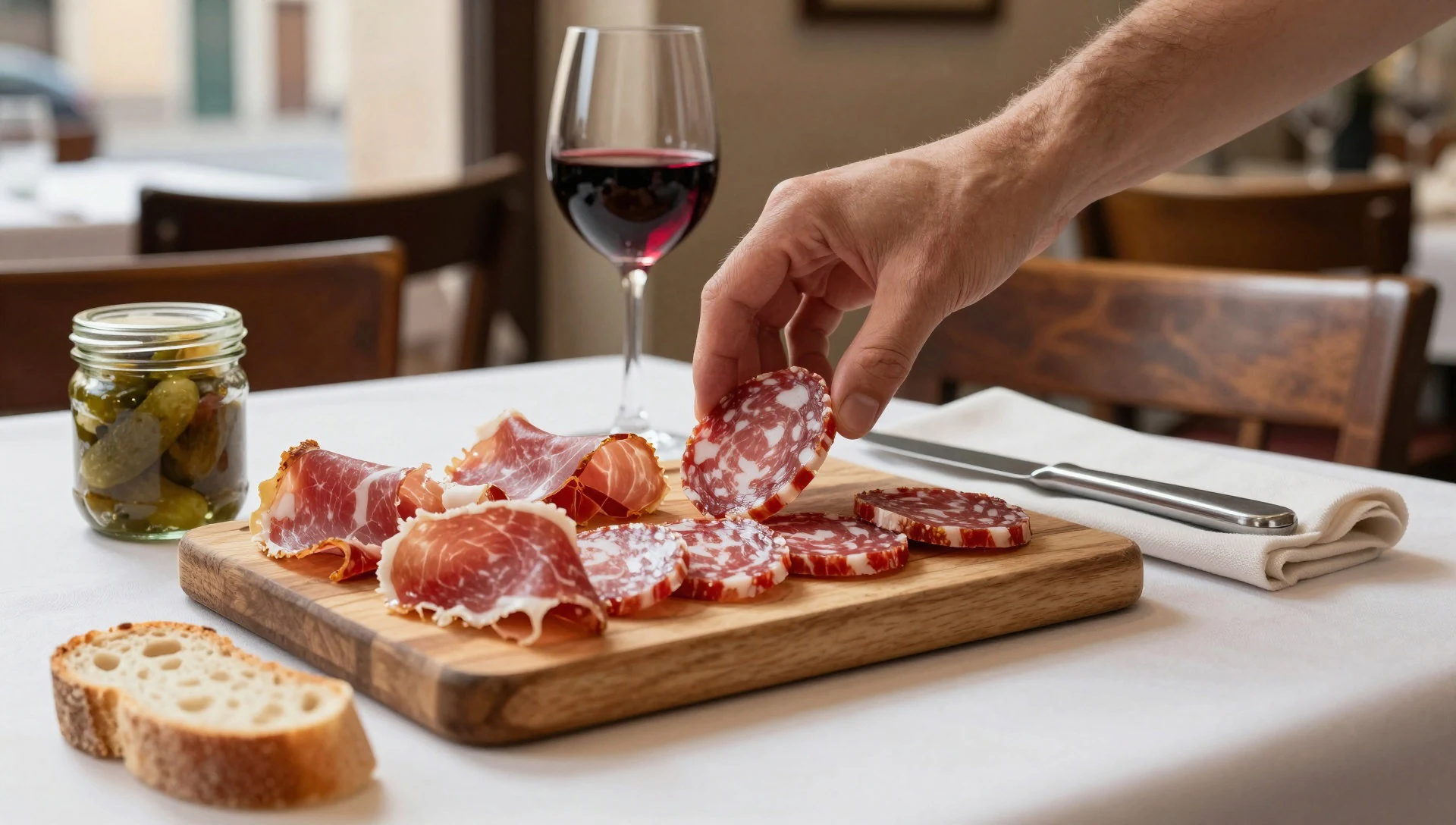
- Parmigiano Reggiano — Cheese dairies and the weekly markets
The hard, granular cheese is made across this part of Emilia and is eaten in chunks, grated over pasta or served with balsamic vinegar. Buying a piece at a dairy or market is the easiest souvenir that travels well. - Erbazzone — Bakeries and delicatessens in Reggio Emilia
A savoury pie of greens and cheese in a thin pastry case, a classic of Reggio home cooking. It is eaten warm or cool, in slices, and makes a cheap, filling snack between sights. - Local wines — Wine shops, farm estates and village eateries
Malvasia, often Bianca di Candia, is the local white, while Barbera and Bonarda are ruby reds. Lambrusco is also made nearby, though not everyone enjoys it. Ordering the house wine of a village eatery is rarely a mistake.
Plan it
Best time. Late April–May and September, when the hills are mild and the views are clear. Summer can be hot on the open hilltop, and winter is cold, with snow on the badlands, which is lovely to see but makes paths slippery.
How long. 1
Getting there. Fly into one of the Milan airports (Bologna is nearer but has few flights), then take a Frecciarossa from Milan Centrale to Reggio Emilia, which takes about an hour. The last leg into the hills is by road, so a hire car or taxi is the practical choice.
Budget. mid
Tips
- Check the official site, castellodicanossa.it, for opening arrangements before you go
- Wear sturdy shoes with grip, as paths are uneven and clay is slippery when wet
- Carry water and a layer, since the hilltop has little shade and weather can change fast
- Base yourself in Reggio Emilia and combine Canossa with a village lunch
- Go early in the day for quieter walls and softer light
Etiquette
- Stay on marked paths and do not climb on the old walls
- Cover shoulders and knees when entering churches
- Greet people in Italian before switching to English
Nearby
Sources
- Wikidata Q1033649 (CC0)
- Wikipedia: Canossa Castle (rev 1332933950) (CC BY-SA 4.0)
- Wikivoyage: Reggio Emilia (province) (rev 5078047) (CC BY-SA 4.0)
- Lato sud del castello di Canossa — Parma1983 (CC BY-SA 4.0)
- Castle of Canossa, Canossa, Italy — Paolo da Reggio (CC BY 3.0)
- Castello di Canossa, comune di Canossa — Simona65 (CC BY 3.0)
- Canossa castle above the badlands — Giorgio Galeotti (CC BY 4.0)
- Castello di Rossena — Franz Xaver (CC BY 3.0)
- Particolare dove vivevano monaci — Emanuela Rabotti (CC BY-SA 4.0)
- Calanchi innevati Canossa — Emanuela Rabotti (CC BY-SA 4.0)
- Castello di Canossa innevato — Emanuela Rabotti (CC BY-SA 4.0)


